Finance teams managing vendor contracts across emails, shared drives, and disconnected systems face missed renewals, duplicate vendors, and payment obligation gaps that erode spend visibility.
Centralizing vendor contracts requires more than file storage—finance leaders need obligation tracking, ERP integration, and audit-ready reporting without disrupting existing workflows.
Key Takeaways
- Contract repositories solve the scattered-contracts problem without replacing existing procurement or legal workflows, while full CLM platforms require thorough migration and reconfigured approval processes
- Finance teams managing 50-100+ active vendor contracts hit the threshold where spreadsheet tracking breaks down and platform ROI becomes material
- AI-powered obligation extraction automatically surfaces renewal dates and payment obligations, while manual tagging approaches collapse at scale
- Deep ERP integration varies widely—validate whether platforms offer real-time bidirectional sync or quarterly CSV exports during vendor demos
- Pilot-friendly platforms let finance teams start with 50-200 high-value contracts to prove ROI before scaling to full repository migration
The best platform depends on whether your team needs a full contract lifecycle management (CLM) system or an intelligence layer that extracts obligation data from existing contracts. Finance teams drowning in scattered vendor agreements need three core capabilities: a searchable repository with finance-grade metadata, automated obligation and renewal tracking, and deep ERP integration that turns contract data into actionable spend insights.
Centralized Repository with Finance-Grade Search
File storage is not a contract repository. Research shows 90% of professionals struggle to locate specific contracts when vendor agreements live in email threads, shared drives, or departmental silos. Finance teams need searchable metadata—vendor name, payment terms, renewal dates, liability caps, termination clauses—extracted automatically and indexed for instant retrieval. A finance-grade repository answers “Which vendors have net-60 payment terms?” or “Show me all contracts expiring in Q3” in seconds, not hours of manual hunting. Without obligation extraction and role-based access controls, even a centralized folder becomes a compliance bottleneck during audits.
Automated Obligation and Renewal Tracking
Manual calendar tracking fails at scale. Organizations lose up to 9.2% of annual revenue to contract mismanagement—missed renewals, duplicate vendor payments, forgotten compliance deadlines. Modern platforms surface obligations proactively: automated alerts for payment due dates, renewal windows (30/60/90 days out), and service-level agreement milestones. The system should flag contract overlaps (two vendors providing the same service) and auto-renewing clauses that require advance termination notice. Automation frees finance teams from spreadsheet maintenance to focus on strategic vendor negotiations and cost optimization.
Integration with ERP and Accounting Systems
“Integrates with NetSuite” claims vary wildly in practice. Finance teams need real-time or near-real-time data sync between contract metadata and ERP systems, not batch uploads or manual CSV exports. The integration should push revenue and expense obligations into the general ledger, reconcile supplier invoices against signed contracts, and map payment terms to cash-flow forecasts. API maturity matters: strong field mapping (contract ID → PO number, vendor entity → ERP supplier record) ensures data consistency. Platforms like full-lifecycle CLM systems handle intake through closeout, while intelligence-layer tools extract obligation data without replacing existing procurement workflows. Contracts.ai offers NetSuite integration that reconciles invoices with contract terms, positioning itself as an add-on intelligence layer rather than a rip-and-replace CLM.
Understanding what finance teams need from a centralization platform establishes the evaluation criteria for comparing specific solutions across obligation tracking, ERP integration, and implementation complexity.
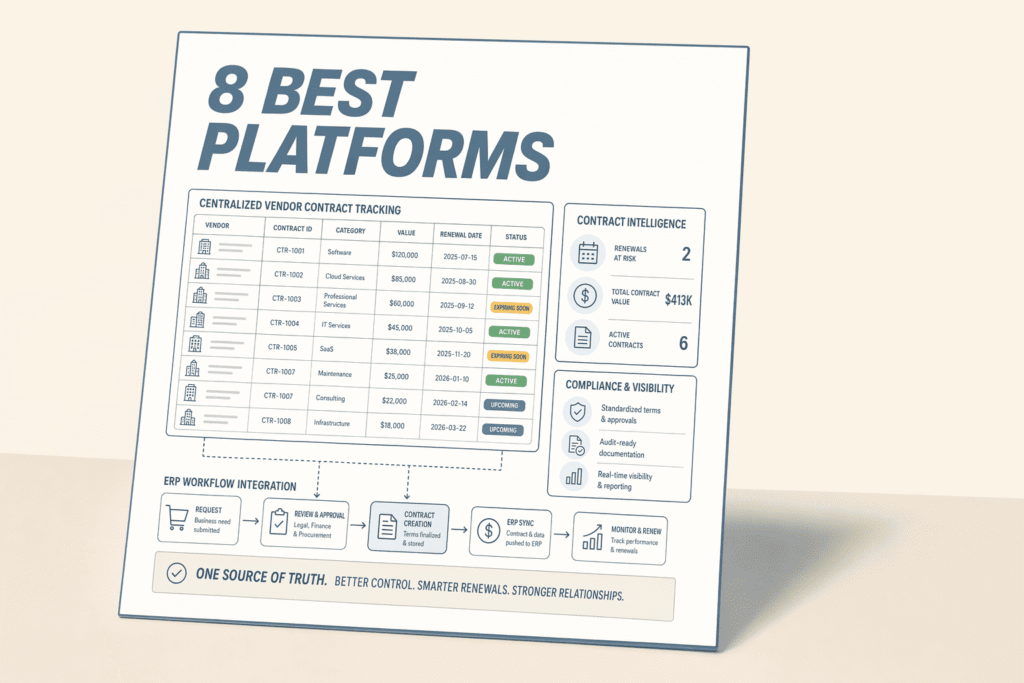
8 Best Platforms to Centralize and Track Vendor Contracts
Finance teams managing vendor contracts across emails, shared drives, and disconnected systems face missed renewals, duplicate vendors, and payment obligation gaps that erode spend visibility. AI-powered contract management platforms centralize agreements, extract obligation metadata, and sync payment schedules to ERP systems, transforming scattered PDFs into operational intelligence finance can act on. The platforms below represent the full spectrum: full-featured CLM systems requiring repository migration, finance-first mid-market tools with vendor-management emphasis, and intelligence-layer alternatives that pilot without disrupting existing storage.
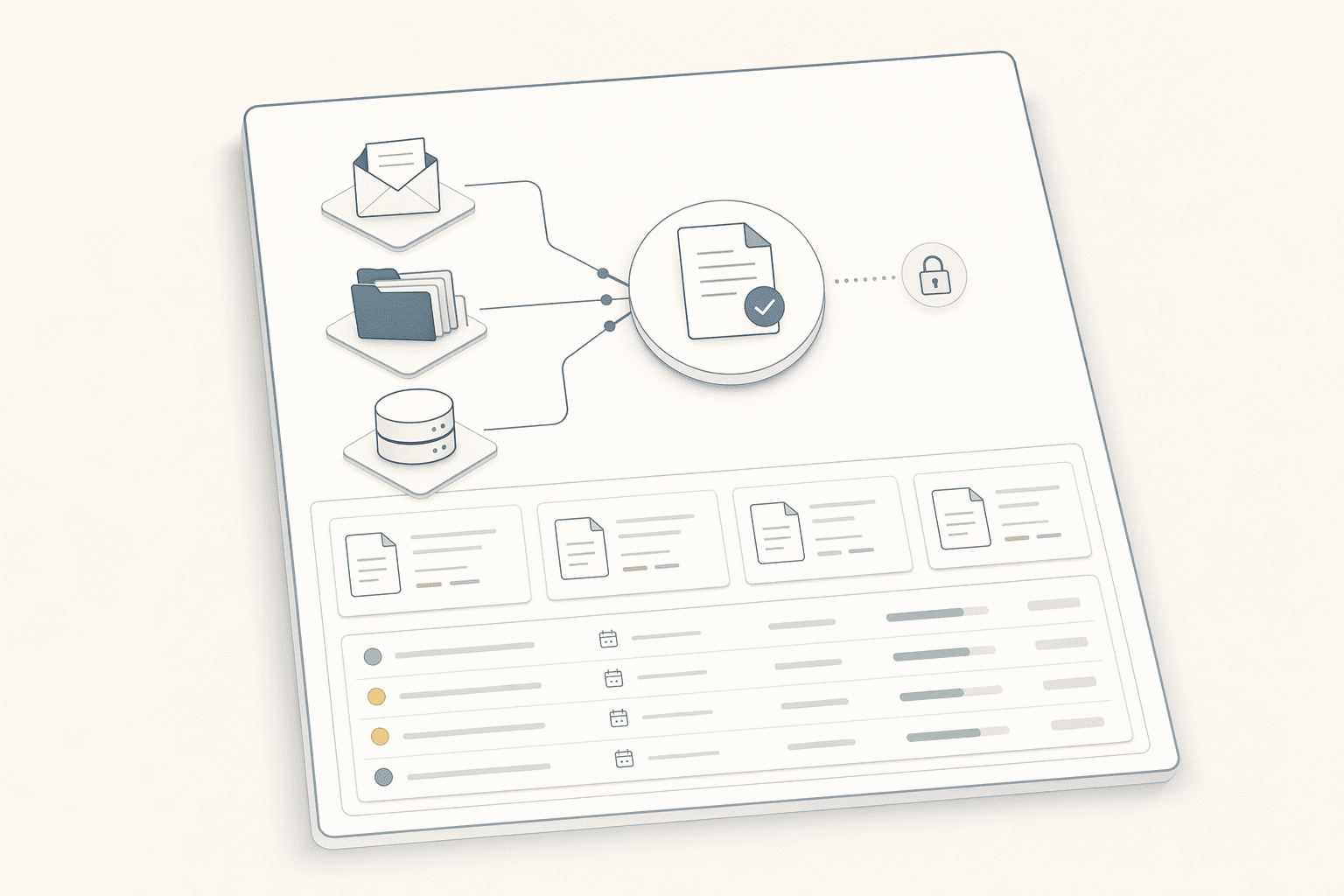
Full-Featured CLM Platforms
These end-to-end contract lifecycle management systems automate drafting, approvals, renewals, and reporting, designed for teams ready to replace legacy repositories with unified governance workflows.
- Ironclad, AI-powered workflow automation for legal and procurement teams managing high-volume vendor agreements. Recognized among 2026’s top solutions for customizable approval chains and cross-functional collaboration. Strengths: deep integration with DocuSign and Salesforce; clause-level risk tagging; automated renewal reminders tied to finance calendars. Limitations: implementation requires 8 to 12 weeks; pricing starts mid-five figures annually; best suited for teams processing 500+ contracts per year who need full audit trails.
- Coupa, Procurement-native CLM embedded in Coupa’s spend management suite, surfacing contract obligations alongside PO and invoice data. Automatically flags duplicate vendors and contract overlaps during requisition approval. Strengths: native ERP sync (SAP, Oracle, NetSuite); three-way matching between contract terms, POs, and supplier invoices; spend-under-management dashboards. Limitations: requires Coupa’s broader procurement platform; annual licensing tied to user count; implementation complexity suits enterprises with dedicated procurement ops teams.
- DocuSign CLM, Extends DocuSign’s eSignature footprint into post-signature obligation tracking and renewal management. Evaluated in 2026 roundups for its AI-assisted clause extraction and Salesforce integration depth. Strengths: smooth handoff from signature to obligation tracking; AI extracts payment schedules, auto-renewal clauses, and termination windows; integrates with Microsoft 365 and Google Workspace. Limitations: pricing scales with active contract count; advanced AI features require Enterprise tier; best for teams already standardized on DocuSign for execution.
- Icertis, Enterprise-grade CLM with industry-specific contract templates (healthcare, manufacturing, financial services) and multi-entity governance for global organizations. Positioned among 2026’s top platforms for scalability and AI-driven risk scoring. Strengths: supports 40+ languages; pre-built compliance frameworks (GDPR, HIPAA, SOX); AI identifies financial exposure in supplier agreements. Limitations: 12 to 18 month implementation timelines; pricing requires custom quote; targets enterprises with 1,000+ active vendor contracts and cross-border operations.
Finance-First and Mid-Market Options
These platforms emphasize vendor consolidation, payment obligation tracking, and finance-system integrations at lower implementation complexity than full CLM suites.
- ContractWorks, Centralized repository with AI-powered obligation extraction designed for mid-market finance and legal teams. Pricing starts at $600/month for 500 contracts; pilot implementation in 2 to 4 weeks without full repository migration. Strengths: OCR scans legacy PDFs for payment terms and renewal dates; automated alert workflows; integrates with QuickBooks and Xero for invoice reconciliation. Limitations: lacks advanced workflow automation (no multi-stage approvals); reporting is pre-built templates only; best for teams managing 100 to 1,000 vendor agreements who need fast centralization without customization overhead.
- Sirion, Positioned as an enterprise-scale contract tracking platform with AI-powered risk identification and obligation management. Automates renewal reminders, payment schedule sync to ERP, and duplicate vendor flagging. Strengths: integrates with SAP Ariba, Oracle Procurement Cloud, and Coupa; AI surfaces non-standard clauses and financial exposure; supports vendor performance scorecards. Limitations: pricing requires sales conversation; implementation spans 8 to 12 weeks; targets procurement and finance teams managing 500+ suppliers with complex multi-year agreements.
- Ivalua, Source-to-pay platform with embedded contract management module that ties vendor agreements to requisition, PO, and invoice workflows. Automatically reconciles contract pricing against purchase orders; flags payment obligations exceeding contracted rates. Strengths: unified spend visibility across contracts, orders, and invoices; real-time contract utilization dashboards; integrates with SAP, Oracle, and NetSuite ERPs. Limitations: requires Ivalua’s broader procurement suite; annual licensing tied to spend-under-management; best for enterprises seeking integrated source-to-pay rather than standalone CLM.
Intelligence-Layer Alternative
This approach extracts obligation metadata and renewal intelligence from existing contract storage without requiring full repository migration, letting finance teams pilot contract tracking on high-value vendor agreements before committing to enterprise CLM transformation.
- Contracts.ai, AI-powered contract intelligence platform that extracts payment schedules, renewal dates, and obligation metadata from vendor agreements stored in existing systems (Google Drive, SharePoint, Box). Pilots with a limited contract set without migrating the full repository or disrupting existing workflows. Strengths: claims 99%+ accuracy in real-time data extraction across legacy and live contracts; integrates with NetSuite, Oracle ERP, and SAP to reconcile supplier invoices against signed terms; customer data is not used for LLM training, addressing data-privacy concerns for regulated industries. Contract data, access, and governance remain under organization control at clause and document level. Limitations: does not support full contract workflow automation (approvals, redlining, negotiation tracking); best suited for finance and procurement teams seeking obligation visibility and ERP integration without ripping out existing contract storage or CLM systems. Pricing: contact for custom quote based on contract volume and ERP integration scope. Request a Demo to evaluate pilot implementation on 50 to 100 high-value vendor agreements.
With eight platforms spanning intelligence layers and full-featured CLM suites, finance teams need a side-by-side comparison of obligation tracking, ERP integration depth, and AI extraction capabilities to match solution scope to implementation appetite.
Comparison: Key Features Across Leading Platforms
Repository and Search Capabilities
Finance teams often confuse document storage with contract intelligence. Basic repositories, shared drives, Dropbox folders, even entry-level DocuSign accounts, offer file upload and keyword search. Finance-grade platforms add structured metadata extraction: vendor name, payment terms, renewal dates, liability caps, indemnification clauses. LinkSquares enables teams to search clauses and track obligations across centralized repositories, turning contract text into queryable data. Conga CLM pairs customizable templates with automated alerts, ensuring payment obligations surface before they’re overdue. The operational difference: a finance analyst searching “net-60 payment terms with Acme Corp” should retrieve every relevant contract clause in seconds, not spend an afternoon opening PDFs.
Obligation Tracking and Renewal Alerts
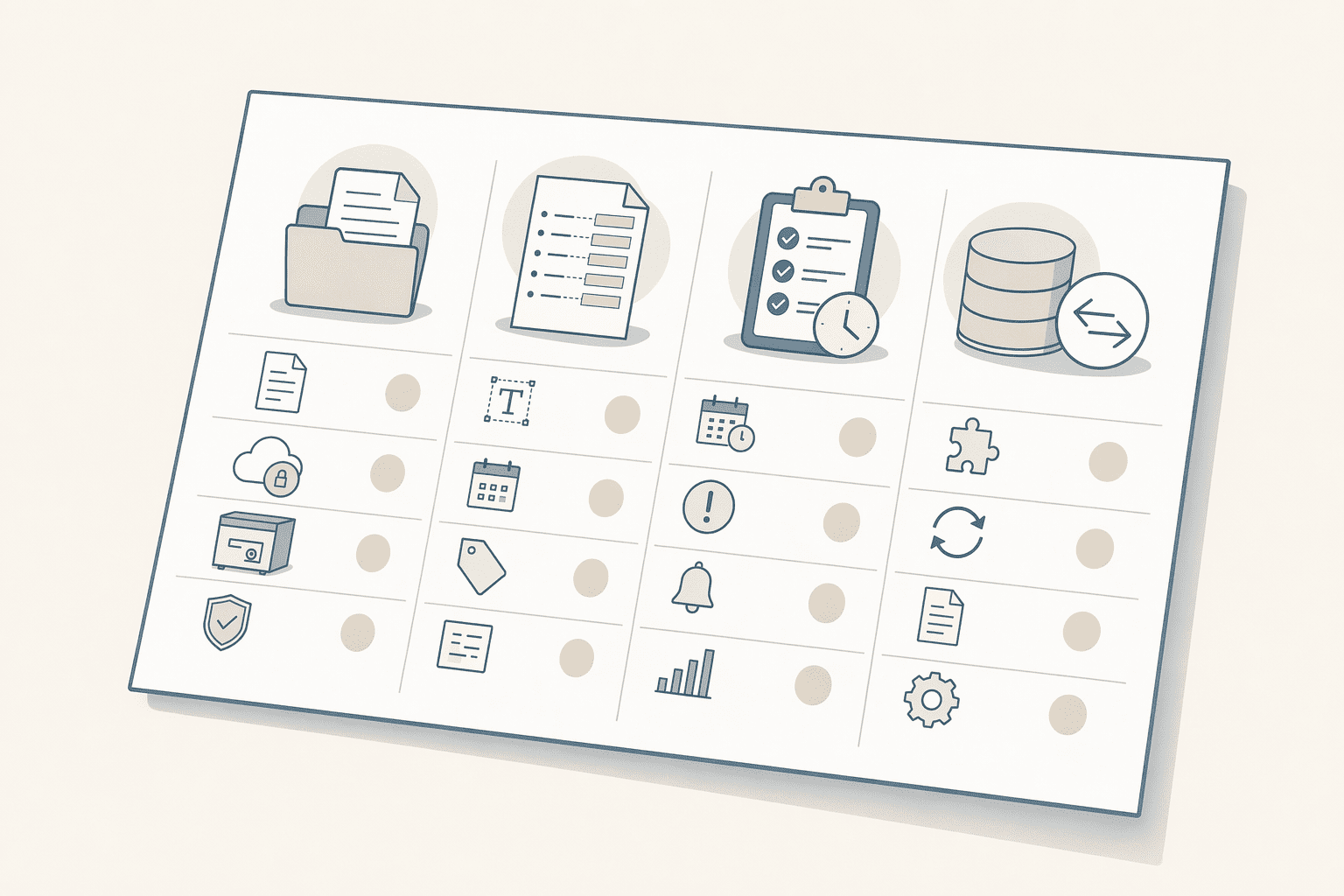
Manual tagging, finance coordinators reading contracts and typing renewal dates into spreadsheets, collapses at scale. Of the 153 CLM platforms listed on G2, fewer than a dozen extract obligations automatically via AI. DocuSign CLM automates clause-level editing and approval workflows but still requires human setup of notification triggers. Conga CLM’s strength lies in automated alerts and reminders that integrate with Outlook and Google Calendar, posting payment obligations 60 days before due dates. Teams evaluating platforms should demand live demos showing how the system parses a sample vendor agreement and populates a finance calendar, not just marketing claims about “smart notifications.”
Finance-System Integration Depth
When vendors claim they “integrate with SAP,” ask whether that means real-time bidirectional sync or a quarterly CSV export. Contracts.ai’s SAP ERP and Oracle ERP integrations push revenue and expense metadata into accounting systems, functioning as intelligence layers that augment, rather than replace, existing infrastructure. Entry-level contract tools priced around $7/month typically offer no ERP connectivity; premium platforms above $99/month vary widely in API maturity. During vendor demos, ask which contract fields map to which GL accounts, how often data syncs occur, and whether the integration requires middleware or runs natively.
Feature comparisons reveal platform capabilities, but selecting the right solution requires mapping contract volume, regulatory exposure, and ERP integration requirements to your finance team’s operational reality.
How to Choose the Right Platform for Your Finance Team
Assess Your Implementation Appetite
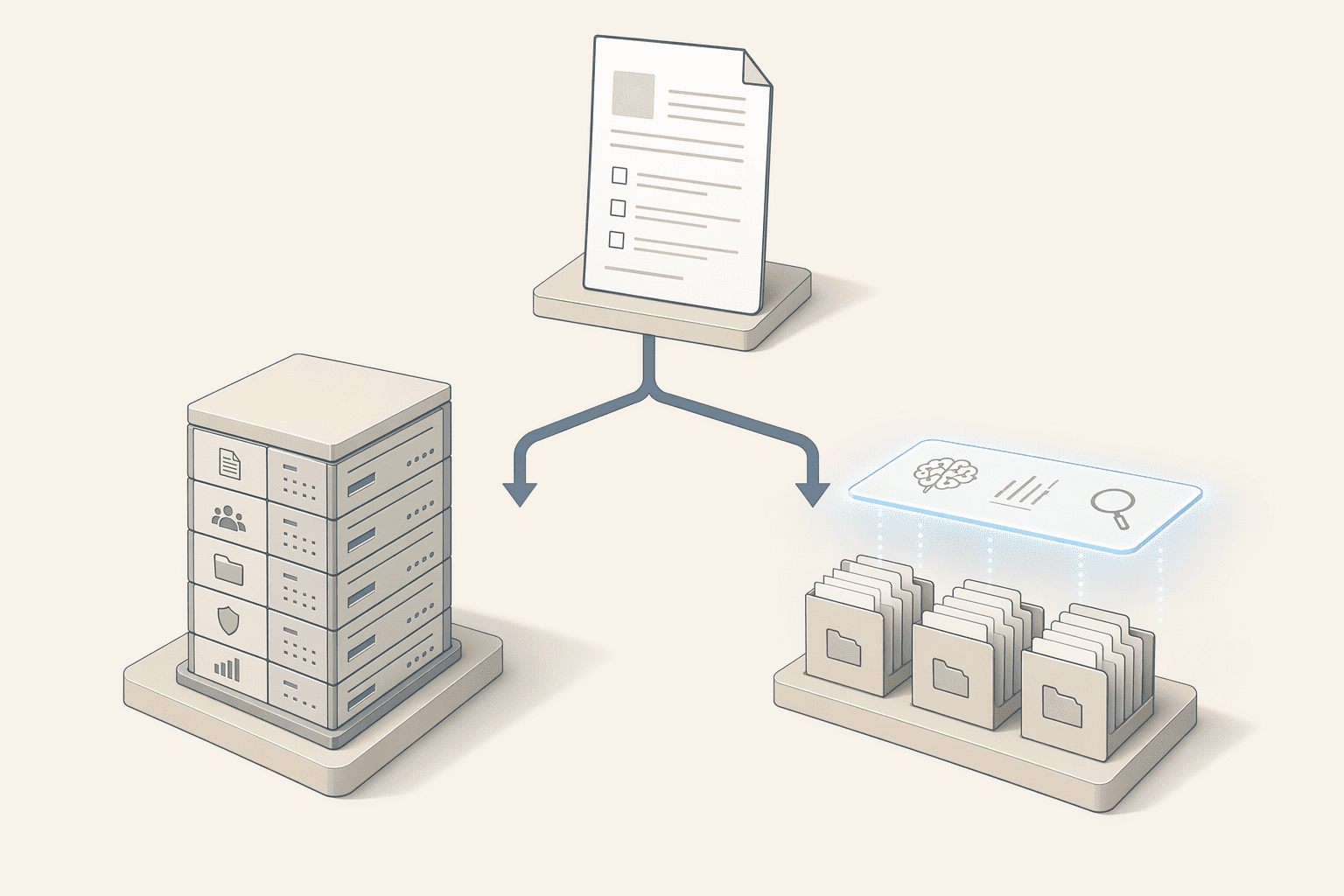
Organizations face a fundamental choice: deploy a full contract lifecycle management platform, requiring migration of every vendor agreement, reconfigured approval workflows, and months of change management, or adopt an intelligence layer that extracts insights without replacing existing systems. Full CLM migration delivers centralized contract creation, negotiation, and execution [F1-7, F1-8, F1-9], but demands bandwidth most finance teams lack. The intelligence-layer approach starts with high-value vendor contracts and expands incrementally. Contracts.ai, for instance, can be piloted with a limited contract set without migrating the full repository or disrupting existing workflows. When your team is stretched thin managing quarter-close alongside contract tracking, pilot-friendly tools reduce risk and accelerate time-to-value.
Match Platform Capabilities to Contract Volume and Complexity
Contract volume and regulatory exposure determine whether you need workflow automation or just visibility. Mid-market firms managing fewer than 500 active vendor contracts often find full-featured CLM overkill, they gain little from negotiation playbooks or multi-stage approval routing when contract count is manageable. Conversely, organizations with high-value supplier agreements, regulatory obligations (GDPR data-processing addenda, HIPAA business-associate agreements), or multi-entity consolidation benefit from platforms that centralize key terms, risks, obligations, and entitlements [F1-10, F1-11, F1-12, F1-13]. The tipping point: when manual spreadsheet tracking causes missed renewals or makes audit preparation painful, automation becomes cost-justified.
Validate Integration Architecture Before Committing
Contract management software is workflow-oriented, not insight-driven, it tells you where a contract is in the process, not what’s inside it. Finance teams face the same risk when platforms fail to integrate deeply with ERP and accounting systems. During vendor demos, ask: (1) Is the ERP integration bidirectional or one-way? (2) What is the sync frequency, real-time, hourly, daily, manual? (3) Which contract fields map to which ledger accounts? (4) Can I see a live demo of the integration, not slides? Platforms with adjacent-technology integration capabilities ensure contract data flows into financial reporting without manual reconciliation. Test API maturity by requesting a sandbox trial that connects to your actual ERP instance, documentation promises mean little if field mapping requires custom development.
Conclusion
Full-featured CLM platforms deliver thorough workflow automation, intake, approvals, lifecycle management, but require rip-and-replace implementation that reconfigures existing processes. Intelligence layers like Contracts.ai offer faster time-to-value with narrower feature scope focused on repository, obligation tracking, and renewal alerts, enabling pilot-friendly deployment without disrupting procurement or legal workflows. Platforms with deep ERP integration surface actionable spend insights and vendor consolidation opportunities, but integration depth varies widely, validate API maturity and sync frequency during vendor demos rather than trusting marketing claims.
As finance teams adopt AI-powered contract intelligence, the competitive advantage shifts from lifecycle workflow automation to spend-visibility workflows that surface duplicate vendors, contract overlaps, and consolidation opportunities, areas where scattered contracts across emails and shared drives create material audit risk and missed savings today.
Start by documenting your current contract volume, ERP integration requirements, and implementation appetite, then pilot with a limited set of 50-200 high-value vendor contracts using Contracts.ai or another intelligence-layer platform to prove ROI before scaling to full repository migration.
Frequently Asked Questions
What’s the difference between a contract repository and a full CLM platform?
A contract repository provides centralized storage, search, and basic obligation tracking, enough to solve the scattered-contracts problem without disrupting existing workflows. A full CLM platform adds intake automation, approval workflows, and lifecycle management from authoring through closeout, requiring thorough migration and reconfigured processes. Finance teams drowning in vendor contracts often need the repository layer first.
Can I start with a subset of high-value vendor contracts, or do I need to migrate everything upfront?
Pilot-friendly platforms let you start with 50-200 high-value vendor contracts to prove ROI before scaling. Full-featured CLM platforms generally require thorough repository migration to unlock workflow automation features. The trade-off is faster time-to-value versus end-to-end lifecycle management capability.
How do I know if a platform’s ERP integration is real-time or just a quarterly CSV export?
During vendor demos, ask three questions: Is the integration bidirectional? What is the sync frequency, real-time, hourly, daily, or manual? Can I see a live demo, not slides? Many platforms market NetSuite integration when they only offer one-way batch exports, creating the same insight gaps contract management software exhibits.
Which platforms offer AI-powered obligation extraction vs manual tagging?
Ironclad, DocuSign CLM, Icertis, and Contracts.ai offer AI-powered obligation extraction that automatically surfaces renewal dates, payment obligations, and termination clauses from contract PDFs. ContractWorks, Sirion, and Ivalua rely on manual metadata tagging or semi-automated extraction. Manual approaches collapse at scale when 90% of professionals struggle to locate specific contracts.
Do contract centralization platforms help finance teams consolidate duplicate vendors?
Yes, platforms with spend-visibility workflows like Coupa, Ivalua, and Sirion flag duplicate vendors by surfacing contracts with overlapping services, similar vendor names, or redundant payment obligations. This finance-operations outcome is distinct from legal-first CLM features, addressing the duplicate-vendor risk that erodes spend visibility when contracts live across disconnected systems.
What contract volume threshold justifies moving from spreadsheets to a centralized platform?
When you cross 50-100 active vendor contracts, spreadsheet tracking breaks down, missed renewals, audit gaps, and duplicate vendors become material risks. Mid-market firms managing fewer than 500 active vendor contracts often discover this threshold retroactively after a missed auto-renewal or failed audit, when manual tracking costs exceed platform subscription costs.
Are contract centralization platforms secure enough for finance data?
Enterprise-grade platforms meet SOC 2 Type II, ISO 27001, and GDPR compliance standards, the same security thresholds finance teams require for ERP and accounting systems. Contracts.ai specifically does not use customer data for LLM training, addressing a common AI-platform data-privacy concern that finance teams should validate during vendor selection alongside NIST 800-53 vendor management baselines.
Sources
- Contract Tracking Explained: Key Strategies for Businesses – www.sirion.ai (2026)
- 5 Benefits of a Vendor Contract Management Software Component – www.venminder.com (2023)
- 10 Best AI Contract Management Software in 2026 – cloudeagle.ai (2025)
- 10 Best Contract Management Software for 2026 – aavenir.com (2026)
- Best Contract Lifecycle Management (CLM) Software: User Reviews from March 2026 – www.g2.com (2026)
- I Evaluated the 7 Best Contract Lifecycle Management – learn.g2.com (2026)
- Best Contract Management Software 2026 – www.capterra.com (2026)
- Buyer’s Guide: Contract Lifecycle Management Platforms, 2025 – www.forrester.com (2025)