






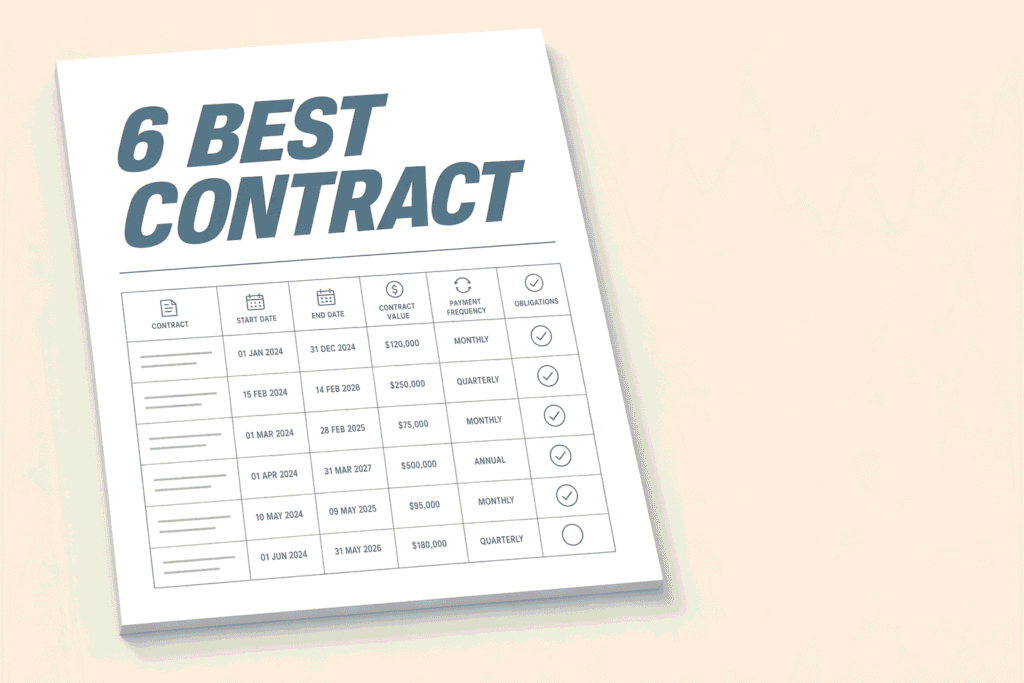
Organizations lose approximately 9% of revenue annually when renewal dates and payment obligations slip through manual tracking processes. Automated contract renewal tracking systems extract financial obligations from executed agreements and surface them before they become liabilities.
Key Takeaways
- Revenue leakage from missed renewals costs businesses up to 9% of annual revenue, driven by obligations buried in unstructured contract text
- AI-powered clause extraction transforms renewal dates and payment terms into structured alerts, but accuracy depends on integration with finance systems
- Six platforms—ranging from full-stack CLM suites to post-signature intelligence layers—offer distinct approaches to obligation tracking and ERP connectivity
- The integration-versus-replacement decision hinges on existing CLM investment, contract storage locations, and pilot deployment speed requirements
- Finance teams should prioritize platforms with accurate AI extraction, native ERP integrations, and role-based access controls over feature breadth
Organizations lose approximately 9% of revenue to contract leakage when renewal dates, payment terms, and compliance deadlines remain invisible until after they’ve passed. Contract renewal tracking transforms this from a legal workflow exercise into a revenue operations discipline—one that surfaces financial obligations before they trigger auto-renewals, penalty clauses, or forfeited negotiation windows.
The Revenue Impact of Missed Renewal Deadlines
Missed contract deadlines can cost businesses up to 9% of annual revenue—for a mid-sized enterprise generating $500 million annually, that translates to $45 million in preventable losses. The damage accumulates in three areas: unfavorable auto-renewals lock in outdated pricing when 30-day notice windows close silently; penalty clauses activate when payment approvals fall through the cracks; and lost negotiation use materializes when finance teams discover renewal dates only after contracts have already rolled over.
Why Traditional Calendar Reminders and Spreadsheets Fail
Research shows that 90% of professionals struggle to locate specific contracts when needed, and the root cause is fragmentation: obligations are scattered across emails, spreadsheets, and individual calendars. When a contract lives in a shared drive, its renewal clause in a legal repository, and the payment term in a procurement email, no single owner has a complete view—and automated alerts can reduce manual tracking time by 75-90% when systems centralize this intelligence.
Post-Signature Obligation Monitoring vs. Pre-Signature Approval Workflows
This article addresses post-signature intelligence, systems that extract renewal dates, payment terms, and compliance obligations from executed agreements, not pre-signature contract creation or approval routing. Contracts.ai, for example, is described as a post-signature intelligence layer that transforms executed agreements into structured, operational intelligence; it does not support pre-signature approval workflows. Some organizations need full contract lifecycle management (CLM) replacement; others need an intelligence add-on that layers onto existing signing and storage infrastructure.
Understanding the revenue impact of manual tracking establishes the business case, now we examine how automated systems prevent leakage through structured extraction and proactive alerts.
How Automated Obligation Tracking Prevents Revenue Leakage
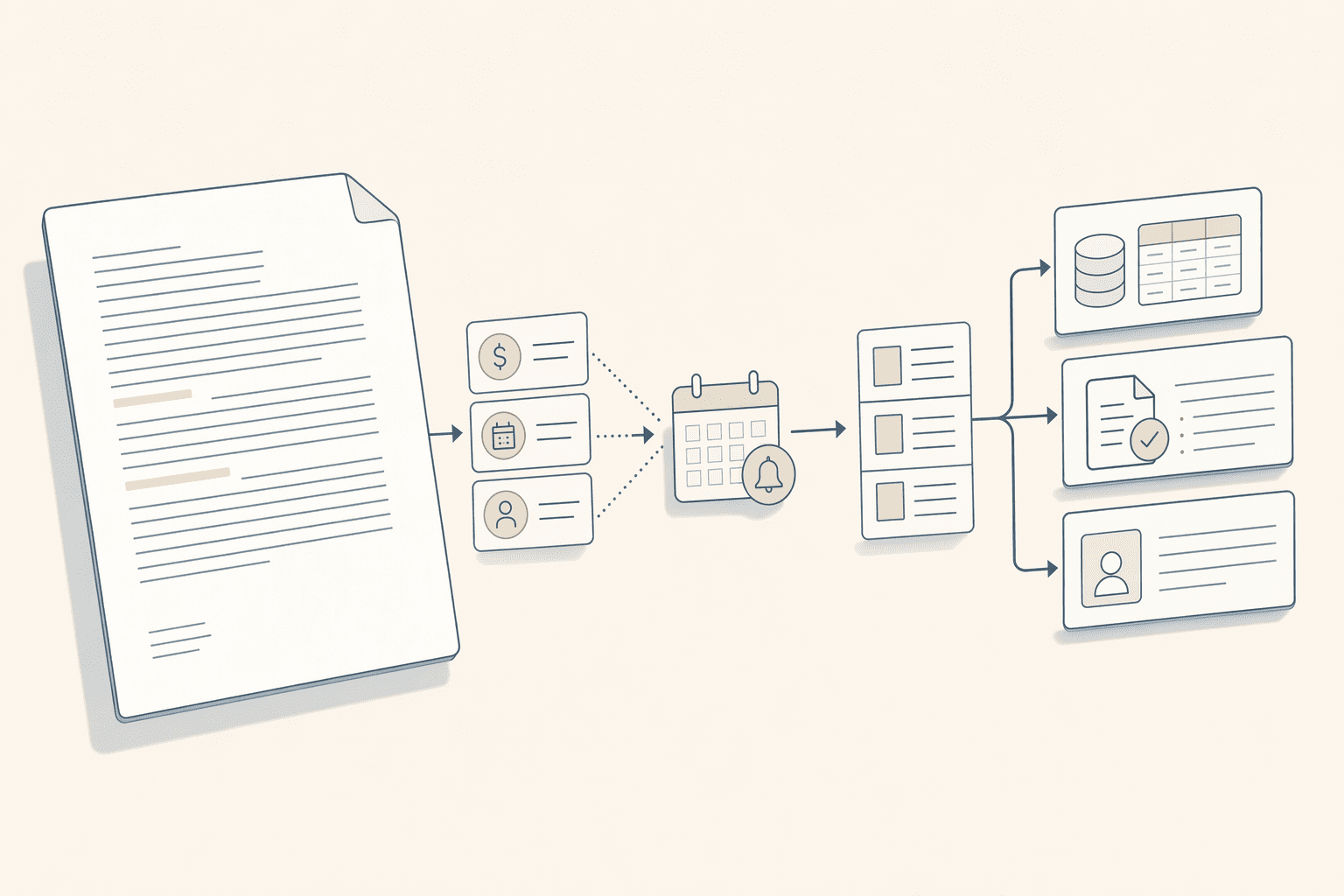
Revenue leakage from missed renewals and overlooked payment terms is a structural problem: financial obligations live in unstructured contract text, while finance systems expect structured data. Automated obligation tracking closes this gap by extracting commitments from executed agreements, scheduling alerts on operational timelines, and routing structured data into ERP, AP automation, and CRM platforms where finance teams already work.
AI-Powered Extraction of Payment Terms and Renewal Clauses
AI-powered clause extraction is the automated identification and structuring of obligations, terms, and metadata from contract documents using machine learning and natural language processing. NLP models scan executed agreements for payment schedules, renewal notice periods, auto-renewal clauses, penalty terms, termination rights, and audit obligations, the financial commitments that trigger revenue recognition, payables, and compliance events. Obligation tracking surfaces deadlines, milestones, renewal events, compliance requirements, and performance obligations through centralized software systems that improve accountability and reduce operational risk.
Alert Timing and Multi-Channel Notification Systems
Extraction alone does not prevent leakage; obligations must surface at the right moment for the right stakeholder. Real-time obligation tracking enables continuous monitoring and automated alerts that improve compliance while reducing spend leakage and risk. Leading systems configure 30-, 60-, and 90-day alert cadences tied to renewal deadlines, payment due dates, and notice-period cutoffs. Escalation rules route notifications to finance, procurement, or legal based on obligation type, delivering alerts via Slack, email, Microsoft Teams, or in-app dashboards so teams see commitments where they already work.
Integration with Finance Systems: ERP, AP Automation, and CRM
Extracted obligations deliver value only when finance teams can act on them inside their operational systems, and many contract intelligence platforms aim to sync contract metadata, renewal terms, payment schedules, counterparty names, into downstream systems. AP automation systems match invoices against extracted payment terms; CRM platforms update opportunity records with live contract status. This bi-directional flow eliminates manual re-keying, ensures finance dashboards reflect current obligations, and supports the integration-vs.-replacement decision: organizations with embedded CLM workflows often add an intelligence layer (AI extraction and alert orchestration) rather than replacing their entire finance stack.
Theory matters less than execution. The platforms below represent tested approaches to extracting, alerting, and integrating contract obligations into finance workflows.
6 Contract Management Platforms with Renewal Tracking Capabilities
The systems below represent distinct approaches to post-signature obligation management. Some are intelligence layers that integrate with existing repositories; others are full-stack CLM suites with renewal tracking embedded in broader workflows. Evaluation criteria include AI extraction accuracy, integration flexibility, and depth of renewal alert logic.

Contracts.ai: Post-Signature Intelligence Layer for Existing CLM Stacks
Contracts.ai positions itself as the post-signature intelligence layer that extracts obligations from executed agreements without requiring repository migration. The platform transforms signed contracts into structured, operational intelligence and integrates with existing CLM tools rather than replacing them.
Strengths: Customer data is never used to train public or shared models. SOC2 and SOC3 certified, with GDPR and HIPAA compliance frameworks. Pilot deployment possible without full repository migration, addressing rip-and-replace concerns.
Limitations: Does not support contract approval workflows; the platform focuses exclusively on post-signature intelligence rather than pre-signature routing or negotiation management.
Best for: Finance and procurement teams that already own a CLM system but need better visibility into renewal dates, payment terms, and compliance obligations across legacy and active contracts. Ideal when the existing CLM handles approvals well but extraction and reporting fall short.
Ironclad: Full-Stack CLM with Workflow Automation
Ironclad delivers obligation tracking within a thorough CLM suite that spans both pre-signature workflows and post-signature obligation management. Each obligation carries an owner, status, and type, with a centralized dashboard providing portfolio-wide visibility.
Strengths: Unified platform covering drafting, negotiation, approval routing, and post-signature tracking. Strong integration ecosystem for ERP, CRM, and procurement systems. Enterprise-grade permissions model ties obligation access to repository record permissions.
Limitations: Obligation management is an add-on module, not included in base licensing. Requires edit access to the underlying contract record to assign or own an obligation, which can complicate cross-departmental workflows.
Best for: Legal operations teams seeking a single system for both pre-signature workflow automation and post-signature obligation tracking, especially when contract approvals and clause library management are equally important.
Icertis: Enterprise Contract Intelligence Platform
Icertis targets large enterprises with complex procurement and compliance requirements. The platform emphasizes AI-powered risk scoring and multi-language support for global contract portfolios.
Strengths: Deep configurability for multi-entity organizations. Supports complex approval hierarchies and regulatory compliance tracking across jurisdictions. Pre-built connectors for major ERP platforms (SAP, Oracle, NetSuite).
Limitations: Implementation timelines typically span several months due to configurability depth. Pricing and deployment details require direct vendor engagement; not publicly disclosed.
Best for: Global enterprises with thousands of supplier agreements, multi-language obligations, and complex compliance frameworks requiring audit trails and role-based governance.
DocuSign CLM: Agreement Lifecycle with Native eSignature
DocuSign CLM extends the company’s eSignature platform with post-signature obligation tracking. Adoption friction is low for organizations already using DocuSign for execution workflows.
Strengths: Smooth integration with DocuSign eSignature reduces toolchain complexity. Pre-built templates accelerate contract creation. Familiar interface lowers training overhead for teams already using DocuSign.
Limitations: Obligation tracking capabilities are less mature than dedicated CLM platforms. Advanced workflow automation and clause-level extraction may require custom configuration or third-party integrations.
Best for: Mid-market organizations that prioritize eSignature workflow continuity and want to add basic renewal tracking without introducing a separate CLM vendor.
Juro: Browser-Based CLM for Mid-Market Teams
Juro emphasizes speed and simplicity for mid-market legal and finance teams. The browser-based interface supports collaborative contract creation alongside obligation tracking.
Strengths: Rapid deployment with minimal IT involvement. Collaborative editing interface allows legal, finance, and business stakeholders to work within the same document. Transparent pricing tiers designed for mid-market budgets.
Limitations: Feature depth is narrower than enterprise-focused platforms. Integration catalog is smaller; custom connector development may be required for niche ERP or procurement systems.
Best for: Mid-market companies with 50-500 employees that need contract collaboration and basic renewal tracking without the complexity or cost of enterprise CLM suites.
Cobblestone Software: Configurable CLM with Deep Finance Integrations
Cobblestone focuses on renewal tracking and finance system integrations, particularly ERP and accounts payable automation platforms. Configurability supports custom workflows without requiring developer resources.
Strengths: Pre-built integrations for NetSuite, SAP, Oracle ERP, and AP automation tools. Configurable obligation types and alert logic support diverse renewal scenarios. Mid-market pricing with tiered licensing based on user count.
Limitations: User interface design trails newer entrants; learning curve is steeper for non-technical users. AI extraction capabilities are less advanced than platforms built around natural language processing.
Best for: Finance and procurement teams that require tight integration with ERP and AP systems, especially when contract data must flow directly into invoice reconciliation and vendor management workflows.
Platform Comparison: Key Renewal Tracking Dimensions
| Platform | AI Clause Extraction / Metadata Capture | User Rating (G2) |
|---|---|---|
| Contracts.ai | 99%+ accuracy in real-time extraction; natural language queries across contract base | Not publicly disclosed |
| Ironclad | Structured obligation types with owner/status tracking; requires edit access for assignment | 4.6/5 (enterprise workflows) |
| Icertis | AI-powered risk scoring; multi-language support; clause-level extraction | 4.5/5 (global enterprises) |
| DocuSign CLM | Basic obligation tracking; strongest in eSignature continuity | 4.3/5 (mid-market adoption) |
| Juro | Collaborative editing with lightweight obligation tracking | 4.5/5 (ease of use) |
| Cobblestone Software | Configurable obligation types; ERP-focused metadata fields | 4.2/5 (finance integrations) |
Selection criteria should weight architectural fit over feature parity. Organizations with existing CLM infrastructure benefit from intelligence-layer add-ons like Contracts.ai; those building from scratch may prioritize full-stack platforms like Ironclad or Icertis. Mid-market teams often favor speed-to-value (Juro) or finance-system alignment (Cobblestone, DocuSign CLM).
Feature lists obscure the decision criteria that matter: extraction accuracy, alert reliability, and integration flexibility. The comparison below isolates these variables.
Comparison: Renewal Alerts, Payment Term Extraction, and Integration Flexibility
Renewal Alert Timing and Escalation Rules
Finance teams prioritize platforms that surface renewal obligations before they become liabilities. Best-in-class systems offer configurable notice periods (30/60/90 days), escalation workflows that route alerts to finance, legal, and procurement stakeholders based on contract value or risk tier, and multi-channel notifications (email, Slack, in-app dashboard). Evaluates platforms on alert reliability and integration satisfaction. Platforms with weak escalation logic force teams to rely on manual calendar reminders, reintroducing the risk of missed deadlines.

AI-Powered Payment Term and Obligation Extraction Accuracy
Extraction accuracy separates intelligence layers from document storage tools. Contracts.ai claims >99% accuracy when extracting data from documents in real time, preserving source language alongside structured fields. Platforms that cannot handle non-standard clause phrasing (e.g., “net-45 with 2% early-pay discount”) generate incomplete metadata, forcing finance teams to manually review contracts flagged as ambiguous. The result: partial automation that still requires full-time contract analyst oversight.
Finance System Integration: ERP, AP Automation, and CRM Connectors
Integration breadth determines whether contract intelligence reaches the systems that act on it. Contracts.ai’s NetSuite integration reconciles supplier invoices with signed contracts, closing the gap between procurement commitments and accounts payable execution. Platforms that lack native ERP connectors (Oracle, SAP, NetSuite) or require middleware to push obligation data to finance systems add latency and integration maintenance overhead. Teams in regulated industries (energy, healthcare) face additional compliance requirements for cross-system data lineage, making API flexibility a non-negotiable criterion.
Comparing capabilities clarifies trade-offs, but the right system depends on your existing infrastructure, team structure, and deployment timeline.
Choosing the Right System Based on Your Tech Stack and Team Structure
Intelligence Layer Add-On vs. Full CLM Replacement
The integration-versus-replacement decision hinges on four criteria: (1) existing CLM investment, if you’ve already deployed a workflow-native platform like Ironclad or DocuSign CLM, an intelligence layer preserves that spend; (2) contract storage locations, centralized repositories favor full-stack CLM, while scattered PDF libraries (email, SharePoint, Dropbox) favor extraction-first tools; (3) team ownership, finance-led buyers prioritize ERP integration and payment tracking, whereas legal-led buyers focus on approval workflows and clause libraries; (4) implementation tolerance, full CLM migrations require 3 to 6 months of data onboarding, while intelligence layers can run pilot deployments without repository migration. Contracts.ai was founded by practitioners who unified global contract repositories inside regulated enterprises, positioning it as the no-migration option when finance teams need immediate visibility into renewal terms and payment obligations across legacy agreements.

Role-Based Access Controls: Finance, Legal, and Procurement Team Needs
Finance teams reading contracts, legal approving spend, and procurement managing supplier relationships demand granular permission models. Contracts.ai uses role-based access controls with granular permissioning by user and team, enabling finance to surface renewal dates without editing contract terms, while legal retains approval authority. Full-stack CLM platforms like Agiloft and Icertis offer comparable RBAC depth but require workflow configuration across all departments; intelligence layers inherit access patterns from existing document storage, reducing cross-functional setup friction.
Implementation Timelines and Data Migration Requirements
Pilot deployment speed separates intelligence layers from workflow-native CLM. Contracts.ai’s team has overseen enterprise technology evaluations and unified global contract repositories, enabling no-migration pilots that surface renewal obligations within days. Full-stack implementations, Ironclad, Icertis, DocuSign CLM, require 3 to 6 month onboarding cycles to migrate contract metadata, configure approval chains, and train users. Finance operations losing revenue from missed renewals favor the faster path; organizations rebuilding end-to-end contract governance justify the longer timeline for workflow unification.
Conclusion
Full-stack CLM platforms like Ironclad and Icertis deliver pre-signature and post-signature workflows but demand 3-6 month data migration projects. Intelligence-layer tools such as Contracts.ai extract obligations from existing repositories without migration but don’t support contract approval routing. Enterprise platforms suit large organizations with complex procurement requirements, while mid-market tools prioritize deployment speed over configurability.
As AI extraction accuracy improves and finance systems adopt contract intelligence APIs, the line between standalone CLM platforms and intelligence-layer add-ons will blur, buyers will evaluate systems on integration flexibility and obligation tracking precision rather than feature breadth.
Start by documenting your current contract storage locations (email, shared drives, legacy CLM) and identifying your most critical renewal deadlines. Then explore Contracts.ai’s pilot deployment to extract obligations from existing repositories without a full migration project, leveraging pre-built integrations with Oracle ERP and SAP.
Frequently Asked Questions
What’s the difference between contract lifecycle management (CLM) and contract renewal tracking?
CLM platforms manage pre-signature workflows (drafting, negotiation, approval routing) plus post-signature obligations, while contract renewal tracking focuses exclusively on extracting and alerting renewal dates, payment terms, and compliance obligations from executed agreements. Post-signature intelligence layers like Contracts.ai do not support contract approval workflows, they extract obligations without replacing pre-signature CLM systems.
How do I consolidate contracts scattered across email, shared drives, and legacy systems?
Two paths exist: full data migration into a CLM repository (Ironclad, Icertis, DocuSign) requiring 3-6 months of consolidation effort, or intelligence-layer extraction from existing storage locations without migration. Contracts.ai enables pilot deployment without repository migration, extracting obligations directly from email, shared drives, and legacy systems.
Can finance teams access contract obligations without legal team approval workflows?
Role-based access controls enable finance teams to view payment terms, renewal dates, and financial obligations with read-only permissions, while legal retains write access to approval workflows and clause libraries. Platforms like Contracts.ai and Cobblestone provide finance-specific dashboards that surface obligations without requiring legal workflow participation.
How accurate is AI extraction of payment terms and renewal clauses?
Extraction accuracy depends on training data quality, clause standardization, and human review workflows. High-confidence scoring surfaces obligations that match standardized patterns, while medium- and low-confidence items require human verification. Integration connectors ensure extracted obligations flow into finance systems for validation and action, closing the accuracy feedback loop.
What ERP and finance systems integrate with contract renewal tracking platforms?
Native integrations exist for Oracle ERP, SAP, NetSuite, Workday, and AP automation platforms like Bill.com and Tipalti. Contracts.ai’s NetSuite integration reconciles supplier invoices with signed contracts, while connectors sync renewal terms and payment schedules into ERP general ledgers and procurement modules.
How does Contracts.ai protect customer data and comply with privacy regulations?
Customer data is never used to train public or shared models. Contracts.ai is SOC2 and SOC3 certified, with GDPR and HIPAA compliance frameworks in place. The platform processes obligations exclusively for providing contract intelligence services, no data is used for advertising or unrelated purposes.
What’s the typical implementation timeline for a contract renewal tracking system?
Intelligence-layer tools like Contracts.ai deploy in 2-4 weeks without data migration, extracting obligations from existing repositories. Full CLM implementations (Ironclad, Icertis) require 3-6 months for data migration, user training, workflow configuration, and stakeholder onboarding. Pilot deployment speed depends on contract storage centralization.
Sources
- Contract Tracking Explained: Key Strategies for Businesses – www.sirion.ai
- AI Contract Management Software 2026: 10 Best Tools – bindlegal.com (2026)
- 10 Best AI Contract Management Software in 2026 – www.cloudeagle.ai (2025)
- Top 10 AI-Powered Contract Management Software – www.saaslaunchr.com (2025)
- Leveraging technology for improved contract management in the energy sector – www.researchgate.net (2024)
- Best AI Contract Management Software for 2026 – Factorial – factorialhr.com (2026)
- Three Ways Contract Management Software Can Enhance Your Tech Competence – www.forbes.com (2021)
- 10 Best Contract Management Software for 2026 – aavenir.com (2026)