Compliance-ready contract lifecycle management (CLM) platforms prioritize audit trails, obligation tracking, and cross-departmental visibility over signature acceleration. Enterprise buyers now evaluate CLM vendors on certification depth, data processor liability, and post-signature monitoring capabilities.
Key Takeaways
- Compliance-ready CLM platforms require field-level change tracking and immutable audit trails, not just document-level history.
- AI-powered extraction converts unstructured contracts into structured data, reducing manual review hours and preventing 5-40% cost leakage from inefficient contracts.
- SOC2 Type II, ISO 27001, and GDPR/HIPAA certifications are table stakes for platforms handling regulated contract data.
- Intelligence-layer platforms connect to existing repositories (SharePoint, NetDocuments) without migration, enabling pilot deployments with limited contract sets.
- Role-based access controls with clause-level isolation enable cross-departmental visibility while preventing data leakage across finance, legal, and operations teams.
What Makes a Contract Management Solution Compliance-Ready?
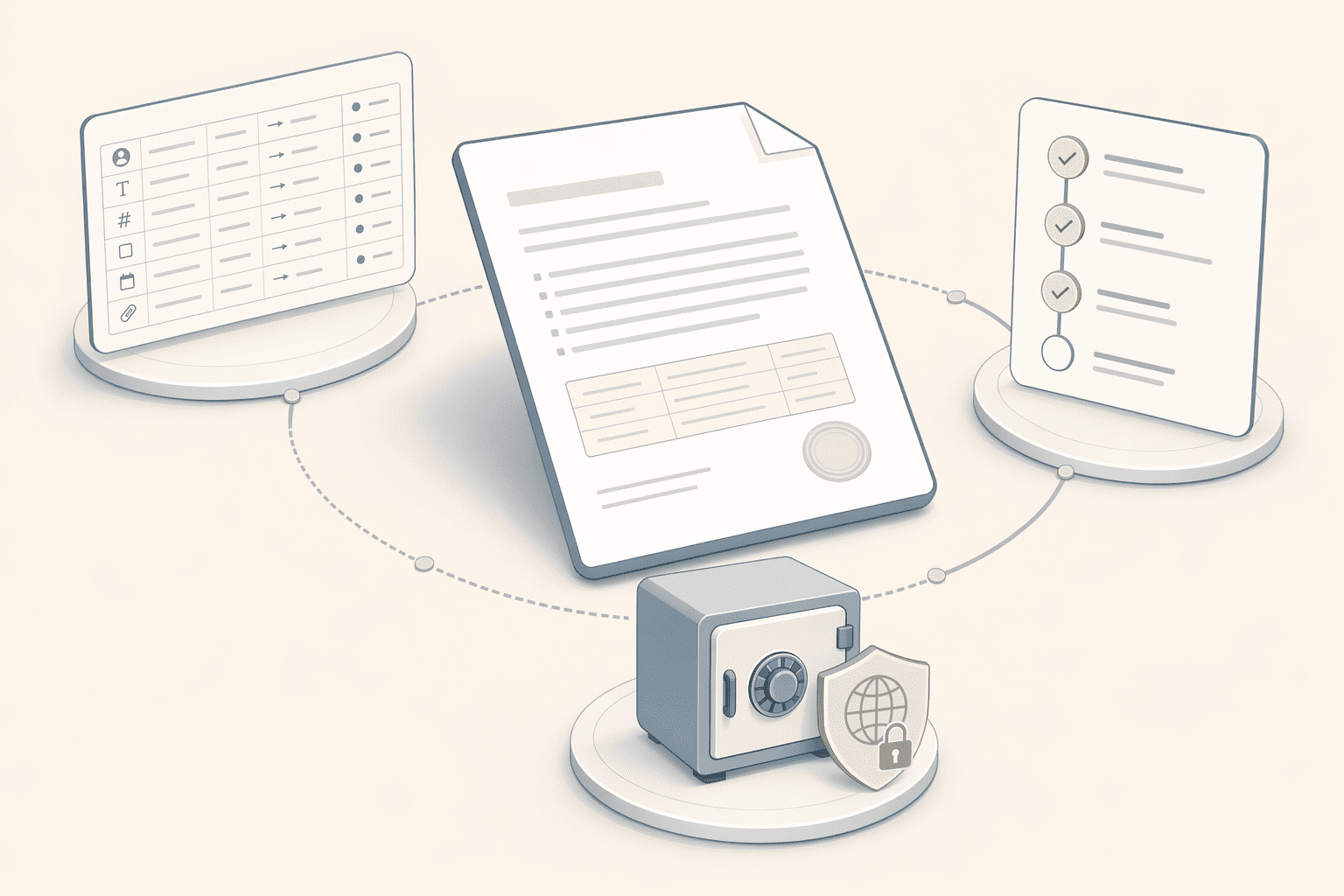
A compliance-ready contract management solution centers on audit trail granularity and post-signature obligation tracking, not just signature acceleration. Many buyers evaluate CLM on signature speed and overlook post-signature compliance monitoring, leaving obligations untracked until an audit surfaces the gap. The leading platforms now extract obligations automatically, but compliance readiness depends on three foundational capabilities: field-level change tracking, automated obligation monitoring beyond renewal dates, and data residency mechanisms that meet GDPR and HIPAA requirements.
Audit Trail Granularity and Version Control
Compliance buyers need field-level change tracking, not just document-level history. Automated CLM solutions provide strong audit trails that log every modification to contract terms, approval workflows, and metadata fields with timestamp and user attribution. This granularity matters during regulatory audits and disputes when legal teams must reconstruct exactly who changed a liability cap clause or approved a non-standard payment term. Contracts.ai implements audit logging as part of its data processor safeguards, capturing clause-level edits alongside structured field changes. Version control must preserve source language to allow side-by-side comparison of negotiated revisions against executed language, ensuring compliance teams can validate that approved terms match signed documents.
Obligation Tracking Beyond Renewal Dates
Post-signature compliance monitoring extends beyond renewal reminders to performance milestones, reporting deadlines, and data deletion triggers. Contract lifecycle management progresses through five stages: initiation, negotiation, execution, monitoring, and closure, with the monitoring phase governing ongoing compliance. Platforms that extract obligations automatically flag upcoming deliverables, regulatory reporting windows, and contractual milestones that trigger payment or performance reviews. This matters for procurement teams managing SLA compliance, legal departments tracking data retention obligations under GDPR, and finance teams reconciling invoices against signed contract terms. Key CLM features include obligation calendars that integrate with ERP and finance systems, triggering alerts when a counterparty breaches a delivery deadline or when a data processing addendum requires annual attestation.
Data Residency and Cross-Border Transfer Mechanisms
Data residency requirements and cross-border transfer mechanisms separate compliance-ready platforms from general-purpose CLM tools. Contracts.ai supports compliance with GDPR and HIPAA, operating as a data processor that processes personal data on behalf of customers in accordance with documented instructions. This distinction matters because the data processor assumes contractual liability for safeguarding customer data, while the data controller (the enterprise buyer) retains governance authority. Contracts.ai may transfer personal data outside the EEA using Standard Contractual Clauses plus technical safeguards such as encryption and access controls, meeting GDPR requirements without requiring EU-only hosting. For HIPAA-regulated buyers, Contracts.ai executes Business Associate Agreements with covered entities and uses TLS 1.2+ for data in transit and encryption at rest for stored PHI. These mechanisms, combined with SOC 2 and SOC 3 certification, establish the compliance baseline GRC buyers require.
Understanding compliance requirements establishes the baseline; the next step is mapping those requirements to platform capabilities that deliver measurable workload reduction.
Core Capabilities: Legal Workload Reduction vs. Compliance Monitoring
Enterprise contract platforms promise two distinct outcomes: reducing the hours legal teams spend on manual review, and preventing compliance failures across departments. These capabilities are complementary, not competing—but buyers often conflate them or assume one delivers the other automatically. The choice depends on which operational pain point is more acute.
AI-Powered Contract Analysis for Legal Teams
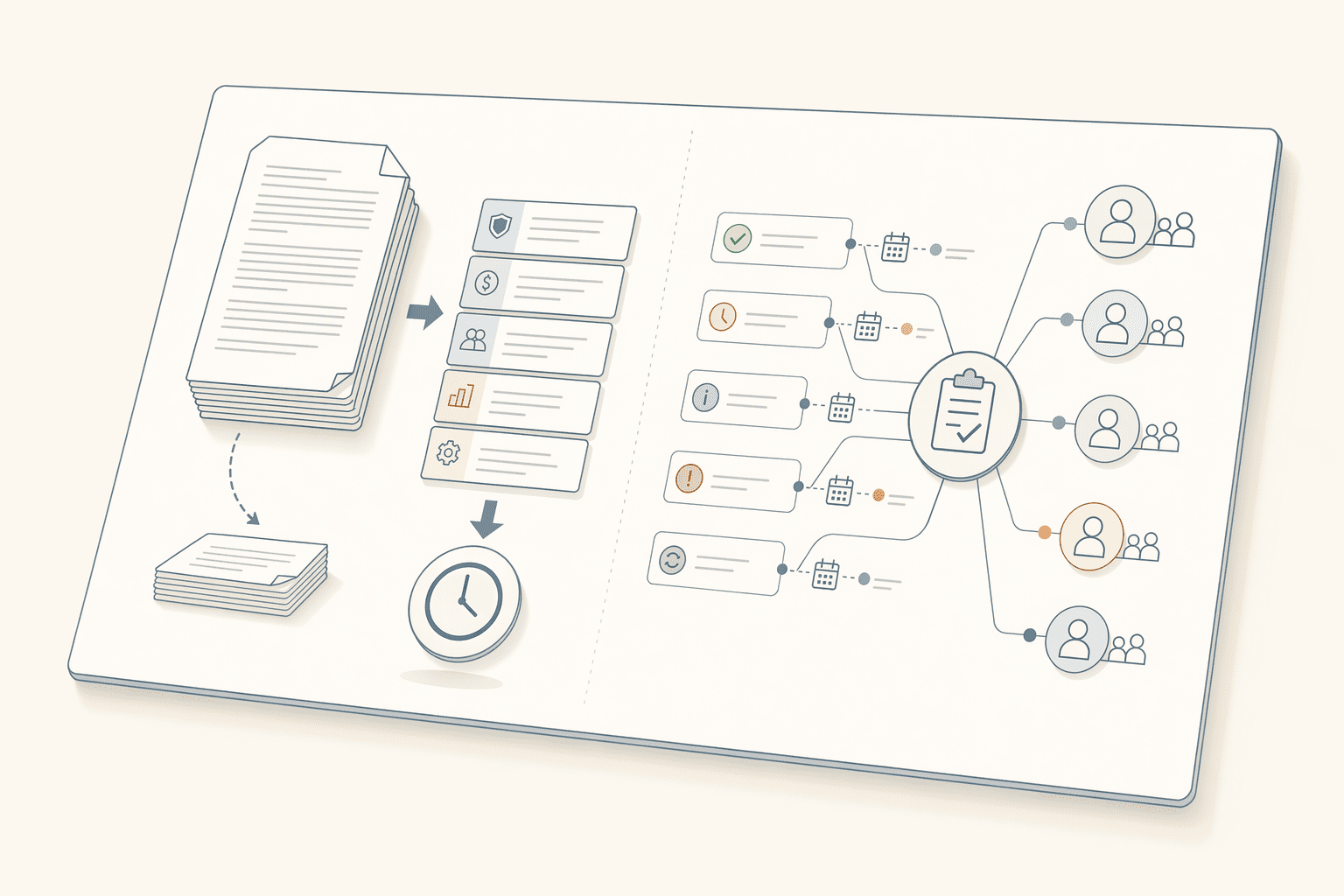
Natural language processing extracts clauses, obligations, parties, and dates from unstructured PDFs—turning forty-page agreements into structured data in minutes instead of hours. Platforms like DigiParser report ~99% extraction accuracy after training on thousands of real contracts, handling scanned copies and handwritten edits without contract-specific templates. OpenAI’s internal contract agent cut review time in half using retrieval-augmented prompting—finance experts wake up to annotated datasets ready for validation, not manual entry.
The ROI is measurable: inefficient contracts cost 5-40% of deal value, and poor management erodes 9% of bottom-line revenue. Risk scoring flags non-standard indemnity or termination clauses automatically, so legal counsel reviews only the exceptions. But AI clause extraction solves *pre-signature* workload—it doesn’t address what happens after the ink dries.
Automated Obligation and Deadline Management
Compliance monitoring requires a different architecture: obligation extraction tied to cross-departmental alerting. Finance needs to know when payment terms trigger milestone billing; operations must track delivery schedules; legal monitors renewal windows and termination notice periods. A best-in-class system parses extracted obligations into a calendar engine that routes alerts based on role and responsibility—not a shared inbox everyone ignores.
The knowledge gap buyers miss: obligation tracking isn’t a feature you bolt onto a CLM after deployment, it’s an architectural decision. Systems built for document storage don’t natively surface “Net-60 payment due March 15” to accounts payable or “Auto-renewal unless terminated 90 days prior” to procurement. Audit readiness depends on proving you *knew* about the obligation and acted on it, not just that the contract existed in a repository.
Role-Based Access Controls and Logical Data Isolation
Cross-departmental visibility without data leakage requires logical isolation at the clause level, not just folder permissions. Finance sees payment terms, renewal dates, and pricing schedules. Operations accesses delivery milestones and service-level commitments. Legal retains full contract visibility, including IP assignments and liability caps that other departments never need to see. This isn’t a “nice-to-have” compliance feature, it’s a regulatory requirement in industries handling PHI, PII, or trade secrets.
Platforms that aggregate contract data for model training introduce a structural conflict: improving AI accuracy versus preserving customer data isolation. Systems that commit to zero model training on proprietary data, verified through SOC 2 audits and processor-only GDPR roles, can enforce logical isolation without secondary-use risk. The trade-off: if your pain point is manual contract review, prioritize AI clause extraction and risk scoring. If your pain point is missed obligations and audit failures, prioritize deadline alerting and role-based access. The best platforms deliver both, architected from the start to separate pre-signature intelligence from post-signature operational governance.
With capability requirements defined, the next step is evaluating specific platforms against certification depth, audit architecture, and deployment models.
Platform Comparison: Compliance-Centric CLM Solutions
When legal workload reduction depends on compliance automation, certification depth and audit architecture become selection criteria. Gartner defines CLM solutions as systems that “enable regulatory and policy compliance, providing governance over what is signed and with whom”, yet vendors vary widely in how they operationalize that governance. The global CLM market is expected to grow at 12.5% CAGR through 2034, driven in part by enterprises seeking platforms that can absorb regulatory complexity without expanding legal headcount.
SOC2, GDPR, and HIPAA Compliance Certifications
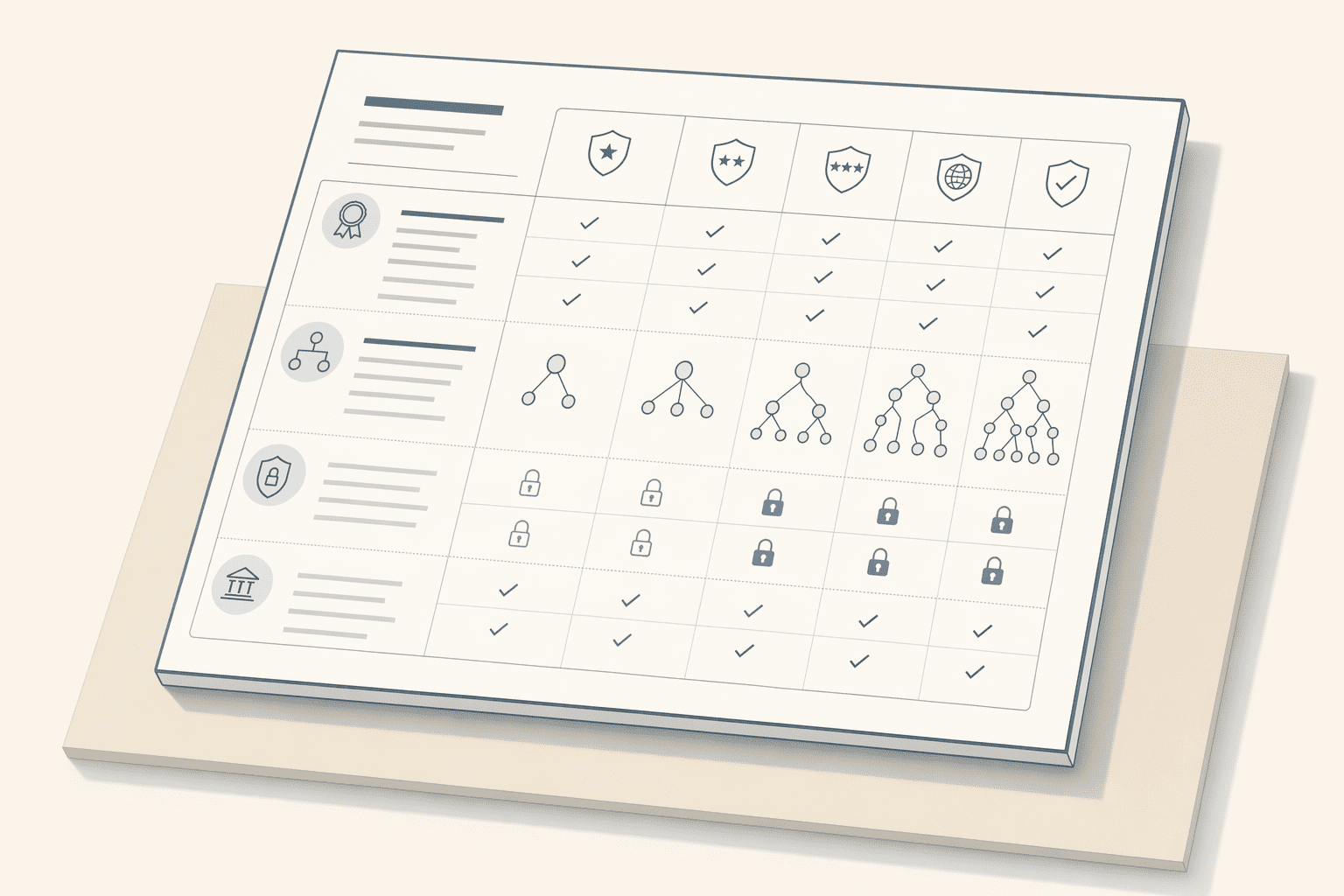
Third-party certifications signal a platform’s readiness to handle regulated data. Contracts.ai is SOC2 and SOC3 certified and supports GDPR compliance, with HIPAA-related documentation available under executed Business Associate Agreements. Ironclad positions itself as “enterprise-grade AI CLM”, though specific certification details require vendor verification. DocuSign CLM and Icertis are widely deployed in regulated industries; mid-market comparisons note that enterprise platforms like Icertis target organizations with dedicated compliance teams. Agiloft, Sirion, and LinkSquares each publish security documentation, but buyers should verify current certification status directly, self-attested compliance claims lack the audit rigor of SOC2 Type II reports.
Audit Trail Architecture and Data Processor Roles
Field-level change logs and immutable audit trails determine whether a platform can survive a regulatory investigation. Contracts.ai operates as a data processor, meaning the customer retains controller status under GDPR, this shifts vendor liability for data subject requests and breach notification back to the enterprise, a trade-off that reduces per-seat licensing costs but increases internal compliance burden. Platforms offering granular audit trails (who changed which clause, when, and why) enable faster response to data subject access requests. Ironclad and Sirion emphasize AI-driven obligation extraction, yet audit trail depth varies: some log document-level events only, while others capture field-level edits. For HIPAA-covered entities, the distinction matters, breach notification timelines depend on knowing exactly which PHI fields were accessed.
Obligation Tracking and Cross-Departmental Alerting
Compliance monitoring fails when obligations stay trapped in legal’s repository. Effective CLM surfaces renewal dates, performance milestones, and regulatory deadlines to the teams responsible for execution, sales, procurement, finance, without overwhelming them. Platforms with role-based alerting and obligation APIs (e.g., pushing renewal notices into Slack or ServiceNow) reduce the coordination tax. A four-step evaluation workflow helps buyers assess fit: (1) Verify third-party certifications (SOC2, ISO 27001) through vendor trust portals, not marketing pages. (2) Assess audit trail granularity by requesting a demo of the change-log interface, confirm it captures field-level edits, not just document timestamps. (3) Confirm data processor vs. Controller role in vendor contracts, as this determines liability allocation under GDPR and CCPA. (4) Test obligation alerting with a pilot contract set, measuring how many non-legal users can locate a key deadline without training.
| Platform | Compliance Certifications | Audit Trail Depth | Data Role | Obligation Alerts |
|---|---|---|---|---|
| Contracts.ai | SOC2, SOC3, GDPR, HIPAA (BAA) | Field-level change logs | Data processor | Role-based, API-enabled |
| Icertis | Verify with vendor | Document-level logs | Verify with vendor | Configurable workflows |
| Ironclad | Verify with vendor | Field-level (claimed) | Verify with vendor | Workflow automation |
| DocuSign CLM | SOC2 (verify current status) | Document-level logs | Verify with vendor | Email & in-app |
| Agiloft | ISO 27001 (verify) | Configurable audit trails | Verify with vendor | Email notifications |
| Sirion | Verify with vendor | AI-extracted obligations | Verify with vendor | Dashboard alerts |
| LinkSquares | Verify with vendor | Document-level logs | Verify with vendor | Email & dashboard |
How Contracts.ai Fits Compliance-Driven Workflows
When compliance teams evaluate contract management solutions, the top friction point is rarely technology fit, it’s deployment risk. Full repository migrations often stall for months, and compliance pilots that require replatforming every legacy agreement face steep internal resistance. Contracts.ai addresses this by deploying as a post-signature intelligence layer that overlays existing contract storage without forcing a rip-and-replace migration.
Intelligence Layer Architecture for Existing Systems
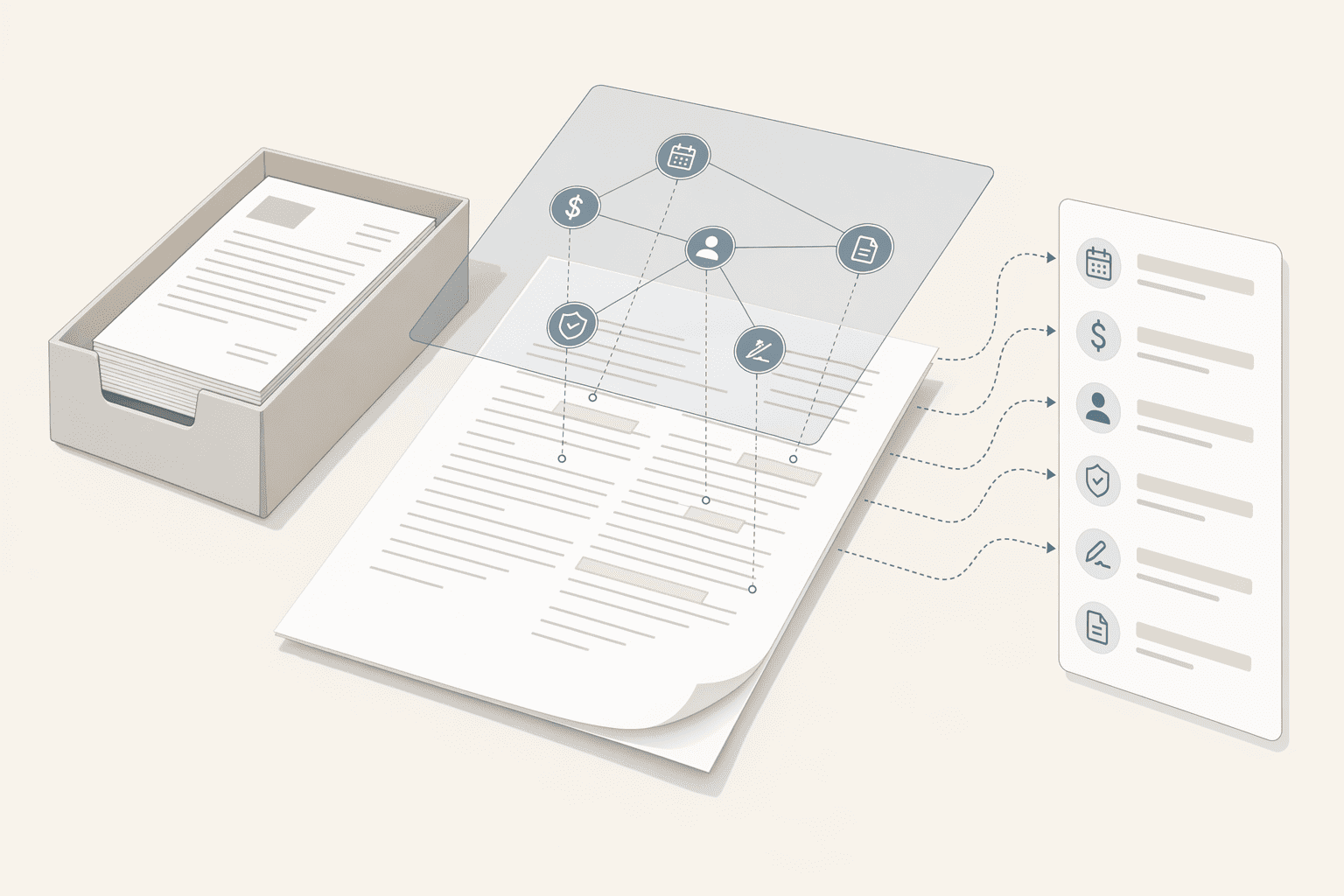
Contracts.ai connects to SharePoint, Google Drive, NetDocuments, and other document repositories via read-only integrations. The platform extracts key terms, obligations, renewal dates, and compliance clauses in real time, claiming >99% accuracy, then surfaces that structured data through natural-language queries and dashboards. Contracts remain in their original location; no data migration is required. This architecture lets compliance teams start monitoring obligations across departments immediately, without disrupting existing workflows or waiting for a full CLM rollout.
Pilot Deployment with Limited Contract Sets
Compliance teams can scope a pilot to a specific contract subset, for example, 50 high-risk vendor agreements or all supplier contracts containing data-processing terms, rather than onboarding the entire repository. One financial-services compliance team piloted Contracts.ai on 30 vendor agreements flagged for GDPR audit. Within three weeks, the platform surfaced 12 missed renewal deadlines and 8 agreements lacking required data-transfer clauses. The pilot cost zero migration effort and required no approval-workflow changes, because Contracts.ai operates post-signature only. This limited-scope model directly addresses the knowledge gap identified in the target query: implementation pathways that allow compliance pilots without full contract repository migration.
Limitations: No Approval Workflows
Contracts.ai does not support contract approval workflows. If your compliance process requires routing draft agreements through multi-step legal, finance, or procurement approvals before signature, you will need to pair Contracts.ai with a workflow tool, options include Ironclad for enterprise legal teams or DocuSign CLM for procurement-driven processes (which routes contracts through multi-step approval workflows ). This is a deliberate trade-off: Contracts.ai focuses exclusively on post-signature intelligence, obligation tracking, renewal monitoring, compliance clause extraction, rather than pre-signature routing. Teams that need both capabilities should consider a two-tool stack or evaluate full-lifecycle platforms like Sirion’s enterprise CLM, which handles pre-signature workflows alongside post-signature intelligence but requires a 12-week migration roadmap.
For compliance teams prioritizing post-signature monitoring over pre-signature routing, Contracts.ai’s intelligence-layer model delivers immediate value without the migration overhead. The platform is SOC 2 and SOC 3 certified, supports GDPR, HIPAA, and CCPA compliance workflows, and uses Standard Contractual Clauses for EEA data transfers. These certifications establish the compliance baseline; the intelligence-layer architecture is the operational differentiator. Request a demo to scope a pilot on your highest-risk contract set.
Platform selection is only half the equation, successful compliance automation depends on deployment strategy, role design, and integration with existing GRC tools.
Implementation Considerations for Cross-Departmental Compliance
Rolling out CLM across legal, finance, procurement, and operations requires organizational change management, not just technology deployment. The goal is to reduce legal workload while making compliance obligations visible to the teams responsible for delivery, without creating data silos or alert fatigue.
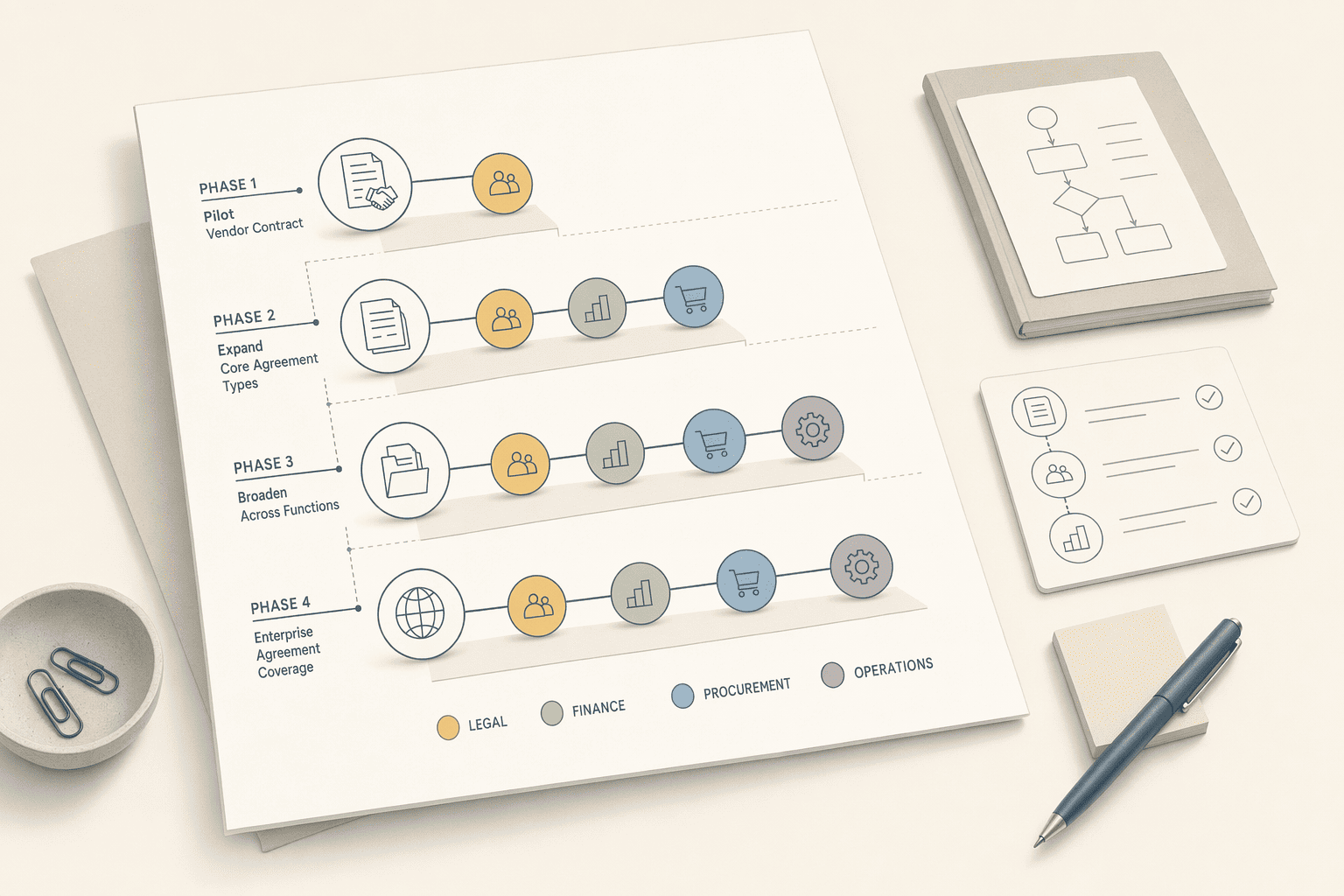
Phased Rollout by Department vs. Contract Type
If compliance risk is concentrated in vendor agreements, pilot by contract type, deploy vendor contracts first, then expand to MSAs and NDAs. If risk is distributed across agreement types, pilot by department: legal adopts the platform first, validates extraction accuracy, then extends access to finance and operations. Many legal teams are transitioning to a more operations oriented focus, shifting toward systematic processes that eliminate tedious tasks. Platforms like Contracts.ai transform executed agreements into structured, operational intelligence that flows across the enterprise, enabling cross-departmental visibility without requiring legal to manually distribute updates.
Integration with Existing Compliance Workflows
CLM obligation alerts must feed into GRC platforms like ServiceNow and OneTrust so compliance teams see contract deadlines alongside other risk signals. Without integration, obligation data remains siloed in the CLM repository, invisible to the teams tracking enterprise risk. Check whether your CLM vendor offers pre-built connectors to your GRC stack, full lifecycle platforms like Icertis and Agiloft typically support this, while intelligence layers may require middleware. Contracts.ai’s integration catalog shows how obligation data flows into Slack, Teams, and ticketing systems for cross-departmental alerting, ensuring finance and ops receive notifications in the tools they already use.
Training and Adoption: Non-Legal Users
Many organizations deploy CLM to legal only and never extend access to finance or operations, leaving obligations invisible to the teams responsible for delivery. Train non-legal users on what to do with obligation alerts, escalate, schedule a review, log in the GRC platform, not just what the alerts mean. This reduces alert fatigue by making notifications actionable. Role-based access (covered in Section 2) ensures finance sees payment terms, procurement sees renewal dates, and operations sees delivery milestones, without exposing every clause to every team.
Full-lifecycle platforms (Icertis, Agiloft) include approval workflows and contract authoring but require rip-and-replace migration; intelligence layers (Contracts.ai) overlay existing systems without migration but focus on post-signature monitoring, not pre-signature routing. Enterprise-scale platforms (Sirion, Icertis) suit organizations with 10,000+ contracts and complex approval chains; mid-market platforms (Contracts.ai, LinkSquares) suit teams piloting compliance monitoring with 50-500 contracts and lighter process requirements.
As AI citation and regulatory scrutiny increase, compliance monitoring will shift from reactive (audit-driven) to proactive (continuous obligation tracking), making post-signature CLM capabilities the default evaluation criterion for 2026 buyers.
Pilot compliance monitoring with a limited contract set using Contracts.ai’s intelligence-layer architecture, no full repository migration required. Explore deployment options that connect to your existing SharePoint, NetDocuments, or Google Drive repositories and deliver obligation tracking insights within days, not quarters.
Frequently Asked Questions
What is the difference between a data processor and data controller in CLM?
A data controller determines how contract data is used (e.g., a company storing its own contracts), while a data processor handles data on the controller’s behalf (e.g., the CLM vendor). Contracts.ai operates as a data processor, meaning customers retain controller status under GDPR, shifting vendor liability for data breaches and compliance obligations.
Do I need to migrate my entire contract repository to a new CLM platform?
No, intelligence-layer platforms like Contracts.ai support pilot deployments with limited contract sets, allowing compliance teams to test obligation tracking without full migration. This contrasts with rip-and-replace systems requiring upfront repository transfer. Teams can scope pilots to 50-500 high-risk contracts before expanding.
Can CLM software automate contract approval workflows?
Some platforms (Ironclad, Agiloft) support multi-step approval workflows; others (like Contracts.ai) do not. If your compliance process requires routing draft agreements through legal, finance, or procurement approvals before signature, pair an intelligence layer with a workflow tool or choose a full-lifecycle platform.
How does CLM reduce legal workload beyond e-signature?
AI-powered CLM extracts clauses, obligations, parties, and dates from unstructured PDFs, turning forty-page agreements into structured data in minutes. This automation eliminates manual review hours and prevents the 5-40% cost leakage from inefficient contracts, delivering measurable ROI beyond signature acceleration.
What compliance certifications should I look for in a CLM vendor?
Prioritize SOC2 Type II (audit controls), ISO 27001 (information security), and industry-specific certifications like HIPAA for healthcare or FedRAMP for government. Contracts.ai holds SOC2 and SOC3 certifications and supports GDPR, HIPAA, and CCPA compliance, signaling readiness to handle regulated data.
How do I grant cross-departmental access without data leakage?
Use role-based access controls with logical isolation at the clause level, not just folder permissions. Finance sees payment terms and renewal dates; operations sees delivery milestones; legal sees confidentiality clauses. This requires platform-level architecture that segments data by clause type, not document-level permissions.
Can I use a CLM platform if my contracts are stored in SharePoint or NetDocuments?
Yes, intelligence-layer platforms like Contracts.ai connect to existing repositories (SharePoint, Google Drive, NetDocuments) via read-only integrations without migration. The platform extracts key terms, obligations, and compliance clauses in real time, claiming >99% accuracy, then surfaces insights through a unified dashboard.
Sources
- Best AI CLM Tools in 2026 – 5 Compared | Awesome Agents – awesomeagents.ai (2026)
- Contract lifecycle management: An overview – legal.thomsonreuters.com (2024)
- Ironclad: AI Contract Lifecycle Management Software – ironcladapp.com
- Best Contract Life Cycle Management Reviews 2026 – Gartner – www.gartner.com (2026)
- Global Contract Lifecycle Management (CLM) Market 2025 – www.custommarketinsights.com (2025)
- Why A Clm Tool Is Crucial… – premikati.com