







Introduction
A procurement VP at a Fortune 500 company discovered her team was paying for 1,200 software licenses no one had used in over a year. Phantom subscriptions like this are so common they have become a line item in most large enterprises. Unchecked, maverick spending adds roughly 20% to total purchasing costs through inflated unit prices, duplicate payments, and auto-renewals that lock in unfavorable rates.
These leaks hide in plain sight. A supplier quietly raises unit prices above the negotiated rate card. Accounts payable cuts a second check for an invoice that was already paid.
A contract auto-renews at a 7% premium because no one caught the 90-day notification window. These are not sophisticated fraud schemes. They are the predictable consequence of contract data locked inside static PDFs that never get compared to the actual money leaving your bank account.
The shift from periodic manual audits to AI-powered continuous monitoring changes the math entirely. Instead of sampling a handful of invoices once a year, a post-signature intelligence layer cross-references every transaction against the contract terms that govern it. Inefficiencies plague 76% of contracting teams, a statistic that makes the case for automation on its own. The tools ranked here each attack a different layer of the problem: clause-level intake controls and real-time payment reconciliation.
Key Takeaways
The eight tools profiled below span the full contract lifecycle, from pre-signature playbook enforcement to post-signature invoice reconciliation. Here are the core insights that emerged from the analysis:
- Financial return is measurable: Enterprises using automated obligation monitoring report a 6, 12% average reduction in value leakage, translating directly to recovered dollars that manual audits miss.
- Post-signature monitoring closes the biggest gap: Most organizations audit contracts before signing but lack a systematic way to verify that suppliers actually bill according to those terms once the ink dries.
- Clause-level prevention stops leakage at the source: Blocking non-compliant redlines during negotiation through playbook enforcement prevents unauthorized commitments from ever entering the system.
- A repository alone is not enough: Centralizing contracts is foundational, but without automated reconciliation of POs and invoices against extracted obligations, a repository does not catch ongoing overspend.
- Security due diligence is non-negotiable: Any tool that touches your vendor spend data must stand up to a clear verification checklist covering encryption, access controls, and SOC certification before procurement signs off.
1. Contracts.ai, The post-signature intelligence layer that overlays your current ERP, catching unauthorized spend without a rip-and-replace migration
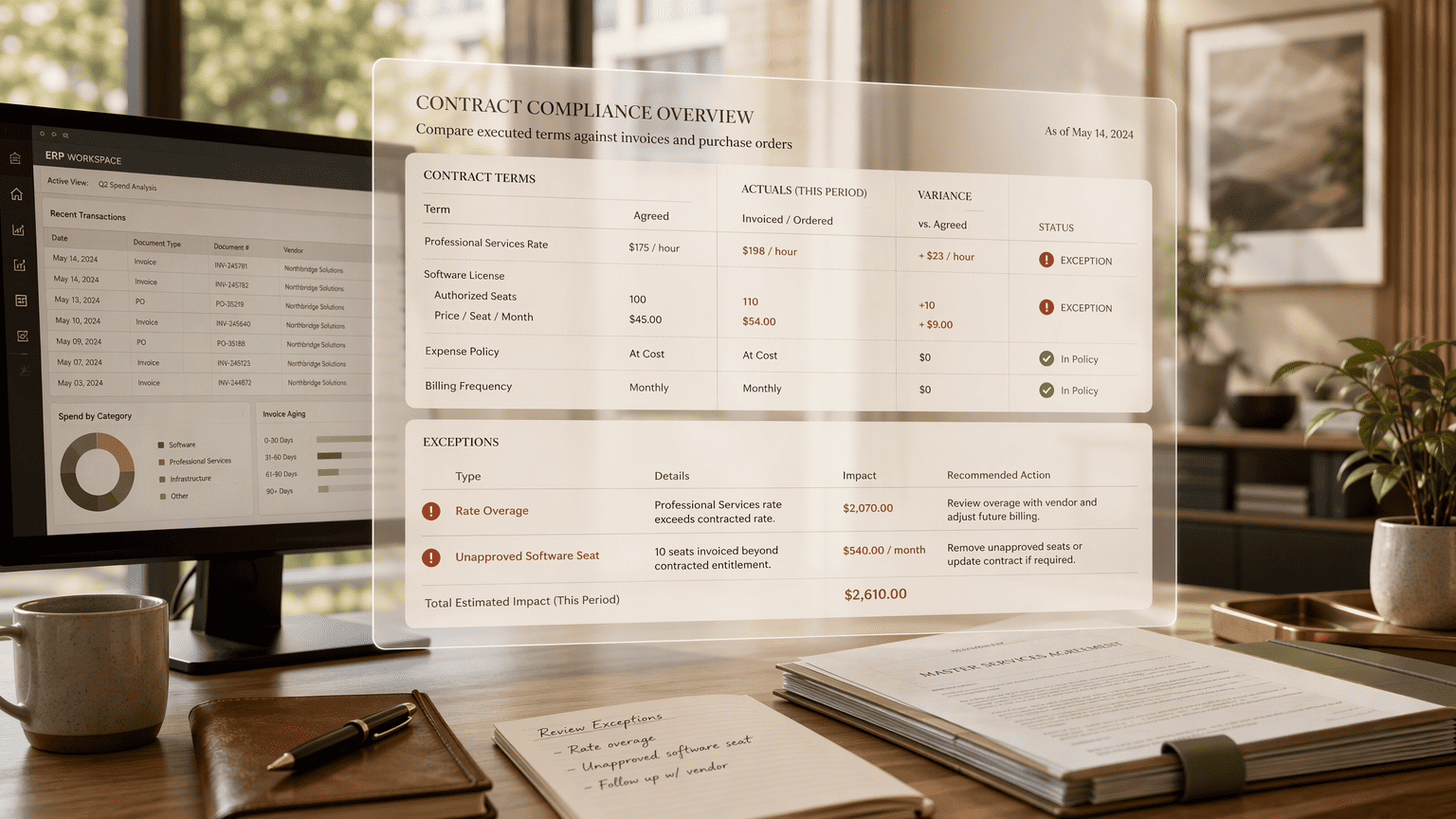
Contracts.ai reads your executed agreements in minutes and cross-references the extracted terms against the invoices and POs already moving through your ERP. When a supplier bills above the contracted rate or a payment lands for software seats nobody provisioned, the platform flags it immediately.
It works on top of your current stack. Connect it to the procurement and finance systems you already use. Contracts.ai pulls structured data from legacy and live contracts without a migration project or a repository overhaul. A limited pilot is straightforward because you never need to move your full contract corpus to get started.
The platform was founded in 2025 by Jenn McCarron and Phani Gunturu. Their team has structured millions of contract data points inside highly regulated environments, and the product reflects that origin: it treats executed agreements as operational infrastructure, not static files. Post-signature intelligence solves the problem where the ERP runs fine but the obligations inside it stay invisible to the payment layer. Contracts.ai fills that gap directly.
2. Sirion, Real-time obligation extraction and variance alerts that reduce value leakage by 6 to 12%
Sirion’s core mechanism is extracting obligations from contract language and mapping them to a live dashboard that sends automated variance alerts when invoices or POs deviate from negotiated terms. The platform manages over seven million contracts with an aggregate value approaching US$800bn, a scale that gives its obligation-extraction models a significant training advantage. When a supplier’s invoice crosses a threshold that contradicts contracted pricing, a flag fires without a human needing to run the comparison.
Enterprises using Sirion report a 6 to 12% average reduction in value leakage by aligning actual spending and performance to negotiated terms. That range, while self-reported, reflects the delta between what was agreed to and what gets paid when monitoring is periodic rather than continuous.
The platform also claims up to 50% acceleration in end-to-end cycle times and 80 to 90% faster specialist tasks through AI agents. For large procurement teams where enterprise contracts commonly take 24 to 30 weeks to complete and involve more than 80 friction points, that speed translates to contracts getting into compliance monitoring faster instead of stalling in negotiation queues where spending runs unchecked.
3. Icertis, Clause-level risk detection and playbook enforcement that blocks non-compliant redlines at the intake stage
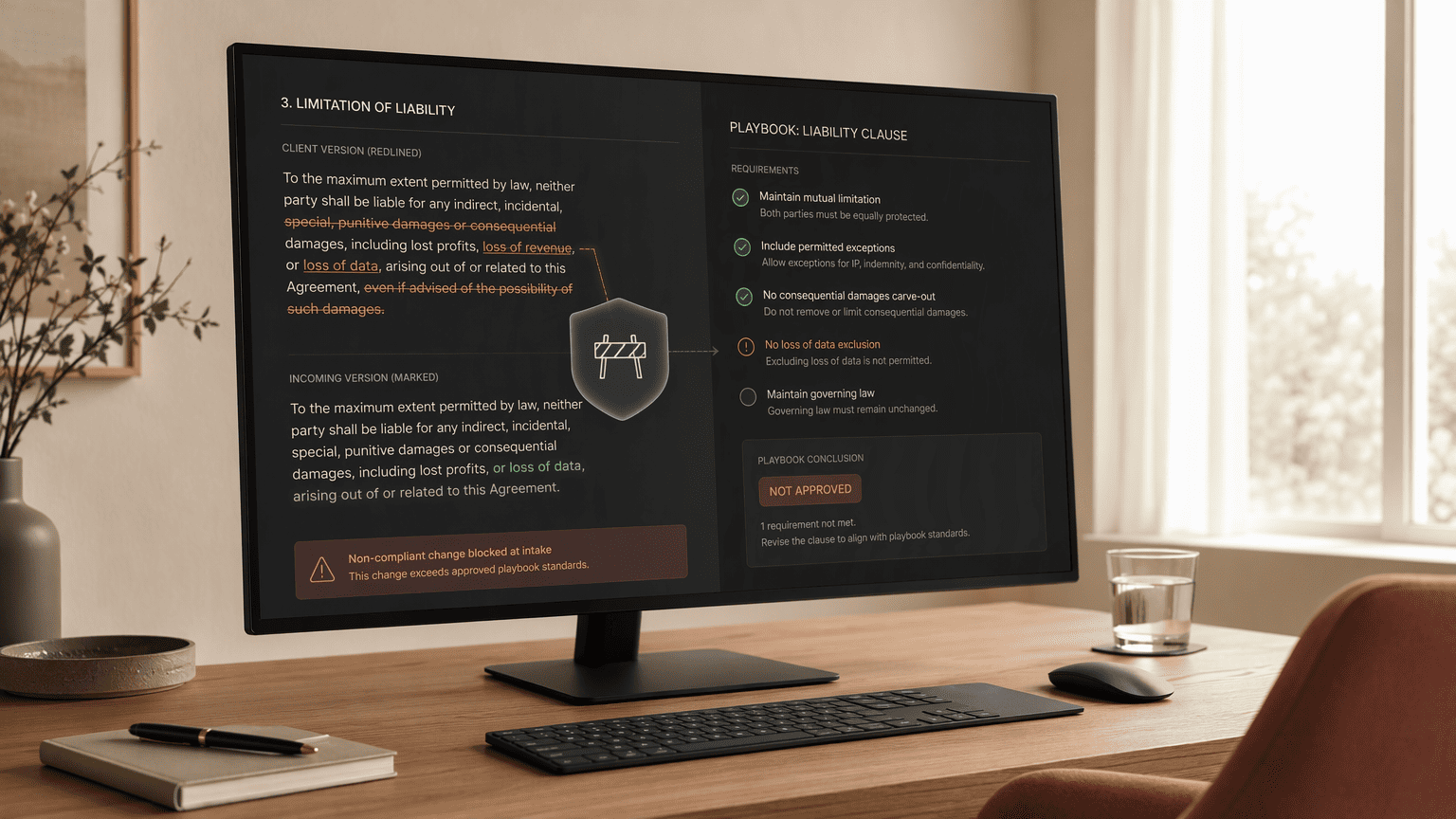
A counterparty changes one sentence in a liability clause, and that small edit shifts millions in exposure. Icertis catches the deviation the moment the redlines come back. It compares the submitted language against your playbook for indemnity, liability caps, and pricing terms, then flags any gap. A junior reviewer cannot skim past it because the system blocks the variance until someone with authority resolves it. The contract never gets signed with terms that create unauthorized financial exposure.
Playbook enforcement at intake moves detection from post-signature audit to pre-signature drafting. You stop the non-compliant commitment before it becomes a line item that downstream tools have to chase.
4. Evisort, AI-driven metadata extraction and automated approval gating for role-based signatory controls

Evisort pulls key fields out of contracts automatically so your contract management system populates without anyone typing in data. It then pairs that extraction with automated approval gating, nothing moves forward unless the signer holds the right delegated authority for the dollar amount and commitment level involved.
That second layer is the one that stops trouble before it starts. A department manager who tries to execute a three-year software deal beyond their approval limit hits a wall. Without it, that contract becomes maverick spend the moment ink hits paper.
When metadata extraction and approval gating run together, contract intake turns into a structured, auditable sequence. You get a record of who approved what and whether they had the authority. That record is the control that keeps unauthorized commitments out of the payable stream entirely.
5. Agiloft, Rules-based contract compliance monitoring with granular audit trails and custom workflow automation
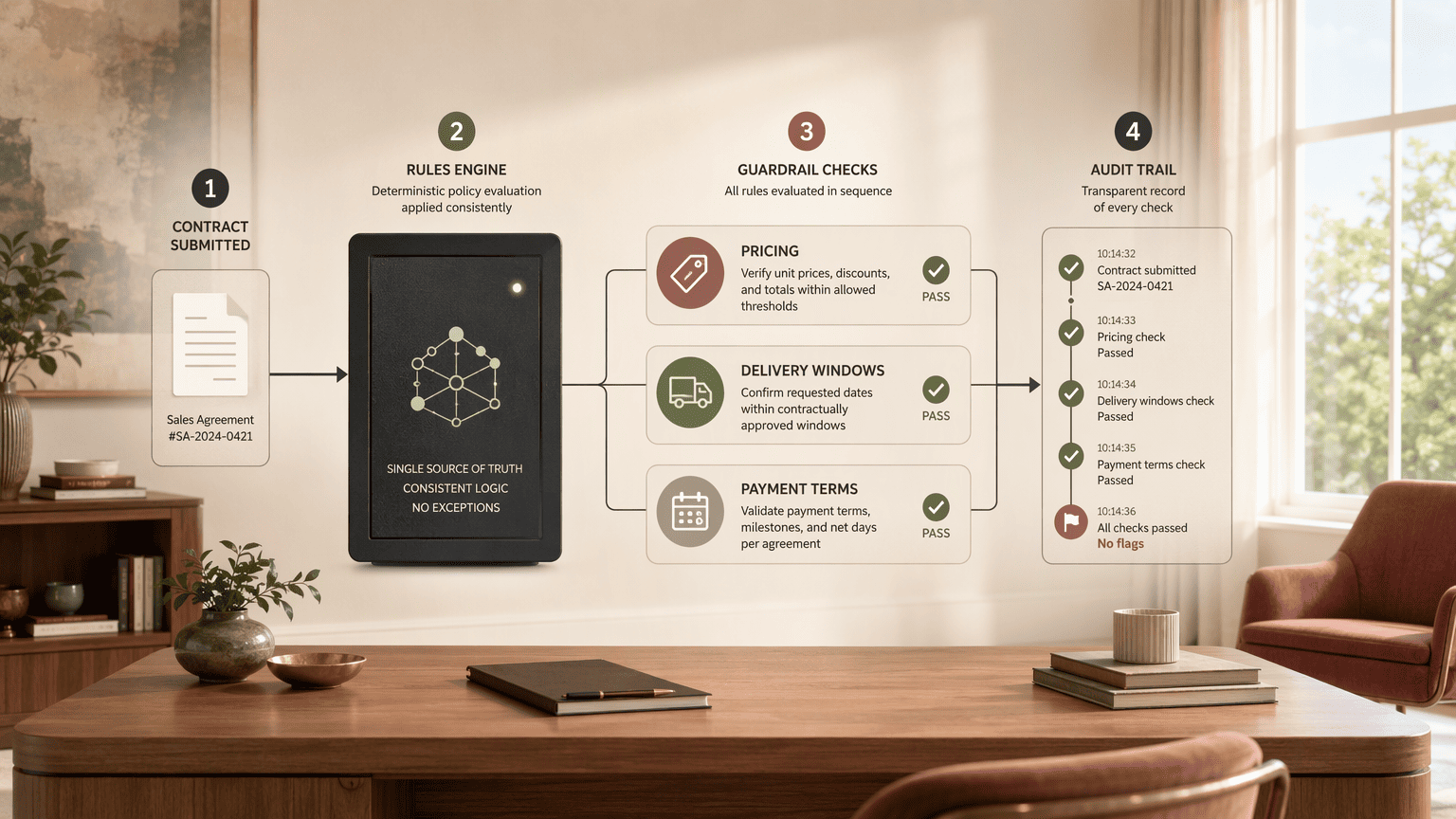
Agiloft runs on a deterministic rules engine, so compliance checks execute the same way every single time. That predictability is the whole point for procurement teams who answer to regulators or internal audit committees. Several key capabilities are built around this approach:
- Set your own guardrails: Define hard thresholds for pricing, delivery windows, and payment terms, and the system flags any contract that steps outside them before it ever gets signed. No probability scores, no model drift. Just explicit rules that either pass or fail.
- Maintain a tamper-evident audit trail: Every modification, approval, and deviation is captured in a record that can’t be altered after the fact. When a compliance officer needs to reconstruct who changed a clause and why, the full sequence is already there.
- Automate post-detection workflows: Custom workflows let you halt an invoice payment, loop in the legal team, or block a renewal until someone with the right authority clears the flag. Escalations route to specific roles instead of landing in a shared queue, so the person reviewing a pricing exception is someone who actually owns that decision.
6. DocuSign Insight, Explainable AI risk scoring that surfaces deviation rationale for legal and procurement teams
DocuSign Insight assigns a risk score to every contract deviation and tells you why that score exists. That transparency helps different teams take immediate, informed action:
- Procurement managers get surfaced deviation rationale. The tool spots exactly what shifted from the standard template and links it to a material concern, like uncapped liability or a modified payment schedule. That means you don’t have to keep a master copy open on a second screen to understand what you’re looking at.
- Legal teams spend less time on triage because the system pre-screens for clause types that carry real financial exposure. Reviewers skip the safe edits and go straight to the provisions that can cost the company money, which compresses the review cycle considerably.
- Auditors get a complete decision log. Every risk flag and the decision tied to it is logged automatically. You end up with a trail that shows who reviewed a deviation, what the supporting rationale was, and why the team ultimately accepted or rejected the term. That record holds up when audit or compliance asks follow-up questions months later.
7. Conga Contracts, Centralized repository with PO-invoice reconciliation and automated renewal tracking

Conga Contracts puts every agreement in one searchable place and matches billed amounts to contract terms without manual sampling. The table below lays out how its lifecycle tools compare to the way most teams handle this today:
| Feature | Conga Contracts | Manual Process |
|---|---|---|
| Contract Repository | Centralized with structured metadata search | Scattered across shared drives and email inboxes |
| PO-Invoice Reconciliation | Automated cross-reference of billed amounts to contract terms | Periodic sampling of invoices by accounts payable |
| Renewal Tracking | Automated alerts tied to notification windows | Relies on calendar reminders that are easily missed |
| Auto-Renewal Prevention | Flags unfavorable auto-renewals before they trigger | Often discovered after the renewal locks in |
Automated renewal tracking closes a common leakage point: contracts that auto-renew at bad rates because the window to review them closed before anyone acted.
8. What to verify about security, encryption, and SOC certification before the tool touches your spend data
Any tool that processes your vendor spend data inherits the risk profile of a system touching sensitive financial records. Before procurement signs off on deployment, verify what happens to data in two distinct states: where it sits and where it moves. Critical security requirements include:
- Strong encryption in transit and at rest: Get specific documentation on the algorithms used, not a checkbox. Confirm who holds the keys and how they are rotated. Contracts.ai states that contract fields are encrypted in both states, a baseline expectation for every platform you evaluate. If a vendor can’t name the cipher, move on.
- Granular role-based access controls: Can you restrict a user to viewing only supplier contracts above a certain dollar threshold, or only those tied to a specific cost center? Ask for a demo that proves it, not a slide that describes it.
For any vendor, review the SOC report period covered and confirm your service falls within its scope. A report that excludes the product you’re buying is paperweight.
- A current subprocessor list: Contracts.ai engages vetted subprocessors including Google Cloud and Vercel, list available on request. Request this from every vendor.
- A documented incident response posture: Confirmed procedures for breach detection, reporting, and remediation must exist, with a contractual obligation to notify affected customers under defined timelines.
- Data isolation: Your contract data should be logically walled off and never used to train generalized models unless you explicitly opt into that.
Conclusion
Unauthorized vendor spend exploits the gap between what contracts say and what accounting systems pay. The tools ranked here close that gap at three points: Icertis and Evisort block non-compliant commitments at the intake stage, Contracts.ai and Sirion catch pricing and payment deviations after execution through continuous reconciliation, and Agiloft wraps the whole process in auditable, deterministic compliance rules. Layering those controls and verifying the security foundation underneath them turns contract compliance from an annual audit exercise into an always-on financial safeguard.
Frequently Asked Questions
What are the most common types of unauthorized or maverick spending hidden in vendor contracts?
The most common forms of leakage can add roughly 20% to total purchasing costs:
- Inflated unit prices above negotiated rates
- Duplicate payments for the same line item
- Unapproved scope creep billed as change orders
- Phantom subscriptions for unused software licenses
- Auto-renewals that lock in unfavorable rates without review
What features should an AI-powered contract analysis tool have to detect billing discrepancies and non-compliant terms?
It should include clause-level risk detection that flags deviations from standard indemnity and pricing, automated obligation extraction into live dashboards, variance alerts that compare POs and invoices to contract terms, and playbook enforcement that blocks non-compliant redlines during negotiation.
How does automated contract review compare to manual audits for spotting financial leakage?
Manual audits sample a fraction of transactions periodically and miss systematic patterns. Automated review monitors every transaction continuously, flagging discrepancies in real time. Enterprises using automated obligation monitoring report a 6 to 12% average reduction in value leakage compared to periodic manual approaches.
What steps should a legal or procurement team take to set up ongoing contract compliance monitoring?
Centralize contract intake with mandated digital audit trails, enforce role-based approval gating so only authorized personnel can sign or modify terms, and integrate the contract tool with existing ERP and procurement systems to sync POs, invoices, and contract data for automated reconciliation.
How can post-signature contract intelligence tools prevent overspend without replacing existing ERP or CLM systems?
These tools layer a monitoring engine on top of current systems, reading contract data from the ERP and flagging discrepancies. No migration or rip-and-replace is required. You can pilot with a limited contract set and see results without disrupting existing workflows or repositories.
Sources
- Contract Platforms to Prevent Unauthorized Commitments – www.sirion.ai
- Contract Performance Management for Financial Institutions | PostSig – postsig.com






