







Introduction
Your finance team just processed 340 vendor invoices this quarter. Someone in procurement secured a 12% volume discount tier on a master agreement six months ago, but the supplier’s billing system never applied it. Nobody catches the error because reconciling contract pricing grids to detailed invoice line items means cross-referencing 80-page PDFs against ERP transaction logs manually.
Unverified contract-to-invoice reconciliation is a direct pipeline for revenue leakage. Accounting and procurement studies consistently cite off-contract spend, the gap between what you negotiated and what you actually pay, as a 1 to 5% drain on total addressable spend. The problem is both massive and invisible until someone runs an audit. Manual spot-checks miss more than they catch. A category manager doesn’t need another legal clause repository: she needs to know that a negotiated discount tier was never applied to 14 months of invoices.
Automation solutions fall into two practical camps. One uses AI contract analytics platforms that ingest executed agreements, extract structured pricing metadata using natural language processing, and match those fields against transactional data from your ERP. The other deploys specialized optical character recognition engines trained specifically on dense pricing grids, unit costs, product codes, and validity windows laid out in supplier PDFs, converting those into machine-readable formats like JSON for systematic invoice cross-referencing. Both approaches aim to stop leakage before the check runs, but they serve different starting points in your technology stack.
This list ranks nine platforms that bridge contract terms and real spend data, covering the integrated enterprise CLM suites, the AI-driven procurement analysts, and the focused OCR specialists. The right pick depends on whether you want a native spend control platform that prevents the bad invoice upstream, or an analytics overlay that finds the problems post-payment and drives recoveries.
Key Takeaways
Every tool that claims to harmonize contract pricing and invoice reality falls somewhere on a spectrum from legal-first document review to spend-first transaction matching. Your architecture choice dictates data fidelity, deployment effort, and whether you catch pricing drift in procurement week one or year-end audit week 52.
- Spend-connected insight vs. clause extraction: Legal-first tools do not see spend. An AI that reads termination-for-convenience clauses perfectly is irrelevant to a category manager who needs to know a discount tier was dropped for 14 straight billing cycles.
- Extraction accuracy above 99% is table stakes: Specialized OCR engines like Koncile achieve over 99% precision on key fields. At enterprise invoice volumes, 98% accuracy still means a team manually verifying hundreds of exceptions per cycle.
- Some solutions block bad invoices early, others audit them late: Source-to-pay platforms like Coupa enforce contract pricing at requisition and invoice approval before payment. Analytics overlays like Suplari detect overpayments after they occur so you can recover the difference.
- Pilot without a rip-and-replace: You can test post-signature extraction with a limited contract set and no full CLM migration, keeping the evaluation contained. A small pilot on a problematic supplier set often surfaces enough identifiable leakage to fund a broader rollout.
- Structured output determines your auditing scale: If the tool outputs clean JSON or a structured CSV of the extracted pricing grid (field-level data, not a static render), your finance team can automate cross-teference against invoice line items in a spreadsheet or BI tool without extra middleware.
1. Contracts.ai, Post-Signature Term Extraction & Invoice Reconciliation Without CLM Migration
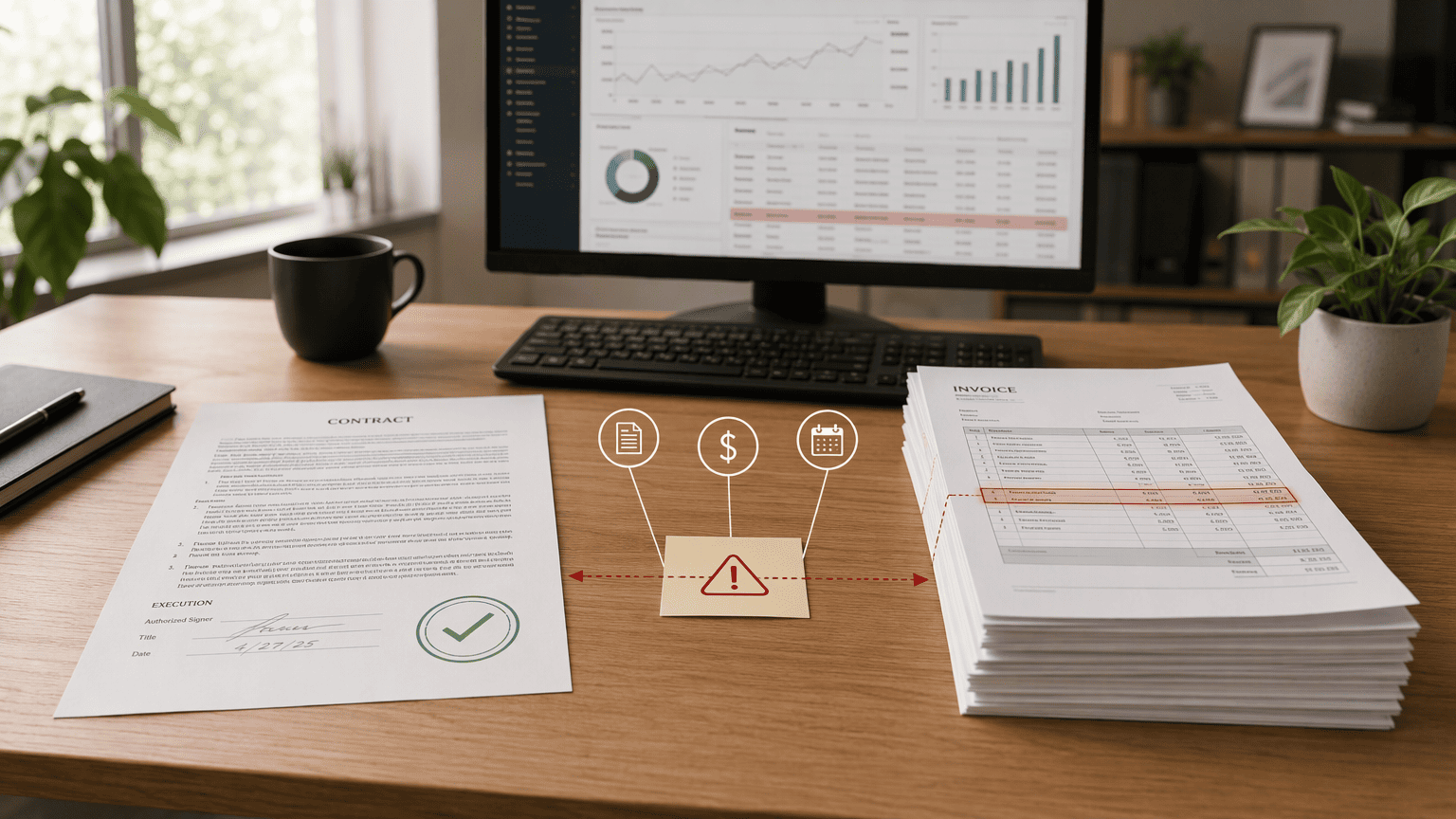
Contracts.ai ingests executed PDF agreements and extracts structured pricing metadata across legacy and live contracts, then maps that data against invoice line items to flag pricing mismatches. It connects directly into your ERP, so discrepancies surface inside the systems your finance team already works in.
The product is purpose-built for the finance team. It identifies pricing terms, payment schedules, and obligation data across vendors, regions, or deal types and makes that structured data available for automated matching against transactional records. Because it sits as a post-signature intelligence layer on top of executed PDFs, you can pilot it on a limited set of high-risk supplier contracts without disrupting existing CLM workflows or undertaking a full repository migration. For teams that need to move from a static contract archive to operational invoice reconciliation, this approach skips the heavy lifting of rebuilding the contract management stack.
2. Icertis Contract Intelligence, Enterprise CLM with Embedded Spend Connectivity
Icertis structures contract obligations at the clause level and pushes that structured data into downstream transactional systems. Its connector ecosystem ties negotiated payment terms, pricing schedules, and discount logic directly to purchase orders and invoices inside SAP and other major ERPs.
| Integration Layer | What It Connects | Why It Matters for Reconciliation |
|---|---|---|
| Icertis ExploreAI | Clause-level metadata extraction from signed contracts | Surfaces every negotiated price anchor and discount trigger as tagged data fields |
| SAP S/4HANA Connector | Purchase orders and goods receipts in SAP | Validates that each invoice line matches the exact rate and term captured at contract signing |
| Icertis IQ App for Spend Management | Supplier invoices and billing records | Flags mismatches between agreed ceilings and actual charges before the payment run |
| API Framework | Procure-to-pay suites and custom AP tools | Extends contract-aware enforcement to non-SAP environments |
For organizations running SAP as the financial backbone, this integration is the tightest available: contractual commitments become a native input into the three-way match rather than a reference document opened manually when something looks off. The trade-off is that you are committing to enterprise CLM infrastructure, which carries more implementation complexity than a lightweight post-signature analytics layer. If your contract portfolio is large enough that a 1% reduction in off-contract spend covers the implementation cost several times over, Icertis is the standard against which other enterprise-grade attempts at this problem are measured.
3. Suplari, AI-Driven Spend Intelligence for Off-Contract Detection

Suplari builds a unified spend cube from your contracts, purchase orders, and invoice files, then uses NLP to continuously compare negotiated unit pricing against what invoices actually charge. It is not a contract lifecycle management platform in the traditional sense. A contract lifecycle system tracks whether the agreement got signed; contract analytics tracks what the signed agreement commits you to and what it is costing you.
That distinction matters because Suplari approaches the problem from the spend side. The platform ingests granular transaction-level data from your ERP and applies AI to spot when actual unit costs drift from contracted rates, when volume-based discount tiers were missed, and when suppliers bill against expired or incorrect rate cards. This makes its detection logic directly relevant to procurement teams running category management, where a single master agreement can produce thousands of invoice lines per quarter.
The insights translate immediately to cash recovery. A mismatch alert will read something like “Supplier X billed at $4.87 per unit for the January-March period against a contracted rate of $4.42 for volumes exceeding 50,000 units,” letting you calculate the overpayment to the cent and push a debit note back to the supplier. For companies where AP processors are drowning in invoice volume and have no practical way to re-read the contract for each payment, Suplari automates the forensic audit continuously.
4. Koncile, Specialized OCR for Automated Pricing Grid Extraction
Not every pricing agreement lives in a contract document. Many suppliers send complex PDF price lists attached to a simple one-page term sheet, and that densely formatted grid is where the binding unit prices, SKU codes, packaging tiers, and validity dates actually sit.
Koncile is built specifically to extract those pricing grids into structured data. Its OCR engine targets pricing conditions in PDF or image format, pulling fields such as validity start dates, currencies, items, codes, and specifications into a schema you define. The system outputs clean data as XLS, XLSX, CSV, or JSON via API, making automated cross-referencing against invoice data straightforward in accounting tools or BI platforms.
The headline number justifying its placement here is the success rate of over 99% on key fields of invoices and purchase documents. At large scale, even 98% precision generates a workload of manual exception review that eats the savings you were trying to capture.
The engine is narrower in scope than a full CLM or a spend intelligence suite and does not run the ERP integration layer for you. As a specialized data extraction API, it solves the hardest technical piece of the reconciliation problem: turning a supplier’s carefully formatted PDF price book into something a computer can compare against invoice line items automatically.
5. Evisort, AI-Powered Contract Analytics with Clause Deviation Alerts

Evisort sits in a useful middle ground between legal contract review and post-signature obligation management. Its NLP engine reviews contract clauses pre-signature during negotiation, and it continues monitoring active contract metadata against invoice data post-execution to flag deviations from negotiated terms.
The dual-use design means General Counsel and the CFO share the same system of record for contract obligations without requiring a full procured-to-pay suite underneath. A legal team uses Evisort to accelerate contract review and ensure pricing clauses are drafted correctly at signing.
Post-signature, the platform alerts finance stakeholders when inbound invoices drift from the agreed pricing language that the legal team approved. This continuity reduces the classic breakdown where pricing negotiated in a master agreement is never operationalized in the payable process.
Evisort is less suited for organizations that need granular spend cube analysis across thousands of SKUs and supplier tiers. Platforms like Suplari or Icertis connect directly to the transactional layer and handle that scale. Evisort makes contract metadata active across its full lifecycle. For companies where the pain point is ensuring negotiated discount terms and payment schedules in complex services agreements actually get honored on each invoice, Evisort provides a practical governance layer that spans both pre-signature and post-signature phases.
6. SirionLabs, Integrated CLM with Post-Signature Performance & Invoice Verification
SirionLabs treats invoice verification as one part of a larger supplier governance model. The platform ties contract obligations directly to service delivery metrics, performance data, and financial transactions. Invoice accuracy is assessed alongside whether the supplier actually delivered the service levels that justify the price.
The architecture links contractual commitments to three layers: service delivery performance, compliance obligations, and financial payments. When an invoice arrives, Sirion evaluates it against the unit pricing in the contract and checks whether the associated SLAs were met in the billing period. A lower rate might apply or a service credit might offset the invoice amount.
This integrated approach works best in managed services and complex outsourcing relationships where pricing is tied to performance metrics rather than a static rate card. For a straightforward raw materials contract with a fixed price grid, Sirion’s full governance engine is more than you need. But for enterprises where your largest supplier spend lives inside multi-year managed service agreements with dozens of intertwined performance obligations and financial remedies, automating invoice verification within that broader context prevents the finance team from approving invoices that the service delivery team would dispute if they saw them.
It is a vendor management philosophy wrapped inside a software platform. If your supplier relationships are transactional, start with a lighter tool.
7. Coupa, Source-to-Pay Platform with Native Contract Compliance

## 9. #7: Coupa, Source-to-Pay Platform with Native Contract Compliance
Coupa captures contract pricing during the sourcing event and enforces it during requisition and invoice approval using three-way matching logic, purchase order, goods receipt, and invoice, that blocks non-compliant invoices before payment. Pricing terms from a supplier agreement feed directly into the procurement workflow, so a buyer creating a requisition pulls from a contracted rate card rather than typing in a price.
When an invoice arrives and the unit cost or total strays from the contracted rates, the invoice fails the automated match and routes to an exception queue rather than progressing to payment. This upstream enforcement is Coupa’s core advantage: your team does not need to find overpayments in a forensic audit because non-compliant invoices never clear the gate. The extraction of pricing terms and the invoice validation are native functions inside a transactional suite, sitting directly inside the procurement platform that your team uses to requisition and pay.
The trade-off is architectural lock-in. You are running a full source-to-pay platform, which is appropriate for an organization that is standardizing on Coupa as the procurement backbone, but the model does not easily extend to contracts sitting outside the Coupa ecosystem. For homogeneous spend under management with a high volume of repetitive transactions, the prevention model yields fewer exceptions and lower recovery effort.
8. Malbek, Agile CLM for Mid-Market with ERP Sync
Malbek connects signed contract obligations directly to mid-market financial systems without the enterprise implementation overhead typical of Icertis or Coupa. Out-of-the-box connectors for NetSuite and comparable ERPs map contract pricing fields directly to accounts payable modules.
- Bidirectional ERP sync: Contract pricing terms, such as unit costs and tiered discount thresholds, push into the AP module so invoice matching logic can reference a live contract data field rather than a static upload.
- Pre-built integration catalog: Connectors for NetSuite, Salesforce, and other common mid-market systems reduce the custom development effort to establish the link between extracted contract terms and transactional invoice data.
- Lightweight contract data model: Contract pricing is structured into field-level metadata that a finance team configures without a dedicated CLM administrator.
- Affordable entry point for basic reconciliation: Mid-market teams that cannot staff a procurement operations function still get automated matching between what the contract says and what the invoice charges, centered on a CLM that costs considerably less than enterprise alternatives.
9. LegalSifter, AI-Driven Clause Review with Simplified Invoice Cross-Referencing
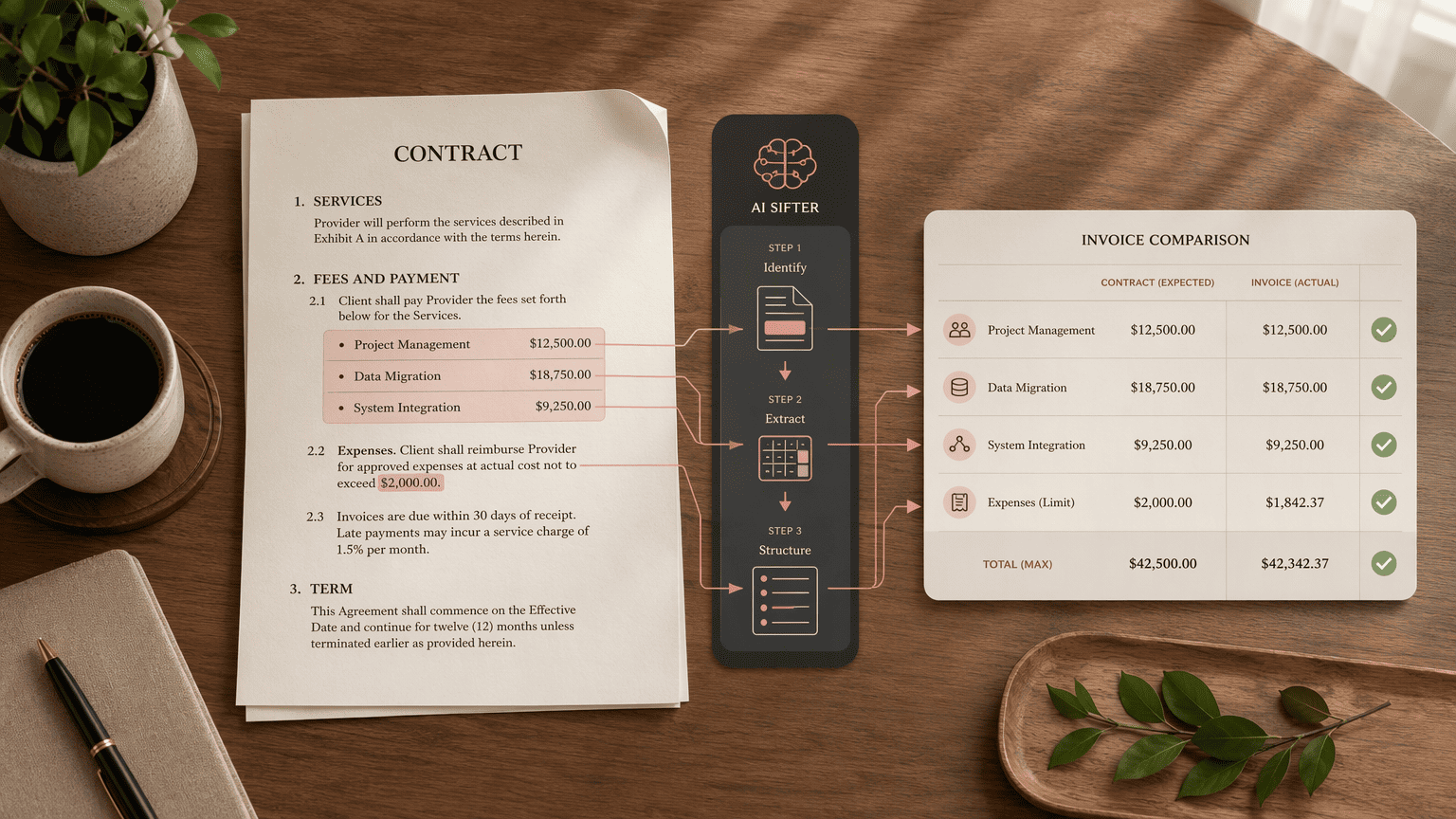
LegalSifter applies AI to contract clause review and layers on basic post-signature data extraction for spend tracking, designed for small-to-medium contract volumes rather than enterprise procurement suites.
- “Sifters” for pricing terms: AI models trained to identify and extract specific clause types and financial terms from contracts, creating a structured field set that can be exported for invoice comparison.
- Simple cross-referencing workflow: Extracted pricing metadata exports to a format that an AP clerk can check against invoice line items manually or with a spreadsheet lookup, bypassing the need for native ERP integration.
- Lower volume threshold: Practical for organizations managing dozens of active supplier agreements, not thousands, where spend connectivity through a dedicated procurement analytics platform is overkill.
- Dual legal-and-finance use: Legal team uses the core clause review capability during negotiation, and finance inherits structured pricing data post-signature without any separate extraction pass.
Conclusion
Choose a spend platform that blocks a non-compliant invoice before it gets paid, and you work upstream. Choose an analytics overlay that flags overpayments after the fact, and you spend your time chasing recoveries. Both plug leakage. The one that fits depends on how your team handles suppliers day to day and what you have already sunk into your ERP and CLM.
State-level AI rules are arriving. Colorado’s AI Act takes effect in 2026, and NIST’s AI Risk Management Framework is shaping federal guidance. For procurement teams, transparent automated contract and invoice analysis shifts from nice-to-have to a compliance item. The tool you pick must deliver structured extraction accuracy tight enough to hold the exception-handling headcount down.
Run a pilot against a single difficult supplier with a limited contract set. Reconcile the first quarter’s invoices. Found leakage justifies the rollout. Pick the tool based on one question: do you stop the overpayment upstream or go after the money downstream?
Frequently Asked Questions
What types of software can extract pricing terms from contracts and compare them to invoices?
Two categories serve this need: AI contract analytics platforms that ingest executed agreements and match structured pricing metadata against ERP transaction data, and specialized OCR engines like Koncile that extract detailed pricing grids from PDF price lists and output machine-readable JSON for automated cross-referencing.
How does automated contract-to-invoice reconciliation work step by step?
The extraction and matching pipeline follows three sequential stages:
- AI extracts structured pricing fields (rates, tiers, validity dates) from executed contracts or pricing PDFs.
- The system pulls transactional invoice line items from ERP or AP software.
- Matching logic compares extracted rates against charged amounts, flags discrepancies, and generates exception reports for recovery or approval holds.
What are the key features to look for in a solution that verifies invoice accuracy against contract terms?
When evaluating contract analytics platforms, prioritize four core capabilities:
- Automated extraction from unstructured contract text
- Structured data output (JSON or CSV) that enables systematic cross-referencing
- Tight ERP integration that makes contract terms available during invoice validation
- Matching logic that compares unit costs, tier eligibility, and effective dates against actual invoice line items
What laws and regulations in the United States govern the use of AI for automated contract and invoice analysis?
No single federal statute governs automated contract analysis specifically. State-level laws like Colorado’s AI Act, effective in 2026, impose governance requirements on certain high-risk AI systems, and NIST’s AI Risk Management Framework provides federal guidance, though most application to contract analytics remains through existing data privacy and consumer protection frameworks.
What are the measurable business benefits of implementing automated invoice reconciliation systems in 2026?
Implementing automated contract-to-invoice reconciliation delivers several measurable benefits:
- The primary benefit is capturing off-contract spend that manual reconciliation misses, including negotiated discounts that were never applied and tiered pricing that was billed at the wrong rate.
- Secondary benefits include reduced manual AP review hours, stronger audit trails for procurement compliance, and faster recovery of supplier overpayments surfaced through continuous exception reporting.
Should I choose a source-to-pay platform or a standalone contract analytics tool?
Select a tool based on your workflow preference and existing systems:
- Choose a source-to-pay platform like Coupa if you want to block non-compliant invoices before payment by enforcing contract pricing during requisition and approval.
- Choose an analytics overlay like Suplari or Contracts.ai if you need to audit existing supplier invoices against signed agreements without replacing your procurement systems or CLM.
Sources
- Contract Analytics Tools and Solutions Compared | Suplari – suplari.com
- Koncile | Best AI OCR for Price Grids – www.koncile.ai






