






Introduction
The US government alone loses an estimated $203 billion a year to improper vendor payments. That number hangs over every AP and procurement leader trying to close a widening gap between what was promised in a contract and what actually shows up on an invoice. For years, the tools to catch these leaks simply didn’t exist at scale.
Now you can actually find software that promises to bridge this gap, but it’s not as simple as flipping a switch. The technology is at a genuine inflection point. AI data extraction from any invoice format now works with surprising precision. Using AI to perform the legal reasoning required to judge contract compliance is still fragile, because the underlying benchmarks show that today’s models hit about 79% accuracy on discrepancy detection when the clauses are structured cleanly; on messier real-world language, that number drops fast.
This article walks through what the tools can actually do today, what they cannot yet do reliably, and exactly where you should apply human judgment alongside the algorithms.
Key Takeaways
Automated invoice-to-contract auditing tools now exist, but their real-world reliability depends on how you deploy them. Here’s what you need to know before evaluating any option:
- Extraction is mature: AI can parse almost any invoice format (scanned, faxed, smartphone photo) into structured data with field-level confidence scores and automated arithmetic checks.
- Reasoning is fragile: Large language models often miss subtle errors and struggle to justify them legally, meaning you cannot outsource audit judgment entirely to generative AI.
- Feature checklist matters: Genuine audit tools must offer automated cross-referencing, configurable tolerance thresholds, anomaly categorization, and ERP integration. Simple OCR is not audit software.
- Pricing is opaque: Most vendors don’t publish pricing, favoring subscription-plus-volume models. Free trials, such as a 30-day no-credit-card option, let you test extraction accuracy before committing.
At a Glance

Here is how the options compare across the dimensions that matter most.
| Tool / Category | Invoice Extraction Accuracy | Contract Reasoning Capability | Best Use Case | Price Model |
|---|---|---|---|---|
| Dedicated audit platforms (e.g., AppZen, MindBridge) | >95% on clean PDFs; ~85% on scanned/faxed | Configurable rules engine; 70 to 80% discrepancy detection on structured contracts | High-volume, repetitive invoice matching with hybrid review | Subscription plus per-invoice volume fee |
| ERP-native modules (e.g., SAP Invoice Management, Oracle Payables) | >90% on supported invoice formats | Limited to simple rate caps and arithmetic; no semantic clause parsing | Companies already heavily invested in that ERP ecosystem | Bundled with ERP license, plus per-transaction add-on |
| General-purpose AI parsers (e.g., InvoiceXML, Rossum) | >95% on almost any format; field-level confidence scores | No built-in contract reasoning; requires external rules engine | Businesses focused on extraction accuracy first, building custom audit logic later | Free trial (30 days, no credit card); then pay-per-API-call or monthly tier |
| Large language model wrappers (e.g., custom GPT, Claude API) | 85 to 90% on clean invoices; lower on noisy scans | ~79% discrepancy detection on clean clauses; much lower on messy real-world language | Prototyping and low-volume audits where false positives are acceptable | Pay-per-token; no predictable volume pricing |
| OCR-only tools (e.g., ABBYY, Tesseract) | 70 to 80% on clean documents; frequent errors on poor-quality scans | None; output is raw text, not structured audit fields | Simple digitization, not compliance auditing | Usually one-time license or per-page fee |
The Core Mechanism: How AI Cross-References Invoices Against Contracts
The engine behind automated invoice auditing runs through a precise sequence. First, no matter what you throw at it (a crisp PDF, a wrinkled thermal receipt, a faxed purchase order), the system digitizes and parses the document. Tools like InvoiceXML extract every field and validate them against the EN 16931 invoice data model, confirming all required fields are present, correctly typed, and within acceptable value ranges.
The parser then verifies the arithmetic: unit price × quantity = line total, and sum of lines + tax = invoice total. This calculation check alone catches a substantial slice of vendor errors without ever consulting the contract. Where things get harder is the contract side.
The semantic parsing of a legal agreement to extract precise payment terms, rate caps, and line-item rules requires a different engine. In a properly designed audit tool, that parsed contract becomes a ruleset against which the structured invoice data is cross-referenced. The tool flags a line when a billed rate exceeds an agreed cap, when a charge appears with no matching contract term, or when a calculated percentage exceeds a contractually defined share of a subtotal.
Step-by-Step Technical Walkthrough: Bridging AI Invoice Parsing to Contract Compliance

Before you begin, gather your prerequisites:
- A representative sample of at least 50 invoices spanning multiple vendors and formats
- The corresponding executed contracts or rate cards in searchable text
- A defined list of the five to ten most common discrepancy types your team already sees
This preparation lets you evaluate any tool on your actual data, with all the smudged thermal receipts and badly angled phone photos that break a parser in the real world.
With those assets in hand, your setup work is the same across platforms. You ingest invoices through the tool’s API or upload interface, deliberately including the worst formats you receive: smartphone snapshots of crumpled paper invoices and faded thermal-printed receipts. During initial setup, you tune extraction parameters and set confidence score thresholds. Once invoices flow, the engine maps extracted line items against structured contract clauses. Discrepancies are categorized into defined anomaly types (rate mismatch, cap exceeded, unexpected fee), and each flagged line carries the expected amount, the variance, and the confidence behind the extraction.
Do not automate closure on the first pass. Keep a human reviewer in the loop for every flagged exception during at least one full payables cycle. This validates both the tool’s precision and your pre-set thresholds before you even consider any straight-through processing.
Key Features to Demand in Vendor Invoice Auditing Software
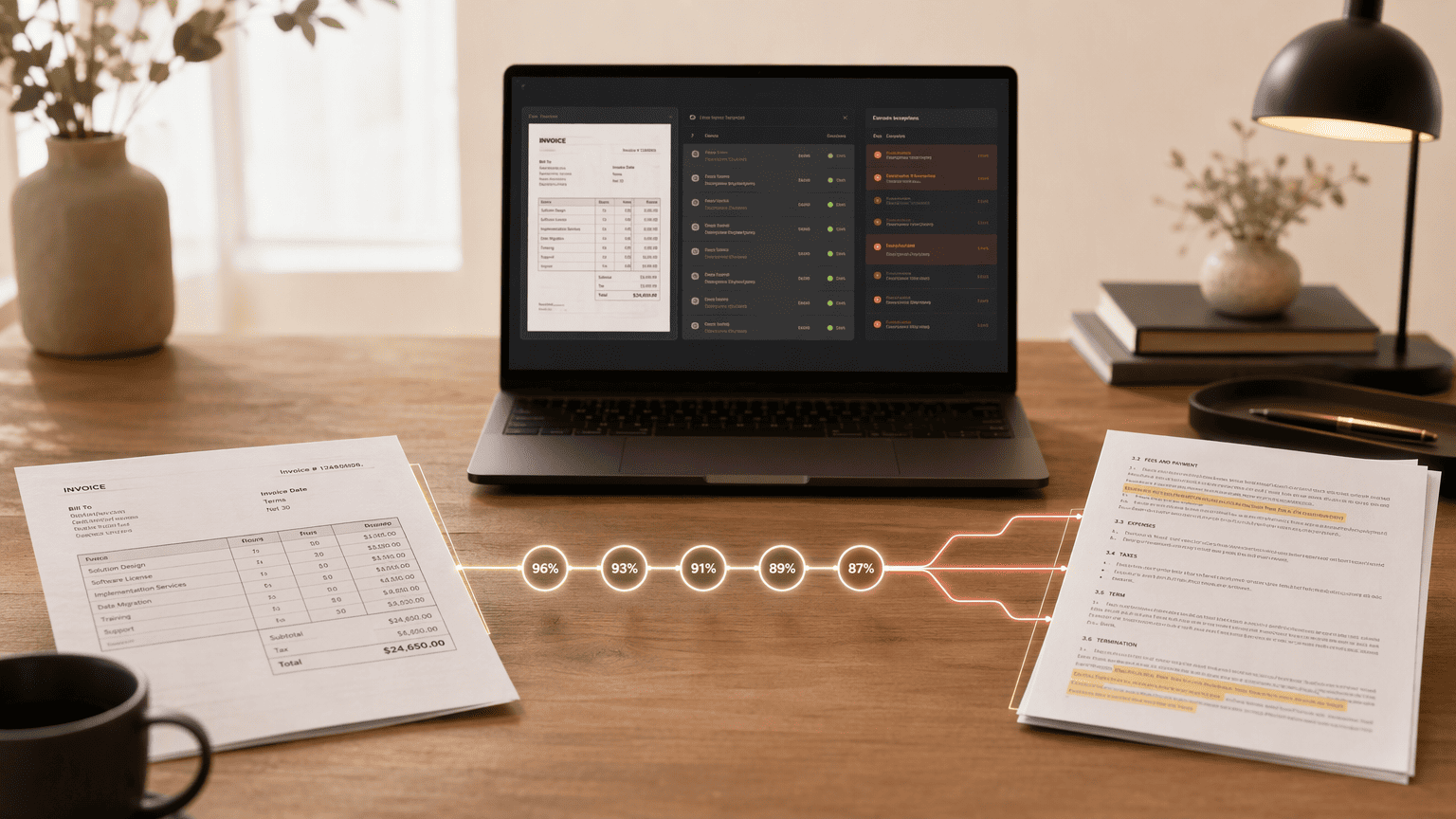
You cannot evaluate these tools by skimming the marketing copy. A genuine audit engine cross-references extracted invoice data against a parsed contract or rate card. Anything that stops at data extraction is just an OCR tool.
Demand field-level confidence scoring. Each extracted element (seller, buyer, tax calculation, and individual line items) should carry a score from 0.0 to 1.0, and the platform must let you set different routing rules by confidence threshold. A tool without configurable tolerances will drown your AP team in false positives or, worse, let genuine discrepancies pass silently.
The arithmetic layer matters. The engine must automatically verify that unit price multiplied by quantity equals the line total and that the sum of all lines plus tax matches the invoice total. Beyond raw extraction, look for categorized anomaly flagging: the system should label discrepancies by type, covering rate mismatches and percentage-cap breaches. Finally, confirm that the tool can integrate with your ERP or AP system so flagged exceptions feed into the workflows your team already uses, rather than creating a separate data silo.
The Fragile State of AI Legal Reasoning: Why LLMs Miss Subtle Contract Anomalies
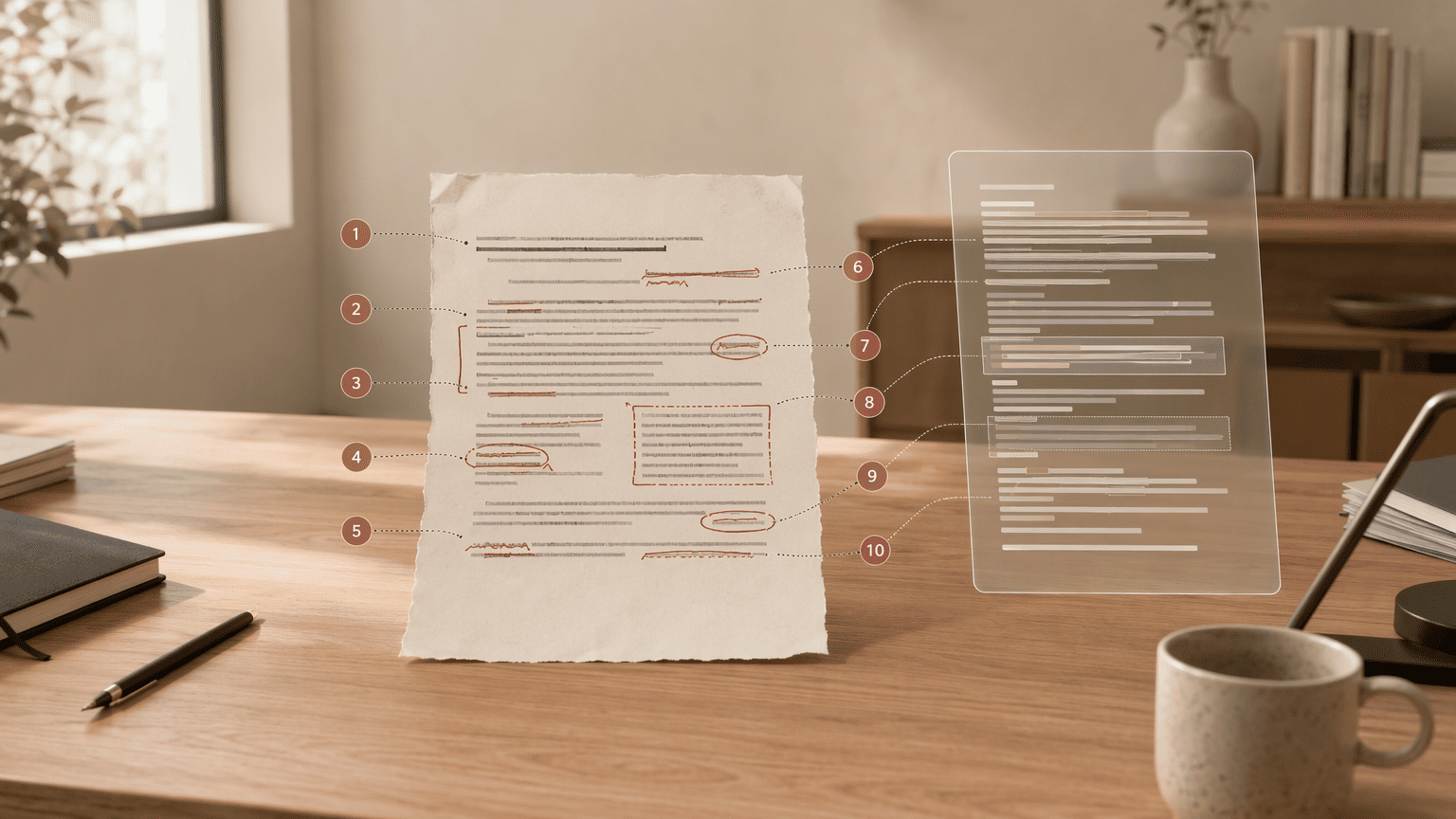
Data extraction has matured far faster than legal reasoning. Fresh 2026 research makes this asymmetry uncomfortably clear. The CLAUSE benchmark, positioned as a first-of-its-kind evaluation of LLM legal reasoning fragility, deliberately produced over 7,500 real-world perturbed contracts and generated 10 distinct anomaly categories, each validated against official statutes using a retrieval-augmented generation system. The results should sober anyone planning to hand audit judgment entirely to generative AI:
- Subtlety breaks the models: Even leading LLMs often miss subtle errors, the exact kind that a trained contract specialist would catch on a careful read.
- Justification is the harder problem: The same models struggle even more when asked to provide legally sound justifications for the discrepancies they do manage to flag.
- Anomaly diversity matters: With 10 distinct categories spanning semantic contradictions, numerical mismatches, and definitional ambiguities, no single reasoning strategy proved strong across all anomaly types.
The practical implication is straightforward. Use LLMs to propose flags and accelerate review, but never let them serve as the final arbiter of a contract compliance dispute. Your audit trail must preserve the human judgment call on every material discrepancy.
Targeting Government Improper Payments: The Centorum & Contracts.ai Approach
If any environment demands invoice auditing precision, it’s government procurement. The $203 billion annual improper payments figure isn’t just a talking point. It represents concrete financial damage that contract compliance verification is specifically designed to reduce.
Under federal acquisition rules, the contracting officer carries a non-negotiable duty: review every invoice before payment to determine whether the items and amounts claimed are consistent with the contract terms. When a contractor fails to deduct questionable amounts, the contracting officer is responsible for making the required deduction. Upon receiving an audit report, the officer must determine the allowability of all costs covered by audit while exercising independent business judgment before acting on any audit finding.
These aren’t aspirational guidelines. They are legal obligations layered on top of an already overstretched review workforce. Automation that can pre-flag discrepancies, surface confidence-weighted exceptions, and preserve a clean audit trail directly supports this mandated review function.
Platforms like Centorum have oriented their entire mission around post-award contract enforcement for government buyers. A tool like Contracts.ai takes a complementary angle, focused on converting executed agreements into structured, machine-readable data infrastructure that can feed downstream audit logic. Contracts.ai was built to extract key terms across legacy and live contracts quickly and structure them into an operational intelligence layer that avoids the static-repository trap. The product can identify terms across vendors, regions, or deal types, and you can pilot it with a limited contract set without migrating your full repository or disrupting existing workflows. That makes it a practical on-ramp for teams that need structured contract data before an invoice audit engine can function.
For government buyers, the step from structured contract data to a repeatable audit process is still where human expertise earns its keep. The contracting officer’s required independent judgment is not a gap the software fills. It’s the control that the software supports.
Compliance-Ready Infrastructure: HIPAA, SOC2, and GDPR in Spend Auditing
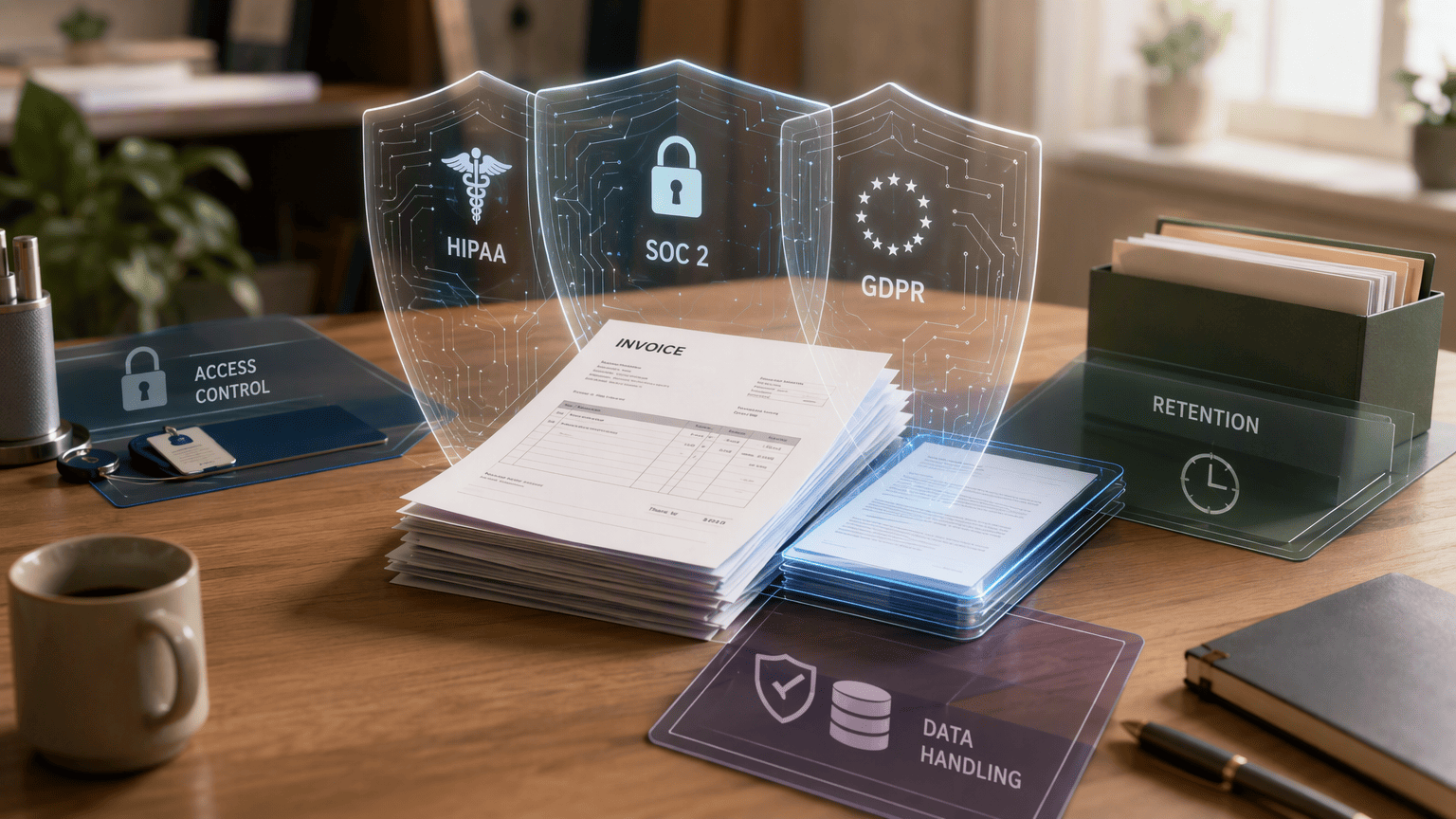
Invoice auditing involves documents that often carry more than dollar amounts. Vendor invoices routinely contain personally identifiable information, business identifiers, and in healthcare settings, protected health information. Any platform processing this data sits squarely inside your regulatory perimeter.
For organizations subject to HIPAA, the requirement is specific and non-negotiable. The platform must execute a Business Associate Agreement, handle PHI strictly according to your documented instructions, and maintain the technical and administrative safeguards that keep disclosures lawful. Contracts.ai executes BAAs with all customers processing PHI and describes its commitment to safeguarding the confidentiality, integrity, and availability of PHI in accordance with HIPAA regulations. On the broader privacy and security front, the same demands apply across regimes. Under the GDPR and as amended by the CPRA, an audit tool acts as a data processor for the customer-provided content it ingests. You need documented evidence that the vendor does not use your contract or invoice data to train generalized models unless you explicitly agree.
The infrastructure checklist should include:
- SOC 2 Type II certification as a minimum bar
- Role-based access with least privilege enforcement
- Encryption across both transit and storage
- Support for data subject rights requests (access, rectification, erasure, and portability) so that if an invoice carries a data subject’s information, you can respond to a legitimate request without technical obstruction
- Original uploaded invoices and reference documents deleted from storage immediately after extraction
- Detailed audit logging covering system activity so you can reconstruct any access event
Before you run a single test transaction, ask for a current subprocessor list and a copy of the incident response program documentation.
The Real Cost of Automated Contract Compliance Software in 2026
Pricing transparency is not this market’s strong suit. Across the available vendors, you will find very few publicly listed price points. The dominant commercial model pairs a base subscription with volume-tiered processing fees that scale with the number of invoices or contract pages consumed. Here is the real-world picture for getting started.
Conclusion
Automated vendor invoice auditing works in 2026. You can deploy tools this quarter that parse any invoice format into structured data, apply your contract rates, and flag discrepancies with a confidence score attached to every line.
What works well is the math. Tools like those from SimplAI and InvoRec extract invoice details and run arithmetic verification automatically. A line total that doesn’t match unit price times quantity gets flagged. A rate that deviates from the contracted schedule gets surfaced. These are deterministic checks, and the extraction layer now handles messy PDFs, scanned images, and inconsistent vendor formats reliably enough to trust the output above a 0.90 confidence threshold.
What lags is the legal reasoning piece. The CLAUSE benchmark tested LLMs on invoice dispute scenarios requiring genuine contract interpretation, spotting a subtle scope exclusion, catching a misapplied escalation clause, understanding when a surcharge conflicts with the MSA. Even the strongest models missed errors that a mid-level contracts analyst would flag, and they struggled to explain the discrepancies they did surface. The benchmark is blunt and recent: legal reasoning on invoices remains a hard problem.
The practical move in 2026 is a hybrid workflow. Route anything below a 0.90 extraction confidence score to a human reviewer. Let the AI surface likely discrepancies, rate mismatches, duplicate line items, calculation errors, but keep a person in the loop on anything resembling a contractual interpretation call. Use generative summaries as a first draft of a dispute email, not the final send. The core capabilities are Centorum for post-award enforcement, LineLint for vendor compliance intelligence, LedgerUp for automated invoicing, and the Enverus PriceBook for contracted rate comparisons across energy supply chains.
Watch the EACL benchmark arc. When models start justifying legal findings with the same reliability as today’s math checks, the calculus shifts from supervised flagging to autonomous resolution. That day hasn’t arrived. But the math layer is ready now, and catching a single undetected overcharge on a seven-figure services contract pays for the deployment.
Frequently Asked Questions
What automated tools exist to audit vendor invoices against contract terms in 2026?
Several tools exist with different approaches. InvoiceXML offers an AI extraction API with arithmetic verification and confidence scoring. InvoRec provides dedicated invoice audit software that flags rate mismatches, cap exceedances, and unexpected fees. Platforms like Centorum target government contract compliance, while Contracts.ai focuses on structuring contract data for downstream audit use. Simplai.ai and Phacet offer configurable validation agents.
How does AI-powered invoice-to-contract matching work, and what data is required?
The AI first digitizes and parses any invoice format into structured JSON, extracting seller, buyer, tax, and line-item fields with confidence scores from 0.0 to 1.0. Simultaneously, the contract is parsed to extract payment terms and rate caps. A cross-referencing engine then compares each invoice line against contractual obligations and flags deviations, with the expected amount, the variance, and a confidence score for each flagged line.
What are the key features to look for in vendor invoice auditing software?
Demand automated cross-referencing of extracted data against contract terms, not just OCR extraction. The tool must include field-level confidence scoring with configurable thresholds, automatic arithmetic verification (unit price times quantity equals line total), categorized anomaly flagging by type, and ERP or AP system integration. Genuine audit tools go well beyond data capture.
How much does automated contract compliance and invoice auditing software cost?
Most vendors do not publish pricing publicly. The dominant model pairs a base subscription with volume-tiered processing fees. InvoiceXML offers a free 30-day trial with no credit card required. Contracts.ai is free to sign up for, with an enhanced plan at $49 per month billed annually, plus discounted pricing for nonprofits and educational institutions. Enterprise audit platforms operate on custom subscription-plus-volume contracts.
What are the benefits and challenges of using AI to audit invoices against legal agreements?
The primary benefit is scale: AI can parse thousands of invoices across formats in minutes, flagging arithmetic errors and rate mismatches instantly. The critical challenge is legal reasoning. The CLAUSE benchmark presented at EACL 2026 demonstrated that even leading LLMs often miss subtle contractual anomalies and struggle to provide legally sound justifications for the discrepancies they do detect.
How does a tool like ContractsAI structure contract data to enable automated invoice reconciliation?
Contracts.ai converts executed agreements into structured, machine-readable data by extracting key terms across legacy and live contracts. It can identify terms across vendors, regions, or deal types and groups related agreements to align shared terms. The structured output preserves source language alongside extracted fields, creating the data infrastructure that downstream audit engines need to cross-reference invoice line items against actual contractual obligations.
Sources
- Centorum — Post-Award Contract Enforcement – centorumai.com
- Invoice Audit Software – Catch Overcharges | InvoRec – invorec.com
- Invoice & Contract Validation Agent – simplai.ai – simplai.ai
- LineLint — Vendor Compliance Intelligence – linelint.com
- Subpart 532.72 – Payments Under Contracts Subject to Audit | Acquisition.GOV – www.acquisition.gov
- Better Call CLAUSE: A Discrepancy Benchmark for Auditing LLMs Legal Reasoning Capabilities – ACL Anthology – aclanthology.org
- Invoice Parser API: Read PDF Invoices into JSON | InvoiceXML – www.invoicexml.com