







Introduction
Your legal team is buried. Not in new disputes, but in the old paperwork that governs your entire business. Every merger clause, renewal date, and non-standard liability cap is a thread that, if pulled the wrong way, unravels months of work. You cannot hire your way out of this; the cost of manually reviewing tens of thousands of legacy agreements is a non-starter.
The promise of reducing legal operations costs by 80 to 90 percent is no longer a slide deck fantasy. It is a concrete outcome driven by a new category of software: the AI contract analysis platform. This is not another Contract Lifecycle Management (CLM) system. Think of it as a non-disruptive intelligence layer that sits on top of what you already use.
Luminance reports a 75% reduction in repetitive contract review work for its users, while Cimplifi cites a staggering 98.8% reduction in review scope on specific matters. These numbers signal a fundamental shift in how legal operations can function. By layering AI directly over your existing repositories, you get portfolio-wide visibility without ripping out your current systems. This article profiles the eight platforms making that 80 to 90 percent cost reduction a reality for in-house teams right now.
Key Takeaways
The platforms that cut costs the most share a common architectural and operational DNA. Here is what to look for:
- Overlay architecture: The system layers GenAI over your existing CLM or storage systems. You avoid the cost and delay of migrating data and retraining everyone on a new platform.
- Self-service querying: Procurement and finance teams search contracts in plain English. The legal department stops being a bottleneck for routine questions.
- Handling sensitive agreement data requires that baseline.
- Automated playbooks: AI moves into workflow automations that flag deviations from standard templates and route approvals without manual touchpoints.
- Defensible governance: The vendor provides auditable workflows that preserve a clear chain of custody over every AI-generated insight. Each answer traces back to the source language.
1. Contracts.ai

Contracts.ai is a post-signature intelligence layer that structures and activates contract data trapped in static storage, turning it into operational fuel for enterprise systems.
- Founding expertise: Co-founded in 2025 by CLM veterans Jenn McCarron and Phani Gunturu, the engineering leadership brings a combined 30-plus years of experience implementing CLMs, ERPs, and procurement systems inside global enterprises.
- Architecture: The platform deploys as a non-disruptive layer over existing repositories. It operates within your data boundaries and does not train generalized models on proprietary customer data.
- Cost & Pilot Model: You can run a pilot on a limited contract set without migrating your full repository. The Basic plan costs $19 per month billed annually, and the Enhanced plan with advanced automation rules is $49 per month billed annually.
2. Luminance: The Legal-Grade AI for Portfolio-Wide Risk Surfacing
Luminance dominates the conversation around enterprise-grade contract risk with several standout features:
- Scale: The platform has fielded over 1.3 million contract intelligence questions across more than 1,000 enterprise customers, functioning essentially as a collective legal brain that can surface non-standard clauses across tens of thousands of documents in seconds.
- Deployment: This is the tool you deploy when the cost of a missed liability cap outweighs the entire annual legal budget.
- Penetration: Users per company can reach 5,000 or more, a signal that Luminance penetrates far beyond the legal department into procurement and finance, removing the bottleneck of legal review at scale.
3. Cimplifi: Defensible Workflows for High-Stakes Contract Review

Cimplifi operates less like a pure software vendor and more like an AI orchestration layer for legal workflows. They specialize in defensible, auditable processes that map directly to eDiscovery standards, which makes them uniquely credible when they cite cost savings on high-stakes contract matters.
Their reported numbers are the kind you build a business case around. For law firms, Cimplifi claims approximately $1 million in cost savings and 21,000-plus hours of review, while corporations see results like a 98.8 percent reduction in review scope. A single matter can shift from a months-long, multi-lawyer review to a targeted exception analysis handled by a single in-house counsel. The savings are a massive compression of billable time and a reallocation of senior legal talent away from document triage.
Beyond the raw numbers, the emphasis on governance is what separates Cimplifi from a standard SaaS contract analytics tool. The platform is built to provide a clear chain of custody for AI-driven insights. In a regulatory audit or litigation, you need to show the defensible workflow that produced a conclusion. Cimplifi’s heritage in managed review and eDiscovery bakes that audit trail into the contract analysis process, ensuring the 80 percent cost reduction does not come at the expense of a spoliation risk.
4. Evisort: The Enterprise-Wide Self-Service Query Engine
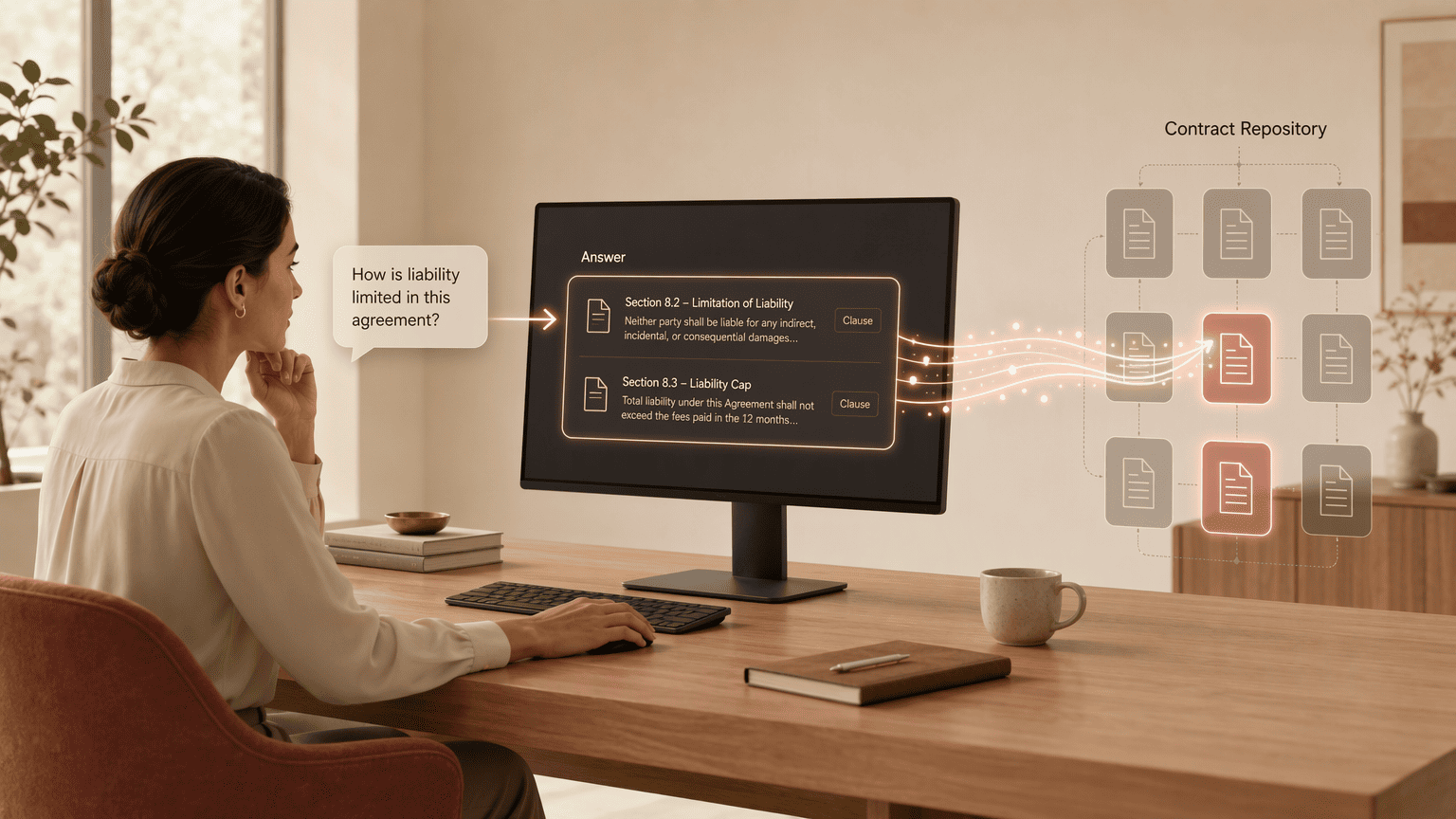
The bottleneck in most legal departments is not drafting. It is answering internal questions about what the contracts actually say. Evisort removes that bottleneck with a natural language query engine that non-legal teams can use without training. Here is how that shifts the operational cost profile:
| Cost Driver | Traditional CLM Approach | Evisort’s Query Engine Approach |
|---|---|---|
| Routine Data Requests | Procurement emails legal; legal manually searches repository; multi-day turnaround. | Procurement types a question in plain English; instant answer with source link. |
| Portfolio Visibility | Periodic manual audits of a contract subset; high risk of missed clauses. | Real-time dashboards surfacing obligations, renewals, and deviations across all executed agreements. |
| Cross-Department Adoption | Low; interfaces are legal-specific and complex. | High; natural language and self-service interface designed for finance, sales, and procurement. |
| Compliance & Risk Surfacing | Reactive; triggered by audit or dispute. | Proactive; automated flagging of non-standard terms against a configurable playbook. |
5. Lexion: AI-Driven Workflow Automation for Lean Legal Teams

Lean legal teams need a tool that operationalizes AI into automated playbooks, not one that simply generates more reading material. Lexion fills this gap by automating the triage and routing of contract reviews so fewer human touchpoints are required before a deal moves forward.
Lexion’s AI workflow engine flags deviations from standard templates and routes them for human judgment only when the exception is real. It eliminates the first-pass redline review and automatically approves standard procurement terms.
6. Icertis: The Full-Lifecycle Platform with Deep Obligation Management
Icertis approaches contract management from the opposite architectural direction as an overlay tool. It is a full-lifecycle CLM with deep AI analytics and obligation management baked into its core. For organizations where contract value is tied to complex post-signature obligations, this is a material consideration.
- Total cost of ownership trade-off: Icertis often requires migration of your full contract repository and a significant licensing commitment, driving initial cost higher. Overlay tools like Contracts.ai and Cimplifi avoid this migration cost by operating on data in place, which can accelerate the path to a 80 percent cost reduction.
- Core strength: Its obligation management capabilities turn contract text into tracked, actionable deliverables and manage the downstream performance of every promise.
- Best-fit scenario: This platform suits highly regulated industries where obligation performance carries severe financial penalties, provided you can absorb the upfront implementation investment and process re-engineering.
7. Summize: The Instant CLM Integration for Existing Repositories

Speed-to-value is a legitimate selection criterion when your legal ops costs are bleeding money every quarter. Summize targets this urgency directly with an integration-first approach that avoids the traditional implementation stall. Instead of requiring a data migration that can stretch for months, Summize connects to your existing repositories, whether that is a mature CLM, a shared drive, or a mix of both, and immediately makes that corpus searchable and summarizable.
This instant connection gives you AI contract analysis without friction. For teams without the patience or infrastructure to replace a legacy system, Summize overlays an AI analysis layer on day one. You can start extracting contract metadata and summarizing clauses without asking IT to restructure the entire data architecture.
The immediate value is rapid contract summarization and clause identification. It turns a disorganized mass of executed agreements into a queryable database. The first stage of review shifts from human reading to AI extraction, which compresses the time a lawyer spends on discovery before they can apply their judgment to a negotiation or dispute.
If your primary blocker to cost reduction is the sheer inaccessibility of contract data scattered across silos, Summize solves that problem fastest. It forgoes the full-lifecycle management features of Icertis in favor of being the lightest-weight intelligence layer you can turn on within a business day.
Conclusion
The 80 to 90 percent reduction in legal ops spend comes from how the system is built, not from a single feature. An overlay like Contracts.ai or Summize runs on top of what you already have. You can pilot it today on a limited contract set without an infrastructure overhaul.
Deep risk surfacing powers the strongest business case. Tools like Luminance and Cimplifi’s defensible review workflows produce auditable, seven-figure savings that make the numbers undeniable.
Your choice turns on one question: do you need a frictionless intelligence layer that activates static data, or a full-lifecycle CLM with obligation management from a vendor like Icertis? For teams prioritizing speed and cost reduction without fighting infrastructure, the overlay approach paired with a self-service query engine maps directly to the 90 percent target.
Frequently Asked Questions
What is an AI contract analysis platform and how does it differ from a traditional CLM system?
An AI contract analysis platform is a software layer that applies generative AI to extract, query, and act on contract data without replacing your existing Contract Lifecycle Management (CLM) system. Traditional CLM governs the full lifecycle from drafting to execution; AI analysis sits on top of current repositories to surface risks and obligations in seconds.
How does ContractsAI’s ‘intelligence layer’ architecture compare to ‘rip-and-replace’ CLM platforms in terms of deployment and cost?
ContractsAI operates within your existing data boundaries, layering AI over your current CLM or storage without migrating the full repository. This approach eliminates the high total cost of ownership and disruption of rip-and-replace platforms, allowing you to pilot on a limited contract set with plans starting at $19 per month.
How can in-house legal teams run a pilot of an AI contract analysis tool without disrupting existing workflows or migrating full repositories?
Run a pilot by selecting an overlay tool that connects to your existing contract storage in place. Here are the sequential steps to follow:
- Select an overlay tool: Choose a platform that connects to your existing contract storage without migration.
- Target a specific subset: Begin with a high-risk group of agreements to limit scope.
- Prove cost reduction: Use platforms like Contracts.ai to demonstrate savings without disrupting procurement or requiring a full-scale data migration.
Sources
- Luminance | Contract Intelligence – www.luminance.com
- Contract AI vs Ironclad CLM 2026 | Gartner Peer Insights – www.gartner.com
- Ivo Customer Stories: How Legal Teams Use AI Contract Review – www.ivo.ai
- AI Contract Review and Analysis: What Legal Teams Need to Know – www.axiomlaw.com
- AI Orchestration for Legal Workflows | Cimplifi – www.cimplifi.com