








Introduction
A London café owner opened an energy bill in 2025 and found they owed £10,000, all because E.ON Next swapped the day and night meter readings. The company later admitted the real balance was a £4,433 credit. That kind of error is a systemic leak. Enterprises lose an estimated 1% to 3% of total contract spend to uncaught overcharges every year, according to data cited in a July 2025 UK Parliamentary debate.
Supplier overcharges happen when the numbers on an invoice do not match the rates locked into the contract. That sounds simple. But finance teams deal with thousands of line items, multiple agreements per vendor, and invoices that arrive as PDFs or paper. Manual spot-checks catch only a fraction of the errors. The rest slip through to payment.
The real fix is automated contract-to-invoice comparison. When structured contract data feeds into a system that parses every invoice line in real time, it flags price deviations before the money leaves the bank. This article walks through a seven-step framework to build that control. You will see how digitizing rate cards, deploying three-way matching, layering AI intelligence, and auditing after signature can close the gap between what you negotiated and what you actually pay.
Key Takeaways
Here is the core framework for stopping supplier overcharges, distilled into its most key points:
- Prevention starts with structured data: You cannot compare an invoice to a contract unless the contract’s rates live as structured data, line items, unit prices, tiers, and discounts, not as static PDFs.
- Three-way matching is the baseline control: Cross-reference the purchase order, the goods receipt, and the invoice; extend that match to the contract itself to catch price deviations before payment.
- AI contract intelligence finds what humans miss: Real-time invoice-to-contract comparison flags subtle pricing discrepancies, like a supplier slipping in a 5% increase that exceeds a contractual cap.
- Thresholds and anomaly detection prevent alert fatigue: Configuring acceptable deviation limits, say, 1% or $50, trains the system to distinguish meaningful overcharges from rounding noise.
- Formalize the dispute workflow immediately: Detection is worthless without recovery; dispute in writing, withhold the contested amount per contract terms, and escalate through the formal resolution clause.
- Post-signature audits catch compounding drift: Periodically re-audit historical invoices against contract terms to catch small, repeated overcharges that compound over months or years.
Step 1: Digitize and Structure Your Contract Rate Cards

Every automated check starts with one hard truth: AI cannot compare what it cannot read. You need your contract pricing data as structured information, unit prices, volume tiers, discount percentages, surcharge caps, not as paragraphs buried in a scanned PDF. Until that extraction happens, overcharge detection is a manual treasure hunt.
It is a living data layer. Rate cards change mid-contract, amendments activate delayed price increases, and rebate tiers adjust after volume thresholds. If your digitized rates are a stale snapshot, your detection engine will miss overcharges that happen the week after you uploaded the data. The setup work here determines whether every subsequent step, auto-matching, variance flagging, recovery workflows, functions or fails.
Pick the extraction path that matches your contract volume and update frequency. The goal is a structured rate repository that the PO team and the AP system both trust as the single source of truth, pulled directly from the signed agreement.
Step 2: Implement a Three-Way Match Across Purchase Orders, Receipts, and Contract Terms
The classic procure-to-pay control is the three-way match: purchase order, goods receipt, and invoice. But that match still leaves a gap. The purchase order sets a price, yet the contract that authorized the PO may contain a different, lower rate. You close that gap by matching the invoice not just to the PO, but back to the contract itself. Follow this ordered sequence to build that safeguard:
- Match price on the invoice to the purchase order: Verify that every line-item unit price on the supplier’s invoice equals the price captured on the authorized PO.
- Match quantity on the invoice to the goods receipt: Confirm that the quantity billed matches what was physically received and recorded in the system.
- Match the purchase order price to the contract rate card: Before approving the PO, validate that its line-item prices align with the agreed contracted rates, including any applicable discounts or volume tiers.
- Invoice totals matching: Sum the invoice and compare it to a calculated expected total; Microsoft Dynamics 365 calls this invoice totals matching, and it catches systemic miscalculations.
- Variance action: When a discrepancy exceeds a defined tolerance, Dynamics 365 displays a match variance icon on the Vendor invoice page, freeze the payment run until the deviation is resolved.
Step 3: Deploy a Contract Intelligence Overlay for Real-Time Invoice-to-Contract Comparison
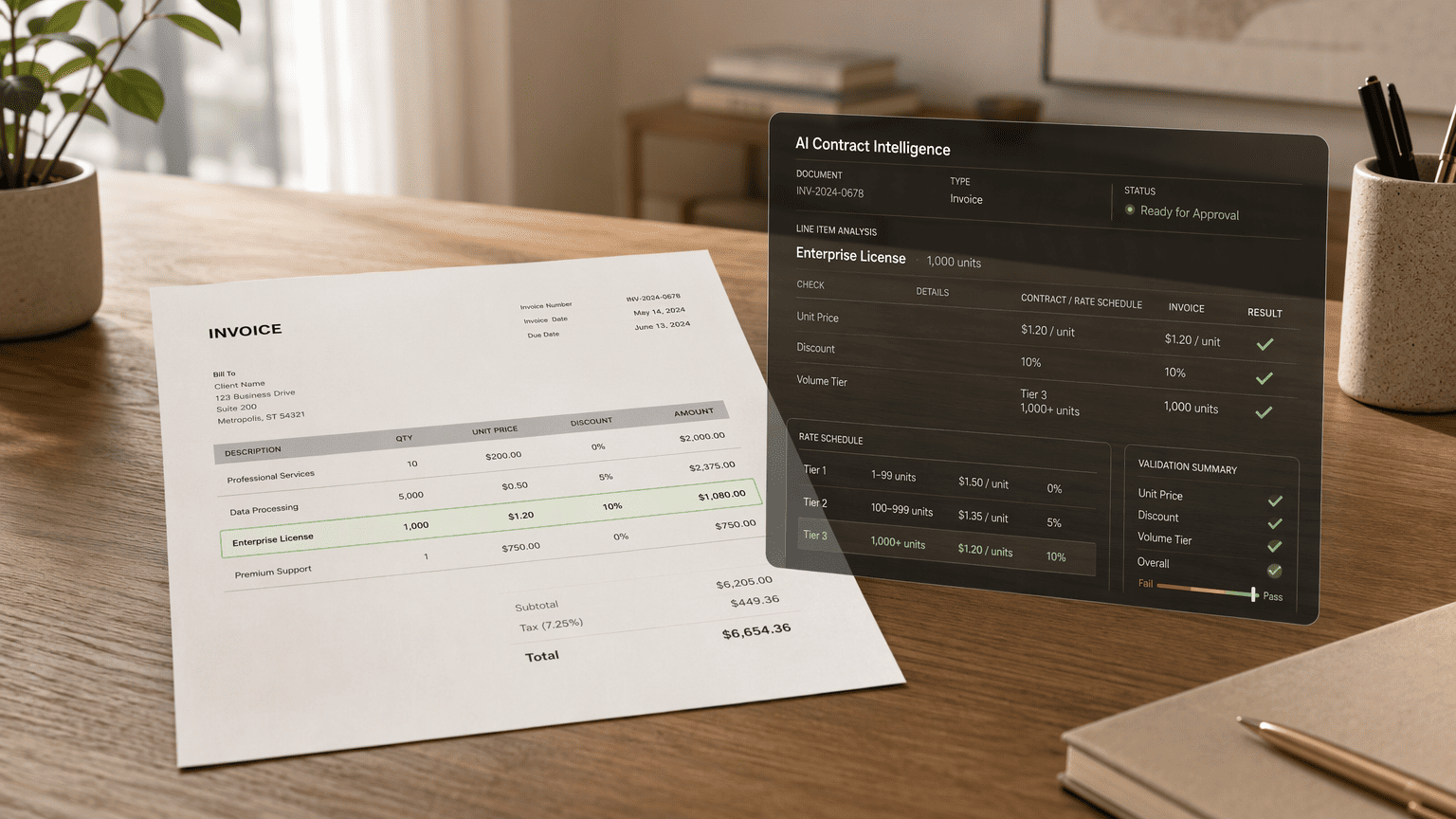
Even a perfect three-way match is historical. It validates the invoice against a PO that may already carry a wrong price. Real-time contract intelligence solves this upstream. An AI overlay parses each invoice line against the digitized rate schedule from Step 1 the moment the invoice arrives, checking unit prices, discount application, and volume-tier adherence before the invoice ever reaches the payment queue.
You can see the stakes clearly in a September 2026 price notice from Murdock Builders Merchants. The company alerted customers that its suppliers had pushed through unilateral increases ranging from 5% to 16% across product lines. If your contract caps annual increases at 3%, a 9% line item buried in a 40-line invoice is nearly invisible to a human reviewer. A system like InvoiceWatch.app, which monitors restaurant supplier invoices for exactly this kind of drift, or Contracts.ai’s structured intelligence layer, flags that deviation in seconds. You receive an alert, not a reconciled bank statement three weeks later.
Step 4: Configure Variance Thresholds and Anomaly Detection

An AI system that flags every single penny discrepancy will exhaust your team within a week. Alert fatigue is the silent killer of compliance programs. Set acceptable deviation limits, both a percentage and a flat dollar amount, so the system surfaces only what matters.
Enterprise platforms follow Microsoft Dynamics 365’s logic: if you set both a percentage tolerance and a tolerance amount, the system evaluates both. When a discrepancy exceeds either threshold, it triggers a match variance. Microsoft’s documentation confirms that if either the percentage or the amount exceeds the tolerance, the line has a matching discrepancy. You avoid getting pinged for a $12 rounding error on a $120,000 contract while still catching the $500 overcharge on a $2,000 PO.
Beyond simple thresholds, anomaly detection models add a second analytical layer. These models learn from your historical spend data to identify patterns that deviate from normal behavior. A supplier who consistently bills $4,900 per month and suddenly invoices $5,200 will trigger the model even if the line-item price technically falls within tolerance. That is invaluable for catching the quiet, creeping price increase.
The real threat is the small, systematic overcharge. A supplier who adds an extra 1.5% across 300 invoices is far more damaging than one blatant error on a single bill. Thresholds calibrated to your spend patterns and supplier history catch that pattern. Anomaly detection catches it faster.
Step 5: Use AI Entity Grouping to Align Shared Terms Across Multiple Agreements

Most organizations do not have one contract per supplier. They have five, or twenty. The same material, service, or SKU appears across multiple agreements, each carrying a different negotiated rate. A supplier who knows your systems are fragmented can invoice against the highest of those rates, even when a separate, active contract entitles you to a lower one.
AI entity grouping solves this. It uses entity recognition to identify that “Acme Corp” in Contract A is the same legal entity as “Acme Corporation” in Contract B, and that “SKU C451-Steel” in one agreement is identical to “45mm Cold-Rolled Steel Coil” in another. The system then aligns the shared terms and enforces the most favorable rate that applies.
Contracts.ai, for instance, can automatically group related agreements and align shared terms across your repository. Once grouped, a single master view shows every active rate for that supplier across every agreement. When an invoice arrives, the AI checks it against the best available contracted price.
The supplier can no longer exploit information you technically hold but could never practically cross-reference. The result: your finance team sees the approved payable, not a reconciled bank statement pulled three weeks after payment, and issues payment instructions to both the supplier and the PO owner with the exact approved line items attached.
Step 6: Formalize the Overcharge Dispute and Remediation Workflow
Detection triggers an alert. Recovery requires a process. If your team spots a $4,000 overcharge but takes three weeks to act, the supplier may already have been paid. The moment an overcharge is confirmed, three actions must happen in parallel:
- File a formal written dispute: Cite the specific contract clause, the line-item discrepancy, and the corrected amount. A written dispute creates a dated record that protects your position under the contract’s dispute resolution clause. Under 49 CFR Part 378, which governs claims for overcharge, duplicate payment, or overcollection in interstate transportation, an overcharge is formally defined and carries specific procedural obligations, and that same principle of formal documentation serves you in any commercial dispute.
- Withhold the contested amount: Most commercial contracts permit the buyer to withhold payment of the disputed sum while the parties resolve the issue. Paying the full invoice and chasing a credit later puts you in the weakest possible bargaining position, the supplier has your cash and you are asking for it back.
- Prevent recurrence by addressing the root cause: In many regulated contexts, and as good commercial practice, require the supplier to submit a written price-change notice before any rate increase takes effect. Approve that notice through a formal contract amendment, not a one-line email. Without that control, you remain reactive.
Step 7: Expand Audit Scopes Post-Signature to Catch Rate Drift Over Time

Most overcharge detection efforts focus on the moment of payment. That is key. But it misses the largest category of leakage: the slow, compounding drift that occurs over months or years.
A contract auto-renews with a clerical error in the pricing table. A volume discount tier resets and no one catches that the old, higher rate is still being billed.
A variable index-linked price adjusts quarterly, and one quarter’s adjustment is wrong. By the time anyone notices, the overcharge has been running for 18 months.
You close that gap by instituting post-signature, periodic re-audits of historical invoices against the governing contract terms. This is a scheduled, automated process, quarterly for volatile or high-spend agreements, annually for stable contracts. Continuous auditing tools compare the full history of paid invoices against the structured rate schedule and flag discrepancies retroactively.
Contracts with auto-renewal provisions are especially dangerous. Infor’s contract invoicing system illustrates one dimension of the problem: only contracts with a Billed Thru date earlier than the Contracts to be Renewed Before date appear on the renewal report. If a billing date is misaligned, the contract may auto-renew at the wrong rate, and slip past the standard approval workflow entirely.
A retrospective check catches that error. Post-signature auditing turns the contract from a one-time negotiation artifact into a living financial control. The mandate extends beyond the PO approval window.
An order matched at intake can still drift wrong a year later. A pricing table updated in one system but not another, a tier break miscalculated at renewal, a 3% escalator applied as 3.5%, any of these produce a small delta that compounds. Without a recurring, system-driven sweep of the entire invoice history against the current contract baseline, you never see it.
The federal government formalizes this principle: Executive Order 14402, issued April 30, 2026, promotes efficiency, accountability, and performance in federal contracting. Agencies that build retroactive contract compliance checks into their standard cadence recover funds that standard payment audits leave behind. The practical setup is straightforward.
Map every active contract to its structured rate table. Schedule an automated comparison run, every invoice line, across every period since inception, against that rate table. Flag every line where the billed amount exceeds the contracted amount, regardless of how many approvals it received at the time.
Route the flags to a designated auditor. This turns the audit scope from a payment-gate snapshot into a full-lifecycle control.
Conclusion
Supplier overcharges drain 1% to 3% of total contract spend every year. That is a measurable financial loss, not an accounts-payable nuisance.
The same technology that spots a utility meter-reading error at a London café can scan thousands of your invoices simultaneously. Digitize your contracts. Match every invoice to the purchase order, the receipt, and the original rate card. Layer AI on top to catch subtle deviations and cross-contract discrepancies. Formalize your dispute process and keep auditing long after the ink is dry.
You need the full audit chain: the purchase order, the receiving report, and the live bank feed all cross-referenced in one place. These seven steps turn contract compliance from a hope into a system. Nothing less protects the full value of every deal your team negotiates.
Frequently Asked Questions
What systems or processes can detect when a supplier invoices above the contracted rate?
Three-way matching systems that cross-reference purchase orders, goods receipts, and invoices are the first line. Adding a contract-to-invoice AI comparison layer, like Contracts.ai or InvoiceWatch, parses each invoice line against the digitized rate schedule and flags any deviation in unit price, discount, or tier before payment is released.
What are the most common types of supplier billing discrepancies that lead to overcharges?
The most frequent discrepancies include incorrect unit pricing, unapproved surcharges, meter-reading errors that swap consumption categories, duplicate payments for the same shipment, back-billing for periods already settled, and volume-tier misapplications. Even a small, repeated line-item error compounds into significant annual leakage.
How can contract AI tools automate the comparison between invoices and agreement terms?
AI tools first extract and structure the contract’s rate data, unit prices, tiers, discounts, using OCR and entity extraction. They then parse incoming invoice line items in real time, compare each charge against the contracted rate schedule, and trigger an alert when a discrepancy exceeds a configured tolerance threshold.
What steps should finance and procurement teams take when they identify an overcharge?
To recover overcharges and prevent recurrence, follow this four-step process:
- File a formal written dispute: Cite the specific contract clause and discrepancy, creating a dated record that protects your position under the contract’s dispute resolution clause.
- Withhold payment for the contested amount: Exercise your right under the contract’s terms to withhold the disputed sum while the parties resolve the issue.
- Escalate through the dispute resolution clause: If the dispute is not resolved, escalate according to the contract’s procedural requirements.
- Require a written price-change notice: Before any future increase takes effect, require the supplier to submit a formal price-change notice approved through a contract amendment, not a one-line email.
What controls can be built into the procure-to-pay cycle to prevent contract rate leakage before payment?
Build a thorough invoice compliance framework with three core controls:
- Build a four-way match: Verify the purchase order against the contract rate card before approval, then match the invoice to the PO and the goods receipt at payment.
- Configure variance thresholds: Set both percentage and dollar-amount thresholds to flag meaningful discrepancies only, avoiding alert fatigue from minor errors.
- Require formal price-change notices: Mandate that all supplier price changes be submitted as formal contract amendments, not informal communications, to prevent unauthorized rate increases.
What is the typical financial impact of uncaught supplier overcharges on enterprise spend?
Data cited in a UK Parliamentary debate in July 2025 estimates that enterprises lose 1% to 3% of total contract spend to uncaught overcharges annually. On a $50 million contract portfolio, that represents $500,000 to $1.5 million in preventable leakage every year.
Sources
- eCFR :: 49 CFR Part 378 — Procedures Governing the Processing, Investigation, and Disposition of Overcharge, Duplicate Payment, or Overcollection Claims – www.ecfr.gov
- Administration of Donald J. Trump, 2026 Executive Order 14402—Promoting Efficiency, Accountability, and Performance in Federal Contracting April 30, 2026 – www.govinfo.gov
- Accounts payable invoice matching overview – Finance | Dynamics 365 | Microsoft Learn – learn.microsoft.com
- Invoicing a Contract – docs.infor.com
- Business Energy Supply Billing: Regulation – Hansard – UK Parliament – hansard.parliament.uk
- Dear Customer, Our suppliers have advised us of forthcoming changes in pricing for their products, which will be effective from – mbmwebapp01.azurewebsites.net






