







Introduction
Your AP team approved a six-figure invoice this month for a services engagement. The rate card looked familiar, the total matched the purchase order, and the approval workflow fired without a hitch. Nine months from now, during a manual reconciliation scramble, someone will notice the hourly rate was 12% above the contracted cap, and a renewal clause triggered an early price escalation nobody caught.
The money is already gone. This is contract leakage.
McKinsey research indicates that up to 80 percent of procurement functions are not fully aware of competitive terms and contract structure. The gap between what you negotiated and what you actually pay widens with every invoice cycle, every renewal, and every scope tweak that slides through without a contract sanity check.
AI-driven vendor invoice auditing has matured into a low-friction, high-ROI capability that plugs this leak without ripping out your ERP or CLM stack. AllCaps reports a 3 to 8% recovery rate on audited vendor spend, while Vaudit pegs recoverable spend at 3 to 7%. Those percentages translate into hard dollars reclaimed from pricing errors, duplicate charges, and unapplied credits your current AP tools never look for.
This article maps the technology mechanics, quantifies the recovery opportunity, and walks through implementation, from a weeks-long pilot to enterprise rollout. You will learn what discrepancy types an engine must catch, how modern tools overlay existing systems, and what procurement and finance teams should prioritize when evaluating a solution.
Key Takeaways
- AI audit engines find that 3 to 8 percent of vendor spend is recoverable.
- The discrepancies that surface most often are wrong pricing, billing cycles that don’t match the contract, charges no one authorized, work that drifted outside the agreed scope, and duplicate payments. These are not exotic edge cases.
- A fixed-scope pilot can produce the first recovery claim in weeks, not quarters. You don’t need years of data. A limited set of contracts and invoices is enough to prove the engine works on your actual spend.
- Modern tools sit on top of the AP system you already have. They connect through APIs, pulling contracts from the CLM and invoices from the ledger. No rip-and-replace required.
- When you evaluate a solution, anchor the comparison on contract-parsing accuracy, speed to first claim, how easily you can pilot with a small data sample, and whether the vendor holds SOC 2 Type II certification with encryption that meets bank-grade standards.
What Automated Vendor Invoice Auditing Is and How It Works
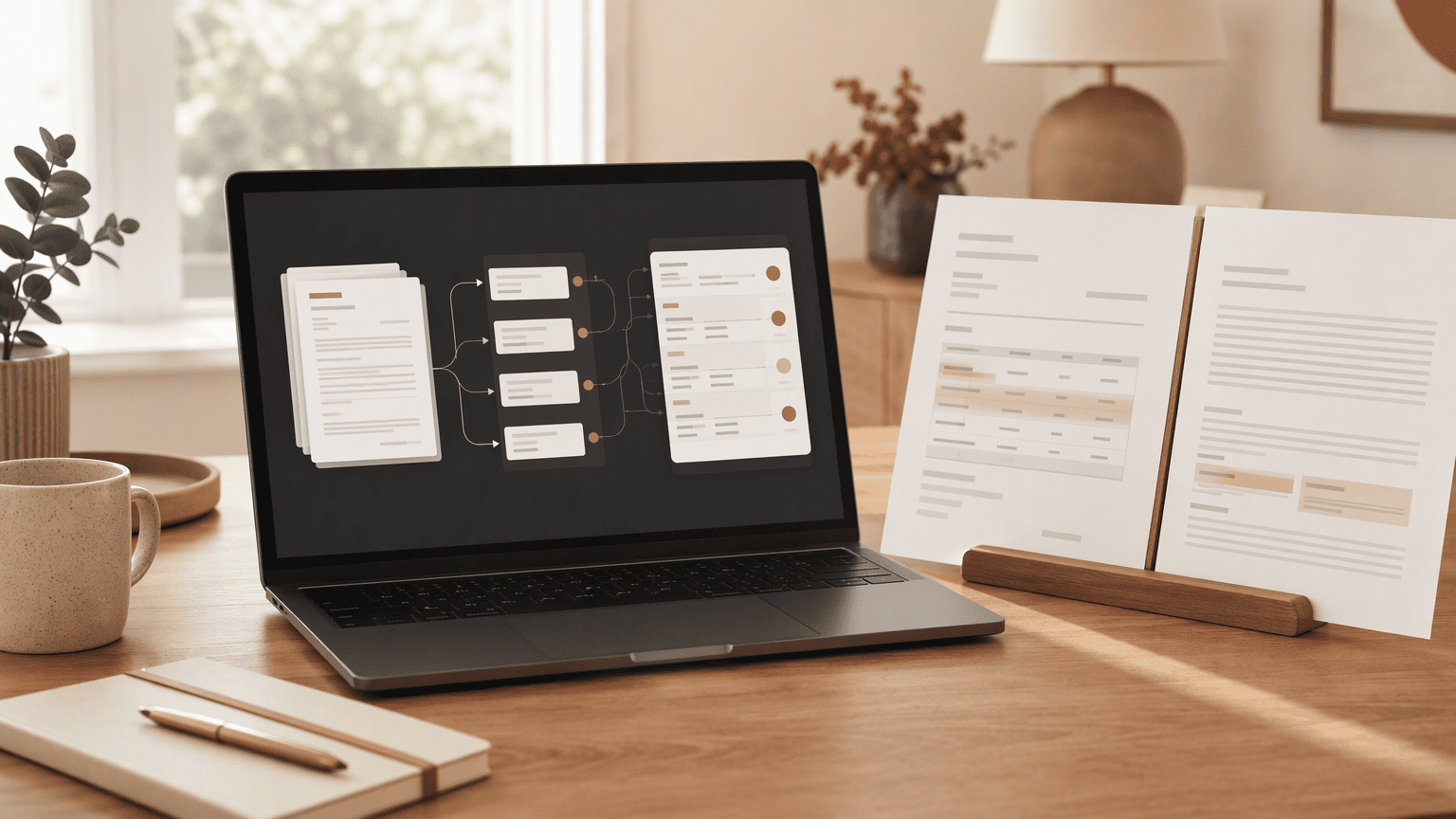
Your finance team pays an invoice, and six months later a routine audit finds you were overbilled by 12 percent across a single vendor relationship. Nobody caught it because nobody had the contract open next to the invoice. Automated vendor invoice auditing is the tooling that keeps those two documents side by side at scale. It uses AI and rules-based engines to extract line items from incoming invoices and compare them against parsed contract terms, flagging discrepancies before the payment run.
It is a distinct category from basic OCR or manual spot-checks. Traditional AP automation reads an invoice enough to code and pay it. An audit engine reads both the invoice and the contract together, cross-referencing pricing tables, payment schedules, service periods, and authorized charges across hundreds of agreements. The core comparison falls apart without that dual read. GEP describes the result: AI can continuously compare purchase orders, invoices, and supplier activity against contract terms and flag pricing shifts, off-contract purchases, or missed supplier commitments immediately.
Setup starts when the engine ingests each contract and extracts structured data: rate caps, volume discount tiers, renewal triggers, and billing frequency. When an invoice arrives, the tool pulls its line items, maps them to the corresponding contractual obligations, and applies deterministic rules and machine learning models to surface mismatches. A bill rate above the contracted ceiling, a charge for a service outside the statement of work, a billing cycle that does not match the agreed schedule, each gets flagged and linked back to the source clause. The workflow runs in four steps: ingestion, where contracts and invoices enter the system through API connections or document uploads; parsing, where NLP extracts structured fields and free-text clauses; cross-referencing, where invoice data is aligned with matched contract terms; and flagging, where discrepancies are categorized by type and financial impact. The output is an exception report, a shortlist of overpayments and compliance gaps ready for recovery action.
The 3 to 8% Recovery Opportunity: Quantifiable ROI and Strategic Benefits
The headline number that catches a CFO’s attention is the 3 to 8% of vendor spend recoverable through automated audit. This is not a theoretical projection; it is borne out by tool-level claims and enterprise case experience.
- Direct recovery: Vaudit cites recoverable spend at 3 to 7% of vendor outlays, while AllCaps reports a 3 to 8% recovery rate. Even at the low end, a company spending $50 million annually on vendors could reclaim $1.5 million in the first audit cycle.
- Immediacy of ROI: Vaudit structures its process around “Day One” ROI through post-bill credits and pre-bill cost corrections, meaning you do not wait a year to see the benefit on the P&L.
- Scale of missed errors: In an illustrative audit of 30 real invoices, AllCaps identified $515,227 in errors that standard AP tools would never surface. These are not rounding errors; they are five- and six-figure misses per audit batch.
- Cost avoidance beyond recovery: Reducing duplicate payments and preventing off-contract spending compound the savings. One McKinsey case cited over $10 million in duplicate payments to suppliers discovered after automating billing and payment processes.
- Strategic upside: Strengthened audit readiness, reduced compliance risk, and the ability to redirect AP talent from reconciliation work to financial analysis are durable, second-order benefits that outlast any single recovery.
Deploying AI Without Ripping Out Your AP or CLM Stack
The biggest practical objection to adopting audit AI is the fear of disrupting a working AP ecosystem. The answer is straightforward: modern tools sit on top of your existing stack.
- Existing-system integration: An audit engine connects to your AP system (SAP, Oracle, NetSuite) and your CLM platform via API, pulling invoice and contract data for analysis without rewriting workflows or migrating repositories. UiPath’s Invoice Validation Against Contract Agreement agent template uses context-grounded contract data to validate invoice details against contract terms within whatever automation fabric the enterprise already runs.
- Read-only overlay design: The tool acts as an overlay, extracting structured information through read-only integrations and returning exception reports to the team that needs them. You continue processing payments the way you always have; the audit engine simply catches what the approval chain misses before cash leaves the door.
- Incremental deployment: The integration model means you do not need to consolidate every contract into one system before a pilot begins. Audit engines can start with a discrete set of high-spend agreements and a month of invoices, proving the recovery model on limited data. This approach adds intelligence without requiring a clean-slate transformation.
Cross-Contract Intelligence: Grouping Agreements for Deeper Audit Accuracy

Single-contract auditing catches the pricing error on invoice #1047. Cross-contract intelligence catches the fact that you paid for the same deliverable twice across three statements of work under a master services agreement.
The most damaging overpayments happen at the intersection of multiple agreements. A volume discount triggered at the MSA level but never applied to individual SOW invoices. Overlapping service periods billed on separate contracts.
A rate escalation clause in one agreement that should have locked in a better price on its sister renewal. These are not edge cases; they are the standard pattern for any organization managing a portfolio of vendor relationships. GEP’s framework shows that AI can pull out pricing, payment terms, rebates, service levels, renewal clauses, and supplier obligations in minutes.
Apply that same capability across a grouped contract portfolio and patterns invisible in single-document review surface immediately. A tool that automatically groups related agreements and aligns shared terms closes a gap that basic contract-vs-invoice checks miss entirely. UiPath’s agent takes a practical step by distinguishing between pilot and standard contracts while validating invoices.
Pilot agreements carry pricing, scope, and payment terms that differ from standard enterprise contracts. An engine that cannot separate the two will produce noise. For procurement teams managing dozens of vendors each with multiple SOWs and amendments, cross-contract analysis separates a finding rate of 1% from the 3 to 8% range that defines the full recovery opportunity.
Discrepancy Types an AI Audit Engine Must Detect
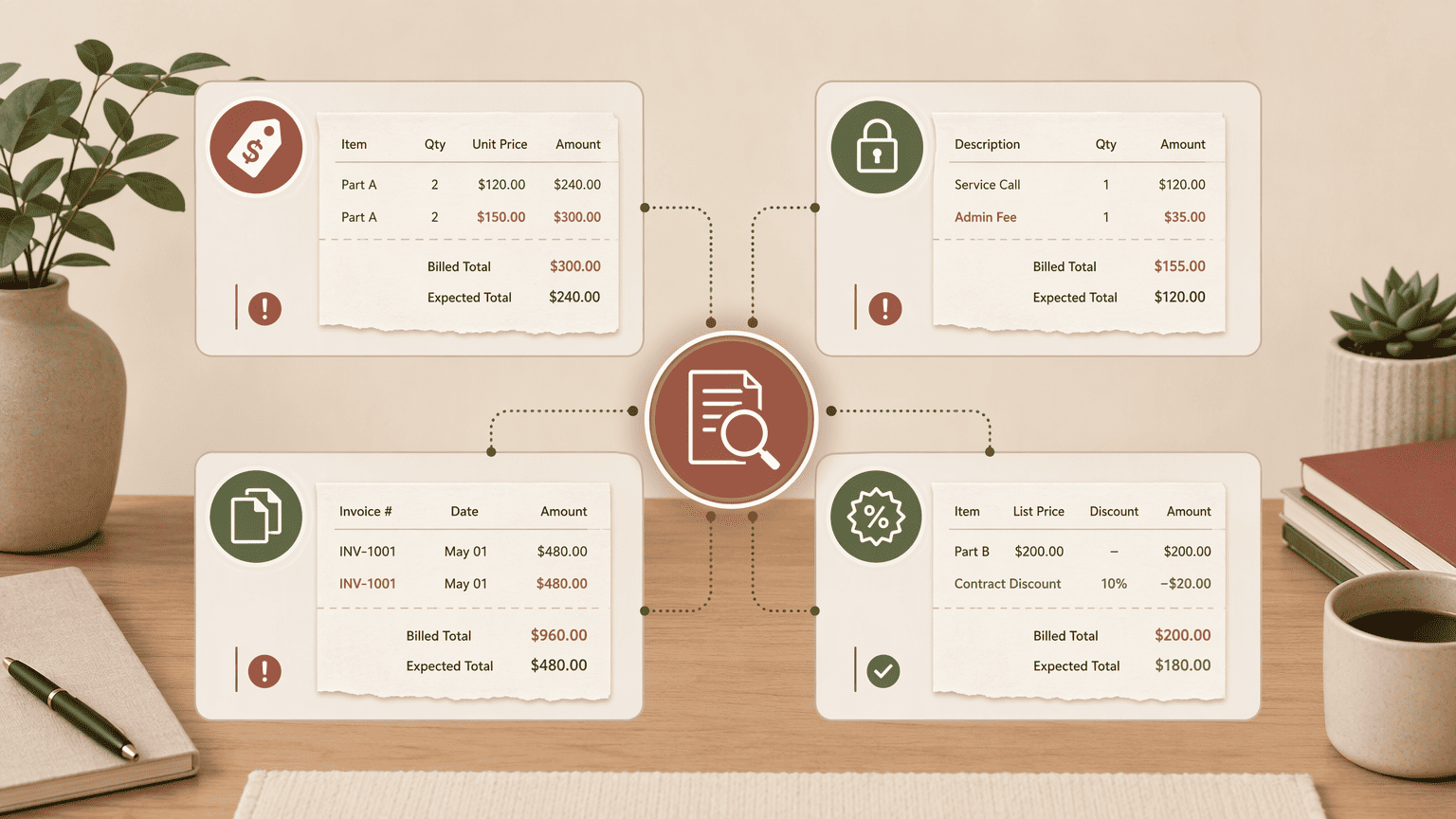
An audit engine is only as good as the error categories it can catch. If it misses a single recurring pattern, the savings math falls apart. These are the discrepancies that matter.
| Discrepancy Type | What It Looks Like | Financial Impact |
|---|---|---|
| Incorrect pricing | Invoiced rate exceeds contracted rate card or fixed price | Direct overpayment per unit; compounding on volume |
| Unauthorized charges | Line item for a service, product, or fee absent from the contract | Pure leakage, you pay for something you never agreed to buy |
| Billing cycle mismatch | Invoice covers a period longer than the agreed billing cycle or starts before the contract effective date | Front-loaded cash outflow, potential double-billing at contract close |
| Duplicate payments | Same invoice or charge paid twice across different AP runs or entities | Dollar-for-dollar recovery opportunity; one McKinsey case found over $10 million in duplicates |
| Unclaimed credits | Contractual rebates, SLA penalty credits, or early-payment discounts not applied | Recoverable cash that AP simply never requested |
| Scope-of-work deviation | Charges for deliverables or hours outside the signed statement of work | Overpayment on work you did not authorize; audit exposure if regulatory compliance is at stake |
Each category represents a cash outflow your current AP review is not designed to catch. AllCaps’s claim of performing 49+ contract checks that ordinary AP automation does not reflects the breadth of the detection surface required to close these gaps.
ContractsAI’s Post-Signature Approach to Invoice Auditing

ContractsAI applies the principle that contract intelligence does not stop at signature. The platform is structured as an intelligence layer for executed agreements, ingesting the final, signed contract, not just the negotiation draft, and making its structured terms available for continuous compliance monitoring. Its founders, Jenn McCarron and Phani Gunturu, built the company in 2025 after a combined 30+ years of experience implementing CLMs, ERPs, and procurement systems inside global enterprises.
The operational logic is straightforward: the engine extracts and organizes key terms, payment schedules, and obligation clauses across agreements, then maps incoming invoice data against those extracted structures. It claims accuracy levels greater than 99% when extracting data from documents in real time.
This post-signature focus shapes how the audit works. Rather than running a one-off analysis, the platform is designed to support ongoing contract compliance monitoring, checking every invoice cycle, flagging deviations as they occur, and linking answers to source contract language for validation. The practical result is an audit capability that is embedded in the contract’s operational life rather than triggered once a year when an external auditor arrives.
Top Vendor Invoice Audit Software Solutions in 2026
The market for automated vendor invoice auditing in 2026 splits into three camps: dedicated audit platforms built for recovery, AI-first contract intelligence tools that catch leakage before it happens, and automation agents that plug into existing workflows. What follows compares the leading options on the dimensions procurement and finance teams care about most.
| Solution | Primary Audit Focus | Deployment Model | Time-to-Value Promise | Security Posture |
|---|---|---|---|---|
| AllCaps | Fixed-scope invoice-vs-contract recovery audit across 49+ check types | SaaS with zero vendor contact required to start | First recovery within weeks of proof engagement | Not publicly detailed; claims enterprise readiness |
| Vaudit | Specialized vendor spend recovery agents for contract, invoice, usage, and pre-bill verification across ad spend, AI spend, and other categories | SaaS with immediate ROI through post-bill credits and pre-bill corrections | “Day One” ROI positioning | Not publicly detailed |
| LedgerUp | AI-first platform combining contract-to-cash automation with spend compliance | SaaS platform | Not explicitly stated; positioned as an always-on automation layer | Not publicly detailed |
| UiPath Invoice Validation Agent | RPA-native agent template for invoice-vs-contract-validation; integrated into existing automation fabric | UiPath ecosystem; distinguishes pilot vs. standard contracts | Limited-data pilot capability for evaluation within existing automation stack | Inherits UiPath platform controls |
| ContractsAI | Post-signature contract intelligence with continuous compliance monitoring and source-linked validation | Intelligence layer overlay; SOC 2 and SOC 3 certified; encryption at rest and in transit | Pilot with limited contract set without full repository migration | SOC 2 Type II, SOC 3; TLS 1.2+ encryption; role-based access and strong authentication |
Pilot in Weeks, Not Quarters: The Typical Implementation Path

A vendor invoice audit pilot does not require a year-long IT project. The modern path gets you to a first recovery claim in two to four weeks.
- Select a defined set: Start by picking a defined set of high-value vendor contracts and the invoices from a recent period. AllCaps structures its engagement as a fixed-scope proof with a fixed fee and no long term, which keeps the financial commitment contained while you validate results. The audit tool connects to your AP system and contract repository through read-only API integrations, extracting structured data without migrating your full repository.
- Run the audit: Next is the audit run itself. The engine parses contract terms, maps invoice line items, applies its discrepancy detection logic, and produces an exception report. Each overpayment and compliance gap links back to the source contract language.
- Review findings and initiate recovery: Your team reviews the findings, validates the claims, and initiates recovery, credits from vendors, corrected billing instructions, or clawbacks on duplicate payments. This works in weeks because you are not replacing your AP stack. You are layering a detection engine on top of what you already use.
- De-risk broader deployment: Starting with a limited data set, ten contracts, a month of invoices, keeps the configuration scope tight and the validation burden low. The pilot de-risks the broader deployment: you see the recovery rate on your own spend before committing to an enterprise rollout.
What Procurement and Finance Teams Should Prioritize in a Solution
Start by evaluating contract parsing accuracy. If the engine cannot reliably extract pricing tables, payment schedules, and obligation clauses from your most complex agreements, everything else is noise. Any tool that cannot link flagged discrepancies back to a specific contract clause with a confidence threshold generates more audit work than it saves.
- Speed to first recovery claim: Platforms that promise ROI within the first month of a fixed-scope pilot, delivering concrete, dollar-quantified findings from your actual invoices against your actual contracts, de-risk adoption in a way that six-month implementation roadmaps cannot. Vaudit’s Day One ROI framing and AllCaps’s fixed-fee proof-of-concept both reflect a market expectation that you should see hard-dollar recoveries before signing a multi-year license. A pilot that runs on limited data, with no requirement to migrate your full contract repository or reconfigure AP workflows, tells you whether the tool works in your environment without betting the department’s bandwidth on a full-scale rollout.
- Security architecture: Your vendor contracts contain pricing structures, volume commitments, and supplier terms that represent competitive use. The solution should meet enterprise standards: SOC 2 Type II certification, encryption of data in transit using TLS 1.2 or higher, encryption at rest, and role-based access controls operating on least-privilege principles. You also need clarity on data handling, specifically whether customer contract data is used to train generalized models. Any ambiguity here is a dealbreaker for procurement functions managing sensitive supplier relationships.
- Integration design: The fastest path to recovery is one that does not require you to change how you pay invoices. The tool should operate as a read-heavy API overlay on your existing AP and CLM systems, extracting data for analysis and returning exception reports without inserting itself into the payment approval chain. The best outcomes come from solutions that deliver intelligence into the workflow your team already runs.
Conclusion
Most of the 3 to 8% of vendor spend that leaks every year has nothing to do with bad contracts. It happens because no one compares every invoice line item back to the negotiated terms before payment goes out. You cannot negotiate your way past a detection problem.
Automated invoice auditing catches those overcharges, duplicate billings, and out-of-scope fees at the source. The tech plugs into existing AP workflows without a months-long implementation, and a pilot run against three high-spend vendors gives you real recovery numbers in weeks, not quarters. That one exercise makes the business case on its own.
Contract leakage is value that slips out after the contract is signed. Treating automated invoice review as standard infrastructure (not an annual spot check) is what separates organizations that keep the value they negotiated from those that watch it bleed out one invoice at a time.
Pick three vendors, run a fixed-scope pilot, and let the engine surface what your payables process has been missing. That is the shortest path from invisible loss to recovered cash.
Frequently Asked Questions
How do automated vendor invoice audit tools work and what types of discrepancies can they detect?
Automated audit tools extract invoice line items and compare them against parsed contract terms such as pricing, payment schedules, and authorized charges. They flag:
- Incorrect pricing
- Unauthorized charges
- Billing cycle mismatches
- Duplicate payments
- Unclaimed credits
- Scope-of-work deviations
What are the key benefits and potential ROI of using software to automatically audit vendor invoices against contract terms?
Audit tools recover 3 to 8% of vendor spend through overpayments and unclaimed credits, with immediate ROI when tools deliver post-bill corrections. Benefits include reduced compliance risk, stronger audit readiness, and redirecting AP resources from reconciliation to higher-value analysis.
How does ContractsAI approach post-signature contract intelligence for invoice auditing?
ContractsAI operates as an intelligence layer for executed agreements, extracting and structuring contract terms for continuous compliance monitoring. It maps incoming invoices against extracted obligations and links flagged discrepancies to source contract language for validation.
What are the top vendor invoice audit software solutions available in 2026, and how do they compare?
Leading solutions include AllCaps for fixed-scope recovery audits, Vaudit for specialized spend agents, LedgerUp for AI-first contract-to-cash automation, UiPath’s agent template for RPA-native validation, and ContractsAI for post-signature intelligence with continuous compliance monitoring. Deployment models, time-to-value promises, and security postures vary by vendor.
What is the typical implementation process for an automated invoice audit tool, and can a pilot be run with limited data?
A pilot runs in weeks: select a limited set of high-value contracts and invoices, connect the tool via read-only API to existing systems, run the audit, validate findings, and claim recoveries. Limited-data pilots are standard and do not require full repository migration.
What should procurement and finance teams look for when selecting an automated invoice audit solution?
Prioritize contract parsing accuracy, speed to first recovery claim (weeks, not quarters), ease of piloting with limited data, bank-grade security including SOC 2 Type II certification and encryption, and non-disruptive integration with existing AP and CLM systems.
Sources
- Product – contracts.ai
- Audit Every Vendor Invoice Against the Contract | AllCaps – www.allcaps.ai
- [PDF] Mitigating procurement value leakage with generative AI – McKinsey – www.mckinsey.com
- How AI Prevents Contract Leakage and Protects Contract Value | GEP Blog – www.gep.com
- Invoice Validation Against Contract Agreement | UiPath Marketplace – marketplace.uipath.com