







Introduction
Your budget leaks every time someone clicks “buy” outside an approved contract. It is often a $19 subscription or a rush software tool, but the aggregate damage is massive. The Hackett Group found world-class procurement teams record 60 percent less savings leakage than their peers. Yet nearly 40 percent of SaaS spending goes completely unmonitored, according to a 2024 Gartner analysis.
Traditional policy enforcement fails because emails get ignored and spreadsheets become outdated before they are saved. An AI intelligence layer catches leakage at the point of purchase. It nudges buyers toward compliance, turning rogue spending into managed spend without adding friction. You keep procurement a business partner, not a compliance battle. We will walk through a seven-step framework that moves you from diagnosing the real drivers to building a KPI dashboard that proves the return on investment.
Key Takeaways
Controlling maverick spend means shifting from reactive policing to guided buying, where AI surfaces the right supplier at the moment a purchase is made. These actions come straight from the seven-step model.
- Diagnose root causes: Categorize maverick spend into tail spend, rogue buying, and non-PO invoices before designing any solution.
- Unify your data: Integrate ERP, P2P, and AP systems to create a single source of truth. AI is useless on dirty data.
- Deploy AI in real time: Use an intelligence layer that classifies requisitions and matches preferred suppliers at the moment of purchase.
- Engineer guided buying paths: Make compliance the default by surfacing pre-approved options and using risk-based soft stops to catch leakage.
- Measure maturity: Track spend under management and contract compliance rates to connect daily actions to financial outcomes for stakeholders.
At a Glance
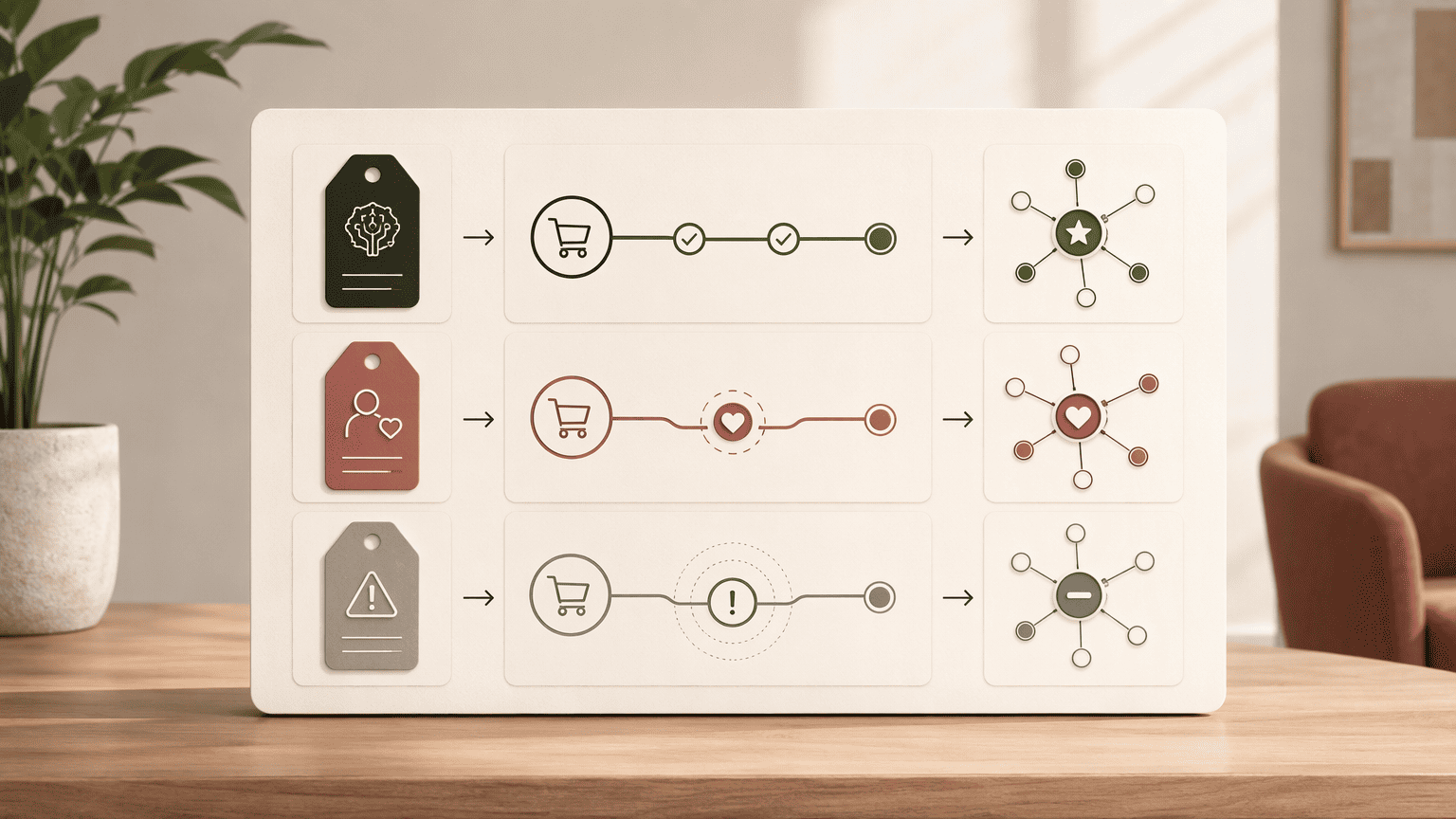
Here is how the options compare across the dimensions that matter most.
| AI Approach | How It Works | Best For | Key Limitation |
|---|---|---|---|
| Real-time supplier matching | AI scans requisition line items and surfaces the cheapest or preferred contract supplier at checkout | High-volume, low-dollar tail spend | Requires clean, normalized supplier master data |
| Guided buying nudge | A pop-up alerts the buyer when an item is available from a contracted supplier and offers one-click redirect | Occasional maverick spend from busy employees | Can be ignored if no soft stop enforces compliance |
| Risk-based soft stop | AI blocks purchase if spend exceeds a threshold or supplier is unapproved, but allows override with justification | Emergency or urgent needs that still need oversight | Creates friction that may push users to expense it instead |
| Autonomous PO generation | AI auto-creates a purchase order from a requisition if it matches a pre-approved catalog item or contract | Recurring known spend with no human touch | Fails for novel or unbundled purchases |
| Anomaly detection and alert | AI flags abnormal order patterns (e.g., same user ordering same item weekly without a contract) | Identifying repeat tail spend that should be cataloged | Reactive, not preventative |
Step 1: Define and Diagnose the Real Drivers of Maverick Spend
Before you can fix maverick spend, you must understand exactly why it is happening. It is rarely just an employee trying to bypass the rules. Typically, the system has trained them to behave this way.
Categorize the leakage and trace each incident back to its root cause.
- Catalog content gaps: Identify where buyers searched your internal marketplace and found obsolete suppliers, missing items, or confusing descriptions. They then went externally to find what they actually needed.
- Approval workflow friction: Pinpoint the requisitions that died in a queue. When an urgent need for a marketing tool sits in a manager’s inbox for four days, the user learns to expense it next time to stay productive.
- Emergency and tail spend patterns: Separate true emergency purchases from repeat, low-dollar “tail” buys. A single department that buys the same unapproved software seat 20 times a year is a sign a catalog item is missing or nobody knows it exists.
Step 2: Unify and Enrich Procurement Data for a Single Source of Truth
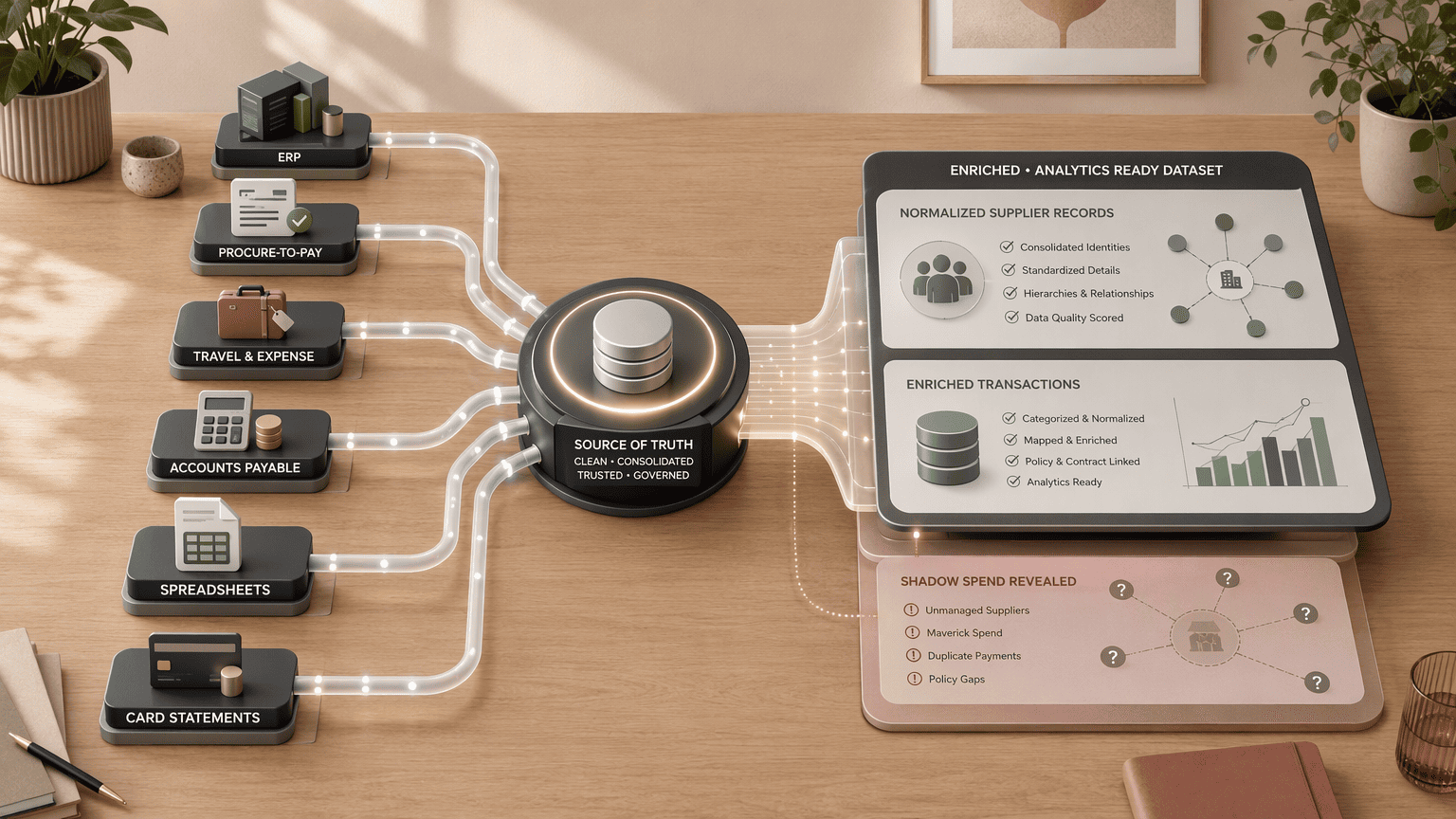
Artificial intelligence starves on fragmented data. Your first technical move is to pull transactions from your ERP, procure-to-pay suite, travel and expense system, and accounts payable into one analytics-ready dataset. This integration surfaces the shadow spend that lives in spreadsheets and credit card statements. A unified set is the only way to answer the fundamental question: how much are we actually spending, and with whom?
After integration, enrich what you pulled. Normalize supplier names so “Adobe Inc.,” “Adobe Systems,” and “ADBE” become one legal entity. Classify every line item to the UNSPSC standard. Clean, mapped data is the prerequisite that turns raw records into the single source of truth an intelligence layer can act on.
Step 3: Deploy an AI Intelligence Layer to Classify and Match in Real Time
With clean data in place, you can now install a decision layer between the buyer and the purchase. This is where the behavioral change actually happens. The AI works while the requisition is being typed, not after the invoice arrives.
- Standardize the requisition: The AI converts a free-text description like “need the thing for the Johnson project” into a standardized UNSPSC category. This reduces variability and ambiguity that downstream systems cannot parse.
- Match to preferred suppliers: Using the category, the buyer’s location, and the company’s historical purchase patterns, the engine instantly surfaces relevant Preferred Supplier List options. The user sees the approved vendor first.
- Explain the recommendation: The AI shows why a supplier was suggested, such as a negotiated 15 percent discount or a proven delivery rating. The final decision always remains with the buyer, but the easiest click is now the compliant one. This approach strengthens decision quality at the purchase requisition stage without touching your existing ERP workflows.
Step 4: Engineer Guided Buying Paths That Make Compliance the Default

An AI recommendation is only effective if the user experience supports it. Guided buying uses the intelligence from Step 3 to reshape what the buyer sees:
- Configure procurement search: rank approved, AI-matched items first in search results, so non-compliant options fall to the bottom or disappear from the punchout catalog.
- Apply behavioral economics: avoid hard blocks that create resentment; use risk-calibrated soft stops instead.
- Design risk-tiered prompts: for low-dollar, low-risk categories, show a subtle banner saying “A contracted supplier is available here”; for high-risk or high-dollar items, trigger a red hard stop that initiates an automatic conversation with a sourcing manager.
The design principle is simple: the path of least resistance always leads to a pre-negotiated, approved supplier. You are not adding a hurdle; you are removing friction from the right choice. Every new dollar steered this way can result in 6 to 12 percent in savings.
Step 5: Reimagine the Approval Workflow with Contextual AI Governance

Rigid, role-based approval chains are a primary reason employees route-buy around procurement. When someone needs a subscription to finish a client deliverable, they will not wait three days for a VP to approve it while on vacation. An AI-driven workflow assesses the risk of the requisition in real time on dimensions of total spend, category sensitivity, and vendor trust score. Low-risk, low-value purchases can be auto-approved instantly, a “no-touch” commerce model that eliminates the administrative delay that fuels non-compliance.
The impact on contract compliance is direct and measurable. The Ardent Partners benchmark shows the average organization has only a 59.5 percent contract compliance rate, versus approximately 75 percent for world-class teams. Dynamic governance closes this gap by routing high-risk buys to human approvers complete with an AI-generated summary of the risk, the policy in question, and a recommended action. The manager reviews an informed recommendation instead of chasing down the details themselves. The process finishes in minutes, not days.
Step 6: Activate Post-Order Surveillance and Tail-Spend Decision Intelligence
Some maverick spend will always bypass your new front-end controls, typically through non-PO invoices and corporate card swipes. A mature program deploys AI to monitor the back door. Post-order surveillance agents continuously scan incoming invoices and expense feeds for transactions from unapproved vendors, matching patterns against historical norms. These agents flag anomalies and explain the variance, so a category manager gets a structured alert rather than a raw data dump to investigate.
This continuous monitoring is where a tool like Contracts.ai becomes relevant. Its approach to making executed agreements operational allows you to check transactions against negotiated pricing, discount tiers, and payment terms, flagging each deviation with a link to the invoice and the source contract.
Once you can see the tail, you shift from detection to automation. AI-driven recommendations can consolidate fragmented tail suppliers into a single marketplace vendor or move a high-frequency, low-dollar category onto a managed procurement card program. The result is a feedback loop where intelligence from the tail actively reshapes and expands your managed spend over time. The average company leaves 42.9 percent of its spend unmanaged. Your goal is to systematically convert that long tail into governed, visible, and optimized purchasing.
Step 7: Measure the Maturity, Build the KPI Dashboard That Proves ROI

Executives fund programs that prove their value. Build a dashboard that translates the AI’s operational work into the language of the CFO:
- Measure operational health: track the AI’s supplier matching rate, the auto-approval rate for low-risk requisitions, and the procurement cycle time from request to purchase order to show the system is functioning and reducing friction.
- Prove financial impact: monitor your contract compliance rate against the world-class benchmark of ~75 percent and your spend under management percentage (best-in-class organizations achieve 91.5 percent), while showing the reduction in tail-spend fragmentation and the hard dollar capture from channeling new spend into negotiated agreements.
- Evolve to strategic metrics: introduce lead indicators like sourcing pipeline velocity and supplier innovation contributions once teams are comfortable, proving procurement has become a value driver rather than a cost center.
Conclusion
Controlling maverick spend is a design problem. You started by diagnosing the systemic gaps that push good employees to buy off-contract and then layered in a unified data foundation to make the invisible spend visible. When you deploy AI to classify, match, and route decisions in real time, buying gets faster and compliant by default: policy adherence becomes the easiest path, so employees follow it. An AI intelligence layer achieves this without replacing the ERP that runs your business, closing the loop with continuous surveillance and board-level KPIs that measure whether spend culture has actually shifted.
Frequently Asked Questions
What exactly is maverick spend and why is it so damaging to procurement?
Maverick spend is any purchase made outside approved contracts, preferred supplier lists, or established procurement workflows. It erodes hard-negotiated volume discounts, fragments spend visibility across the organization, and creates a massive savings leakage problem that prevents finance from accurately forecasting and controlling costs.
How can AI-powered contract intelligence identify and flag hidden maverick spend?
AI agents classify free-text requisitions into standardized UNSPSC categories at the point of entry and match them against preferred supplier lists and historical buying patterns. Tools with contract intelligence can then check those purchases against the actual negotiated pricing and terms inside executed agreements to flag any deviation.
What procurement data points should finance teams analyze to uncover rogue purchasing?
Finance teams should analyze key spend patterns and metrics:
- Analyze tail spend patterns.
- Review non-PO invoice volumes by department.
- Examine transactions from unapproved vendors in the accounts payable ledger.
- Evaluate contract compliance rates.
- Track spend under management, where the average organization only manages 57.1% of its total spend.
How can organizations use an intelligence layer to enforce contract compliance without ripping and replacing their ERP?
A lightweight AI intelligence layer sits on top of your existing ERP and source-to-pay platforms. It structures free-text requisitions, surfaces preferred suppliers from active contracts at the moment of purchase, and provides transparent, explainable recommendations while the final buying decision stays with the human, leaving your core system infrastructure untouched.
What is the step-by-step process for setting up automated maverick spend controls in 2026?
The process follows seven key steps:
- Diagnose the root causes of your maverick spend.
- Unify and enrich procurement data from all systems.
- Deploy an AI layer for real-time classification and supplier matching.
- Engineer guided buying paths that make compliance the easiest click.
- Implement risk-based AI approval workflows.
- Activate post-order surveillance of invoices and expenses.
- Build a KPI dashboard to track maturity and prove ROI.
What does a mature AI-driven procurement control framework look like, and what KPIs prove ROI?
A mature framework uses AI for real-time blocking, dynamic approvals, and continuous post-order surveillance. It relies on a hierarchy of KPIs to prove ROI: operational metrics like the AI’s auto-match rate and cycle time, financial outcomes such as an increasing contract compliance rate driven toward the ~75% world-class benchmark, and a direct, measurable increase in spend under management.
Sources
- Contract Intelligence Software | Suplari – suplari.com
- The Top 6 Procurement KPIs – www.esker.com
- Maverick Spend AI Procurement Solutions | LTM – www.ltm.com