








Introduction
Most treasury teams can recite the math in their sleep: a 2/10 net 30 discount works out to a 36%+ annualized return. And yet those same discounts evaporate every month because invoices stall in approval queues. The 10-day window snaps shut before anyone sees the deadline.
The opportunity goes away because nobody can see it. A standard ERP screen shows an amount due and a due date. That is it.
Procurement signed the clause. AP never saw it. The savings leak out while the team stares at a flat dollar figure.
New contract analytics platforms read the terms inside your signed agreements instead of just showing you a balance. They surface the discount deadline at the point of payment and even predict which suppliers will negotiate. This article walks through the platforms leading that shift, ranked by how well they turn dormant contract language into measurable cash.
Key Takeaways
Here are the core capabilities and economics that define effective early pay discount analytics:
- Predictive scoring changes the game: Models that analyze 80+ supplier data points can forecast which vendors will accept a discount and at what rate, moving you from guesswork to targeted campaigns.
- A 2/10 net 30 discount annualizes to over 36%: That yield dwarfs most short-term investment returns, making systematic discount capture a direct contributor to free cash flow.
- The bottleneck is visibility, not willingness: Invoices sit in approval queues while discount windows expire. Platforms that surface deadlines inside the AP workflow close that gap.
- Automated term extraction is table stakes: If the platform cannot read discount windows, late-fee triggers, and milestone dates straight from your contract PDFs and populate them into payment schedules, keep looking.
- Integration trumps rip-and-replace: Leading tools layer contract intelligence over existing ERPs rather than demanding platform migration, so you can pilot with a limited contract set.
1. Contracts.ai, Unify Supplier-Wide Discount Discovery with Post-Signature Intelligence
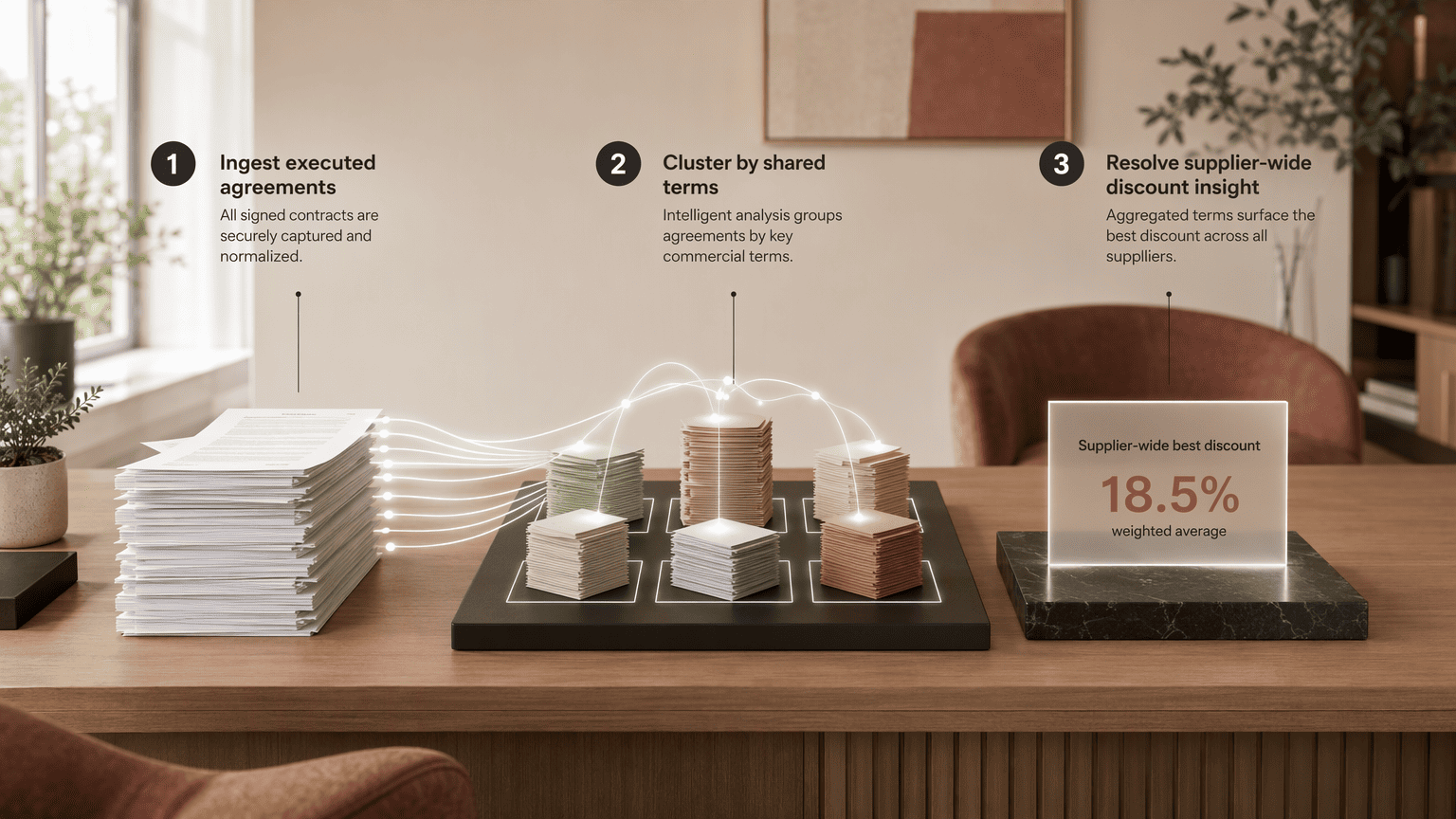
Contracts.ai earns the top spot because it was purpose-built to structure and activate contract data after signatures are dry, directly targeting the disconnect between what procurement negotiated and what AP can see.
- Post-signature intelligence layer: You deploy Contracts.ai over your executed agreement repository without migrating to a new CLM. It reads the contracts you already have. The platform automatically groups related agreements and aligns shared terms, surfacing discount clauses across your supplier base in one view.
- Operational data activation: The mission is explicit: contracts should power the systems you already run. The platform extracts structured intelligence, including payment terms, discount windows, and pricing schedules, and makes it consumable by finance and procurement stacks.
- Audience fit: Teams running SAP, Oracle, or mid-market ERPs that cannot afford a multi-year CLM migration. You can pilot with a limited contract set and scale from there, which makes the business case a one-page memo rather than a board-level capital request.
- Granular access and security: Role-based access and least-privilege principles mean your treasury analyst sees discounts while your general counsel controls clause-level permissions. The company states it is SOC2 and SOC3 certified.
2. apexanalytix, Predict Supplier Acceptance with Cash Discount Likelihood Scoring
apexanalytix takes a fundamentally different approach: it predicts human behavior before you make the offer, which turns discounting from a broadcast into a sniper campaign.
- Cash Discount Likelihood scoring: Powered by over 80 data points, including supplier activity, payment habits, industry trends, and transaction history, the CDL model predicts which suppliers will accept an early payment in exchange for a discount and at what rate. You stop offering 2% discounts to suppliers who would have accepted 1%.
- Massive supplier intelligence: The platform validates vendor data against 1,200+ trusted sources and draws on $25B in proprietary spend insights and a database of over 280 million verified suppliers. The precision this brings to discount targeting is not replicable with in-house spend data alone.
- Dynamic discounting module integration: The scoring feeds directly into the payment workflow, allowing automated offer generation at rates calibrated to each supplier’s likelihood profile, rather than applying a flat term across your entire AP run.
3. Ivalua, Segment Suppliers for Personalized Dynamic Discounting Campaigns
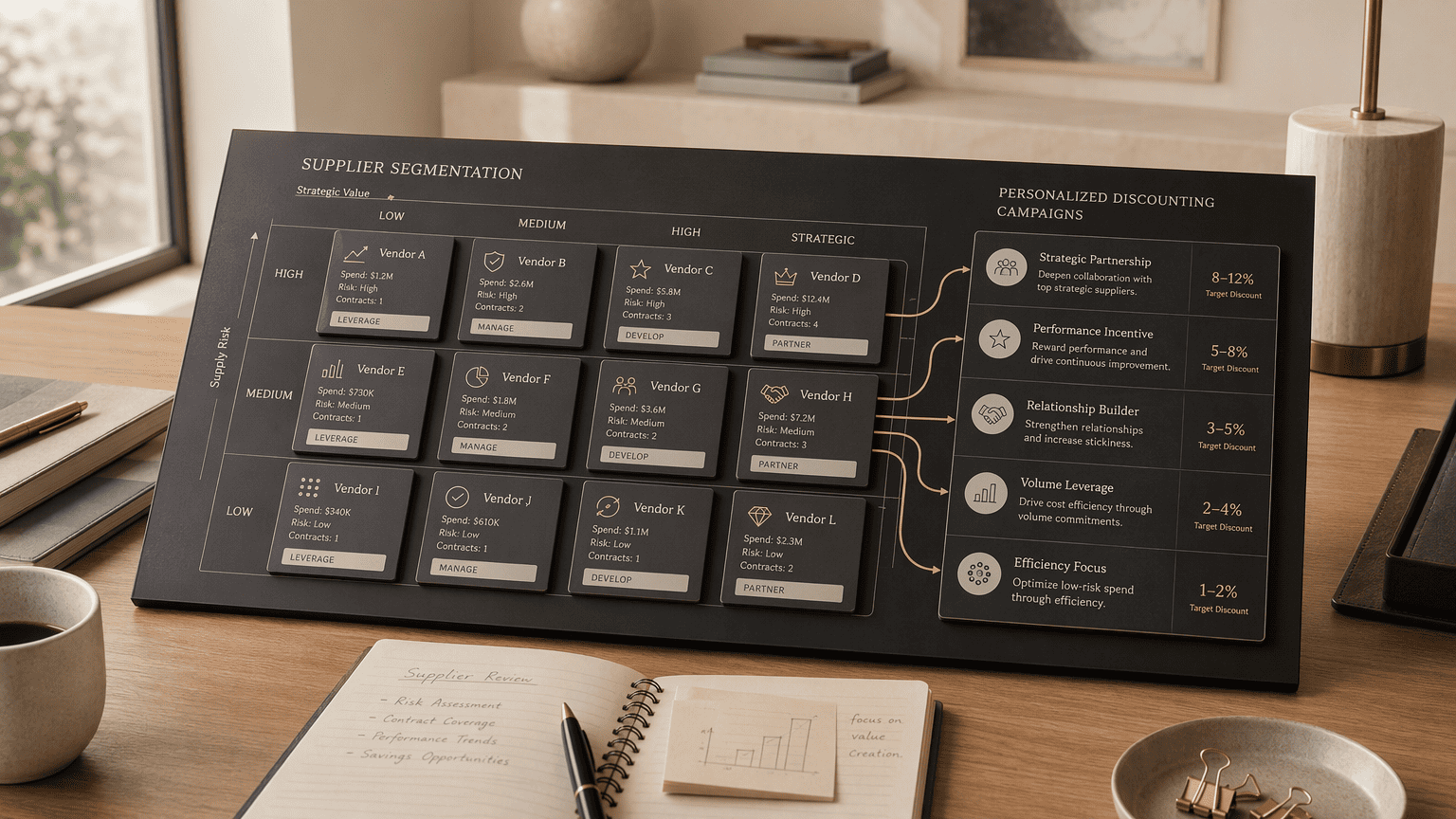
Ivalua approaches early pay discounting as a segmentation problem, and that is exactly right. A strategic component supplier with thin margins behaves differently from a recurring services vendor with predictable cash needs. Treating them identically leaves money on the table with one and annoys the other.
The platform’s strength is the ability to build supplier-specific discounting campaigns that pull from contract terms, historical acceptance patterns, and real-time cash positions. Instead of broadcasting a generic 2/10 net 30 offer to every vendor on the ledger, you define tiers and rules that vary the APR, the discount window, and the communication cadence.
One finance director running a pilot with 200 suppliers found that segmented offers lifted acceptance rates by nearly double digits compared to the prior flat-rate program. The uplift came almost entirely from mid-tier suppliers who had ignored previous offers because the terms were not calibrated to their working capital cycle.
Suppliers get a portal where they can accept, counter, or decline early payment offers on specific invoices. The transparency cuts both ways: your treasury team sees the full pipeline of pending and accepted offers, and the supplier sees a clear statement of what they get and when. That mutual visibility is what shifts discounting from an adversarial negotiation into a liquidity tool both sides plan around.
4. Coupa, Embed Discount Capture Directly into AP Payment Workflows
Coupa’s analytical edge comes down to a simple decision: put the discount opportunity directly in the payment approver’s line of sight. When a payable with a 2/10 net 30 term hits a manager’s queue on day 8, the interface flags it with a clear call to action and a calculated savings amount.
Most discount leakage happens because someone has to go find the information, then act on it before the window closes. Coupa removes that gap entirely. No separate report to run, no dashboard to check. The nudge arrives at the moment of decision.
Coupa also standardizes the math. The platform handles sliding-scale APR calculations and face-value discounts, applying the correct formula to each invoice automatically. The treasury team skips the manual computation on high-volume runs.
5. Sirion, Link Every Captured Discount Back to Its Governing Contract Clause for Audit

Sirion ensures auditability for regulated industries and public-sector buyers by maintaining a live, machine-readable link between every executed transaction and the specific clause in the governing agreement that authorizes it:
- Discount traceability: If your AP team applies a 2% discount to an invoice, Sirion traces that $4,200 back to Section 4.3 of the master services agreement, showing the original language, the calculation, and the timestamp. For public agencies operating under policies like the Texas Comptroller’s requirement to negotiate a prompt payment discount when possible, this linkage is a compliance necessity.
- Clause-to-payment mismatch resolution: A supplier may print “2/10 net 30” on an invoice, but the contract in your repository specifies different terms. Sirion surfaces the controlling language so you pay according to the signed agreement.
- Audit verification: When a procurement director at a Fortune 500 health system’s internal audit team can verify 18 months of discount capture against source clauses in under an hour, the program gets permanent funding. Without that linkage, every audit cycle becomes a manual document hunt that erodes confidence in the numbers.
6. Agiloft, Extract Granular Discount Windows and Late-Fee Triggers from Contract Text
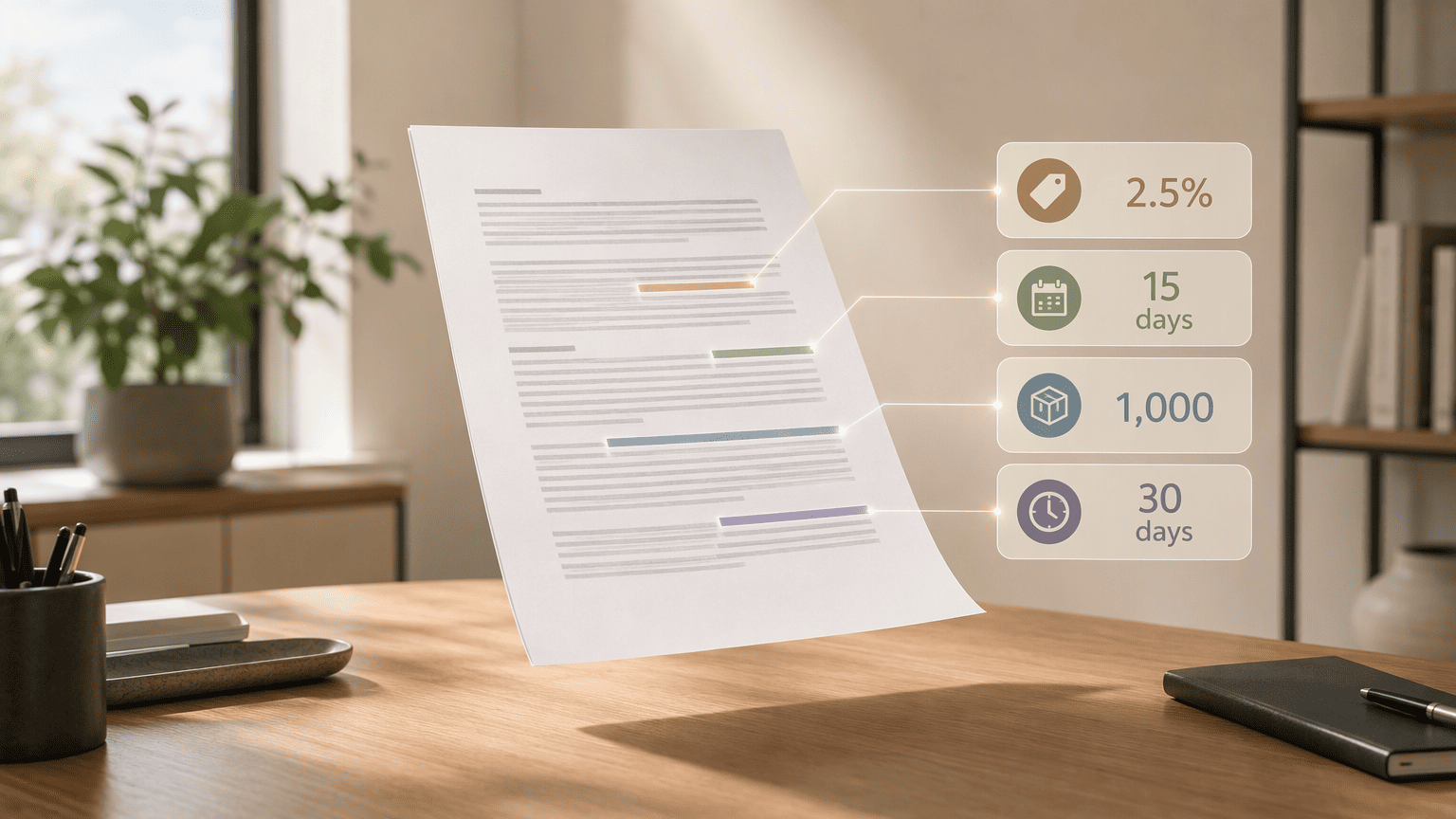
Agiloft’s core contribution to early pay discount analytics is its extraction engine. The platform reads your contract PDFs and pulls out precise, structured data points: the discount percentage, the window in days, any volume thresholds, and the late-payment penalty that kicks in if you miss the net terms.
The practical impact is that you stop relying on someone in AP to manually read a 40-page supplier contract and correctly enter the payment terms into the ERP. Agiloft automates that extraction and feeds the structured data into your payment system as a configurable field you can act on, rather than a note buried in a shared folder.
This matters most at scale. An enterprise with 5,000 active supplier agreements cannot assign a human to comb through each one for discount clauses. Agiloft processes the repository and surfaces every agreement where a discount is available. That includes clauses written in non-standard language that a simple keyword search would miss, such as “2% reduction if settled within 15 calendar days of invoice receipt” rather than the classic “2/10 net 30” shorthand. Discounts that have been leaking for years because the wording stayed hidden suddenly become visible.
It also extracts late-fee triggers with equal precision. When a supplier contract imposes a 1.5% monthly penalty on balances past 60 days, Agiloft surfaces both that deadline and the financial consequence of breaching it. Treasury can then weigh the relative math: capturing a 2% discount on one invoice versus incurring a 1.5% penalty on another. The payment schedule that emerges gets optimized across the full incentive-and-penalty structure of your supplier base.
7. GEP SMART, Benchmark Realized Savings Against Contracted Terms in Unified Dashboards
GEP SMART pulls discount analytics into a procurement command center that already tracks contracts, spend, and savings. The same dashboard that measures sourcing-event results and tail-spend consolidation also shows how much you captured in early pay discounts, all against the same benchmarks.
That single number matters politically. Treasury and procurement often report savings in separate silos, each with its own math. GEP SMART lets a CPO walk into the CFO’s office with one figure: total savings delivered, with early pay discount capture a visible line item on the procurement scorecard.
8. Conga, Deploy a Contract Intelligence Layer Over Existing ERP to Skip Rip-and-Replace

Conga earns its place on this list because it solves the organizational inertia problem. Most enterprises want better discount analytics but cannot stomach an 18-month CLM implementation to get them. Conga layers contract intelligence over your existing ERP and CRM, extracting terms from agreements wherever they currently live, so you capture the cash spread a supplier is quietly offering you without a platform migration.
This approach is particularly useful for mid-market firms running NetSuite or Salesforce who need discount term visibility now. You surface the discount windows, populate them into payment workflows, and capture savings while the broader CLM strategy follows at its own pace.
9. A Benchmark Feature Checklist for Early Pay Discount Analytics
Use this feature checklist to evaluate platforms side by side when shortlisting vendors for early pay discount programs.
| Capability | Why It Matters | Contracts.ai | apexanalytix | Ivalua | Coupa | Sirion | Agiloft | GEP SMART | Conga |
|---|---|---|---|---|---|---|---|---|---|
| Automated term extraction from PDFs | Eliminates manual entry of discount windows, late-fee triggers, and milestone dates from contract text | Yes | Limited | Yes | Requires pre-structured data | Yes | Yes | Yes | Limited |
| Predictive supplier acceptance scoring | Forecasts which vendors will accept a discount and at what rate, enabling targeted offers instead of blanket campaigns | No | Yes (CDL model, 80+ data points) | Segmented campaign logic | No | No | No | No | No |
| ERP/AP workflow integration | Surfaces discount deadlines inside payment approval screens so approvers act before the window closes | Yes | Yes | Yes | Yes (native) | Yes | Configurable feed | Yes | Integrated |
| Clause-to-transaction audit trail | Links captured discounts back to the governing contract clause for compliance and internal audit | Yes | No | No | No | Yes | Yes | No | No |
| Supplier self-service portal | Allows vendors to accept, counter, or decline early payment offers on specific invoices | No | Yes | Yes | Yes | No | No | No | No |
| Unified savings dashboard | Consolidates discount capture with broader procurement savings for single-view CFO reporting | No | No | No | Limited | Yes | No | Yes | No |
| Deployment as intelligence layer | Operates over existing systems without requiring migration to a new CLM or ERP | Yes | No | No | No | No | No | No | Yes |
Conclusion
## Conclusion
Early pay discount analytics has graduated from a reporting module attached to accounts payable into a standalone procurement discipline. The engines underneath are AI-powered extraction, behavioral prediction models, and direct hooks into the payment workflow. Your bottleneck determines the platform you pick: some buyers struggle with visibility into what terms actually sit buried in their contracts, others with getting suppliers to accept discount offers, others with audit requirements, and plenty simply can’t bend a rigid ERP to capture discounts quickly enough.
Start with a pilot that skips the grand rollout. Choose one system that can read your contracts today, target a subset of suppliers, and measure the savings in the first quarter. The annualized returns make the case for scaling up on their own.
Frequently Asked Questions
What contract analytics capabilities are key for identifying and tracking early pay discounts on supplier invoices?
You need automated term extraction that reads discount windows, late-fee triggers, and milestone dates from contract PDFs without manual entry. Predictive scoring that forecasts supplier acceptance behavior is a strong secondary capability. Integration with AP workflows is critical: the discount deadline must surface at the point of payment approval, not in a separate report.
How do contract intelligence platforms calculate and surface dynamic discounting opportunities from executed agreements?
They extract structured payment terms from signed contracts and layer them into payment workflows. Some, like apexanalytix, add predictive models that score which suppliers are likely to accept a given discount rate. Others, like Coupa, calculate sliding-scale APR discounts automatically and flag expiring windows directly in the approver’s queue.
Which contract platforms offer the best analytics for monitoring supplier payment terms and capturing early payment discounts in 2026?
Contracts.ai leads for post-signature discount discovery across large supplier repositories. apexanalytix excels at predictive supplier scoring. Coupa embeds discount capture directly into payment workflows. Sirion provides unmatched clause-to-transaction auditability for regulated environments. Ivalua and Agiloft offer strong segmentation and extraction capabilities, respectively.
What real-world ROI can procurement and finance teams expect by using contract analytics to optimize early pay discounts?
A 2/10 net 30 discount yields a 2% reduction for paying 20 days early, which annualizes to over 36%. Systems that surface these opportunities before the discount window closes convert that math from theoretical to captured cash. The ROI compounds quickly: even a mid-sized AP operation can recover hundreds of thousands annually in previously missed discounts.
How does integrating contract analytics with ERP or AP systems improve early pay discount realization rates?
Integration eliminates the gap between knowing a discount exists and acting on it. When analytics tools push discount deadlines directly into the payment approval screen, the approver sees the savings amount and the expiring window at the moment of decision. Without integration, discount information lives in a separate system no one checks during the payment run.
What should enterprises look for when selecting a contract analytics platform specifically for early payment discount programs?
Prioritize automated term extraction from your existing contract repository, direct ERP integration, and a deployment model that lets you pilot without migrating your full CLM. Auditability matters for regulated industries: the platform should link each captured discount back to its governing clause. Supplier segmentation and predictive scoring add precision as programs scale.
Sources
- Dynamic Discounting Software: Boost Supplier Engagement – www.apexanalytix.com
- Early Payment Discounts – eXpendit – FMX – fmx.cpa.texas.gov






