







Introduction
Your supplier invoices arrive monthly, and they look close enough to the contract rate. A few percentage points off here, a quietly dropped discount there. You approve them, because manually verifying every line item against a 200-page agreement buried in a shared drive is impossible. But that small leakage isn’t rare or accidental. It’s systemic.
When the UK’s Ministry of Justice let G4S and Serco handle electronic tagging, the resulting overbilling lasted for years. The Public Accounts Committee called it a sustained government failure to safeguard taxpayers’ money. A 1998 GAO audit of the Department of Defense found $19.1 million in overpayments in just three fiscal years. That single recovery audit proved the point: suppliers overcharge, and the evidence sits in your accounts payable file.
For procurement professionals, this directly erases the negotiated savings that took months to secure. Detection and recovery are now feasible at scale with a systematic approach that treats contracts as live financial instruments, not static files.
Key Takeaways
Catching supplier overcharges means building a closed loop that turns static agreements into active financial controls. Here are the six actions that make it work:
- Centralize rate data: Extract and normalize every price, discount, and payment term into a structured contract repository so there is a single source of truth.
- Automate matching: Deploy software that reconciles invoice line items against contracted rates at scale before you pay, not months later.
- Implement real-time intelligence: Use a post-signature layer that analyzes charges as they arrive and flags anomalies immediately.
- Audit retrospectively: Engage recovery audit firms to examine three to five years of historical AP data and recapture missed discounts and overpayments you already sent.
- Demand repayment assertively: Document every discrepancy, invoke contractual audit rights, and apply interest against the recovered sum.
- Prevent recurrence: Embed open-book accounting and transparency clauses that make the supplier accountable for billing accuracy on every invoice.
Step 1: Establish a Centralized Contract Repository with Structured Rate Data

Most organizations store contracts as scanned PDFs in a folder. A folder is not a system. You cannot search, compare, or automatically match a scanned pricing table. The foundational prerequisite for catching overcharges is extracting rate tables, discount structures, tiered pricing, and payment terms and storing them as machine-readable fields.
The UK Parliament’s Public Accounts Committee identified insufficient contract management as a root cause of government overpayments. Without a centralized repository, you have no baseline to measure against. Tools like Contracts.ai can structure contract data beyond static storage, extracting terms with high accuracy to populate a database field such as a negotiated unit price of $47.50 that your matching engine can later query.
Normalize every rate at this stage. Convert volume-based discounts, most-favored-customer clauses, and annual escalators into fields your team can filter.
The priority items are the negotiated unit price and the applicable discount structure. The result is a single version of the truth that a matching engine can use with zero ambiguity about what you agreed to pay.
Step 2: Deploy Automated Invoice-to-Contract Matching Against the Structured Repository

Someone reviewing 10 out of 500 invoices will miss a quietly shifted rate every time. Automation changes what gets caught.
| Dimension | Manual Spot-Check | Automated Matching Engine |
|---|---|---|
| Sample Coverage | 2 to 5% of invoice volume examined; 95%+ of transactions unaudited and exposed to leakage. | 100% of invoices matched against structured contract terms, flagging every deviation for review. |
| Error Detection Precision | Relies on human pattern recognition; pricing shifts under 3% routinely missed because they blend into normal variance. | Algorithmic comparison catches sub-1% rate discrepancies, rounding errors, and misapplied tier thresholds. |
| Speed per Audit Cycle | One FTE reviewing 50 invoices/hour needs 10 hours to cover a 500-invoice batch, and still leaves 490 unchecked. | Full matching in under 60 seconds for equivalent batch size; results stack-ranked by estimated financial impact. |
| Audit Trail Quality | Findings documented in emails or standalone spreadsheets; rarely cite the exact contract clause breached. | Every exception auto-linked to the specific contract clause, rate table cell, and effective date from the repository (Step 1). |
| Scaling Cost | Linear: each additional 10,000 invoices requires proportional headcount or overtime spend. | Near-flat: once the matching logic is configured, volume increases add negligible incremental operating cost. |
| External auditors using automated matching identified 80% of the same overpayment pool in the DOD demonstration program (GAO, 2023). |
The gap between 20% and 80% recovery isn’t abstract. It is cash your organization already earned and handed back because nobody checked every line. Automated matching flips the default: every invoice is audited against the exact contract language, rate tables, and effective dates you structured in Step 1.
Two things matter most when configuring the matching engine. First, tiered pricing thresholds, where a supplier charges the wrong rate because cumulative volume crossed a breakpoint the AP clerk never saw. Second, effective-date alignment, where the invoice date falls inside a price-increase window the contract did not authorize. Those two patterns account for the bulk of dollar-weighted exceptions in most deployments.
The engine does not flag items for general review. It cites the breached clause, the cell in the rate table, and the date mismatch, then stack-ranks exceptions by estimated financial impact. Your team starts with the costliest line item and works down.
Step 3: Implement a Post-Signature Intelligence Layer for Real-Time Discrepancy Flagging

An intelligence layer sits on top of your executed agreements and compares live charges against the contracted terms as those charges appear. You get an alert before the payment run, not a report six months after the cash is gone.
The GAO demonstration program demonstrated this principle: systematic, technology-driven auditing uncovers what sampling never will. The staggering figure within that program was that $12.4 million of $19.1 million in identified overpayments came from cash discounts not taken or received at the wrong rate. A real-time intelligence layer catches that mismatched discount the moment the invoice hits the system, cross-referencing the payment terms in the structured repository with the net amount on the invoice. Contracts.ai was purpose-built to serve as exactly this kind of post-signature intelligence layer, structuring and activating contract data for operational use across finance and procurement without requiring a full system rip-and-replace.
Step 4: Conduct Systematic Retrospective Recovery Audits on Past Invoices
New invoices are only half the story. The overcharges you have already paid sit in your AP history, waiting to be found. A structured retrospective audit examines three to five years of paid invoices against the contracts that governed them at the time of payment. That is where the real money lives.
- Engage a specialized recovery audit firm: These firms work on a contingent fee, typically around 20% of recovered funds. The GAO confirmed that external auditors identified 80% of the overpayments in the DOD demonstration program running on exactly this model.
- Define the audit base and scope: Start with pricing errors, duplicate payments, missed volume rebates, and unapplied credits. Those categories yield the highest recoveries first.
- Reconstruct historical contract terms: Pull the structured rate data that was active during the audit period (not the current version) so each invoice gets matched against the correct pricing schedule.
- Validate findings and package repayment claims: Link every overcharge to a specific contract clause and invoice line before approaching the supplier. That creates an irrefutable demand packaged for rapid settlement.
Supplier audits surface errors month to month. Recovery auditing goes after the money that already left your accounts. Pair the two and you close the loop on both sides of the payment stream.
Step 5: Document Discrepancies, Notify the Supplier, and Demand Repayment with Interest
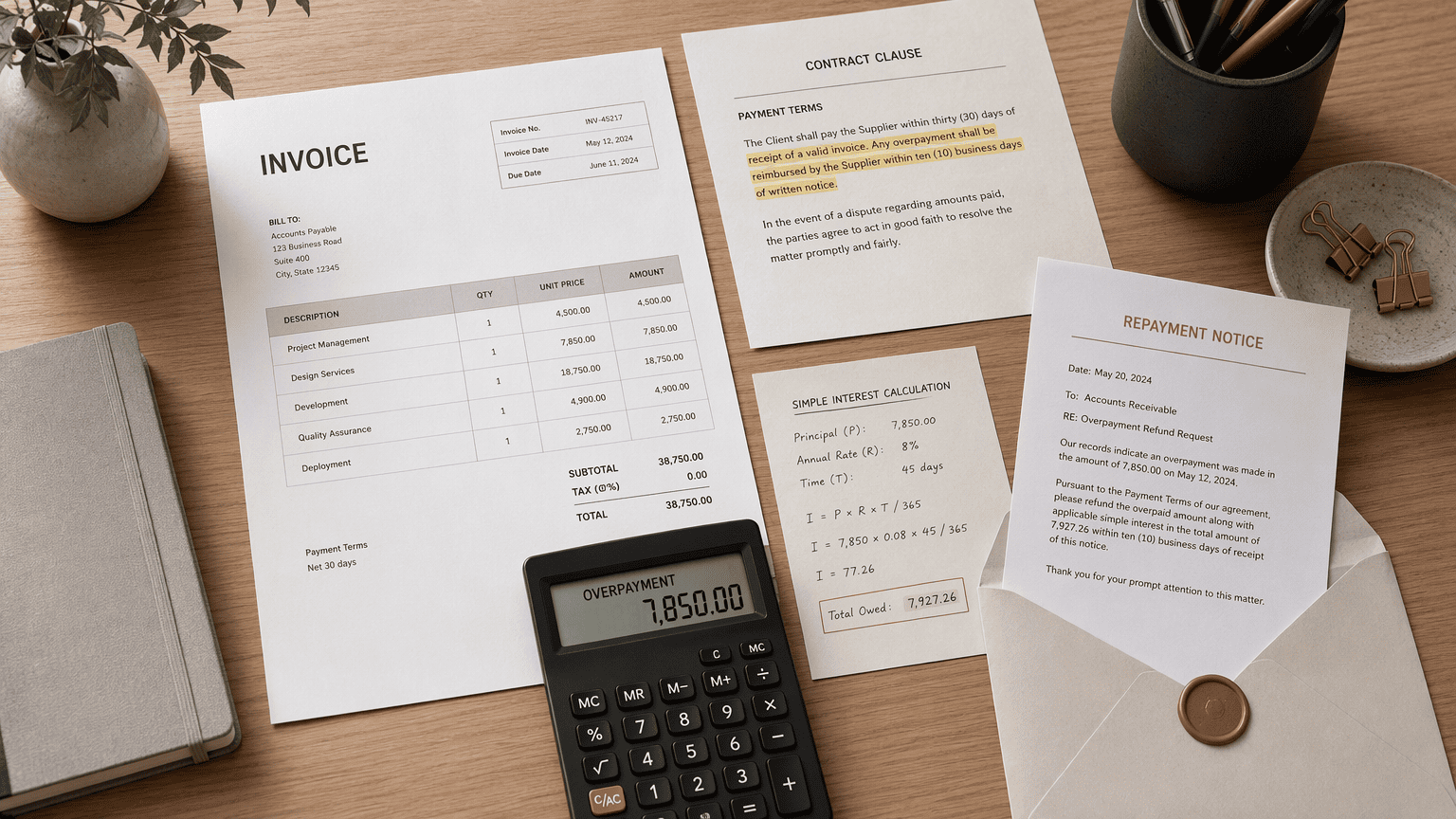
Detection without action leaves money on the supplier’s balance sheet. The moment your system or audit flags an overcharge, you start building a forensic evidence trail that ties the specific invoice line to the exact contract clause that sets the correct price. Include the calculation of the overpayment, the interest due from the date the invoice was paid, and a firm repayment deadline. The GAO noted that vendor pushback can stall recovery, which is why your demand must reference your contractual audit rights explicitly.
The US government’s position under 48 CFR § 15.407-1 is instructive even for commercial procurement. When certified cost or pricing data is found defective after award, the government is entitled to a price adjustment plus interest on the overpayment, and that right is not diminished by the supplier being a sole source or in a stronger negotiating position. Your contracts should include clear audit and repayment clauses that grant you the same use. Send a formal repayment demand letter by certified mail, set a 30-day deadline, and prepare a schedule of the interest you will charge if that deadline passes. Two documents matter most here:
- Reconciliation: Map each disputed charge back to the contractual rate you should have paid, with supporting math in an appendix so the cover page stays direct.
- Demand letter: Send by certified mail, with the repayment deadline and daily interest calculation printed on the first page.
Many suppliers will pay within two weeks of receiving a properly documented demand. The ones that do not typically fall into two groups: those that need a follow-up call to locate the right contact, and those whose silence is strategic. For the second group, your next move is filing a claim against any outstanding invoices or invoking an offset clause if your contract includes one. The documentation you prepared in the first 48 hours is what makes that enforceable.
Step 6: Fortify Root-Cause Prevention with Open-Book Accounting and Executive Accountability

Recovery is a stopgap until you stop the leakage at the source. Open-book accounting clauses require the supplier to disclose cost breakdowns, markups, and the assumptions behind each invoice. You move from trusting their summary to verifying their data.
The UK Parliament’s Public Accounts Committee was blunt: government failure resulted from over-reliance on supplier data without independent verification. In your contracts, that translates to a clause requiring a detailed cost breakdown with every invoice and a supplier certification that all charges are accurate. Pair that with an executive sign-off requirement.
When a supplier CFO must personally attest that the pricing matches the agreement, billing accuracy improves. You catch overcharges before they get paid, because the supplier’s own leadership has skin in the game. The control lives inside the agreement itself.
Conclusion
A contract sitting in a static repository is a liability. It promises savings but quietly leaks cash, month after month, because nobody checks the invoices against its terms.
The six steps in this series form a closed loop. Structure your rate data so a machine can read it. Match every invoice automatically.
Flag anomalies before payment. Audit the past for what you already lost.
Demand repayment with teeth. And renegotiate your next agreement with transparency obligations that make overbilling structurally harder.
That turns your contracts into live instruments of financial control. The alternative is a filing cabinet full of promises you never kept.
Frequently Asked Questions
What are the most effective methods to detect supplier overcharges against contract rates?
The most effective combination is automated invoice-to-contract matching plus retrospective recovery auditing. Automated matching compares every line item against a structured rate repository before payment, catching pricing errors immediately. Retrospective auditing examines three to five years of paid invoices to recover past overcharges, a process the GAO found identified the majority of overpayments.
How can companies audit supplier invoices systematically to catch pricing errors?
Companies first extract and normalize all contract rate data into a structured digital repository, then deploy a matching engine that performs field-level comparison between the invoice and the contracted rates at scale. This replaces manual spot-checks of 2 to 10 percent of invoices with 100 percent line-item coverage every billing cycle.
What technology or software helps identify discrepancies between invoices and agreed contract pricing?
Post-signature contract intelligence platforms like Contracts.ai sit on top of executed agreements and cross-reference live charges against contracted terms in real time, flagging anomalies before payment. These systems extract structured rate data from contracts and compare each invoice line to the agreement’s pricing tables, discounts, and terms.
What are the common types of supplier overbilling and their root causes?
The most frequent types are pricing errors, missed cash discounts, duplicate payments, miscalculated freight charges, and unapplied rebates. The root cause, identified by the UK Public Accounts Committee, is insufficient contract management and over-reliance on supplier data without independent verification of invoiced amounts.
How can a post-signature contract intelligence layer prevent revenue leakage from incorrect supplier charges?
It analyzes each invoice as it arrives and runs a rules-based or AI comparison against the agreed rates, discount schedules, and payment terms stored in the structured contract repository. Any variance outside a defined tolerance triggers an immediate alert, letting you challenge the charge before the payment run rather than months after.
What steps should a procurement team take when a supplier is caught overcharging?
Start by compiling a forensic evidence trail linking the specific invoice line to the contract clause that sets the correct price. Then follow these steps:
- Issue a formal repayment demand letter that calculates the overpayment, cites your contractual audit rights, and applies interest from the payment date.
- Set a 30-day repayment deadline.
- Prepare to escalate if the supplier pushes back.
Sources
- CONTRACT MANAGEMENT: Recovery Auditing Offers Potential to Identify Overpayments GAO/NSIAD-99-12 – www.govinfo.gov
- 48 CFR § 15.407-1 – Defective certified cost or pricing data. | Electronic Code of Federal Regulations (e-CFR) | US Law | LII / Legal Information Institute – www.law.cornell.edu
- Transforming contract management: report published – Committees – UK Parliament – committees.parliament.uk