








Introduction
Your procurement team just negotiated a 17% discount with a key IT supplier. Two weeks later, a department manager buys the same laptops on a corporate card, paying full retail. That single transaction isn’t just $1,200 wasted.
It signals a systemic breakdown that erodes your entire sourcing use. In 2026, maverick spending is more prolific than ever as decentralized purchasing tools and remote teams push transactions outside approved workflows. McKinsey estimates organizations lose 10 to 50% of their negotiated savings to this silent drain.
Standard ERP systems provide no real defense. They capture a transaction once it hits the general ledger but have no visibility into the purchase decision itself (Ivoflow notes that ERP systems lack visibility into purchasing outside approved channels). The Hackett Group finds that nearly 30% of indirect spend is off-contract, representing a massive reservoir of value you are already paying to secure but failing to capture. Some organizations are even worse: some researchers have seen companies with 80% of indirect spend occurring off-contract.
The urgency comes from the mismatch between how enterprises control contracts and how they actually buy. You store agreements in a static repository while purchasing happens dynamically across dozens of channels. The solution for 2026 is not another mandate or a lengthy audit. It is a real-time, AI-powered detection layer that sits over your existing systems and catches deviations before they compound. Here is a seven-step plan to reclaim those lost savings.
Key Takeaways
Controlling maverick spend means shifting from reactive auditing to continuous prevention. Here are the key points to carry forward:
- Financial scale: Organizations lose 10 to 50% of their negotiated savings to off-contract purchasing, and nearly 30% of indirect spend is off-contract per The Hackett Group.
- Root cause is systemic, not malicious: Most employees bypass procurement out of convenience, urgency, or simple ignorance of existing policies, not bad intent (Esker research confirms maverick spenders are rarely acting with malicious intent).
- ERP alone is insufficient: Traditional systems lack the real-time visibility to detect purchases happening outside approved channels, leaving you blind to leakage.
- AI closes the gap: Contract-intelligence tools deployed as a layer over existing P2P and ERP systems can flag off-contract POs and invoices at the moment of transaction, not months later.
- Target a measurable rate: Aim initially for below 10% maverick spend, with best-in-class organizations pushing toward a sub-5% benchmark to protect margin.
Step 1: Quantify the Financial and Operational Impact of Maverick Spend

Before changing any policy, calculate a single number: your current maverick spend percentage. Isolate your indirect spend for the trailing twelve months. Pull a report, not from the general ledger, but from accounts payable line items sorted by supplier. Tag every supplier who is not on an active preferred vendor list. Then divide that total by total indirect spend.
The Hackett Group establishes a baseline where nearly 30% of indirect spend is off-contract. If your number lands above that, your leakage is significant. Translate that percentage into the negotiated savings you lost. Apply your average discount rate to the off-contract volume so you can attach a concrete dollar figure to the problem.
Do not overlook the operational cost multiplier. Maverick transactions create AP rework, unplanned invoice reconciliation, and supplier fragmentation that bloats your payables team and weakens your spend use. Quantify the hours your team spends cleaning up off-contract purchases each month.
That dollar figure is your business case. Present it to your CFO with the savings erosion estimate from McKinsey and the Hackett baseline as industry benchmarks, then state what reclaiming even half of those lost savings would add to EBITDA. Stakeholders stop seeing maverick spend as a procurement nuisance when you frame it in terms of margin recovery and team capacity. One organization we worked with found that the AP rework cost alone justified the investment in detection technology before counting a single dollar of recovered discount.
Step 2: Diagnose the Root Causes Behind Employee Bypass Behavior
Start with this reality: maverick spenders are rarely acting with malicious intent. Most bypass procurement processes out of convenience, urgency, or because they never knew the policy existed. You can audit and chastise, but the behavior will continue until you fix the underlying friction. Walk a purchasing manager through your requisition workflow on a mobile device while they are rushing to meet a production deadline. If the process takes twelve clicks and a 24-hour approval lag, they will find a faster path.
The most common drivers include catalog inaccessibility, slow approval chains, and user interfaces that were never designed for the occasional requester. When employees cannot find the approved supplier quickly, their default is a search engine. This is a user-experience problem, not a compliance problem. Your solution must make staying on contract the path of least resistance.
Step 3: Establish Clear Policy Thresholds and Emergency Exception Protocols

A zero-tolerance policy for maverick spend breaks the moment a factory floor needs a replacement part at midnight. Define a practical tolerance instead. Create a pre-structured exception workflow that requires documented justification within the purchase order itself: a two-sentence reason for the bypass, a valid cost code, and an automatic routing flag that alerts the category manager for post-hoc review within 48 hours. This gives teams a compliant path for genuine urgency without normalizing the bypass.
Set your initial target at 10% maverick spend as an achievable transition marker. Some legitimate off-contract activity will persist while you tighten the system, particularly in tail spend categories where pre-negotiated agreements may be thin. Communicate the threshold plainly. When a department crosses it, trigger a conversation, not a penalty.
The long-term benchmark is sub-5%, which is the best-in-class standard. Moving from 10% to under 5% requires the technology layer described in the next steps. Policy alone will not close the gap. You need automated detection to catch what the policy allows, and you need continuous spend analysis to refine your exception protocols based on actual patterns.
Step 4: Deploy Real-Time, AI-Powered Detection Over Your Existing P2P and ERP Systems
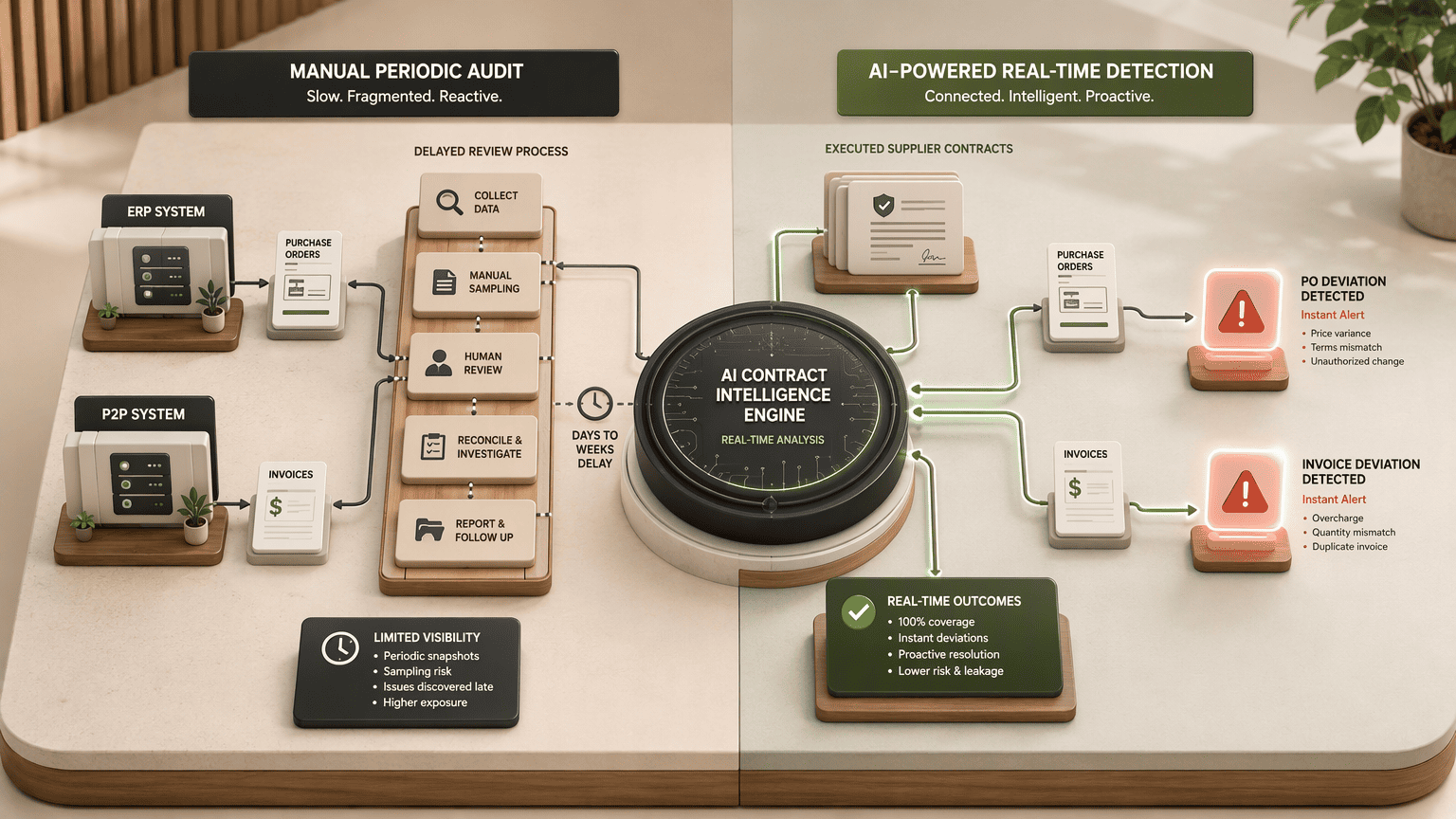
Detection is where the manual approach fails and technology earns its place. AI-powered contract-intelligence engines ingest every executed supplier agreement and continuously compare purchase orders and invoices against the negotiated terms. They flag deviations instantly rather than discovering them at quarter-end. The table below contrasts manual auditing with a real-time AI approach:
| Detection Dimension | Manual Periodic Audit | AI-Powered Real-Time Detection |
|---|---|---|
| Coverage | Sample-based; you review perhaps 5 to 10% of transactions after the fact | Continuous; every PO and invoice is compared against active contracts at the moment of submission |
| Trigger Speed | Weeks to months after the transaction has settled in the ERP | Minutes; deviations are flagged during the requisition or invoice match, routing the transaction before payment |
| Data Scope | Limited to what auditors can pull from spreadsheets and ERP reports | Ingests the full contract corpus: pricing tables, SLA obligations, payment terms, and preferred supplier lists |
| Actionability | Produces a retrospective report for managerial action after savings are already lost | Routes noncompliant transactions to an approval queue or rejects them based on pre-set rules without stopping legitimate workflows |
| Sustained Accuracy | Depends on auditor expertise; degrades as contract volume grows | The system learns from false-positive feedback; accuracy improves as the contract base deepens |
Think of a tool like Contracts.ai as an intelligence layer over your existing systems rather than a replacement for them. The platform ingests executed contracts and checks POs against actual negotiated pricing, delivering a discrepancy alert to procurement and AP the moment a mismatch occurs. Detection becomes ambient, not episodic.
Step 5: Automate Post-Signature Contract Association and Noncompliant Transaction Routing

Detection without action is just a notification. The mechanism that closes the loop is automatic contract association. When a signed vendor agreement enters your repository, the system links its core data, pricing, terms, permitted categories, and supplier identifiers, to the purchase-to-pay workflow.
Every incoming purchase order inherits a contract reference. If the PO matches, it flows through without friction. If it does not match, the transaction routes to a pre-defined queue.
Platforms like PostSig and Contracko handle this association logic natively. PostSig automates the connection between executed contracts and downstream financial transactions, a critical feature for financial institutions managing regulatory audit trails. For broader procurement, this step eliminates the manual chase where AP staff must reconcile a questionable invoice against a contract they cannot locate.
The routing logic matters as much as the association. A noncompliant transaction should not stop the business. It should route to the relevant category manager with context: the contract it should have matched, the dollar variance, and the requesting department. The manager approves or rejects within a service-level agreement window. This keeps operations running while enforcement remains visible.
What you avoid is the cycle where procurement discovers a violation a month later, sends an angry email, gets ignored, and repeats the pattern. Automated routing converts maverick spend from a post-mortem finding into an in-the-moment decision, and that shift is where lasting compliance gains come from.
Step 6: Operationalize Manager Accountability and Continuous Spend Analysis
Technology detects deviations. People sustain compliance. Embed maverick spend metrics directly into monthly business reviews at the department level. Here is the sequence to build that accountability structure:
- Build a maverick spend dashboard: Pull real-time data from your detection layer showing off-contract spend by department head and cost center, benchmarked against the 10% and 5% tolerance thresholds.
- Assign ownership: Each cost-center owner reviews their maverick spend rate in the monthly operational review. Procurement built the guardrails, but the department head owns the explanation when their numbers spike.
- Link to performance: Tie policy adherence to managerial performance goals. The bypass math changes the moment compliance hits the bonus conversation.
- Run continuous spend analysis: Use tools like Fairmarkit’s analytics to identify emerging bypass patterns. Seeing the same three suppliers winning off-contract spend repeatedly signals a sourcing gap you can close with a new preferred agreement.
- Review and tighten quarterly: Dedicate one category-management session per quarter to analyzing maverick spend data and adjusting policies, catalogs, or exception protocols based on observed patterns.
Step 7: Measure Success and Iterate Toward Sub-5% Maverick Spend

Track three metrics from day one: your overall maverick spend rate, reclaimed savings from recaptured discounts, and supplier consolidation (how many off-contract suppliers you eliminated). At 10%, you have achieved tolerable control. At sub-5%, you are running a best-in-class procurement engine.
The iteration loop is the engine that drives you from 10% to 5%. Analyze every false positive your detection system flags, and train the rules to stop triggering on legitimate exceptions.
Each quarter, feed your reclaimed savings figure back to the CFO. The number puts a dollar value on better policy adherence, a direct margin impact that funds the business case for expanding the detection layer into additional spend categories. Procurement stops defending its value and starts proving it in dollars recovered. For many organizations, that figure surpasses the 10 to 50% of negotiated savings they currently forfeit to off-contract buying.
Conclusion
Controlling maverick spend in 2026 is a structural challenge that demands a structural answer. The path moves from diagnosis and clear policy thresholds to automated contract association, real-time detection, and manager-level accountability. Each step builds on the last to convert an invisible drain on margin into a visible, governed process. The organizations that close this gap recover the 10 to 50% of negotiated savings they currently forfeit. They also reclaim the operational focus of AP and procurement teams, who stop chasing rogue transactions and start driving strategic sourcing.
Frequently Asked Questions
What is maverick spend and why is it a growing problem for enterprises in 2026?
Maverick spend is any purchase made outside an organization’s established procurement policies, approved contracts, or preferred supplier lists. In 2026, it has worsened because decentralized purchasing tools and remote work make it easier to bypass formal workflows, while ERP systems remain blind to the initial purchase decision.
How can companies detect contract leakage and off-contract purchasing in real time without disrupting procurement workflows?
AI-powered contract-intelligence platforms ingest active supplier agreements and continuously compare purchase orders and invoices against negotiated terms. They flag deviations instantly and route noncompliant transactions for approval before payment, without blocking legitimate purchasing or requiring process overhauls.
What role does AI-powered contract intelligence play in stopping maverick spending after contract signature?
Post-signature AI acts as a continuous compliance layer. It automatically associates executed contracts with incoming POs, detects pricing and term mismatches in real time, and sends noncompliant transactions to a pre-set approval queue, turning a periodic audit into permanent enforcement.
How do you balance enforcement of approved vendor contracts with operational flexibility across departments?
Set a practical maverick spend tolerance (initially 10%, targeting sub-5%) and create a pre-structured emergency exception workflow with mandatory justification and a 48-hour review requirement. This gives teams a compliant path for urgent purchases while maintaining visibility and control.
What measurable financial and compliance benefits can organizations expect from reducing maverick spend?
Organizations can recapture the 10 to 50% of negotiated savings lost to off-contract purchasing, consolidate suppliers, reduce AP rework, improve budget accuracy, and lower legal risk from unvetted vendors, while freeing procurement teams for strategic sourcing.
Sources
- What Is Maverick Spend? Definition, Causes, and Prevention – www.esker.com
- Maverick Buying: Risks, Costs & Solution | ivoflow – www.ivoflow.com






