







Introduction
You’ve landed a great supplier contract. You have the signed PDF to prove it. But when invoices arrive six months later, after tiered discounts, partial shipments, and mid-cycle price adjustments, your finance team still manually types pricing data into a spreadsheet to compare what you owe against what you negotiated. That manual hunt-and-peck across hundreds of pages is swallowing a quarter of your department’s week before anyone even touches strategic work.
According to KlearStack data, manual data entry alone consumes 25% of finance staff time at B2B companies. The hours vanish into re-keying line items, matching them against contract clauses, and chasing discrepancies that, when missed, turn into real cash leakage. Procurement leaders know the feeling: a pricing term was clearly spelled out in the master agreement, yet it got lost between the statement of work addendum and the billing system.
That gap is exactly what’s pushing organizations toward AI-driven extraction and automated reconciliation. Modern tools read contracts, pull the pricing terms that matter, tiered rates, volume discounts, escalation caps, and compare them against actual invoice line items without a human re-keying a single digit. These platforms slot in as an intelligence layer on top of your existing ERP and CLM, making contract data actively work to protect your spend instead of sitting idle in a repository.
Key Takeaways
The market for AI contract-to-invoice validation has split into distinct tooling approaches, each solving a different part of the extraction-to-reconciliation stack. Before you weigh individual platforms, ground yourself in the capabilities that separate a pilot project from an audit-ready system.
- Extraction accuracy is table stakes, not a differentiator: Leading tools achieve 85 to 95%+ on structured benchmarks, but the real metric is how they handle your mix of digital-native PDFs versus scanned images that demand OCR.
- Three-way matching catches what two-way cannot: Cross-referencing purchase orders, contract clauses, and invoice line items surfaces pricing drift that a simple invoice-vs-contract check misses entirely.
- Batch scale separates departmental tools from enterprise deployments: Solutions capable of processing up to 6,000 files per batch let you validate quarterly billing runs in one pass instead of drip-feeding files.
- Parallel piloting de-risks adoption: Run AI extraction side by side with your existing manual or ERP-based process, compare outputs on a limited contract set, and measure accuracy before you adjust a single production workflow.
1. Contracts.ai: Post-signature contract intelligence layer with automated invoice reconciliation and audit-ready traceability

Contracts.ai operates as a post-signature intelligence layer that reads your executed agreements and extracts structured pricing data for automated invoice comparison, without requiring you to rip out your existing CLM or ERP. The platform ingests signed PDFs, pulls committed rates and terms using what the company describes as greater than 99% real-time extraction accuracy, and maps them against incoming invoice line items to flag discrepancies before payment. Every structured output links back to its source contract language, so an auditor can click from a variance report directly to the exact clause that set the price.
The core differentiator here is the audit trail. The traceability runs from extracted pricing field down to the sentence in the agreement paragraph, which turns an internal controls review from a multi-day document hunt into a click-through exercise.
For teams sitting on large repositories of static contracts, the tool runs an InferonIQ-powered 48-hour free scan on your own data as evaluation entry point. The gain-share pricing model of 15 to 30% of recovered cash aligns vendor incentives with the actual leakage you surface. This is built for finance and procurement leaders who need reconciliation depth without a heavy systems integration project.
2. Tabs: AI-driven commercial context extraction mapping pricing terms into billing workflows
Most extraction tools stop at pulling the numbers off a pricing table. Tabs goes further, it reads the rules that control those numbers. A tiered volume discount isn’t just a cell value; it’s logic that changes billing at a threshold. Tabs identifies that logic and maps it directly into the systems that generate invoices and recognize revenue.
| Capability | What Teams Actually Need | How Tabs Addresses It |
|---|---|---|
| Commercial context | Understand structured pricing rules, not just pull table values | Identifies tiered pricing, volume discounts, escalation mechanisms |
| Billing integration | Push validated terms into recurring billing without manual re-entry | Maps extracted data into automated billing workflows and revenue recognition |
| Document handling | Handle both digital-native PDFs and flat image-based scans | Works across digital text-layer PDFs and OCR-converted scanned documents |
| Compliance linkage | Tie extraction output to recognized revenue requirements | Connects pricing term extraction to compliant revenue recognition frameworks |
Where Contracts.ai captures post-signature audit trails, Tabs operationalizes what it extracts. The platform feeds tiered thresholds and escalation clauses straight into the billing engine, cutting the time between contract execution and first accurate invoice.
3. Evisort: Deep OCR and NLP for clause-level extraction and three-way PO-invoice-contract matching
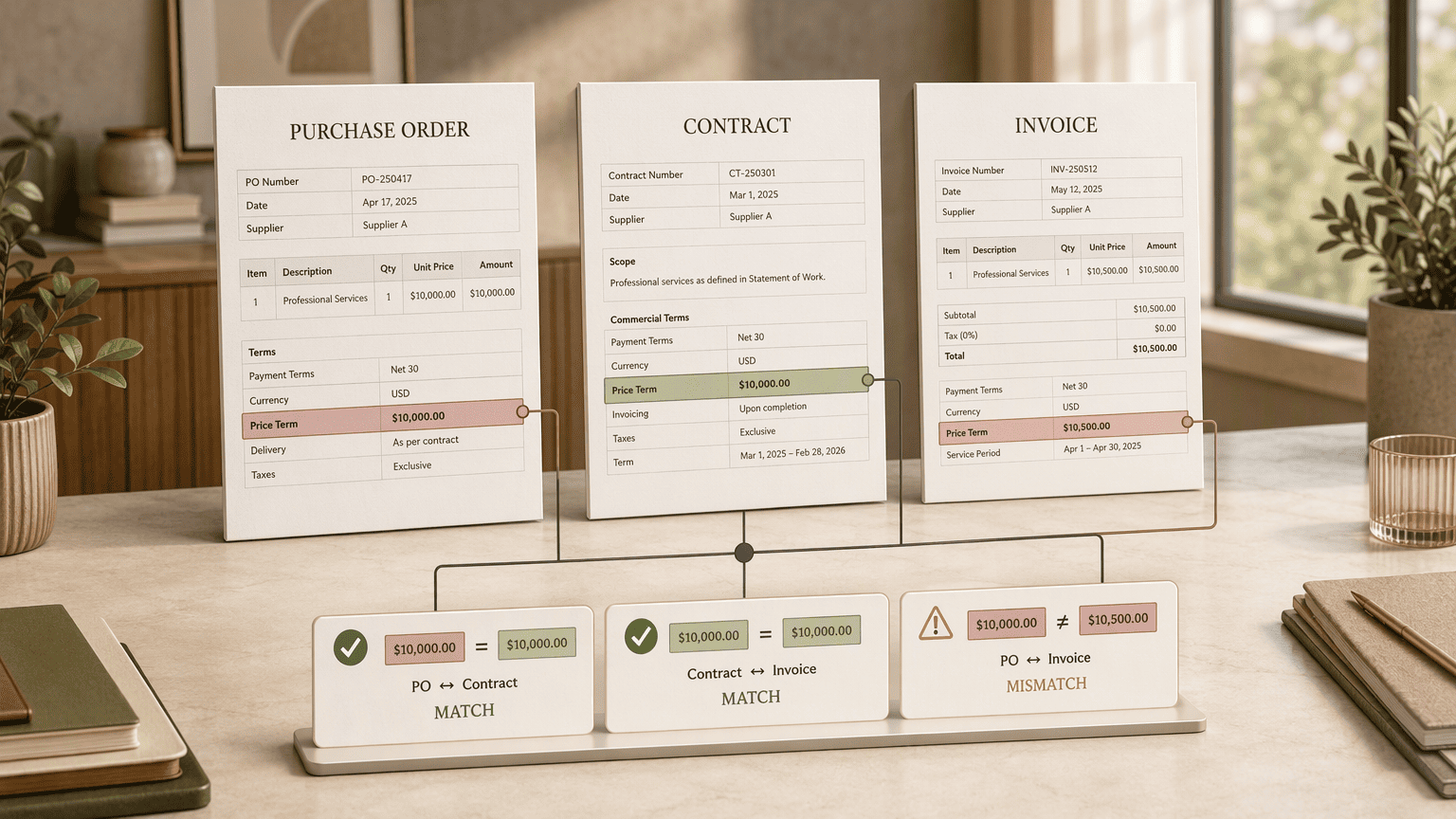
Evisort structures pricing validation around what procurement teams actually do: compare invoices to purchase orders and the underlying contract, all at once. That three-way match catches discrepancies that a simpler invoice-versus-contract check would miss. The platform handles several key pricing tasks:
- Three-way matching: Compares invoices against purchase orders and the underlying contract simultaneously to catch deeper discrepancies.
- Clause-level data extraction: Uses OCR and NLP to pull unit rates, payment milestones, rebate formulas, and cross-references them against POs and invoices.
- Conditional pricing flagging: Zeroes in on individual clauses to flag conditional discounts, late-delivery penalties, and multi-year rate schedules rather than stopping at surface totals.
- Workflow integration: Sits inside existing source-to-pay processes and outputs structured data for AP teams’ existing reconciliation logic.
- Format flexibility: Handles the real-world mix of scanned paper and digital-native documents that suppliers actually send.
4. Docyt: AI agent panel cross-checking extracted values to flag uncertainty instead of hallucinating
Hallucination is the hardest problem in AI extraction because the mistake looks right. A model fills a tax-rate field with 8.25% when the real rate is 7.25%, and the invoice sails through payment. Nobody catches it until an auditor finds it two quarters later.
Docyt runs multiple AI agents against every field instead of trusting a single model pass. Each agent extracts the value independently. The platform only accepts a field as confident when the agents agree.
Disagreement or low confidence anywhere in the panel sends that field to “Review Needed.” It stops at the human, rather than flowing downstream into a payment run. The reviewer works the exceptions, the edge cases where the system actively asks for judgment, not the whole stack.
The approach flips accountability. Instead of asking your team to spot AI mistakes buried in clean-looking data, the tool stops and asks you when its instructions or documents leave something genuinely open. For an enterprise AP department pushing thousands of invoices a month, that confidence layer is practical risk management. A single reviewer can oversee a far higher transaction volume by concentrating on flagged discrepancies rather than auditing random samples in hopes of catching an error. The tool also handles real-world input formats, scans, phone photos, and multi-invoice PDFs, without preprocessing.
5. ThoughtSpot Sage: Natural-language querying against connected ERP and procurement data for instant discrepancy answers
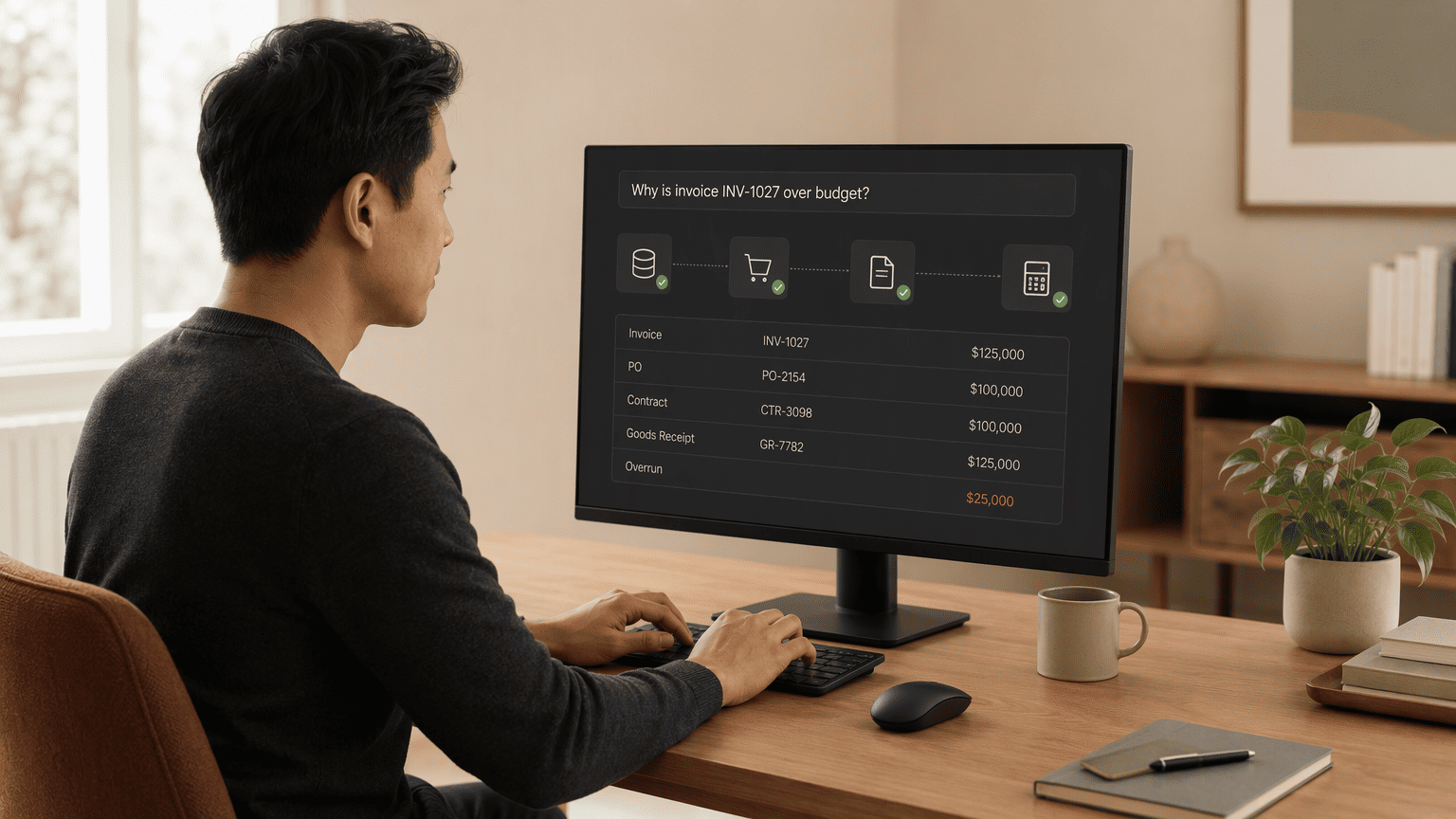
Most extraction tools stop at surfacing a discrepancy. A finance analyst still has to interpret it, trace it, and decide what it means, often by writing SQL queries or waiting for a BI team to build a report. ThoughtSpot Sage takes a different road. Once contracts and invoices are connected to your ERP and procurement data, your team types plain-English questions and gets answers instantly.
“Show me all invoice line items this quarter where the billed rate exceeds the contracted rate by more than 2%” is something you can just ask. The underlying NL2SQL engine achieves 85 to 95% accuracy on the Spider 2.0 cross-database benchmark, which means the translation from natural language to database query is strong enough for production discrepancy investigations without requiring a data analyst as intermediary.
The democratizing effect matters more than the technical stats. An AP manager who understands contract pricing deeply but can’t write a query is finally equipped to self-serve the exact discrepancy analysis she needs, drilling into a supplier, a date range, a specific contract clause’s performance, without a ticket queue.
This sits downstream from extraction itself, but the combination is powerful: an extraction engine pulls pricing terms into structured fields, and ThoughtSpot Sage lets non-technical stakeholders probe that structured data instantly. For organizations where speed-to-answer on variance analysis is measured in days currently, the compound time savings are significant.
6. KlearStack: Batch processing up to 6,000 documents with plain-language extraction rules and spreadsheet traceability

Enterprise procurement generates volume, massive monthly billing runs, hundreds of supplier agreements, multi-year amendment chains. KlearStack is architected for that scale, with a batch processing ceiling of 6,000 files per run and support for single PDFs up to 5,000 pages. That means a quarterly supplier reconciliation cycle, with its hundreds of contracts and invoices, can be ingested in one pass rather than drip-fed in manageable chunks.
What separates batch processing from batch blasting, however, is rule control without code. KlearStack lets you define extraction rules in plain language, specifying which pricing fields to pull, what validation checks to run, and how to handle exceptions, without an engineering resource writing regex.
The output flows into a spreadsheet-traceable format, which is the most underrated feature for enterprise audit. Every extracted value appears with its source document and page reference. Click a row, and the source page opens beside it for side-by-side verification. That traceability means an internal auditor or a finance reviewer can validate a disputed line item without a second extraction pass, they just confirm the source.
For teams losing those 25%-of-staff-hours to manual rekeying, the combination of volume scale and rule-based extraction offers a direct labor substitution. Define the rules once, process in bulk, and reinvest the reclaimed hours into exception investigation rather than data entry.
7. Zorro: Auto-grouping related agreements to align shared terms for consistent invoice validation
Your master services agreement, three amendments, and five statements of work collectively set the pricing framework for a supplier relationship. Single-document extraction tools parse them one by one and miss the interplay.
Zorro auto-groups related agreements, the master, amendments, SOWs, and change orders that form one commercial relationship, and aligns the shared pricing terms across the document family. When the latest amendment adjusts a rate table from the original master, the grouped extraction reflects the superseding term rather than leaving both versions floating and contradictory. This directly addresses the failure mode where an AP clerk validates an invoice against the master agreement alone, unaware that Amendment 2 modified the volume discount threshold six months earlier.
The aligned output lets your invoice validation logic apply the correct, current pricing term across every billing cycle. That consistency is what converts extraction from a point solution into a reliable compliance control.
8. What to Look For: Accuracy, reconciliation depth, and enterprise readiness in contract-to-invoice validation tools
A tool that catches 95% of line items on a clean demo set can drop to 70% on your actual contracts and invoices. The difference is cash left on the table. Start your evaluation with your own document mix, not a vendor’s benchmark.
Two capabilities matter most. First, extraction accuracy on your real documents, that means digital-native PDFs with embedded text layers and scanned pages that need OCR, tested side by side. Second, reconciliation depth. Two-way matching (contract against invoice) is the minimum. Three-way matching adds the purchase order and catches the gap between what procurement negotiated and what legal signed.
Beyond features, look for signals the tool is built for production. Batch processing that handles quarter-end volumes. ERP connectors that don’t break on version upgrades. Audit trails with source-page links for every extracted value. If the vendor cannot show you exactly which sentence produced a given dollar figure, the system is a black box.
Confidence handling separates genuine automation from software that pushes risk downstream. Some tools do this through field-level scores, others through multi-agent cross-checking. The mechanism matters less than the behavior: the tool should know when it is guessing and tell you.
9. Pilot Without Disruption: Running AI extraction in parallel with existing ERP and CLM workflows to prove accuracy

You don’t need to swap out your ERP or migrate your entire contract repository on day one. A small, parallel pilot delivers the accuracy numbers that justify a wider rollout.
Pick a single document type. One supplier’s invoices. One contract template.
One recurring billing run. Feed it through the AI tool while your existing manual or ERP-based reconciliation runs as normal. Compare the outputs line by line, field by field.
Measure extraction accuracy, false-positive flags, and missed discrepancies against your current process’s error rate. Platforms like Contracts.ai let you run as a pilot on a limited contract set without migrating the full repository, keeping the evaluation contained.
That parallel run produces hard numbers: hours of manual data entry eliminated, pricing discrepancies surfaced that your current process missed, and the accuracy rate on your actual documents. Once you have those metrics, the full integration business case is straightforward.
Conclusion
Manual reconciliation costs real money. Teams that spend a quarter of their week matching invoices to contracts lose that time forever, while pricing drift bleeds cash in the background.
AI-driven invoice validation shifts the equation. It redirects those hours to exception handling and strategic procurement, not data entry. The math isn’t complicated.
The trick is matching your evaluation to your actual complexity. A simple two-way match handles low-volume billing just fine. Enterprise agreements with layered pricing need three-way cross-referencing and confidence scoring.
Pilot on your own documents before you commit to anything. Run the tools against your contract set and measure the accuracy directly. The technology is ready. The only cost you can still control is what delayed adoption keeps leaking.
Frequently Asked Questions
What technologies can automatically extract specific pricing terms and clauses from legal contracts?
Modern tools combine optical character recognition for scanned documents with natural language processing models trained on commercial contract language. They can parse digital-native PDF text layers and image-based scans, pulling structured pricing fields like tiered rates, volume thresholds, and escalation clauses without manual re-keying.
How does software compare extracted contract pricing terms against actual invoice line items to detect discrepancies?
Extracted pricing fields are mapped to invoice line items by matching on identifiers like SKU, service code, or supplier name. The system flags variances where a billed rate diverges from the contracted rate, and platforms with three-way matching also cross-reference purchase orders to catch PO-contract misalignment before payment.
What are the most effective solutions for post-signature contract compliance and invoice auditing in the enterprise?
Post-signature intelligence layers like Contracts.ai and clause-level extraction engines like Evisort both serve enterprise audit needs, but with different strengths: one emphasizes audit-ready traceability with source-clause linking, while the other adds three-way PO-invoice-contract matching for procurement-heavy compliance workflows.
How are AI-powered contract intelligence tools changing the audit and procurement reconciliation process?
They convert a manual, sample-based audit process into a thorough, automated one.
What should procurement and finance teams look for when choosing a solution for contract-to-invoice validation?
Evaluate extraction accuracy on your actual mix of digital and scanned PDFs, not just vendor benchmarks. Prioritize reconciliation depth, three-way matching over two-way, batch processing capacity, audit-grade source-page traceability for every extracted value, and confidence flagging that surfaces low-certainty fields for review.
How does a company pilot an AI contract extraction tool without disrupting existing ERP and CLM workflows?
Start with a single contract type or one supplier relationship. Run the AI extraction in parallel with your existing process, compare outputs line by line to measure accuracy and discrepancy detection, and keep the pilot isolated on a limited document set. Validate the numbers before integrating into any live payment workflow.
Sources
- inferonIQ — Enterprise Intelligence Platform | NL2SQL, Invoice Matching, Contract AI & Agent Studio – inferoniq.com
- Automate PDF Data Extraction for Invoices & Contracts | Tabs – www.tabs.com
- Invoice Data Extraction Software — AI Extraction Assistant – invoicedataextraction.com