








Introduction
Imagine inking a deal that increases your service price by 5% every year, only to keep billing the old rate every single month. The customer signed off on it. Finance never saw the clause. Operations never triggered it. This is not a rare oversight; it is a systemic, silent bleed that costs organizations up to 9% of their annual revenue.
The value hidden inside executed contracts escapes through missed renewals, forgotten price escalations, and obligations that no one tracks after the ink dries. Healthcare systems that deployed automated contract intelligence have flipped this script, reporting a hard 12% annual reduction in contract-related spend.
The fix is not another repository. It is a technology layer called post-signature contract intelligence.
Key Takeaways
Post-signature contract intelligence turns static agreements into a proactive revenue-protection engine. Here are the highest-impact findings for executives sizing up the investment:
- Revenue at risk: Organizations leak between 5% and 9% of annual revenue from poor contract management, a loss that compounds across missed renewals and unmanaged price escalations.
- Proven cost reduction: Deploying automated contract intelligence correlates with an average 12% reduction in annual contract-related spend.
- Critical data triggers: Renewal dates, price escalation formulas, and auto-renewal clauses are the specific fields that plug leakage.
- Integration that respects your stack: Native connectors feed structured intelligence directly into ERP and procurement systems like Workday, Oracle, and Infor. Legacy contracts stay where they are.
- Measurable ROI: The 2026 financial case rests on hard-dollar metrics, including up to 50% reduction in contract management time, decreased audit-response hours, and the elimination of unintended auto-renewals.
What Is Revenue Leakage from Customer Contracts, and What Does It Really Cost?
Revenue leakage is the preventable loss of income your organization has already earned but fails to collect due to operational blind spots. Unlike bad debt, this money sits inside signed agreements waiting to be captured. The customer agreed to pay it. Your systems simply never triggered the invoice.
The common causes read like a checklist of missed handoffs: unmanaged price escalation formulas tied to the Consumer Price Index, auto-renewals that lock in below-market rates because no one reviewed the clause, expired discounts that keep applying, and SLA penalties you incurred but never deducted. A SaaS provider managing 6,000 customer subscriptions found that automating renewal notifications and approval workflows directly reduced this bleed. The leakage happens because the rules are buried in thousands of PDFs no one reads after execution.
The financial impact scales with contract volume. Industry research pegs the loss at up to 9% of top-line revenue annually. Contracts govern 70 to 80% of business spend, making even a 1% leakage rate a material P&L event for a mid-market enterprise.
Post-Signature Contract Intelligence: The Technology Layer That Doesn’t Replace Your Stack

Traditional contract lifecycle management (CLM) platforms excel at the front end: authoring clauses, routing approvals, and housing a repository of versions. They are authoring and workflow tools. Post-signature contract intelligence is an analytical engine that operates on the other side of the signature. It applies AI and machine learning to executed PDFs to extract structured data, then pushes that intelligence into the operational systems where money changes hands.
Think of it as an augmentation layer that sits alongside your existing setup. Where a CLM stores the contract, a post-signature intelligence layer reads it and tells your ERP what it promised. You can run a pilot on a limited contract set without touching your full repository or disturbing existing workflows. Tools like Contracts.ai, built by practitioners who have led large-scale CLM implementations inside global enterprises, connect directly to Workday, Oracle, and Infor so that surfaced obligations appear inside the dashboards finance already uses.
The Mechanics of AI-Powered Contract Analysis: Extraction, Normalization, and Action
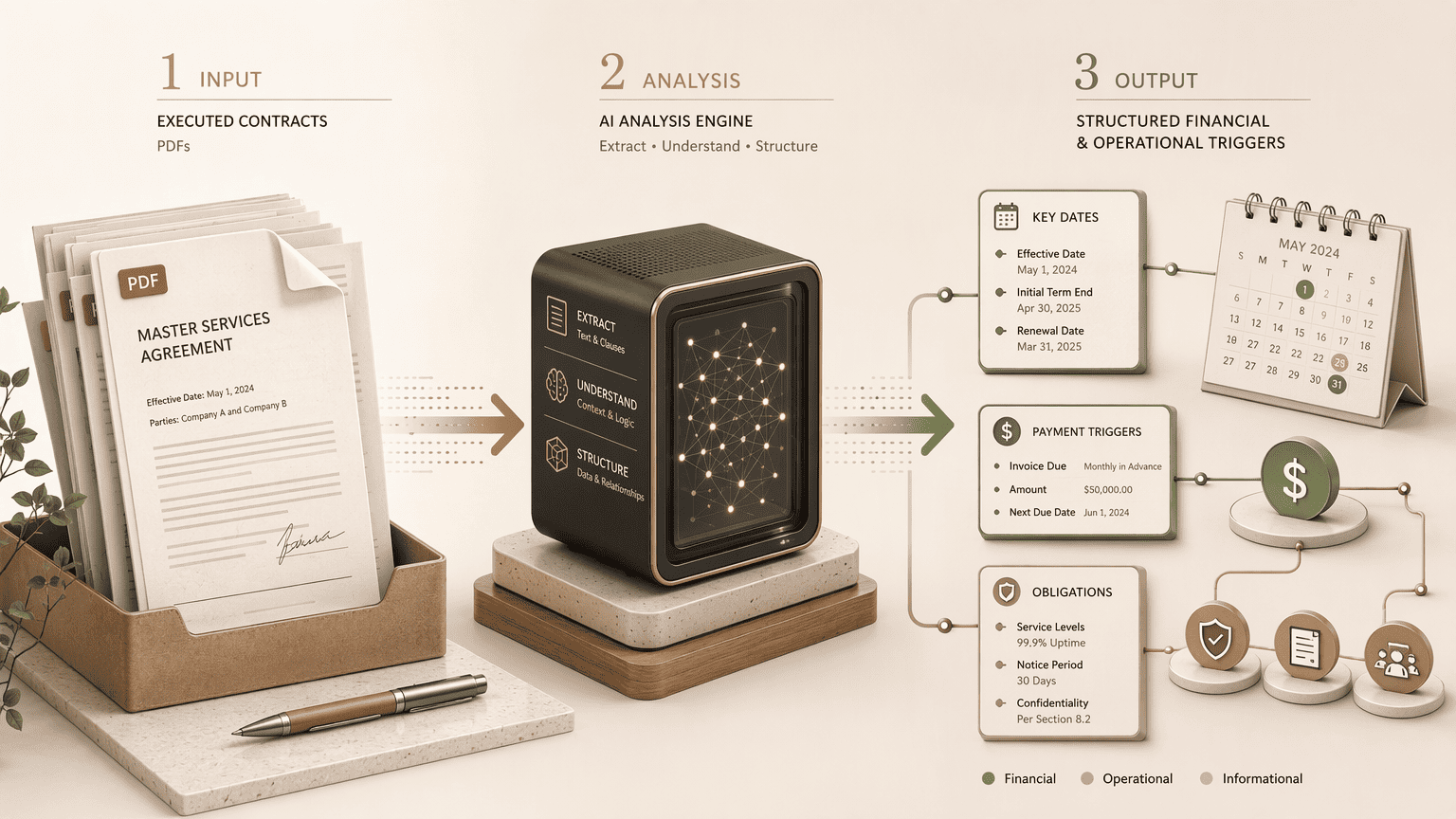
The engine that stops revenue leakage runs on a three-stage cycle. Each stage converts raw contractual language into a financial trigger your team can act on.
| Stage | What Happens | Revenue Impact |
|---|---|---|
| Extraction | AI/ML models scan executed PDFs and pull out structured values for renewal dates, escalation formulas, payment terms, and obligation milestones. Companies like Contracts.ai claim accuracy levels exceeding 99% when extracting these fields at scale. | Surfacing hidden price increases and rebate deadlines that were invisible in static files. |
| Normalization | Raw extracted data is mapped into consistent fields across silos, so a payment term in one vendor’s contract reads identically to a payment term in another’s inside your ERP. | Eliminating the apples-to-oranges reporting that lets off-contract spend slip through. |
| Action | Conversational AI queries let a finance analyst ask, “Which contracts have a price escalation hitting in Q3?” and get an answer linked to the source language. Automated triggers push renewal alerts and escalation deadlines directly into procurement workflows. | Converting a forgotten obligation into a booked invoice before the window closes. |
Critical Data Points to Extract and the Triggers That Plug Revenue Leaks

Not every clause in a contract carries equal P&L weight. The fields that consistently prevent leakage are the ones that change dollars over time.
Renewal dates are the most obvious time bomb; an auto-renewal clause that locks in pricing without review compounds the loss invisibly. Price escalation formulas, especially those indexed to CPI, require a trigger that alerts finance 90 days before the anniversary date so the adjusted rate actually reaches the invoice. Payment terms matter because early-payment discounts and late-payment penalties flow directly to margin. Obligation milestones carry penalties your accounts payable team may be paying without the offsetting credit your contract entitles you to collect. Extracting these fields and wiring them to automated triggers inside your ERP means a contract never again outruns the people who monetize it.
The No-Rip-and-Replace Integration Strategy: Feeding ERP, CLM, and Procurement Systems

Post-signature intelligence works if your teams actually see the data. The model that gets you there in months, without touching your tech stack, relies on native connectors and skips data migration entirely. Here is the path:
- Connect to the source: Point the intelligence layer at your existing contract repository, whether that is a CLM, a shared drive, or an ERP attachment library. Files stay where they are.
- Run extraction on a pilot set: Select a cohort of high-value contracts and let the AI pull structured data. No workflow changes, no user retraining.
- Sync fields to operational systems: Native integrations with Workday, Oracle, or Infor surface extracted renewal dates, escalation triggers, and obligation milestones inside the platforms your procurement and finance teams already use every day.
- Activate automated triggers: Set alerts that push to a procurement dashboard when a price escalation window opens or an auto-renewal deadline approaches.
- Expand incrementally: Scale to additional contract portfolios once the first cohort demonstrates hard-dollar returns. You never touch a system migration.
Measuring Hard-Dollar ROI for Contract Intelligence in 2026
The financial case for post-signature contract intelligence in 2026 rests on three hard-dollar levers:
- Renewal exposure reduction: When a price escalation formula fires three months late, that is revenue permanently lost. When an auto-renewal locks in for a full term at the wrong rate, the margin hit compounds across every invoice of that cycle. Deploying automated extraction converts those invisible risks into a tracked, databased set of triggers. Organizations report cutting contract management time by up to 50% as the manual task of hunting through PDFs disappears.
- Time-to-revenue acceleration: The GSA’s CODY system, an analogous intelligent-automation deployment, saved an estimated 16,000+ hours since launch and is projecting $423,000 in savings by replacing an external contract with automated workflows. Audit-response hours shrink when every obligation is linked to its source language and surfaced on demand.
- Compliance-penalty avoidance: The Accounts Payable Invoice Bot avoided an estimated $2 million in interest charges on late payments by automating notification escalations from Day 1 through Day 30. When finance can query across its entire contract portfolio and get contract-linked answers in seconds, the cost of a missed escalation drops to zero. A healthcare system deploying contract intelligence and reporting a 12% annual spend reduction captured that return without replacing its ERP, its procurement stack, or its existing repository. The ROI materialized inside the tools the organization already owned.
Conclusion
Revenue leakage is a process failure hiding in executed PDFs. Organizations lose up to 9% of annual revenue not because anyone violated a contract, but because no one tracked the clauses that generate cash.
Post-signature contract intelligence closes that gap. The software pulls renewal dates, escalation formulas, and obligation milestones from signed documents and feeds them as triggers into the ERP and procurement systems your team already runs. A static agreement library becomes a dollar-impacting asset.
The extraction-trigger-action mechanism exists now. The path to deployment is simply a native integration layer on top of what you use today.
Frequently Asked Questions
What is post-signature contract management and how does it differ from traditional CLM?
Post-signature contract management is an analytical AI layer that reads executed agreements to surface obligations, renewal dates, and pricing triggers. Traditional CLM focuses on drafting, negotiation, and approval workflows before the signature; post-signature intelligence operates on signed PDFs to extract structured data and feed it into ERP and procurement systems.
How much revenue do companies typically lose through poorly managed customer contracts?
Organizations lose between 5% and 9% of annual revenue due to ineffective contract management, according to industry research by McKinsey and ContractSafe. The leakage comes from missed renewals, unmanaged price escalation clauses, off-contract spend, and compliance failures that remain invisible without centralized oversight.
What AI and machine learning technologies are used to analyze executed contracts at scale?
Post-signature contract intelligence applies AI and machine learning models to extract structured data from signed PDFs, normalizing fields like renewal dates and payment terms across silos. Conversational AI then lets users query the portfolio in plain language, with answers linked to source contract language for validation.
How does an AI intelligence layer integrate with existing ERP, CLM, and procurement systems without rip-and-replace?
Native connectors sync extracted structured data directly into systems like Workday, Oracle, and Infor without migrating contracts or disrupting workflows. The intelligence layer reads from your existing repository, surfaces triggers inside the tools teams already use, and can be piloted on a limited contract set first.
What contract data points are most critical to extract for preventing revenue leakage?
The highest-priority fields are renewal dates, price escalation formulas (including CPI-indexed adjustments), payment terms, obligation milestones, and auto-renewal clauses. Each becomes a trigger that alerts finance and procurement before a renewal locks in bad pricing or an escalation window closes.
How do companies measure ROI after deploying automated contract intelligence in 2026?
Hard-dollar ROI is measured through renewal-exposure reduction, time-to-revenue acceleration, and compliance-penalty avoidance. Organizations track metrics like reduced contract management time (up to 50%), decreased audit-response hours, and the elimination of unintended auto-renewals that previously locked in below-market rates.
Sources
- How Contract Management Software Directly Impacts Your … – www.contractsafe.com
- Contract Management Software For Healthcare | symplr – www.symplr.com
- Prevent Revenue Leakage With Contract Management – SutiSoft – www.sutisoft.com
- 9.2% Revenue Lost to Poor Contracts | Tracking Contracts – www.trackingcontracts.com
- EOA success stories | GSA – www.gsa.gov
- About PostSig | The System of Intelligence for Post-Signature Execution – postsig.com






