







Introduction
You signed the deal. The rebate tiers look great on paper. But months later, those earnings never hit the P&L.
That gap between negotiated rebates and collected cash is where margin quietly bleeds out. Poor contract management erodes an average of 19% of total contract value, according to World Commerce & Contracting, and rebate leakage is one of its most stubborn forms. Even disciplined procurement teams see 3 to 7% of margin disappear through missed thresholds, unclaimed claim windows, and short-payments that nobody catches.
The root cause is painfully simple: your ERP knows what you spent, but it doesn’t know why a different price should have applied. Your contract holds that promise, but it is locked in a static document that cannot tap you on the shoulder when a deadline approaches.
A newer category of software, often called Contract Performance Management, bridges exactly that gap by extracting every rebate percentage, tier threshold, and expiration date from your agreements, then matching those terms against actual transaction data automatically. The output is a live, audit-ready picture of what you are owed before the claim window slams shut.
This list walks through eight platforms that connect the ‘what’ of your ERP with the ‘why’ of your contracts to capture rebates you have already earned.
Key Takeaways
Here are the core realities to carry into your evaluation, drawn from the platform analysis and procurement data below.
- Mind the repository gap: A basic contract storage system cannot flag a rebate deadline or cross-reference an invoice, but the tools ranked here are built to connect terms to transactions automatically.
- The margin math is real: Even best-in-class companies leak 3 to 7% of margin to missed rebates and thresholds, while unfulfilled supplier obligations can leak roughly 2% of spend for large enterprises, which, on a $2 billion spend, equates to $40 million per year.
- Overlay vs. platform: Solutions like ContractsAI and Vendortell sit as an intelligence layer on top of your existing ERP and CLM, while platforms like Icertis and Conga embed rebate tracking into a broader suite. The right fit depends on whether you need a point solution or an enterprise-wide governance play.
- Last-mile support matters: Software alone cannot file a claim, which is why InsideTrack pairs its detection engine with managed services that physically chase the money for teams without the administrative bandwidth to recover flagged rebates.
- Start small for a faster business case: You can validate AI extraction and spend matching on a limited contract set without migrating your full repository or disrupting existing workflows, which makes the business case far easier to build.
1. Contracts.ai: AI-First Extraction and Live Compliance Dashboard
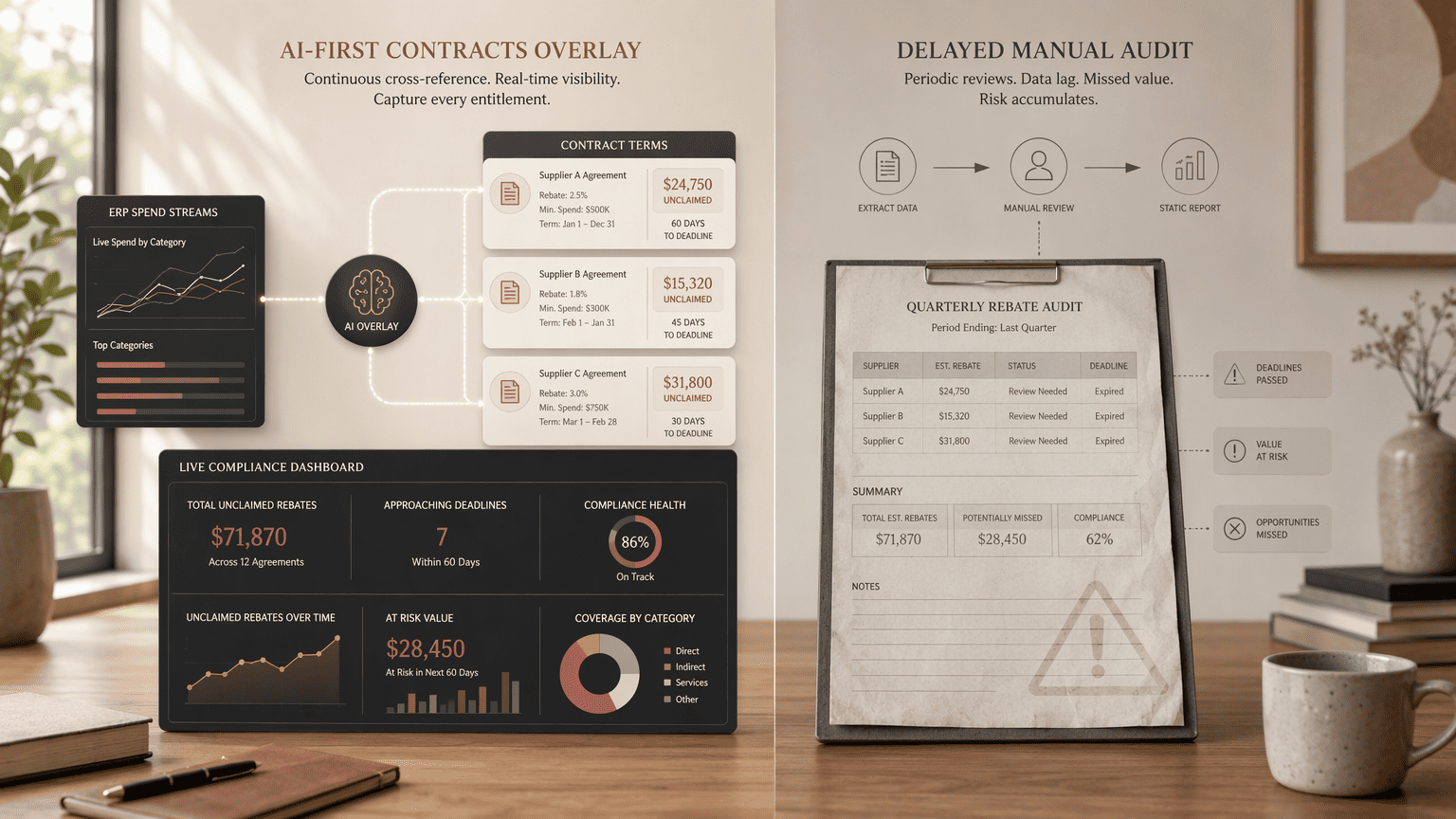
| Capability | Contracts.ai | Manual Audit |
|---|---|---|
| Spend-to-terms matching | Continuous cross-reference against ERP transaction data | Performed retrospectively, often during quarterly or annual reconciliation |
| Compliance visibility | Live dashboard of unclaimed rebates and at-risk deadlines | Static report that is outdated the moment it is generated |
| Impact on existing systems | Overlay that layers onto the current CLM and ERP without replacement | Does not affect existing systems but adds no new intelligence |
Contracts.ai brings an AI-native extraction engine to the rebate tracking problem without forcing you to migrate anything. It reads your agreements, extracts the structured rebate data, matches it against actual spend flowing through your ERP, and presents a live compliance dashboard that shows exactly which rebates are earned but unclaimed right now. The architecture is explicitly non-disruptive: the platform layers over your existing systems rather than replacing them. You can pilot it on a focused contract set first, validate the recovery opportunity, then scale.
2. Vendortell: AI-Powered Contract Intelligence for Multi-Brand Retailers
Vendortell is a Contract Performance Management platform purpose-built for the complexity of multi-brand retail, where rebate agreements vary by banner, vendor, and product category. Its AI reads every agreement and matches the extracted terms against actual purchases and sales, surfacing unclaimed funds before they evaporate.
- 670K EUR recovery in a single week: Vendortell reports recovering 670K EUR for a multi-brand retailer in one week, a concrete proof point that demonstrates what happens when AI extraction meets live transaction matching at scale.
- Non-disruptive overlay model: The platform sits above your existing CLM and ERP stack, so you do not need to consolidate systems or standardize contract formats before it can start delivering value.
- Every clause, not just the obvious ones: Vendortell extracts every rebate percentage, volume threshold, growth incentive, and claim deadline, including terms buried in amendments and side letters that manual reviews routinely miss.
- Retail-specific logic: The matching engine understands the distribution and retail reality of multiple banners buying from shared suppliers, where a single vendor agreement may trigger different rebate obligations depending on which brand placed the order.
3. InsideTrack: Managed Service for Rebate Filing and Short-Payment Recovery

Identifying a missed rebate is only half the battle. Actually filing the claim, chasing the supplier, and collecting the payment requires administrative capacity that many procurement teams simply do not have, which is why InsideTrack pairs its detection software with managed services experts who handle the last mile.
The software flags short-payments, missed tier thresholds, and expiring claim windows just like the other tools on this list. Where it diverges is what happens next: a dedicated team takes that output and physically files claims on your behalf, pursues collections, and pushes recoveries into your bank account. For organizations that know rebates are leaking but cannot hire another full-time analyst to chase them, that combination solves the real bottleneck between detection and cash.
This model reflects what the data tells us about manual processes. Up to 80% of procurement functions are not fully aware of competitive terms and contract structure in the first place, and even when terms are known, the administrative burden of recovery is the silent killer of earned rebates.
4. Enable: B2B Rebate Management with Collaborative Deal Construction

Enable targets a specific and particularly thorny rebate landscape: the complex, bilateral trading agreements that dominate B2B relationships. B2B deals rarely involve a flat percentage that kicks in once a volume threshold is crossed. Instead, they involve multi-tiered, conditional structures negotiated collaboratively between supplier and buyer over months.
Enable builds that collaborative deal architecture directly into its platform. Both parties model rebate scenarios during negotiation, agree on the structure, and then track performance against those terms in a shared portal. A shared view eliminates the reconciliation nightmare where the supplier calculates one rebate amount internally and the buyer arrives at a completely different figure from their ERP data.
The platform also handles the accrual accounting complexity that comes with B2B rebates. Finance teams need to forecast rebate income and book it in the correct periods long before cash lands. For trading-intensive industries, that collaborative governance layer is often more valuable than pure detection speed.
5. Icertis Contract Intelligence: Enterprise CLM with Rebate Compliance Monitoring

Icertis represents the enterprise CLM end of the spectrum: if your organization needs rebate tracking nested within a broader contract governance framework that spans every agreement type, not just procurement, this is the architecture that makes sense. The platform structures contract data into discrete, machine-readable attributes during ingestion, which powers the obligation management engine that monitors rebate commitments alongside delivery requirements, pricing terms, and regulatory obligations all at once.
That unified approach matters at scale. 90% of participants in an executive forum said that digitizing contract management to flag noncompliance and leakage is business-critical going forward, but for the largest enterprises a point solution that only watches rebates creates yet another silo. Icertis embeds the monitoring into the same system that manages the contract lifecycle, so when a supplier misses a delivery performance target that also impacts their rebate eligibility, the connection is automatic. The trade-off is implementation complexity. This is an enterprise deployment, not a rapid pilot.
6. Conga Revenue Lifecycle Cloud: End-to-End Commercial Relationship Management
If your rebate tracking pain sits inside the revenue operations function rather than procurement, Conga addresses it from the quote-to-cash angle. The Revenue Lifecycle Cloud connects contract billing terms, including rebate obligations, directly into the invoicing and revenue recognition process. This closes the gap where a sales team promises a rebate structure that billing never configures.
For organizations that discovered $10 million in duplicate payments and missed rebates after automating billing, this tight integration is where the money hides. The platform ensures that what gets quoted, contracted, and invoiced reflects the same rebate structure. RevOps teams get a single source of truth instead of a reconciliation exercise across Salesforce, the ERP, and a spreadsheet.
7. Sievo: Procurement Analytics for Material Margin and Rebate Verification

Sievo takes a procurement analytics-first approach that will resonate with data-driven sourcing teams. It layers rebate performance data into a broader material margin analysis, so you can see whether a supplier’s rebate generosity is masking a higher base price that is eroding your actual cost position.
A basic recovery tool stops at the rebate ledger. Sievo’s analytical lens closes that loop. A supplier might hit every rebate threshold on schedule while their underlying price increases eat the rebate value and more. Sievo’s dashboards make that pattern visible so procurement can renegotiate with a complete view of total cost, not just with the earned rebate check in hand. That single visibility is the difference between optimizing one line item and optimizing the whole supplier relationship.
Conclusion
Disconnected systems and static documents create the gap between negotiated rebates and collected cash. It is rarely a question of intention. Most procurement teams simply lack the administrative bandwidth to track every claim window while it is still open.
The eight platforms here attack different dimensions of that gap. ContractsAI and Vendortell apply AI extraction to surface obligations buried in contract language. InsideTrack handles the full recovery process as a managed service. Enterprise governance platforms like Icertis embed rebate obligations into the contract lifecycle so nothing falls through the cracks when terms change.
The right choice turns on one question: is your biggest bottleneck detecting unclaimed rebates, or filing for them before the window closes?
Frequently Asked Questions
What software can automatically track contract spend against rebate terms?
Contract Performance Management platforms like ContractsAI, Vendortell, and Enable extract rebate percentages, thresholds, and deadlines from your agreements using AI, then match those terms against ERP transactions to flag unclaimed rebates before claim windows close. They provide live dashboards of what is owed rather than periodic manual reconciliation.
How does AI-powered contract intelligence help capture missed rebate opportunities?
AI reads every agreement in minutes to pull out pricing terms, rebates, service levels, and deadlines that manual reviews often miss. It then continuously compares purchase orders and invoices against those extracted terms, alerting teams immediately when a short-payment occurs or a rebate threshold is approaching.
What key features should I look for in contract software that monitors rebate compliance?
Look for automated contract data extraction, live spend-versus-terms matching, proactive alerts for expiring agreements and at-risk thresholds, a clear audit trail linking every flag back to source contract language, and the ability to pilot on a limited contract set without migrating your full repository.
Can I track rebates without replacing my existing CLM or ERP system?
Yes. Several platforms, including ContractsAI and Vendortell, function as an intelligence overlay that reads agreements from your current repository and cross-references them with your existing ERP. You can typically run a pilot on a focused contract set without disrupting current workflows.
How do I audit supplier contracts to ensure rebate terms are being met?
An AI-driven tool continuously monitors purchase orders, invoices, and supplier activity against contract terms, flagging discrepancies in real time. The best platforms link every finding to the source clause, creating a defensible audit trail that supports recovery audits and supplier conversations.
What distinguishes enterprise-grade rebate management tools from basic contract storage?
Basic repositories only store documents. Enterprise-grade tools actively read and structure the data inside agreements and then connect that intelligence to live transaction systems. A stored contract cannot alert you to a rebate deadline, but a Contract Performance Management platform proactively monitors obligations and flags missed value.
Sources
- How AI Prevents Contract Leakage and Protects Contract Value | GEP Blog – www.gep.com
- [PDF] Mitigating procurement value leakage with generative AI – McKinsey – www.mckinsey.com
- Vendortell – Contract Performance Management Software – vendortell.com