








Introduction
Your FP&A team flags another unexplained budget overrun. Your CPO finds a familiar culprit: a department bought software licenses directly from a vendor at 40% above your pre-negotiated rate. This is maverick spend, purchasing outside approved processes, and it is quietly bleeding your margins.
Experts estimate that a significant share of indirect spend happens this way, eroding hard-won sourcing savings. The traditional fix has been a periodic, reactive audit that catches non-compliance months after the money is gone.
That cycle ends now. A new approach uses AI as a continuous, proactive control embedded directly into how your company buys, turning procurement data from a rear-view mirror into an always-on guardrail that prevents rogue spend before it happens.
Key Takeaways
A unified data layer and AI-driven controls shift maverick spend management from after-the-fact detection to real-time prevention.
- Unified data is non-negotiable: Control starts by consolidating spend data into a centralized intelligence layer without ripping out your existing ERP or P2P systems.
- Shift from detection to prevention: AI-powered contract intelligence blocks non-compliant purchases at the point of requisition. The system stops the wrong transaction before it clears, instead of surfacing it in a report days later.
- Audit at the invoice line-item level: Automated reconciliation of grouped contracts against detailed invoices surfaces hidden maverick patterns that aggregate reports miss.
- Measure what prevents leakage: Forward-looking KPIs like contract utilization rate and real-time off-contract alerts matter more than rear-view spend percentages.
Step 1: Map the True Anatomy of Maverick Spend and Its Root Causes

Employees bypass procurement because of urgent needs, a confusing purchasing process, or simply not knowing a preferred contract exists. The real driver is often a breakdown in process design. Your people follow the path of least resistance, and when the formal route is slow, hidden, or hostile, they walk around it.
A genuine fix starts with categorizing this buying behavior. Separate purchases made out of operational panic from those driven by complex internal bureaucracy. Data from environments with highly decentralized operations shows that autonomy without guardrails naturally fragments buying patterns. Recognizing this means you stop treating symptoms, like a one-off emergency PO, and start fixing the operational failure that made a workaround look like the only viable path forward.
Step 2: Consolidate and Classify Spend Data into a Centralized Intelligence Layer Without Replacing Existing Systems
You cannot control what you cannot see. Building an AI-driven control framework without a unified data foundation will only automate chaos. Here is the practical order of operations:
- Extract without disruption: Pull raw transaction data directly from existing ERPs, P2P suites, and expense systems using their native APIs. No system migration is required; a tool like Contracts.ai, for instance, can be deployed as an intelligence layer over your current tech stack.
- Normalize to a single taxonomy: Cleanse and map inconsistent supplier names, cost centers, and material codes to a common hierarchy so a single supplier isn’t logged as three different entities.
- Classify with AI speed: Apply machine learning to auto-categorize millions of line items into UNSPSC or custom categories. Contracts.ai claims accuracy levels greater than 99% when extracting data from documents in real time, enabling reliable spend classification at scale.
- Federate without rip-and-replace: Expose this clean data through an overlay that connects back to your source systems, creating a centralized intelligence layer where AI models can run while leaving your underlying transaction logs untouched.
Step 3: Deploy AI to Continuously Detect Off-Contract and Anomalous Purchases That Traditional Audits Miss
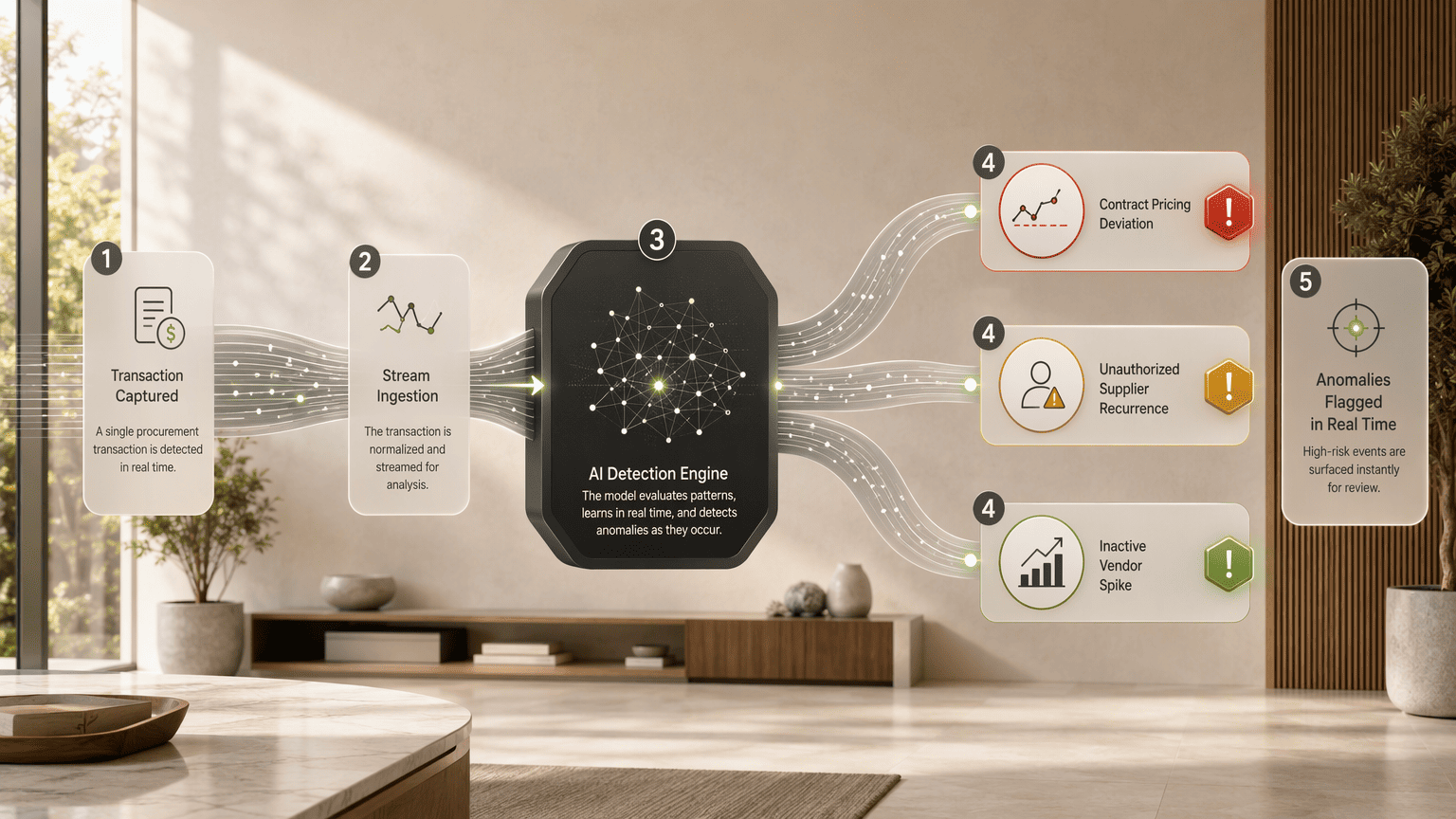
AI changes the game by monitoring every transaction in near real-time. Machine learning models ingest streams of procurement data and flag anomalies automatically. They can:
- Flag contract pricing deviations: detect when an order deviates from a contract’s pricing terms
- Identify unauthorized supplier recurrence: identify repeat purchases from an unapproved supplier hiding behind a general ledger code
- Surface inactive vendor spikes: surface a spike in spending with a vendor that has no active agreement
Instead of hunting for needles in a haystack, your team receives a prioritized queue of non-compliant events.
AI systems can also enforce policy at the moment of purchase. A buyer opening a requisition gets an instant alert if the selected vendor lacks an active contract, with pre-approved alternatives suggested right in the interface. That shifts the intervention upstream, you prevent the non-compliant transaction before it posts. Some platforms go further by maintaining a central, searchable repository of active contracts and compliant supplier catalogs, so every requisition pulls from the right source. This is real-time procurement audit. You stop being a financial historian and become a live operations controller.
Step 4: Enforce Compliance at the Point of Purchase with an AI-Powered Contract Intelligence Layer
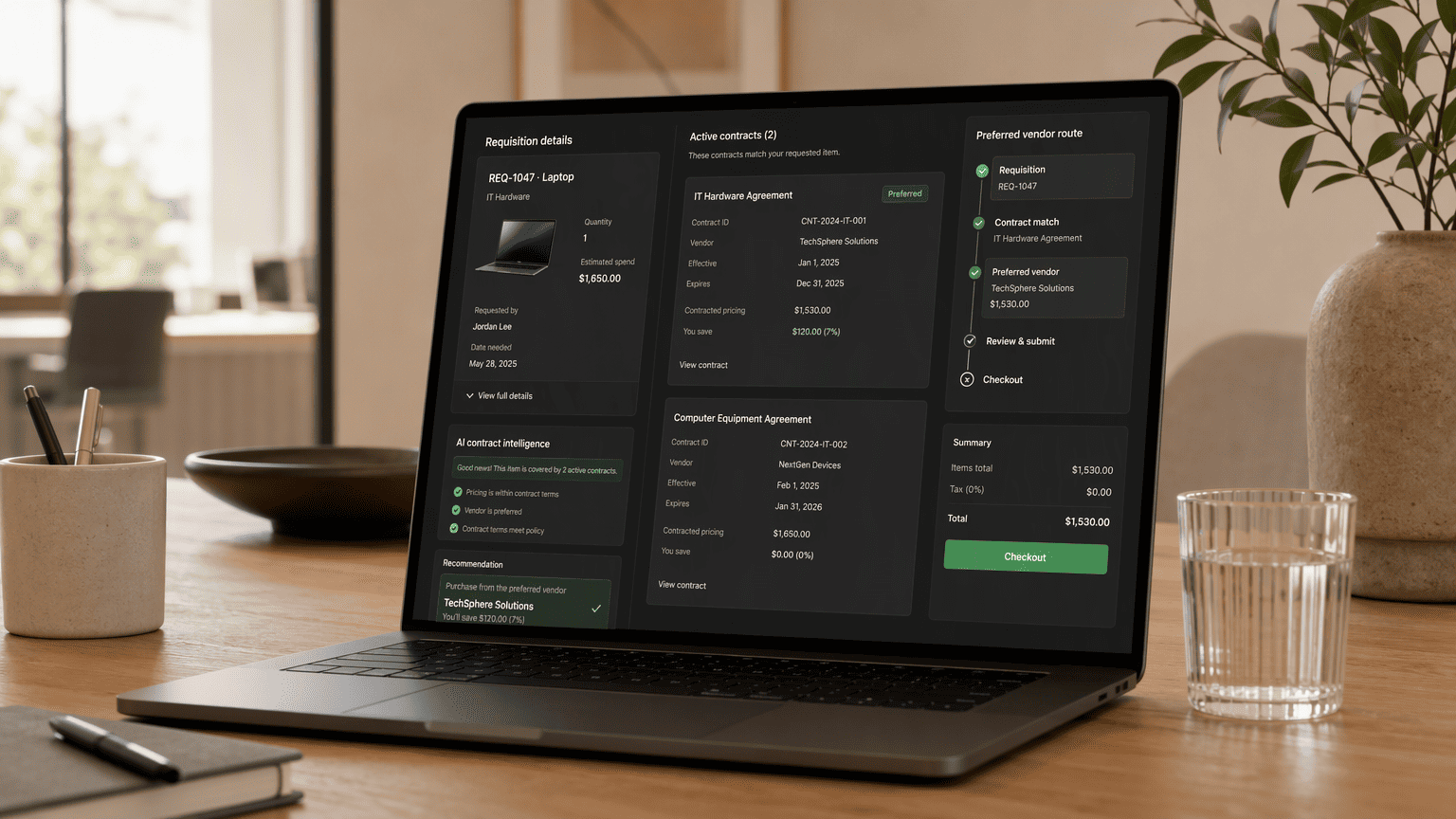
Detecting a violation after the invoice is paid closes only half the loop. The real step-change is stopping the violation before the order is placed. An AI-powered contract intelligence layer embeds your negotiated agreements directly into the employee’s buying flow. When someone requisitions a laptop, the system instantly cross-references that request against your active technology contracts. If a preferred vendor with a pre-negotiated price exists, the requisition is automatically routed to that supplier.
This shifts the burden of compliance from the employee’s memory to the system’s architecture. If someone tries to buy outside the contract, the platform can block the transaction or reroute it, explaining why. Contracts.ai, for example, operates within the customer’s data boundaries and is designed for this exact use case: sitting on top of your executed agreements to power those decisions at the moment of purchase.
Step 5: Automate Cross-Referencing of Grouped Agreements Against Actual Invoices to Uncover Hidden Maverick Patterns
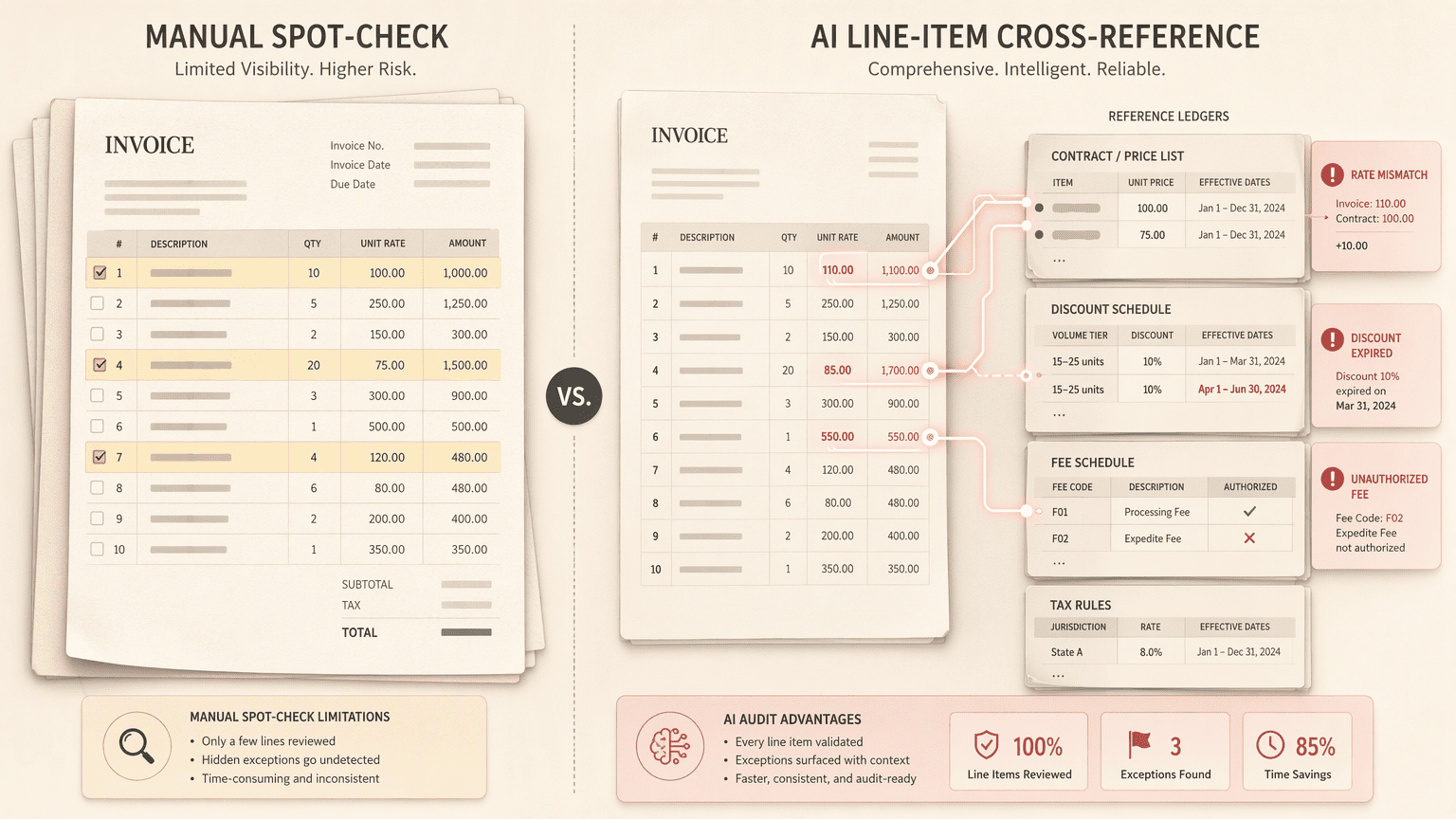
Maverick spend hides in plain sight. A supplier charges within the total contract value but bills at the wrong rate, applies an expired discount schedule, or tacks on fees no one approved. The invoice looks fine at the summary level. Line by line, it isn’t.
Here is how a traditional human audit compares to an automated AI approach for surfacing these hidden costs:
| Aspect | Manual Spot-Check | AI-Driven Line-Item Audit |
|---|---|---|
| Inspection Scope | Sample of high-dollar invoices usually. | Every invoice line item reconciled against the contract. |
| Speed of Detection | Weeks to months after payment. | Continuous, with alerts triggered automatically. |
| Pattern Recognition | Relies on auditor intuition and memory. | Identifies subtle patterns, like a 3% price creep across dozens of low-value invoices. |
| Compliance Risk | High, with a 80% catch rate seen as aspirational in some environments; small transactions under $50K often untested. | Near-complete coverage, finding off-contract charges that aggregate reporting would label as compliant. |
This AI-driven reconciliation process groups related agreements and itemizes every charge. It catches billing discrepancies the moment they surface so you can dispute them before payment, rather than discovering the leakage months later in a report. That is the difference between a policy that looks good on paper and one that protects the bottom line.
Step 6: Simplify the Purchasing Process to Reduce Employee Friction and Drive Adoption
The most sophisticated guardrails are useless if employees will not use them. Process friction is the single biggest behavioral driver of maverick spend. If your internal requisition system requires seven clicks to order a stapler and takes three days for approval, any colleague will find it easier to pull out a company card. A requisition process that matches the speed and ease of a P-card transaction does not have to sacrifice control. It shortens the purchase-to-order cycle by surfacing preferred suppliers inside the buying workflow. When a category manager negotiates an office-supplies contract with 40% discounts, embedding that catalog directly into the requisition screen captures those savings at the point of need. Guided buying catalogs turn negotiated contracts from static PDFs stored on a shared drive into a frictionless path of least resistance. Employees see only the items and suppliers their department is permitted to buy, with punchout links to supplier websites that keep the transaction inside your system. This is real-time procurement audit. You stop being a financial historian and become a live operations controller.
Step 7: Establish Continuous Monitoring, Audit Trails, and Predictive Risk KPIs
A dashboard of trailing indicators won’t cut it. You need metrics that give you a forward-looking view of your compliance health and an unalterable audit trail that supports corporate governance. Focus on these key steps:
- Track the fundamental ratio: maverick spend as a percentage of total addressable spend. In an average organization, only about 57.1% of spend is under active management.
- Set a benchmark target: move that toward the best-in-class 91.5% spend under management. Every single new dollar brought under your control can be expected to yield between 6% to 12% in direct savings.
- Shift to predictive indicators: monitor real-time contract utilization rates and purchase order accuracy. World-class companies using this data-rich approach achieve a overall cost savings rate just over 6%.
- Configure automated alerts: trigger when a department’s off-contract buying frequency begins to rise. That spike is your early warning.
This moves you from generating a monthly static report to running a live risk nerve center. With budgets growing only 1% amid projected workloads that are increasing 10% in 2025, this type of automated oversight is not a luxury, it is the only way your team can keep its head above water.
Step 8: To control spend with AI, you must use that same intelligence to build a guided buying experience.

Your data should power a consumer-grade purchasing interface. When someone types “notebook” into a search bar, AI should automatically surface your contracted supplier’s product first, showing the pre-negotiated price and delivery timeline. Guided buying tools that display preferred catalogs make compliance the path of least resistance by flagging violations at the moment of purchase. Research into user behavior confirms that autonomy with well-designed guardrails leads to better compliance outcomes than rigidly enforced, complex rules.
Reduce decision fatigue by collapsing your supplier base and catalog options downstream from your sourcing work. The famous example from Deere is instructive here: at one point they were purchasing 424 different work gloves across fourteen factories. By centralizing that sourcing to just two dozen preferred options, they radically simplified the procurement process for their factory safety managers. The outcome of that single initiative was a massive reduction in unit costs, with the cost of work gloves dropping by 50%.
Conclusion
Maverick spend is a data problem you solve with process. AI-driven intelligence layered over your existing procurement data turns disconnected transactions into a single control framework.
That lets your team catch and block off-contract buying at the source, so procurement stops acting as a cost center and starts protecting value in real time.
Frequently Asked Questions
What exactly is maverick spend and what are the most common causes in large enterprises?
Maverick spend is purchasing that occurs outside of an organization’s established procurement contracts and processes. The most common triggers in large enterprises are:
- Urgent operational needs that demand an immediate solution
- A complete lack of user awareness that a preferred contract exists
- Internal purchasing processes that are so complex or slow that employees choose to work around them
How can AI and procurement data identify patterns of maverick buying that traditional audits miss?
AI processes 100% of transaction data continuously, while traditional audits rely on manual, periodic sampling. Machine learning algorithms can detect hidden anomalies such as:
- Off-contract purchases from approved vendors
- Price deviations from negotiated benchmarks
- The recurrence of a single unofficial supplier buried under multiple general ledger codes
None of these would a sample-based review reliably catch.
What role do contract analytics and intelligence layers play in enforcing purchasing compliance?
A contract intelligence layer acts as a real-time compliance gatekeeper. Instead of storing static documents, it structures key terms and injects those rules into the purchasing workflow. When a requisition is created, the system instantly matches it against active contracts, automatically guiding the buyer to a preferred supplier or blocking the transaction if it is non-compliant.
How can a company build a maverick spend control framework using data from existing systems without a full system replacement?
You can deploy an AI-powered intelligence layer as an overlay on top of your current ERP and P2P software. This involves extracting and normalizing data from source systems without migrating away from them, enabling you to create a centralized view of all spend and apply AI controls directly to your existing procurement workflows without a rip-and-replace.
What key performance indicators (KPIs) should procurement teams track to measure improvements in spend compliance?
Track maverick spend as a percentage of total addressable spend to measure the size of the problem. Monitor contract utilization rates and purchase order accuracy to gauge process health. In the long run, measure the total percentage of spend under management, aiming to close the gap between the average of 57.1% and the best-in-class 91.5%.
Sources
- Managing Maverick Spend at Deere and Delphi – An Interview with Jon Stegner | Supply Chain Resource Cooperative – scm.ncsu.edu
- How to Reduce Maverick Spending Across Departments | Procurement Magazine – procurementmag.com
- The Top 6 Procurement KPIs – www.esker.com






