








Introduction
A single duplicate payment or a missed early-payment discount feels like a needle in a haystack until you realize your accounts payable team only has time to check one out of every twenty invoices. Those needles add up. Research suggests that companies can lose as much as 0.5% of revenue to overpayments and missed discounts.
For a $100 million business, that is a silent half-million-dollar drain that no monthly close catches. The root cause is rarely negligence. It is a simple math problem: human reviewers cannot manually cross-reference every line item on thousands of invoices against scattered purchase orders and dense contract terms.
The solution is software that reads every invoice, matches it against your agreements, and flags the specific discrepancies that cost you money. AI-powered vendor invoice audit tools have moved from pilot experiments to production-grade systems that deliver full-population audits without slowing down your payment runs. This piece breaks down what these tools do, why they have become urgent, how they work inside your current systems, and where they still need a human eye.
Key Takeaways
AI audit tools can now ingest, read, and reconcile every invoice your business receives, shifting you from a 5% sample check to 100% coverage. Here is what that shift changes:
- Full-population audit replaces spot checks: AI tools scan every invoice, catching errors that slip through manual reviews limited to 5 to 10% of transactions.
- Matching goes beyond invoice numbers: These systems cross-reference line items against purchase orders, contract payment terms, and GL coding rules to flag overcharges and duplicate payments automatically.
- Hard-dollar ROI is measurable and fast: Savings from recovered overpayments, prevented duplicates, and captured early-payment discounts often pay back the software investment within months.
- Human judgment stays in the loop: AI cannot resolve ambiguous contract language or handle a heated vendor dispute. The best tools escalate exceptions to your team with the relevant documents attached.
- Contracts.ai layers on without disruption: An intelligence layer approach analyzes invoices within your existing ERP and email systems, avoiding a rip-and-replace project while delivering audit coverage.
What Are AI-Powered Vendor Invoice Audit Tools?

AI-powered vendor invoice audit tools are software platforms that combine optical character recognition, small language models, and configurable business rules to read supplier invoices and automatically verify them against purchase orders, contracts, and compliance policies.
These systems go far beyond the template-based OCR of earlier automation. A modern audit engine, such as Auditoria’s SmartBots, uses a proprietary small language model comprising three billion tokens fine-tuned for finance-specific terminology. The software interprets text to identify the vendor, line items, quantities, unit prices, and payment terms, then matches those fields against structured data in your ERP. When an invoice line shows a rate higher than the contracted pricing table or requests payment terms your agreement never authorized, the tool flags it instantly. This transforms a manual, retrospective sampling exercise into a real-time, pre-payment control.
For a finance team, the practical difference is stark. Instead of pulling a few dozen invoices for a quarterly audit and hoping the sample is representative, the software audits 100% of your invoices instantly. It does this before cash leaves your bank account. The output is a continuous stream of auto-approved clean invoices, plus a short queue of exceptions your team can resolve before the payment run.
The Real Drivers Behind Automated Contract Compliance

Manual invoice audit has always been a numbers game that finance leaders silently lose. The pressure to close the audit gap comes from multiple directions:
- Sampling rates are too low: Even a diligent AP team typically spot-checks only 5 to 10% of invoices, while the other 90% are paid in bulk without full contract verification.
- CFOs demand real-time controls: Remote and distributed finance teams can no longer circulate paper invoice folders for informal review, and executives want duplicate payments caught before cash leaves the bank, not a month later.
- Technology has caught up: Extraction models can now handle multi-format invoice ingestion across PDFs, email attachments, and scanned images, while cloud-native audit trails eliminate the search across multiple file servers that makes an audit request a days-long hunt.
How Automated Invoice Auditing Works Step by Step
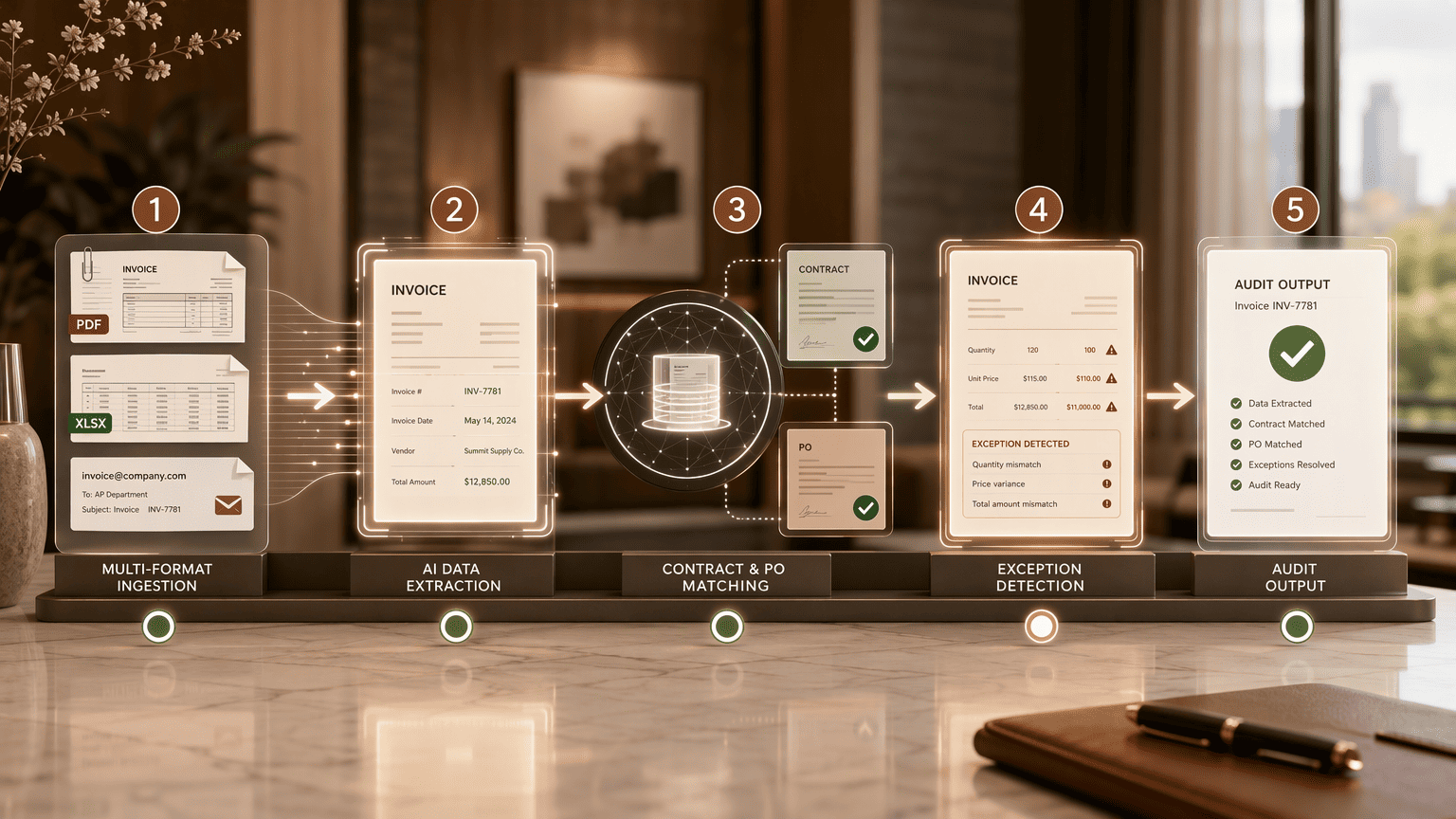
Here is the workflow a typical enterprise-grade audit tool executes on every invoice:
- Multi-format invoice ingestion: The system captures invoice data from email attachments, PDF uploads, scanned paper documents, and direct EDI feeds. It pulls in header-level metadata, line-item details, and attachments in a single step.
- AI-powered data extraction: Optical character recognition and specialized small language models read the invoice and pull out vendor identity, invoice number, line items, quantities, unit prices, payment terms, and tax amounts.
- Contract and PO matching: Extracted data is matched against purchase orders and contractual terms in the system of record, including GL accounts, cost centers, and spend categories tied to line items.
- Discrepancy flagging and duplicate detection: The engine applies business rules and AI pattern recognition to identify overcharges, unauthorized payment terms, and duplicate invoices. It catches same-vendor repeats and cross-system duplicates between expense and invoice records.
- Confidence-scored routing: High-confidence matches are auto-approved for payment processing.
Key Capabilities for an Enterprise-Grade Audit Solution
Not every platform that calls itself an audit tool operates at the scale an enterprise finance team requires. When you evaluate options, a handful of capabilities separate a control system that holds up under audit pressure from a basic OCR script. The table below maps the must-have features against the operational requirement each serves.
| Capability | What It Does | Why It Matters |
|---|---|---|
| Pre-built ERP integrations | Connects directly to NetSuite, SAP, Workday, and Microsoft Dynamics without custom middleware. | Avoids months of integration work and ensures audit data lives in the same system that executes payments. |
| Confidence-driven extraction | Scores every data field extraction as high or low confidence and learns from user corrections over time. | |
| Granular contract term parsing | Reads and validates invoice lines against specific contract fields: GL accounts, cost centers, pricing tables, and payment terms. | Catches overcharges and coding errors that surface-level matching misses entirely. |
| Sophisticated duplicate detection | Finds duplicates by invoice number, vendor name, line item sum, and cross-system patterns. | Prevents the most common hard-dollar AP loss that simple invoice-number matching cannot catch. |
| Makes a real-time audit request a quick export that pulls together logs that would otherwise sit scattered across email threads and shared drives. |
Quantifying the Savings and ROI of Invoice Auditing
The return on investment comes from two directions at once:
- Hard-dollar recovery catches what you would otherwise lose: a director of finance in the life sciences industry reported that 20 percent of their contracts were incomplete or out of date, meaning one in five invoices carried a high probability of discrepancy. Every corrected overcharge and prevented duplicate payment falls straight to the bottom line.
- Soft savings compound the number: automated audit trails slash the labor hours spent on retrieval for quarterly reviews, and capturing early-payment discounts that manual processing consistently misses adds ongoing procurement value.
Recognizing the Risks and Limitations of AI-Only Audits

No AI audit tool can resolve the most difficult part of invoice compliance: a contract that is genuinely ambiguous. Two parties can read a pricing escalation clause or a service scope definition and reach different, defensible conclusions. AI cannot mediate that dispute, and no company should hand the final say on a contested invoice to a language model.
Performance also degrades on dirty input. If your contracts are a mix of decades-old scanned PDFs, incomplete digital records, and inconsistent naming conventions, extraction accuracy will slip. The technology filters effectively, but it does not clean your underlying data.
The industry response to these limitations is human-in-the-loop escalation. When a match fails because no PO is found or the PO has no remaining balance, the system routes the exception to an AP specialist with the relevant documents attached. That is the operating model for production deployments: AI handles the exhaustive first pass, and humans resolve the genuinely hard cases.
How the Contracts.ai Intelligence Layer Audits Without Disruption

A full system migration is the most common reason enterprise finance teams delay audit automation. Contracts.ai takes a different approach, delivering value through several key capabilities:
- Non-disruptive deployment: The platform deploys as an intelligence layer that overlays your existing ERP, email, and file systems, analyzing invoices within the processes you already run rather than forcing a rip-and-replace implementation.
- Contract-specific parsing: Its contract-parsing engine is tuned for the complex legal language of executed supplier agreements, including the dense clauses that sit inside the document body.
- Transparent audit evidence: When a discrepancy between an invoice and a contract clause surfaces, the system links the finding to the source contract language so your team can validate the audit result immediately.
- Pilot-first rollout: Pilot deployments run on a limited contract set without migrating the full repository or changing a single existing workflow, which means you can measure the catch rate against your own invoice volume before committing to a broader rollout.
- Shared intelligence across teams: The shared structured intelligence then feeds into both finance and procurement operations, giving both teams the same real-time visibility into supplier compliance.
Conclusion
You can only audit about 5% of invoices by hand. An AI system processes every single one, instantly. That gap is now purely a question of financial control. The technology is here. The deployment models slot into existing systems instead of demanding a big-bang transformation, and the return shows up in recovered overpayments and captured early-payment discounts.
Continuous, pre-payment invoice audit is headed toward the same taken-for-granted status that automated bank reconciliation reached a decade ago. Companies that move now stop paying for errors they haven’t uncovered yet.
Frequently Asked Questions
What types of software can automatically audit vendor invoices against contract terms?
Several categories of tools serve the AI vendor invoice audit market:
- Specialized AP audit platforms like Auditoria SmartBots and AppZen use AI, OCR, and small language models to read invoices and cross-reference them against contracts and purchase orders.
- Leading AP automation suites build audit capabilities into broader invoice management.
- Intelligence layers like Contracts.ai overlay existing systems to add audit coverage without replacing the ERP.
How does automated invoice auditing work step by step?
The system ingests invoices from email, PDF, and scans, then extracts line items, pricing, and terms using AI. It matches this data against purchase orders and contract records to flag overcharges, duplicate payments, and unauthorized terms. High-confidence matches auto-approve, while exceptions are escalated to your AP team with supporting documents attached.
What are the key features to look for in an AI-powered contract audit tool?
Look for pre-built ERP integrations, confidence-driven extraction that learns from corrections, granular contract term parsing down to GL codes and cost centers, sophisticated duplicate detection across systems, and a complete, unalterable audit trail. Human-in-the-loop escalation with attached source documents is key for handling ambiguous exceptions.
How much can businesses save by using automated vendor invoice audit tools?
Savings come from recovered overpayments, prevented duplicate payments, and captured early-payment discounts. Companies report that up to 20% of contracts contain errors that lead to invoice discrepancies. One industry benchmark suggests companies can lose up to 0.5% of revenue to these errors, making the annual hard-dollar recovery substantial at scale.
What are the risks or limitations of relying on AI for contract compliance audits?
AI cannot resolve genuinely ambiguous contract language or mediate legal disputes between parties. Extraction accuracy drops on poor-quality scans and inconsistent data. Most tools address this with a human-in-the-loop model: the AI flags discrepancies and escalates hard cases to your team, but it does not remove the need for human judgment on complex exceptions.
Sources
- [PDF] AP Invoices – Come See Auditoria.AI at Workday Rising 2022 – info.auditoria.ai
- AI-powered invoice auditing – Cloudfront.net – d2uars7xkdmztq.cloudfront.net
- Accounts Payable Audit Software Ensures Hassle-Free Invoice Audit | GEP Blog – www.gep.com
- Invoice automation for scanned documents – Finance | Dynamics 365 | Microsoft Learn – learn.microsoft.com






