







Introduction
A 2/10 Net 30 term sounds simple: pay within 10 days, save 2%. On a $100,000 invoice, that’s $2,000 in savings just for paying early. Those savings stack up across hundreds of supplier invoices into serious working capital improvement.
Yet most finance teams leave a staggering portion of that value on the table. The culprit is a data disconnect. Signed contract clauses promising the discount live in one system. The actual invoices and their timestamps live in another.
No human AP clerk can manually cross-reference every invoice against the exact contract language in real time. Discounts expire silently while cash that should have stayed in the business flows out. This guide identifies seven platforms that bridge that gap. Each uses contract analytics to surface every discount you are owed and verify it before the payment run.
Platforms like ContractControl parse payment terms directly from procurement agreements and flag mismatches before invoices hit the ERP. That means the discount a supplier promised in the contract appears in the payment run even when the invoice header omits it. The result: capture rates shift from “we catch what the clerk notices” to systematic extraction of every negotiated term across the vendor base.
Key Takeaways
The platforms below range from non-disruptive intelligence layers to full-lifecycle CLMs. Three strategic insights stand out before you compare them:
– Deployment architecture dictates speed and adoption: You face a core choice between rip-and-replace platforms that require full data migration and non-disruptive intelligence layers that read from your existing ERP and CLM systems without disrupting workflows.
1. Contracts.ai, The Post-Signature Intelligence Layer That Operates on Your Existing ERP and CLM Systems
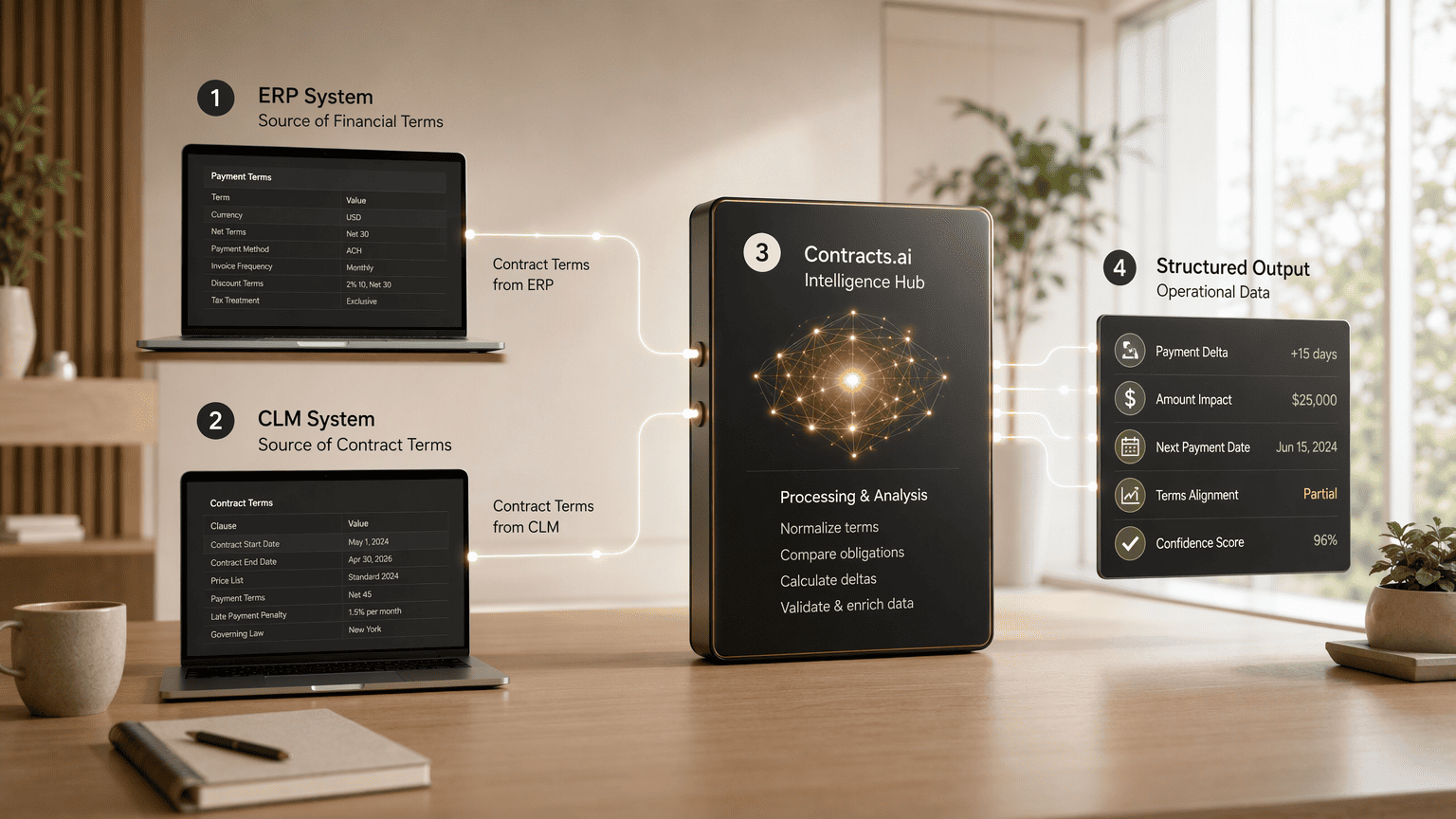
Most contract analytics tools ask you to rip out your existing CLM and migrate everything. Contracts.ai takes the opposite approach:
- Cross-system extraction: It reads pricing formulas, rebates, and escalation terms directly from your current CLM and ERP systems.
- Delta computation: It calculates the difference between what was contractually agreed and what is actually being paid.
- Post-signature intelligence: It structures contract data for operational use across enterprise systems, not just locked in static storage.
Co-founded by practitioners who have led large-scale CLM implementations and structured millions of contract data points inside global enterprises, the platform claims accuracy levels greater than 99% when extracting data from documents in real time. Every answer it surfaces is linked to source contract language for validation. That direct audit trail matters when your audit committee asks to see the proof behind a discount capture claim.
The system automatically groups related agreements and aligns shared terms, so a single supplier’s rate card can be validated across every region and business unit that uses it. You can run a pilot with a limited contract set without migrating the full repository or disrupting existing workflows. That makes it the most practical entry point for finance teams who need analytics now, not after a year-long CLM migration project.
2. Centime Customer Portal, Automating Discount Capture with Bank-Level Compliance for the Mid-Market
Centime targets a specific, painful gap: mid-market firms that know discount terms exist in their contracts but have no automated mechanism to actually capture them. The platform ties payment execution directly to contract term eligibility.
| Feature | Centime Customer Portal | Typical Manual Process |
|---|---|---|
| Discount application | Automatically applies discounts when eligibility windows open and removes them upon expiration | Relies on AP clerk to notice terms, calculate deadlines, and manually adjust payment amounts |
| Payment timing control | Three autopay timing options: invoice date, due date, or last discount day | Single, undifferentiated payment run schedule |
| Bulk payment capacity | Supports up to 200 invoices in a single transaction | Pay invoices one at a time |
| Compliance posture | Auditable, certified security framework | Typically unaudited payment processes |
3. SimpliContract RateIQ, Continuous Invoice-to-Contract Compliance Checking Against Precise Clause Language
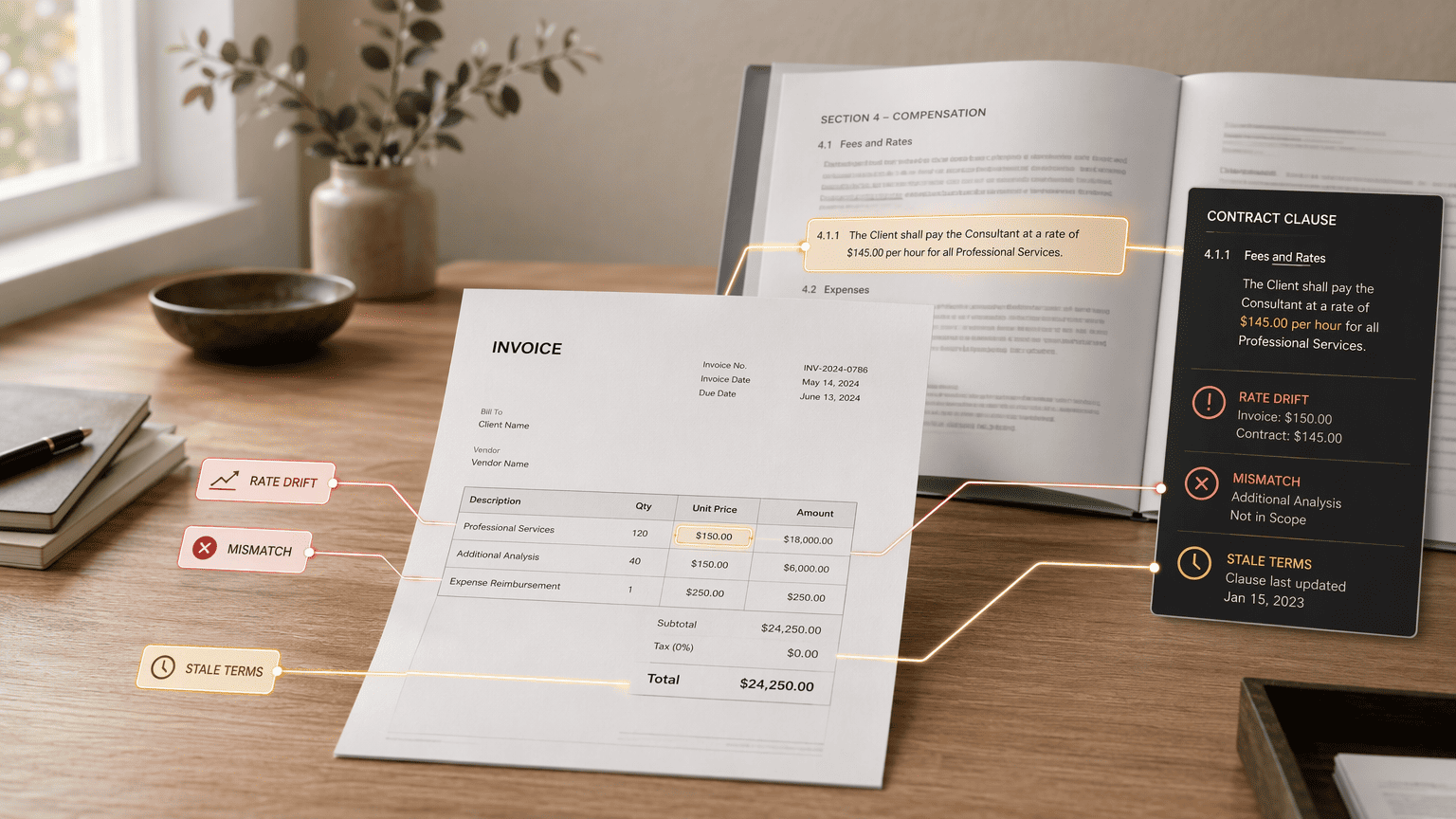
RateIQ shifts discount verification from periodic sampling to continuous, clause-level checking. An AP manager spot-checks a handful of invoices each quarter against contract PDFs stored in a shared drive. RateIQ checks every invoice against the exact contract clause for rate drift. It keeps every negotiated rate honest, catching drift, mismatches, and stale terms before they show up on an invoice.
Take a 2/10 Net 30 term. RateIQ verifies:
- The discount calculation
- The eligibility window
- The net amount on every line before the payment file is cut
The same supplier can hold a different rate in every region and business unit, with no single view of all of it. RateIQ centralizes that data so compliance checking runs by date, by rate, and by clause, continuously.
4. HighRadius Autonomous AP, AI-Powered Discount Surfacing Across Massive, Fragmented Supplier Portfolios

When your supplier portfolio spans thousands of vendors across dozens of ERP instances, manual discount capture stops being difficult and starts being impossible. HighRadius Autonomous AP is built for this enterprise-scale fragmentation. Its AI scans all contractual terms across the estate and flags invoices within the discount window, eliminating the manual invoice-by-invoice review that typically misses 30 to 40% of eligible discounts.
The underlying problem is data fragmentation: your discount terms sit in one CLM, your invoice timestamps live in an ERP, and your supplier master data might be in a third system. No single human can reconcile them at scale. The HighRadius engine systematically harvests those missed discounts by:
- Connecting the dots algorithmically across fragmented data sources
- Surfacing opportunities that would otherwise slip past the payment deadline unnoticed
That 30 to 40% recapture is not marginal yield. It is frequently six or seven figures in recovered working capital for a large enterprise.
For teams managing hundreds of supplier agreements, the platform turns discount capture from a manual treasure hunt into an automated, auditable line item on the cash flow statement.
5. ContractControl, Purpose-Built CLM with EU Data Residency for Global Compliance Teams

Not every organization needs an analytics layer today. For some, the priority is getting the contract repository itself under governance control, particularly when multi-jurisdiction data residency requirements come into play.
ContractControl provides full-lifecycle contract management with EU data residency features that keep contract data stored within required geographic boundaries. If your compliance team is staring down a GDPR audit and your contracts currently live in scattered SharePoint folders, this is the right starting point. However, be clear on the boundary: ContractControl:
- Manages the contract lifecycle but does not perform post-signature, invoice-checking verification
- Requires a separate layer or manual process to verify that invoices actually honor the discount terms your contracts mandate (unlike RateIQ or Centime)
6. Comparing Deployment Models: Rip-and-Replace Platforms vs. Non-Disruptive Intelligence Layers
Not all discount analytics platforms deploy the same way. The single most important architectural decision you will make is whether to rip out your existing contract infrastructure or layer intelligence on top of it. This choice dictates your timeline, cost, and likelihood of user adoption.
The traditional model, seen in many full-suite CLM migrations, demands that you export, clean, migrate, and re-platform every contract, template, and clause library into a new system before any analytics can run. Implementation timelines often stretch past twelve months. Procurement teams resist because their existing workflows get broken. The analytics promise gets buried under the migration project plan.
The intelligence layer model leaves your current systems alone. Contracts.ai, for instance, reads from your existing ERP and CLM systems. You connect, it extracts, and structured intelligence flows into finance and procurement dashboards, often within weeks rather than quarters.
There is a trade-off. Rip-and-replace ultimately gives you a single, consolidated platform and, if the migration is executed well, a cleaner data foundation long-term. But the cost and organizational friction are real.
A pilot with limited contracts lets you validate the analytics first and expand later. For most finance teams whose primary goal is capturing missed discount yield right now, the intelligence layer approach aligns better with the urgency of the problem. You can evaluate both paths, but understand which one you are choosing before you sign anything.
7. How to Handle Complex Rate Structures: Tiered Discounts, Escalations, and Multi-Region Cards

Simple 2/10 Net 30 terms are the easy case. Real supplier contracts often contain tiered discounts that deepen at volume thresholds, annual escalation formulas, and region-specific rate cards that make a single invoice’s correct discount a multi-variable calculation. Handling these requires extraction capabilities that go beyond fixed-term recognition.
- Start with clause extraction that reads formulas, not just dates: Platforms like Contracts.ai and SimpliContract RateIQ are designed to extract pricing formulas, rebates, and escalation terms from unstructured contract language, not just scan for a “2%” string. This is what separates true contract analytics from basic OCR.
- Map every supplier’s rate across every region and business unit: The same supplier can hold a different rate in every region. Centralize those rates into one auditable view so a procurement card payment in Europe and an invoice in the US are both checked against the correct, region-specific contract clause.
- Automate tier and escalation logic inside the verification engine: If a contract says “2% discount up to $500,000 annual volume, 3% thereafter,” the platform must track cumulative volume in real time and apply the correct tier on each invoice. Manual tracking of this is nearly impossible at scale.
- Validate against the payment run, not a monthly report: Rate drift and tier mismatches must be flagged before payment execution, not discovered in a post-close variance report when recovery is already difficult.
Conclusion
Finance teams are leaving 30 to 40% of available early-pay discount yield untouched, not because the cash is not available, but because the data connecting contract terms to invoice execution is broken. The platform spectrum covered here offers a clear path to recapture that value. If your priority is speed and non-disruption, start with a post-signature intelligence layer that reads from your existing ERP and CLM systems. If governance and data residency dominate your risk register, a full-lifecycle CLM like ContractControl sets the right foundation first. Either way, the technology exists to stop leaving that 2% on every invoice.
Frequently Asked Questions
What contract analytics capabilities are key for identifying and calculating the ROI of early payment discounts?
The key capabilities are clause-level extraction of payment terms like 2/10 Net 30, continuous invoice-to-contract matching to catch rate drift, and automated ROI calculation on each discount window. Without clause-level accuracy, finance teams cannot reliably quantify the exact savings a discount term should produce on each invoice.
How can AI-powered contract intelligence platforms automatically surface early payment discount opportunities across large supplier portfolios?
They connect fragmented data sources that no human AP clerk can reconcile at scale across thousands of suppliers.
What are the best enterprise platforms with post-signature analytics for finance and procurement teams to optimize working capital?
The platforms split into two architectural categories. Post-signature intelligence layers like Contracts.ai and SimpliContract RateIQ read from existing systems and verify payments against contract clauses. Full-suite platforms like HighRadius Autonomous AP and Centime’s portal integrate discount capture directly into the payment execution workflow.
How does Contracts.ai provide an intelligence layer over existing ERP and CLM systems to unlock early pay discounts?
It operates as a post-signature analytics engine that extracts pricing formulas, rebates, and escalation terms directly from the customer’s existing CLM and ERP systems. It computes the delta between contractual obligations and actual payments, linking every surfaced finding to the source contract language for audit validation, without requiring a full CLM migration.
What are the key differences between rip-and-replace deployment and a non-disruptive intelligence layer for discount capture?
Rip-and-replace platforms require full contract data migration into a new system before analytics can run, often extending timelines past twelve months and disrupting procurement workflows. Non-disruptive intelligence layers read from existing ERP and CLM systems without migration, letting finance teams run a pilot on a limited contract set and reach value in weeks, not months.
What privacy and compliance features must a contract analytics platform have when processing supplier payment and discount terms?
Role-based access controls, encryption in transit using TLS 1.2 or higher, and documented incident response procedures are baseline requirements for audit readiness.
Sources
- 2/10 Net 30 Early Payment Discount: Formula & Examples – www.highradius.com
- RateIQ — Catch Pricing Deviations Before You Pay | SimpliContract – www.simplicontract.com
- Accounts Receivable Customer Payment Portal | Centime – www.centime.com