







Introduction
Your finance team just closed the books on another quarter. Revenue targets were met, but something feels off. Discounts approved in the eleventh hour were higher than planned, a key supplier invoice arrived with rates that no one verified against the master agreement, and nobody remembered to trigger the penalty clause for a vendor that missed their delivery date by a mile.
You are not staring at a sales problem; you are staring at post-signature contract leakage. PwC research reveals a staggering reality: enterprises can hemorrhage 5 to 9% of annual revenue purely from poorly managed obligations in already-executed contracts.
The good news is that this drain is no longer an unavoidable cost of doing business. A new category of technology, AI-powered contract intelligence software, directly targets this gap by converting static, inert PDF documents into dynamic assets that your financial systems can actually monitor and enforce long after the ink has dried.
Key Takeaways
Here are the core arguments for why contract intelligence is becoming a non-negotiable financial control:
- The silent drain is quantified: Enterprises lose 5 to 9% of annual revenue to missed obligations and unverified terms in executed contracts, not from flawed pre-signature negotiations.
- AI obligation extraction: Machine learning now ingests legacy PDFs, classifies complex clauses, and populates a structured register so deadlines, rebates, and penalties never slip through the cracks.
- Non-disruptive integration: Modern tools deploy as an “intelligence layer” that syncs extracted obligations directly into your existing ERP and CLM systems via integration hubs, avoiding a costly rip-and-replace.
- Measurable cash control: By automatically matching invoices against negotiated rates and alerting you to looming renewals, the technology gives finance teams operational control over money that previously evaporated unseen.
What Is Contract Intelligence and How It Targets Post-Signature Revenue Leakage

Contract intelligence is an AI-powered software layer that ingests finalized, executed agreements and uses natural language processing (NLP) to turn unstructured legal text into a searchable, structured data model. It is not about drafting or negotiation, that is classic Contract Lifecycle Management (CLM). This technology focuses on the phase after the signature, where most agreements become “shelfware” that quietly leaks money. It reads every clause in a portfolio and pulls out the obligations, milestones, pricing tables, and renewal dates that need attention, giving your team a machine-generated map of financial and operational commitments that would otherwise sit unread.
Without it, you are relying on human memory to track thousands of promises.
Leading solutions take different approaches. Agiloft’s data-first obligation management model lets you convert a static clause into a trackable task assigned to a specific stakeholder with one click. AI-native platforms like Sirion.ai and Icertis go further, they create a digital twin of the deal, checking actual supplier behavior or customer payments against the legal promise continuously. When a variance appears, you get an alert immediately, not months later during a manual audit.
The Staggering Financial Drain of Unmanaged Contractual Obligations
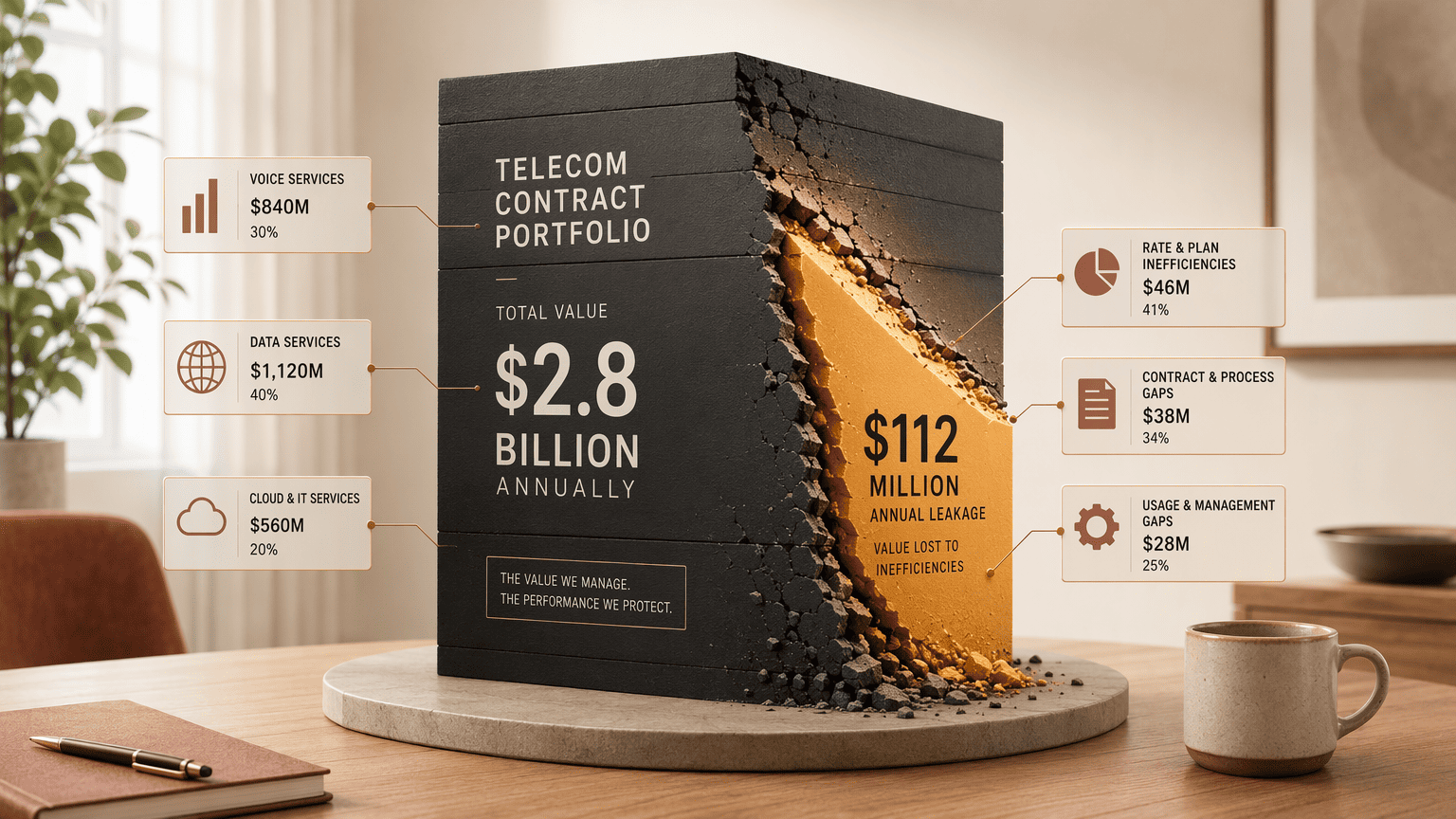
The mechanics of this loss are mundane but brutal. A telecom firm managing 15,000 active vendor contracts worth $2.8 billion annually could watch approximately 4% of that value evaporate through operational inefficiencies, translating into $112 million in annual leakage. The table below breaks down exactly how these seemingly minor oversight gaps compound into massive earnings erosion, illustrating why manual tracking is no longer viable for a modern finance function.
| Leakage Category | How the Money Is Lost | The Financial Fallout |
|---|---|---|
| Auto-Renewal Misses | Failure to trigger a non-renewal or renegotiation notice within a narrow window means locking in unfavorable legacy rates for another full term. | A 7% above-market rate on a multi-million-dollar SaaS contract auto-renews, costing hundreds of thousands in unnecessary spend. |
| Unverified Invoices | Accounts Payable processes invoices against purchase orders but without cross-referencing the master contract’s negotiated discounts or tiered pricing. | A supplier “rounds up” a unit cost by $0.02, a delta no human spots, resulting in massive leakage across high-volume deliverables. |
| Forgotten Rebates & Penalties | Volume-based rebates owed by a supplier, or late-delivery credits, are never clawed back because the obligation to track them sat in a dense PDF. | A logistics provider misses service-level commitments 15 times in a year with zero consequence because the SLA clause was not actively managed. |
| Undelivered Contract Deliverables | A software vendor owes custom reporting or a consulting firm owes a final strategy roadmap that gets lost in the post-closure shuffle. | The value of these deliverables is a straight write-off, effectively increasing the real cost of the purchased service. |
How AI Transforms Static Contracts into Operational Intelligence
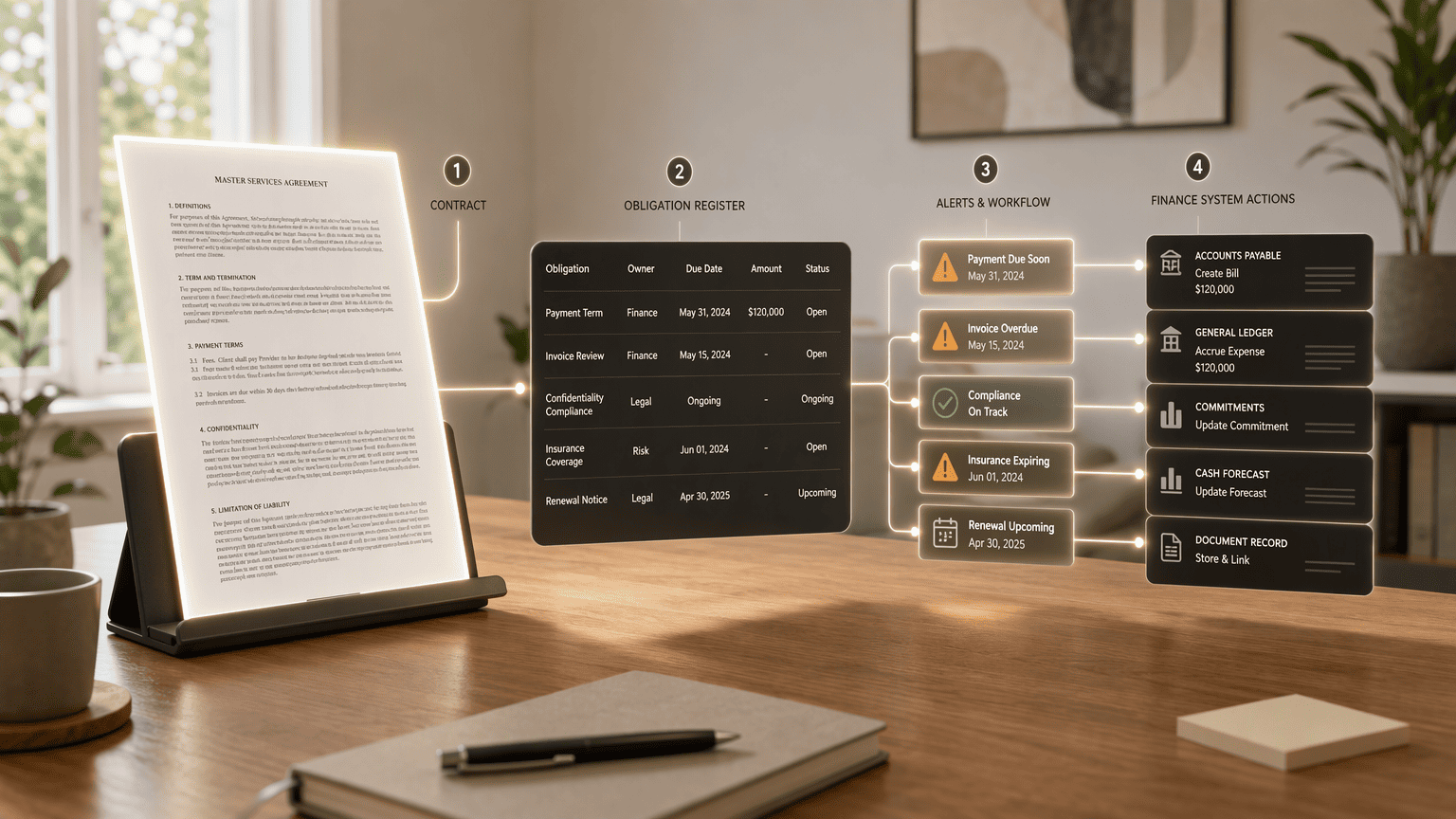
Converting a static document into an active financial control follows a distinct, automated sequence. Rather than skimming for a signature, the AI reads for meaning and builds a structured obligation register that acts as a single source of truth for post-signature performance. The steps below outline the transformation from a dormant PDF into a living asset that can power alerts and trigger actions across your finance stack.
- Ingestion and digitization: The AI pulls contracts in their native format, scanned images, Word documents, or PDFs, and applies optical character recognition (OCR) to make every character machine-readable.
- Clause classification: Machine learning models trained on legal language identify and label specific clauses, distinguishing a pricing table from a limitation of liability or a termination-for-convenience right.
- Metadata extraction: AI can pull out pricing, payment terms, rebates, service levels, renewal clauses, and supplier obligations in minutes, extracting specific dates, dollar amounts, and party names into a clean, structured data field.
- Obligation activation: The structured data is used to create a dynamic register where obligations like “deliver QBR by Oct 1st” stop being text on a page and become a ticketed task assigned to a stakeholder with a strict deadline.
- Continuous event triggering: The system pushes notifications and automated email alerts to the relevant parties, ensuring finance teams never miss a window for renegotiation or a discrepancy between an invoice and the true negotiated rate.
The Intelligence-Layer Architecture: Enhancing ERP and CLM Without Rip-and-Replace
The immediate fear of any technology leader hearing this is the prospect of a massive, disruptive migration. Contract intelligence avoids that risk entirely by sitting on top of your current architecture. It deploys as a middleware that uses an integration hub to push structured intelligence into the systems you already rely on, NetSuite or SAP for financial validation, and Salesforce or Agiloft for customer lifecycle tracking.
You do not need to rip out your existing contract repository or rebuild your accounting rules. The AI handles the heavy lift of reading unstructured text and then exports its findings. For instance, Contracts.ai was built specifically to structure and activate contract data beyond static storage, enabling operational use across enterprise systems without replacing them. It can share structured intelligence across finance and procurement, allowing you to automatically compare purchase orders and invoices against the actual contract terms in real time. You keep your database; you just finally populate it with the truth.
Choosing a Privacy-First, Operator-Led Contract Intelligence Solution

When evaluating tools, you must apply three critical filters:
- Privacy-first architecture. You must prioritize a solution that acts as a data processor on documented customer instructions, never a data controller with broad rights to use your content. A solid solution isolates your data within your tenant boundary and maintains strict encryption: TLS 1.2 or higher in transit, strong encryption at rest. Contracts.ai operates inside your data boundaries and explicitly commits to not training public, shared, or generalized large language models on proprietary customer data. You retain full ownership and control. Demand audit rights and subprocessor transparency to keep that confidence.
- Operator-led design. You need a human-in-the-loop tool that validates AI findings. Contracts.ai links answers directly to the source contract language for immediate verification, so your team can decide quickly. The point isn’t an army of robots. It’s an augmented staff that spots a $0.02 price discrepancy across 15,000 invoices, then hands the finding to you.
- Auditability. Any system housing your obligations must generate clause-based reports so you can find every contract containing a specific regulatory clause or payment term. When new tax laws or financial regulations appear overnight, pulling every affected agreement in seconds turns a compliance scramble into a reporting exercise.
Head-to-Head: Contract AI Audits vs. Traditional Manual Reviews

If catching leakage is the goal, you cannot rely on a process that only discovers the problem during quarterly supplier reviews, at which point the cash is already long gone. A manual audit, however diligent, relies on sampling and can never keep pace with the volume of modern enterprise contracts. AI contract intelligence inverts this cost structure by replacing a calendar-bound forensic exercise with a real-time monitoring and alerting system built directly into the operational flow.
A manual team faced with 15,000 contracts might review a small subset, entirely missing a penalty clause buried deep in a document that nobody opened since the signing ceremony. AI, in contrast, delivers 100% clause coverage. It does not sample; it systematically reads every line.
The efficiency gains are not marginal; they are transformational. Where a legal team might take two weeks and significant billable hours to abstract obligations from a complex M&A deal, AI-powered extraction tools, such as those built into platforms like Kira from Litera, complete the bulk entity extraction in minutes. The accuracy gap closes as well, with some AI providers now claiming extraction accuracy levels exceeding 99% when pulling structured data points from documents in real time. This eliminates the manual omission rate entirely.
Speed defines the recovery potential. AI can constantly compare purchase orders, invoices, and supplier activity against the contract. If a supplier shifts pricing unexpectedly, you find out right away, not three months later during an annual spend analysis. For a telecom carrier facing $112 million in potential annual leakage, the difference between a three-month lag and a same-day alert represents tens of millions in direct cost recovery.
Conclusion
You don’t have to accept that 5 to 9% of revenue leaks into missed deadlines and unenforced terms. The tools that catch those drains in real time are already built, and they plug into your existing systems without a rip-and-replace overhaul. When a static contract folder turns into a live financial control, contract intelligence stops being a legal back-office function. It becomes a P&L lever the CFO’s office can’t afford to leave untouched. Most organizations still bleed money this way every quarter, but the fix is sitting right there.
Frequently Asked Questions
What technology specifically targets revenue leakage from executed contracts after they are signed?
AI-powered contract intelligence software is the dedicated technology. Unlike standard CLM tools focused on drafting, it uses natural language processing (NLP) to extract financial obligations, milestones, and pricing terms from finalized agreements and actively monitors them to prevent post-signature value loss.
How does AI extract and structure data from static contracts to prevent payment errors and missed obligations?
AI ingests PDFs and scans, applies machine learning to classify clauses, and isolates key fields like payment amounts and deadlines. It converts unstructured text into a structured obligation register that triggers automated alerts for renewals or mismatches against invoices, catching errors in real time.
What is the financial impact of poorly managed contracts on enterprise revenue?
Research from PwC indicates enterprises lose 5 to 9% of their annual revenue strictly from poor post-signature obligation management. In a practical example, a telecom with $2.8B in vendor contracts can face approximately $112 million in annual leakage purely from operational inefficiencies and missed terms.
How does a contract intelligence layer integrate with existing systems like ERP and CLM without a rip-and-replace?
It deploys as a middleware intelligence layer. Using integration hubs, the AI pushes structured obligation data directly into your current financial systems (like SAP or NetSuite) and CLMs, enriching existing records without migrating repositories or disrupting current workflows.
What are the key features to look for in post-signature contract management software to stop revenue leakage?
When selecting contract AI software, you should prioritize these three capabilities:
- Real-time alerts triggered by AI obligation extraction for upcoming deadlines and payment discrepancies
- Automated invoice matching that continuously compares supplier invoices against agreed contract terms
- Privacy-first architecture that guarantees customer data is not used for public model training or pooled across tenants
How do contract AI tools compare to traditional manual contract audits for finding revenue recovery opportunities?
Traditional manual audits rely on time-lagged sampling and often catch leakage months after it occurs. Contract AI tools provide 100% clause coverage instantly, continuously comparing invoices and activity against terms in real time, turning audit from a forensic history lesson into a proactive financial safeguard.