








Introduction
Your finance team approved a 24-month SaaS contract with a hard-won 8% volume discount. Eleven months in, the vendor quietly switches billing tiers and starts charging the standard rate. The invoices keep flowing, the AP clerk processes them the same way they always do, and nobody notices the error for six billing cycles. By the time the overpayment surfaces, the money has already left the account and the clawback process becomes a two-month battle.
This scenario is the predictable consequence of running modern procure-to-pay workflows through manual eyes and spreadsheet trackers. In 2026, automated invoice-to-contract auditing tools have crossed from early-adopter curiosity to operational necessity. They read the contract, parse the invoice, compute the correct payment, and surface any deviation with clause-specific evidence, all before the payment batch runs.
A new wave of tools, including specialized platforms like Genesis and AI-native validators like Concilely, now perform line-item, tiered, and capitated pricing checks automatically. They act as a pre-payment intelligence layer over existing ERP and CLM systems, catching the silent price increases and missed auto-renewal changes that cost enterprises millions each year.
Key Takeaways
Automated invoice auditing tools exist now and are maturing rapidly. They have moved beyond simple rule-matching to AI-native, contract-aware computation.
- Pre-payment intelligence layer: Modern audit tools compute the correct payment amount before funds are released.
- AI parsing plus contract engine: They pair AI document parsing with a real-time contract compliance engine to flag variances with clause-specific evidence.
- Four-way match capability: Leading solutions like Genesis achieve a clean four-way match among bill sheet, purchase order, patient charges, and vendor invoice, driving match exceptions below 1%.
- Silent deviation detection: Tools like Concilely surface silent price increases and auto-renewal changes hidden in vendor invoices.
- Integration without rip-and-replace: These platforms connect to your existing billing inbox, ERP, or EHR via mailbox forwarding, API, or flat-file integration.
What Automated Invoice-to-Contract Auditing Means in 2026

An automated invoice-to-contract auditing tool is AI-powered software that reads both the vendor’s contract and their invoice, computes what you should pay under the relevant clauses, and identifies any delta with a direct citation to the contract language.
This category has evolved beyond the three-way match (invoice, PO, goods receipt) that has defined AP automation for decades. The state of the art in 2026 is a four-way match incorporating the contract itself as the authoritative pricing source. Genesis, for instance, performs line-item, tier, capitated, and primary-vs-revision checks against contract pricing and clinical rules, then routes only flagged exceptions to human specialists. The difference is fundamental: a three-way match confirms you received what you ordered, while a contract-aware audit confirms you are paying what you agreed to pay.
Think of it as shifting audit from a rearview mirror to a checkpoint gate. The tool computes the correct payment and stops the incorrect one.
Platforms like Concilely take a different vector on the same problem. They connect directly to your billing inbox, parse incoming invoices with AI, and check them against stored contract terms. When a price, quantity, or renewal term diverges, the system alerts your team with a specific explanation. This moves audit upstream, before anyone codes the invoice in the ERP.
The Causes and Drivers Behind the Urgent Need for Audit Automation
Three structural shifts in how enterprises buy and pay for goods and services have made manual contract-to-invoice reconciliation unsustainable.
- Exponential contract complexity: Modern supplier agreements carry tiered volume pricing, capitated constructs with annual spend limits, primary-vs-revision pricing for replacement goods, and multi-year escalator clauses. A single hospital implant contract can contain hundreds of line-item pricing rules that no AP clerk can retain across thousands of invoices.
- Silent price increases and missed renewals: Vendors change billing rates, add new line fees, or roll into auto-renewal at elevated terms, often buried in dense invoice formats. Concilely’s maker reported building the tool after repeatedly seeing small businesses miss these hidden changes. By the time a spreadsheet tracker catches the drift, six or seven figures may have already walked out the door.
- The unpoliceable spend black hole: In healthcare, bill-only implant cases are one of the largest and least-audited spending categories. Vendor reps submit invoices with little real-time validation against capitated agreements. Genesis was purpose-built for this environment, automating every line audit because manual policing at scale is impossible.
How AI-Powered Invoice Auditing Technology Actually Works

The workflow begins when an invoice lands, not when a human opens it. The tool ingests multi-format documents, PDFs, spreadsheets, even photographs of bill sheets submitted via a mobile app, and parses every line item using AI-powered OCR and document intelligence. It reads unstructured invoice fields the way a trained auditor would, identifying unit prices, quantities, item descriptions, and total amounts regardless of layout. You don’t build templates for each vendor format ahead of time.
Simultaneously, the system pulls the relevant contract clauses from its structured repository. It knows which agreement governs this vendor, which amendment is active, and which pricing tier applies based on cumulative volume or effective dates. The engine then performs a line-by-line match: invoiced rate against contracted rate, billed quantity against cap limits, calculated extension against the arithmetic the clause dictates. When a variance emerges, the tool attaches the specific contract language that defines the correct payment, creating an audit-ready exception package.
Flagged invoices drop into a human-in-the-loop specialist queue for review. The system has already computed the discrepancy and proven it against the contract. The specialist confirms or adjusts, and the corrected payment data flows back into the ERP or EHR system before the payment run executes.
Key Audit Rules: Line-Item, Tiered, Capitated, and Duplicate Detection
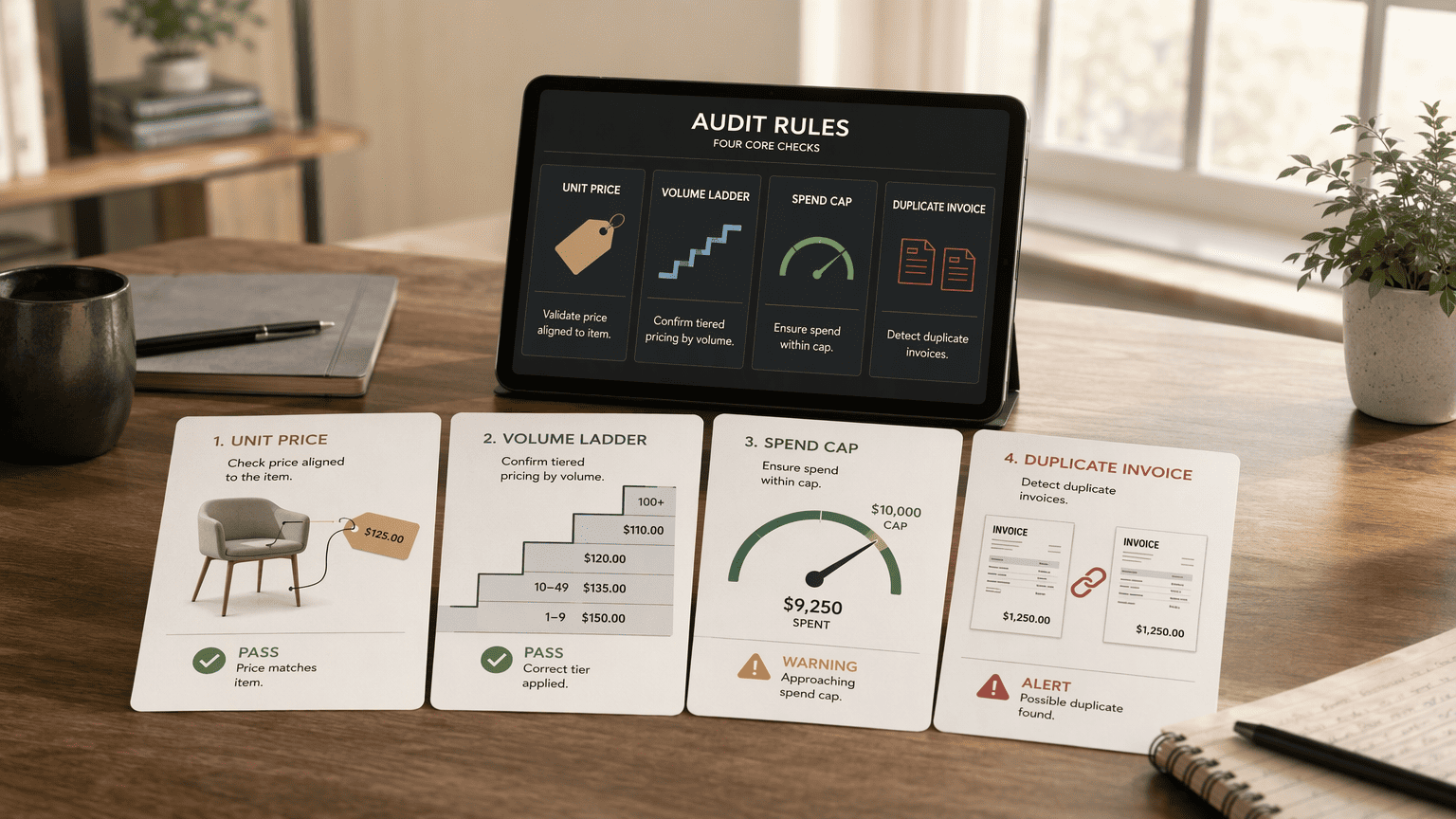
A credible audit tool must enforce pricing models beyond simple one-to-one rate matching. Line-item pricing verification confirms the invoiced unit price matches the contracted rate for each distinct item. Cumulative volume tier enforcement checks whether the vendor has correctly applied a lower rate once a purchase threshold is crossed, a common failure point when vendors bill across multiple POs. Capitated pricing monitoring watches aggregate spend against a contract’s ceiling, flagging invoices that would breach the cap before payment is made. Primary-vs-revision comparison identifies when a vendor charges a replacement-parts price that differs from the agreed primary-vs-revision formula.
Duplicate detection extends beyond matching invoice totals. Genesis captures lot, serial, and expiry data via barcode, preventing the same implant from being billed twice under different invoice numbers.
Deploying Audit Intelligence Over Existing ERP and CLM Systems

The architecture layers over what you already run.
Audit tools connect to your existing billing inbox through mailbox forwarding. Incoming invoices are intercepted and parsed before they ever reach your AP queue. Flat-file, SFTP, or API integrations pull contract clauses from your CLM repository. After the audit computation runs, corrected purchase orders or patient charges push back into your ERP or EHR.
One enterprise anxiety stalls adoption more than any other: the fear that audit automation means ripping out core financial systems. The design removes that obstacle. Genesis Bill-Only Automation integrates directly with hospital ERP and EHR environments, flowing audited data back into the transactional systems the organization already runs. ContractsAI applies the same principle, sitting its intelligence layer over executed agreements without disrupting the CLM or procurement tools underneath.
Your AP workflow stays intact. The audit tool inserts a checkpoint gate that runs automatically.
Expanding Audit Scope: Contract Families and Shared-Term Alignment
Most invoice audit conversations begin and end with single-contract validation. A more advanced and often overlooked capability is cross-contract normalization, the ability to validate one invoice line against a parent agreement and confirm that terms flow correctly across an entire contract family.
Enterprises rarely manage discrete, standalone agreements. They manage contract families: a master services agreement, multiple statements of work, regional addenda, and amendment stacks that modify pricing terms on different effective dates. When an invoice arrives under one SOW, the correct payment may depend on a volume tier defined in the parent MSA or a rate adjustment introduced by an amendment signed six weeks prior.
An audit intelligence layer handles this by automatically grouping related agreements and aligning shared terms. If a master agreement caps annual spend at $500,000 across all subsidiary SOWs, the engine tracks cumulative invoicing against that cap, regardless of which entity issues the invoice. It also cross-references definitions: a “unit” defined in one amendment governs pricing across every SOW that references it, so invoice lines that treat a unit as something else get flagged before approval.
This capability transforms audit from a transactional checkpoint into a strategic contract governance function. You catch billing errors, and you enforce the commercial structure you negotiated.
Critical Features for Selecting an Enterprise Invoice Audit Tool
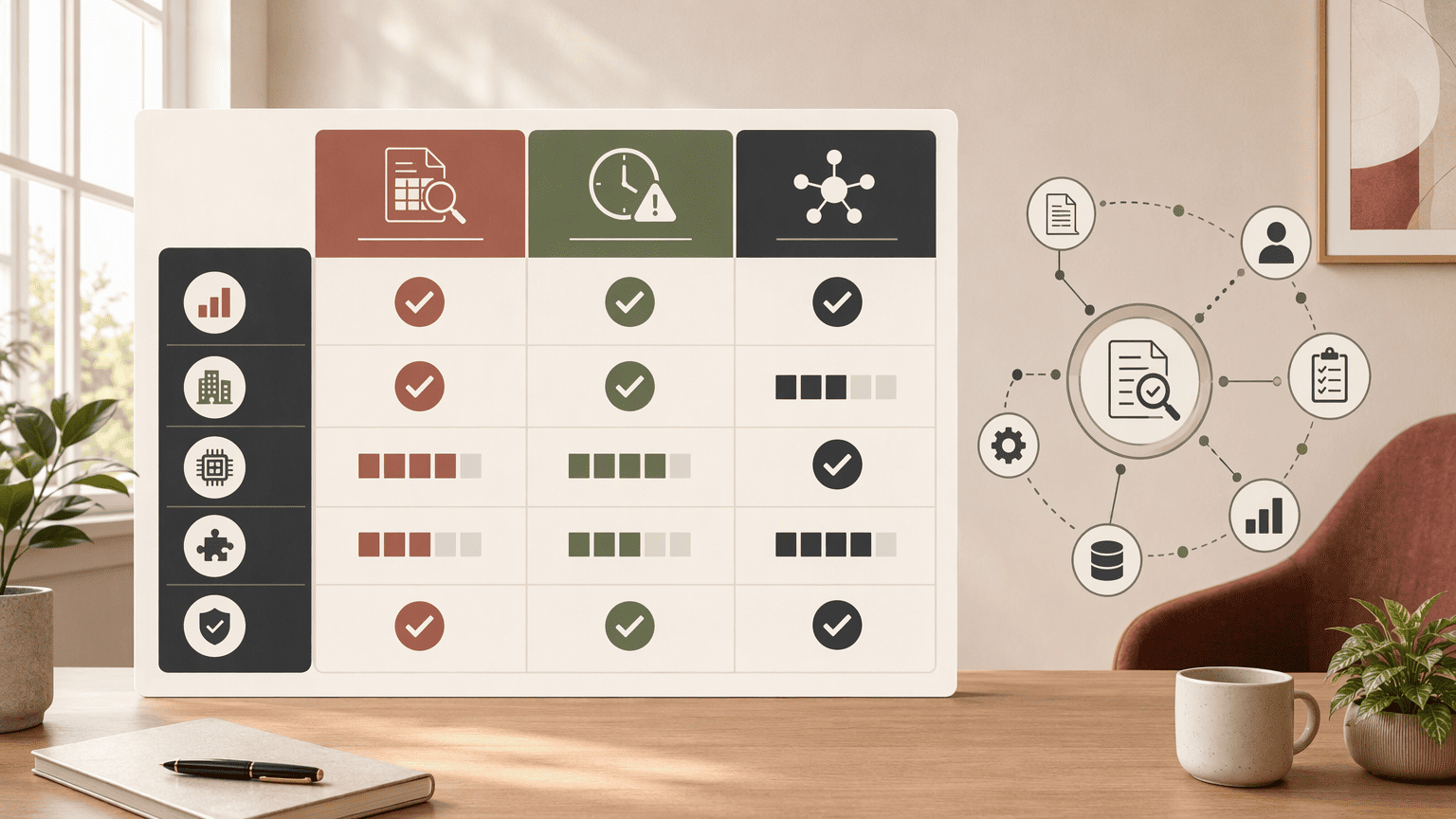
Not every tool labeled “AI audit” performs the same functions. The table below maps the capabilities that separate a genuine contract-aware audit platform from a standard AP automation module.
| Feature | What It Does | Why It Matters |
|---|---|---|
| Native line-item contractual auditing | Audits every invoice line against contract pricing, tiers, caps, and revision rules automatically | Catches deviations that header-level matching misses: this is the core value prop |
| Real-time pre-payment alerting | Flags variances with clause-specific evidence before the payment batch runs | Stops overpayments from leaving your accounts by surfacing discrepancies during the approval window, when you can still act |
| ERP/EHR bidirectional integration | Pulls POs and pushes corrected charges back into your transactional systems | Prevents a second manual entry step and keeps the ERP as the system of record |
| Pre-case vetting and vendor self-service portals | Lets vendor reps submit cases through a mobile app in about a minute with barcode-captured lot and serial data | Shifts compliance upstream: contract adherence is enforced before the invoice is even generated |
| Audit trail granularity | Maintains a complete, immutable record of every match decision, exception, and override | Supports compliance reviews, vendor negotiations with cost-per-case analytics, and audit defense |
Conclusion
Automated invoice-to-contract auditing tools are a mature operational capability in 2026, deployed across enterprises and specialized verticals like healthcare. Continuing to rely on manual reconciliation and spreadsheet tracking is an active risk vector that leaks margin with every billing cycle.
Framing audit automation as a back-office efficiency play undersells it. Pre-payment, contract-aware intelligence turns every incoming invoice into a verifiable enforcement point for the commercial terms your team negotiated.
The tools exist now. The gap is the recognition that manual audit stopped being adequate the moment contracts grew more complex than a human can hold in working memory.
Frequently Asked Questions
What types of software tools can automatically audit vendor invoices against contract terms?
AI-native audit platforms like Genesis and Concilely are purpose-built for automated invoice-to-contract auditing. They read both documents, compute the correct payment, and flag variances. General AP automation modules and ERP add-ons offer three-way matching but typically lack clause-aware contract enforcement and line-item pricing validation.
How does automated invoice-to-contract auditing work, and what technology powers it?
AI-powered document parsing extracts invoice line-items regardless of format. A contract compliance engine pulls relevant clauses and performs a line-by-line match against agreed rates, tiers, and caps. Variances are flagged with clause-specific evidence and routed to a human specialist before payment is released.
What are the key benefits and ROI of deploying an invoice audit tool in 2026?
The primary benefit is catching overpayments before funds leave your accounts, including silent price increases, missed tier discounts, and duplicate billing. Secondary ROI comes from staffing use, stronger vendor negotiation data, and match exceptions dropping below 1% on audited invoices.
How do solutions like ContractsAI enable finance and procurement teams to audit invoices post-signature?
ContractsAI acts as an intelligence layer over executed agreements. It can automatically group related contract families, align shared terms across parent agreements and addenda, and validate invoice lines against the correct governing clause, all without replacing your existing CLM or ERP systems.
What features should enterprises look for when selecting a vendor invoice auditing tool?
Prioritize native line-item and tiered pricing enforcement, real-time pre-payment alerting, smooth ERP/EHR integration, pre-case vetting capabilities, and granular audit trails. These features separate a true contract-aware audit platform from standard AP automation that only performs header-level matching.
How does automated auditing help maintain compliance and reduce billing errors?
It enforces contract terms at the payment gate, preventing unauthorized rate changes and duplicate charges from being paid. An immutable audit trail documents every decision, supporting regulatory compliance and providing cost-per-case analytics that strengthen vendor accountability during negotiations and audits.
Sources
- Product – contracts.ai
- Concilely: Validate vendor invoices against contract terms | Product Hunt – www.producthunt.com
- Genesis Bill-Only Automation | Implant Case Capture & Audit – www.genesisahc.com






