








Introduction
A supplier invoice lands on your desk with a rate that doesn’t match the contract. Your first instinct is to call it a clerical error and move on.
Don’t.
G4S and Serco overcharged the UK Ministry of Justice on electronic tagging contracts for years before anyone noticed. Both companies repaid tens of millions of pounds, but only after the damage was done. That money was gone long before the repayments arrived. The same thing is happening inside your P&L right now: silent leakage from unverified rate cards.
In the UK public sector, approximately £90 billion is spent annually on complex private-sector services. The government later admitted it placed “too much trust in contractors” and relied excessively on supplier-supplied data. The Public Accounts Committee found that departments historically “took their eye off the ball,” lacking the commercial expertise to challenge their private-sector counterparts. That trust-first model is a gaping hole.
Overcharge detection is a proactive profit-recovery discipline. It demands an institutionalized verification rhythm instead of reactive fire drills. This article lays out a six-step framework to catch and prevent contractual overbilling. We will map the root causes, embed audit-ready visibility into your agreements, restructure approval workflows, and deploy technology to automate verification at scale.
Key Takeaways
- Your first defense against financial leakage is a diagnostic taxonomy. Without classifying how an overcharge happens, your team is just treating symptoms. The most common systemic root causes: incorrect rate tables applied at the line level, volume-tier misclassification where you’re billed at a higher unit cost than your actual volume warrants, and missed discount thresholds triggered by poor data integration. Other frequent failures include currency or CPI indexation errors on multi-year agreements, duplicate billing across separate purchase orders, and unauthorized scope creep billed outside the original statement of work.
- Map each category to a specific detection method. An incorrect rate table can be detected by a simple line-item comparison between the invoice and the contract’s rate card attachment. A missed volume discount threshold requires an audit of cumulative spend against the tiered pricing schedule. Prioritize these root-cause categories by potential spend impact, and you focus your audit energy on the highest-leakage areas first instead of treating every anomaly the same way.
Step 1: Classify your overcharge exposure by mapping common root-cause categories

Before you can catch supplier overcharges, you need a clear map of where the money actually leaks. Most overbilling falls into a few predictable buckets, and knowing which ones match your contracts lets you focus your audit where the recovery potential is highest. You are looking for known failure patterns that show up repeatedly across industries.
Start by categorizing every active agreement against three root-cause profiles. First, rate-card drift: the supplier applies a price that does not match the agreed schedule, whether by inflating a line item, using an outdated multiplier, or charging standard rates when a discounted tier should apply. The Medicare Fee-for-Service program saw a 6.55 percent improper payment rate in fiscal year 2025, totaling $28.83 billion, and rate mismatches are a major contributor.
Second, scope creep: charges appear for goods or services the contract never authorized, or quantities exceed what any approved change order permits. Third, term expiration: the supplier continues billing under a lapsed agreement with pricing that was meant to reset or terminate. Tag each contract with its primary exposure category and assign a rough dollar estimate based on monthly spend.
A contract worth $50,000 a month with signs of rate-card drift deserves a different level of scrutiny than a $2,000 agreement with clean billing history. This triage step transforms a daunting pile of invoices into a ranked audit queue, so your first hours of review target the highest-value recoveries.
Step 2: Embed audit-ready visibility clauses in every new and renewed supplier contract
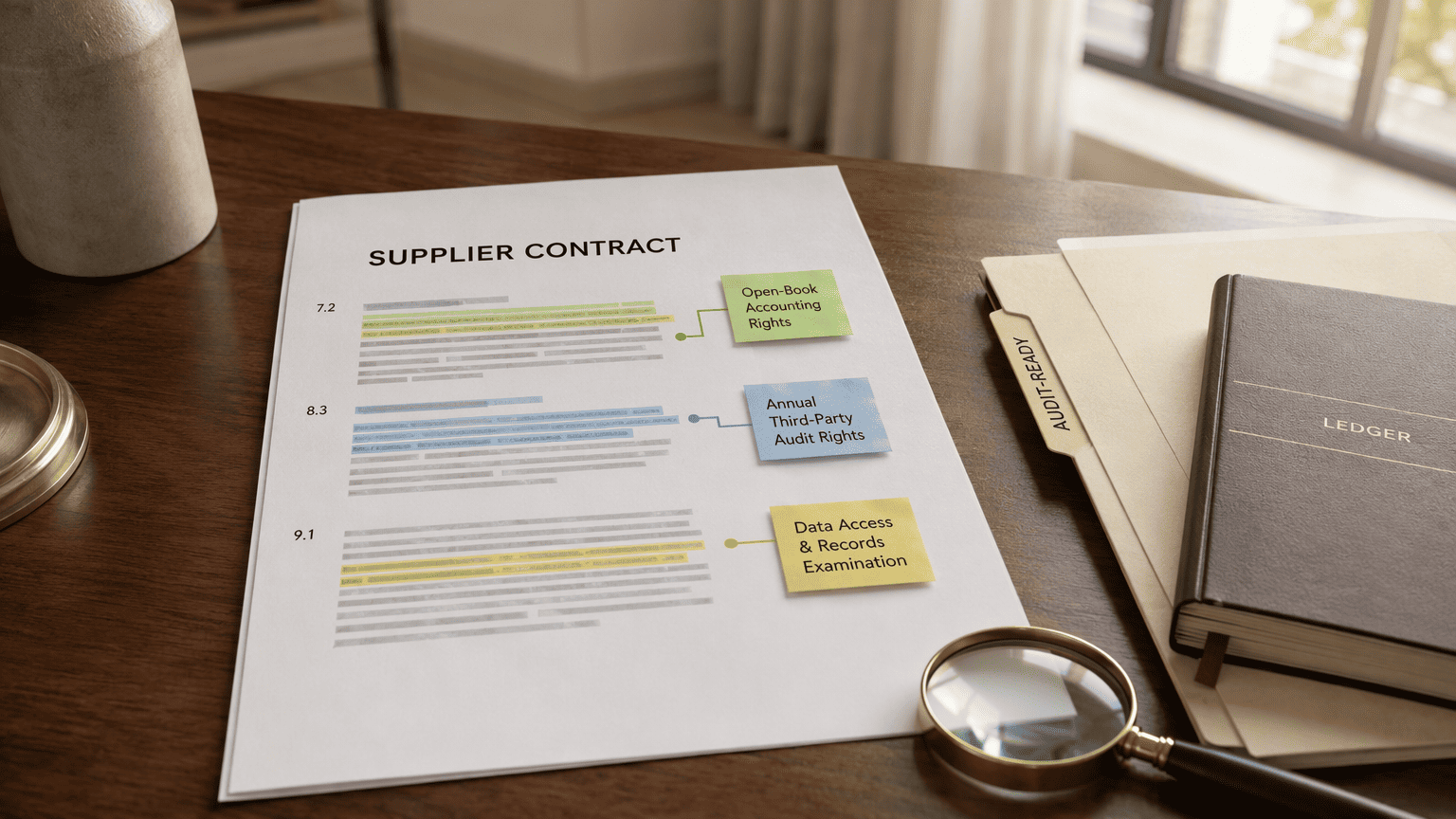
The biggest loophole suppliers exploit is your lack of contractual access to data. Closing it means transforming your contracts from passive documents into enforceable audit instruments. This begins with embedding specific clauses in every new and renewed agreement. You need to mandate open-book accounting, which strips away the supplier’s ability to hide cost components. You need third-party audit rights with a defined frequency, at least annually, that let you or a hired firm walk in and inspect financial records directly.
Do not stop there. Require an electronic rate card attachment as a formatted, machine-readable schedule to the contract. The clause must include a line-item data disclosure mandate, forcing the supplier to deliver invoice data at the transactional level. Finally, codify financial penalties for non-compliance with these audit requests. The UK government’s shift toward making published contracts the norm is a powerful precedent.
Pre-contract negotiation is when this door is open. Once a deal is signed, you lose all use. Frame the audit clause as a standard requirement from the start. Suppliers who push back aggressively signal a risk you should price into the deal. A tool like Contracts.ai can structure these terms across all your agreements, ensuring that a promise of visibility made at the negotiation table doesn’t get lost in a static filing cabinet.
The best-practice model is clear: make crown representatives with genuine commercial experience accountable for holding these clauses. That means moving beyond checkbox compliance to a state where a specific, senior individual owns the enforcement. A contract without a name attached to its visibility mechanism is a contract already leaking.
Step 3: Build a segregation-of-duties workflow that separates invoice approval from payment

Fraud and error thrive on single points of failure. If the same person who approves an invoice also validates its rates and releases the payment, your control environment has a gap designed for overcharges to slip through.
Build a segregation-of-duties workflow rooted in a three-way match. Separate the invoice receipt process into distinct, owned functions: one person logs the invoice, a second performs the line-item review against the contract’s agreed rate card, and a third approves and authorizes the payment execution. Define threshold-based escalation rules that require documented evidence of rate verification for every invoice above a set dollar value.
This forces an independent verification step before any funds are released. After G4S, the UK Public Accounts Committee found contract management was too centralized and unsupervised, with oversight buried in a PDF.
The three-way split addresses that structural weakness directly. Each function gets its own sign-off in the system, and no single person can push an invoice from receipt to payment without someone else verifying the rates match the contract.
Step 4: Deploy an intelligence layer to automate line-item rate cross-referencing without ripping out your ERP
Checking every invoice line against every contract rate by hand doesn’t scale. The workaround is an intelligence layer that sits on top of your existing systems. AI-driven contract intelligence software ingests your agreements through OCR, extracts rate cards, and automatically matches each invoice line item against the pre-extracted, agreed rates. It flags any variance that exceeds your preset tolerance.
The critical architectural decision is a non-disruptive overlay. The integration approach typically uses an API or a flat-file exchange, where the tool pulls structured invoice data from your finance system and cross-references it with the parsed contract terms. When selecting a solution, a vendor-neutral criterion should focus on whether the tool can link an answer back to the source contract language for validation, so your team can trust a flagged discrepancy without hunting for the clause.
Contracts.ai says its platform automatically groups related agreements and aligns shared terms, with extraction accuracy claimed at greater than 99%. A pilot can be run with a limited contract set without migrating the full repository or disrupting existing workflows. That means structured intelligence reaches finance and procurement instantly. Your static document library becomes an active audit engine that catches errors the moment an invoice is ingested.
Step 5: Run a continuous, scheduled rate-verification cadence with structured evidence capture
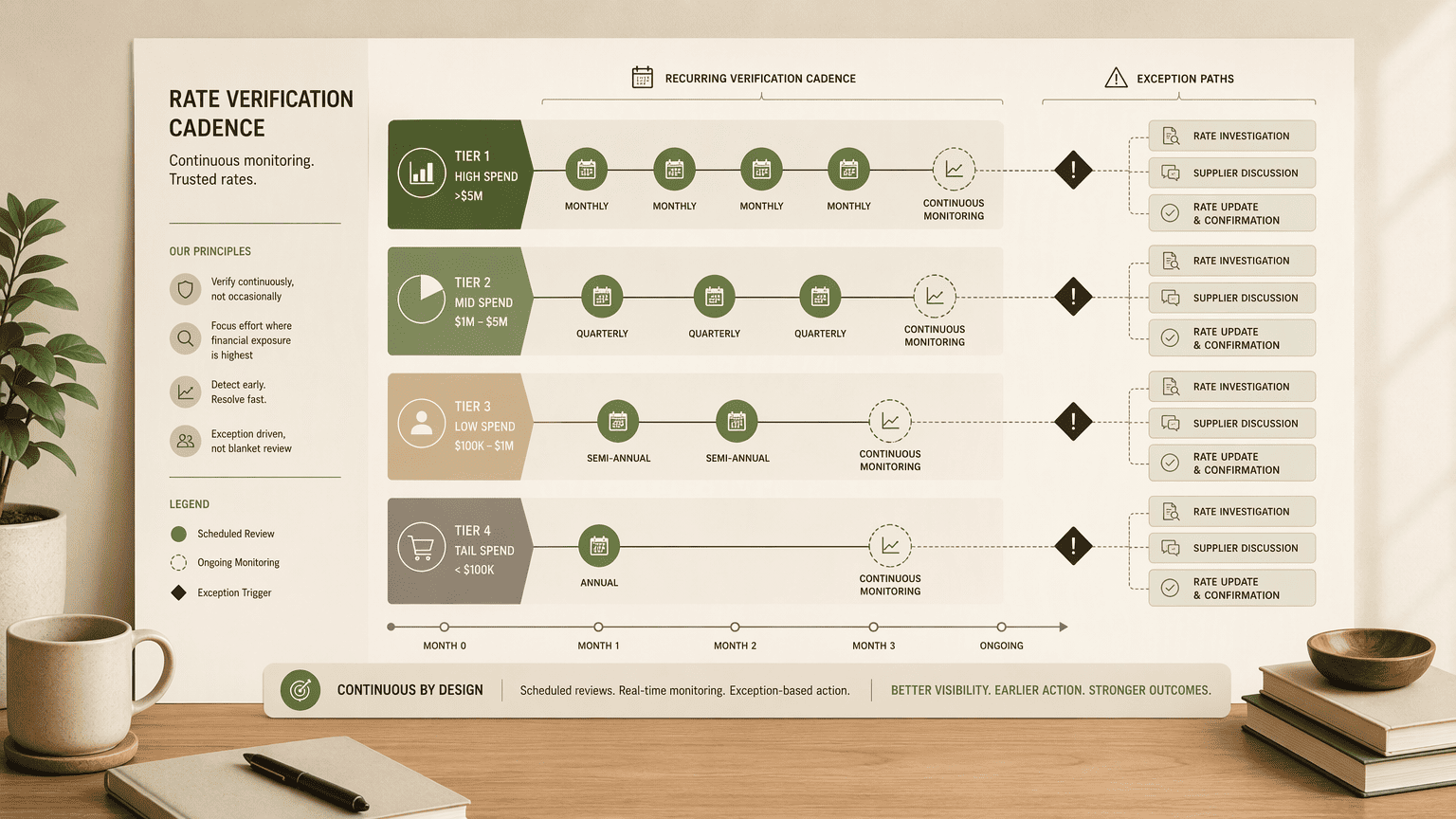
The G4S and Serco scandal was a multi-year failure of detection cadence. Shifting from annual or ad-hoc reviews to a continuous monitoring schedule catches a billing error in days, not a buried PDF. The table below defines a verification frequency by spend tier and prescribes the evidence-capture standard for each audit cycle.
| Spend Tier & Risk Category | Verification Frequency | Evidence-Capture Standard | Exception-Handling Protocol |
|---|---|---|---|
| High-Value Strategic (Top 10% of spend, complex rate cards) | Weekly automated flag reviews | Structured variance summary with source contract clauses linked; timestamped data extract | Immediate hold on payment batch; formal dispute package triggered within 48 hours |
| Mid-Tier Managed (Recurring, moderate complexity) | Monthly scheduled audits | Random line-item sampling with full reconciliation screenshots; audit log annotations | Quarantined line items; supplier credit memo required within 30 days, or the difference is deducted from next cycle per a clause trigger |
| Low-Value Transactional (High volume, simple rate) | Quarterly random sampling | Automated variance dashboard with threshold-based exception reporting (>5% variance) | Aggregate quarterly debit memo issued to supplier with a reconciliation report |
Step 6: Execute a supplier dispute with an audit-backed, dollar-quantified recovery package

An anomaly is not recovered cash. You must convert a detected variance into a repayment by provisioning a legally strong, supplier-proof dispute file. Assemble your package in this order:
- Assemble the quantified variance summary: Calculate the exact dollar amount of the overcharge, including any interest that has accrued. Model the language from federal guidelines where, if it is later determined an overpayment has been made and is not repaid within 30 days, the excess will begin to bear interest.
- Cite the exact contract clause violated: Pinpoint the specific rate card attachment, section, and schedule where the agreed rate is defined. Do not make a subjective claim; quote the contract language directly to make the breach unambiguous.
- Attach the audit evidence package: This is the structured evidence from your continuous monitoring protocol, the screenshots, timestamped data extracts, and automated variance flags. Present it as a formatted file ready for a third-party arbitrator.
- Issue a formal demand letter: Using a standard template, state the total repayment due, the legal basis, the documented evidence, and a clear payment deadline, typically 15 to 30 days. Reference the contractual audit rights clause you embedded in Step 2.
- Define contractual escalation triggers: If the demand letter is not satisfied, immediately trigger the next step you prescribed in the contract. This could be escalating the dispute to a named senior executive, invoking a binding arbitration clause, or, in cases of substantive fraud, a referral to authorities. Two G4S contracts were referred to the Serious Fraud Office to investigate.
- Negotiate from a position of evidence: The psychology is simple. Do not negotiate on the validity of the facts; they are closed. Your negotiation is solely about the remediation plan and the repayment schedule. A relationship can survive, and even improve, when you handle a dispute with firm, precise professionalism that rewards compliance.
Conclusion
Overcharge detection rewires how your organization controls supplier spend. You diagnose exposure, embed audit clauses, automate enforcement, and then execute audited recovery. Each step builds a compounding P&L defense against supplier billing errors that, across global procurement, add up to a £90 billion-scale problem. The cost of doing nothing is quiet, compounding leakage that rewards supplier non-compliance year after year, right under your approval sign-off.
Frequently Asked Questions
What are the most common ways suppliers overcharge against agreed contract rates?
The most common root causes are systemic errors:
- An incorrect rate table applied to a line item.
- A missed volume-tier discount because your actual volume exceeds the billing tier.
- Duplicate billing across separate POs.
- Unauthorized scope creep.
- Currency or CPI indexation errors on multi-year deals.
What manual or automated processes can procurement teams use to detect supplier overbilling?
Procurement teams can deploy a segregation-of-duties workflow where an independent person performs a line-item review against the rate card before payment. Automated detection uses AI-powered contract intelligence software to cross-reference every invoice line against extracted rate cards and flags discrepancies in real time, removing the manual bottleneck.
How can AI or contract intelligence software flag price discrepancies across invoices and agreements?
An intelligence layer ingests contracts via OCR, extracts the rate card as structured data, and automatically matches each invoice line against it. It flags any variance that exceeds a preset tolerance threshold. The answer is linked back to the source contract language for immediate, auditable validation before you release the payment.
What internal controls and audit workflows prevent or catch supplier overcharges?
The critical control is separating invoice receipt, rate verification, and payment approval responsibilities. A three-way match is required, with threshold-based escalation rules. Continuous monitoring cadences, weekly for high spend, monthly for recurring, with structured evidence capture standards build a proactive prevention model instead of a reactive one.
How much money do organizations typically recover or lose due to supplier billing errors?
Losses are substantial and systemic. In a notorious example, G4S and Serco overcharged the UK Ministry of Justice on electronic tagging contracts for years, forced to repay tens of millions of pounds. On a macroeconomic scale, Medicare FFS alone has an estimated improper payment rate of 6.55%, representing $28.83 billion.
Sources
- Overbilling Detection – Flo – www.spendflo.com
- 125 – www.govinfo.gov
- Comprehensive Error Rate Testing (CERT) | CMS – www.cms.gov
- Transforming contract management: report published – Committees – UK Parliament – committees.parliament.uk






