






Introduction
Your procurement team spent six months negotiating a 15% discount with a strategic supplier. The ink is dry. The savings are in the forecast.
And then, three floors away, a new hire buys the exact same materials from a random website at list price because they didn’t know the contract existed. Most organizations lose 10 to 50% of their negotiated savings to exactly this kind of bypass behavior.
That leakage is predictable and solvable. Every quarter you let it run costs you measurable margin.
Maverick spend is purchasing activity that deliberately or accidentally ignores your active contracts and approved supplier lists. It differs from legitimate tail spend (unbudgeted but compliant small-dollar purchases) because it represents a compliance breakdown. Each off-contract transaction inflates costs by roughly 12 to 18%, extends procurement cycle times, and exposes your AP team to unvetted vendor risk. Nearly 30% of indirect spend is off-contract, according to The Hackett Group, so you are rarely trying to stamp out a rounding error.
You solve this with a process and visibility framework, not a stern email. When a department keeps buying around the contracts, the system failed them. This guide walks you through a six-step sequence: diagnose the root causes, quantify the dollar leakage with a hard baseline, deploy real-time interception tools, engineer guided buying paths that make compliance the default, police your legacy contracts for term drift, and lock in a monthly maverick spend ratio that keeps every department accountable to a sub-5% target.
Key Takeaways
Here are the core mechanics and metrics that underpin the six-step framework:
- Three-layer control model: Combine automated approval blocks, real-time contract intelligence detection, and transparent governance metrics to interrupt maverick spend before cash leaves your AP queue.
- Root cause triage: Most bypass behavior traces to poor contract visibility, a clunky requisition UX, or a decentralized speed-over-compliance culture. Fixing these prevents more leakage than any policy memo.
- Sub-5% maverick spend ratio: Leading organizations treat that ratio (non-compliant spend ÷ total spend) as the single governance heartbeat, targeting a number below 5% with department-level reporting.
- 12 to 18% cost premium: Every off-contract dollar carries a measurable premium over negotiated rates, and quantifying it turns anecdotal frustration into a P&L conversation the CFO will fund.
- Intelligence layer, not rip-and-replace: You can detect unauthorized purchases in real time by sitting an AI-powered contract intelligence layer on top of your current ERP, with zero need to migrate your repository first.
At a Glance

Here is how the options compare across the dimensions that matter most.
| Root Cause | Diagnostic Method | Typical Indicator | Example Impact |
|---|---|---|---|
| Contract invisibility | Check if employees can see approved vendors at requisition point | Static repository no one accesses during buying | Employee buys from unapproved website at list price |
| Cumbersome procurement UX | Time a compliant PO vs. a rogue purchase card transaction | Compliant PO takes 5+ screens; card swipe takes 30 seconds | System rewards bypass behavior |
| Decentralized speed-driven culture | Survey category managers on contract awareness | Managers operate autonomously without visibility | Duplicate or overlapping contracts undermine savings |
| Lack of real-time enforcement | Test if purchase orders are blocked for non-approved vendors | Rogue orders are approved without contract check | Leakage continues unchecked |
| Inadequate governance metrics | Review monthly spend reports for compliance breakdowns | Maverick spend ratio >5% without department tracking | CFO cannot quantify lost savings |
Step 1: Diagnose the Root Causes and Triggers in Your Procurement Process
Before you bolt on tools or rewrite approval rules, isolate exactly why your people bypass contracts. Most organizations can trace it to three structural drivers, and each one demands a specific diagnostic method:
- Contract invisibility at the moment of purchase: If an employee cannot instantly see which vendors are approved for a specific category when they open a requisition, they will default to a search engine. Audit how many contracts sit in a static repository no one accesses during a buying event.
- Cumbersome procurement UX: When a compliant purchase order requires five screens and an off-contract credit card swipe takes thirty seconds, your system rewards bypass behavior. Time a typical requisition from intent to submission and compare it to a rogue purchase card transaction.
- Decentralized and speed-driven culture: In organizations where category managers operate autonomously without visibility into overlapping contracts, rogue spend gets framed as “making the quarter.” Map purchasing volume by cost center and look for managers who consistently use non-contracted suppliers under a threshold they know won’t trigger audit.
Step 2: Detect and Quantify Hidden Maverick Spend with Audit-Ready Digital Trails
Most procurement teams sense leakage exists but cannot put a defensible dollar figure on it. Without that number, you are asking for budget to solve a vibe.
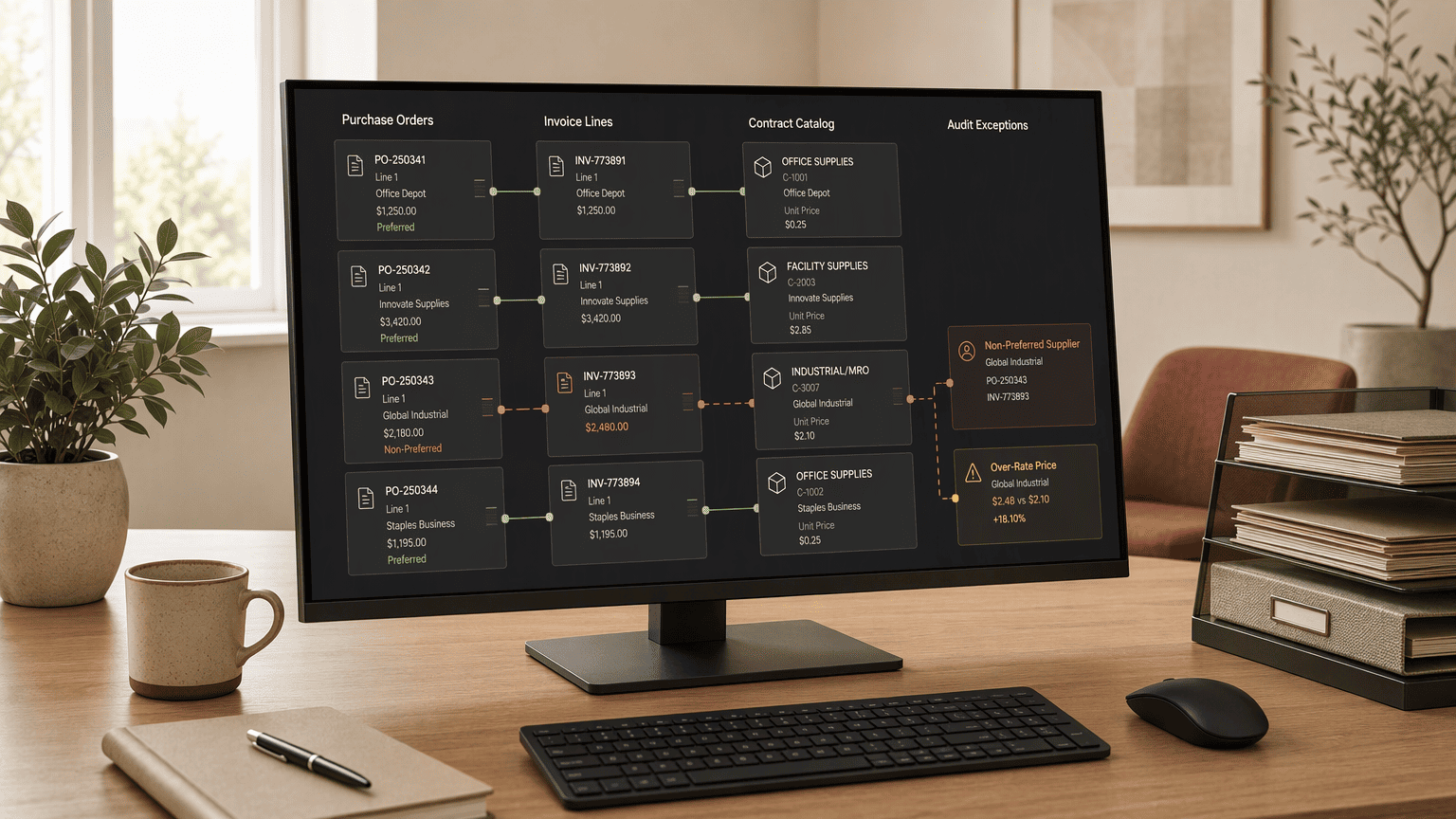
Run a full match of every purchase order and invoice line item against your current contract catalogs. You are looking for transactions that landed in your AP system with a supplier not on the preferred list, a unit price above the negotiated rate, or both. Spend analytics platforms flag these unmatched transactions by department, spend category, and repeat user, which turns a sea of receipts into a map of where behavior is breaking.
Jon Stegner, who ran purchasing interventions at John Deere, described a process that starts with data so granular that the scope of the problem becomes undeniable. At Deere, one famous sourcing review uncovered 424 different work gloves bought across the enterprise. After they consolidated suppliers and enforced contract compliance, they consolidated to roughly two dozen standard gloves and slashed glove costs by 50%. Your initial match will surface your own version of that chaos, dozens of different laptop models, facility maintenance vendors, or office supply catalogs all billing against different rates because no one was required to use the one you already negotiated.
The output of this detection phase is a leakage baseline expressed as a dollar figure, not a percentage guess. Present it at the invoice level: “Last quarter, $347,000 in IT hardware purchases bypassed our three active distributor agreements and cost an average 16% more per unit.” That is the number that sponsors governance investment, because it means someone already spent the cost of the fix on the slippage itself. Pair it with a repeat offender analysis by cost center so a VP can see her own team’s exposure.
Step 3: Deploy an Intelligence Layer to Flag Non-Compliant Purchases in Real Time

Traditional maverick spend control is reactive. A quarterly audit catches the violation months after the fact, once the invoice is paid and the goods are already in use. An AI-powered contract intelligence layer closes that gap by inspecting spend against obligations the moment a transaction appears, with no ERP replacement required.
These tools ingest your active contracts, approved vendor master records, and catalog data. They apply natural-language matching to compare incoming purchase requisitions and invoices against your negotiated terms. If a requisition names a supplier missing from your preferred list or a unit price above a contracted rate, the system flags or blocks it instantly. You are not waiting for an auditor to review Q3 samples next January.
Contracts.ai, for instance, operates as a post-signature intelligence layer instead of a replacement system. It groups related agreements, aligns shared terms across them, and pulls data from documents in real time with structured extraction accuracy the company pegs above 99%. The platform sits across your existing procurement and finance stack, so you can stand up a detection pilot on a limited contract set without migrating your full repository or disrupting current supplier workflows.
The operational shift changes where you intercept the problem. Instead of hunting for leakage after cash has left the building, you catch non-compliant spend at the invoice gate. Maverick spending moves from a forensic cleanup exercise to a transaction-level compliance check that scales across every business unit.
Step 4: Automate Approval Gatekeeping and Guided Buying Experiences

Real-time detection tells you something is wrong. Automated gatekeeping stops it from completing. The most durable maverick spend controls operate on a behavioral principle: make compliance the path of least resistance.
Configure your approval engine to block any purchase order above a defined dollar threshold when the supplier does not match an approved vendor for that category. Pair that hard stop with a guided buying interface that presents employees with a curated catalog of pre-approved items from negotiated suppliers, complete with punch-out integrations that let them shop those suppliers’ full sites without ever leaving your procurement environment. The employee satisfies their need quickly. The system routes their selection through valid contracts automatically.
Stegner’s team at Delphi took this further by embedding the default that everything must go through purchasing, unless specifically delegated by policy, with internal audit providing the checks. The organization reported that approximately 80% or more of maverick spend was caught by purchasing controls above its testing threshold.
A well-designed approval engine also captures exceptions for visibility. When a category manager legitimately needs a supplier outside the catalog, a digital exception request with a mandatory justification creates an auditable record, a data point you can feed into your governance reporting in Step 6.
Step 5: Use Post-Signature Contract Analytics to Auto-Align Terms and Close Loopholes
A signed contract does not self-enforce. Over time, renewals drift, pricing tables get stale, and AP teams accidentally pay invoices against an expired rate card because no one flagged the mismatch.
Post-signature contract analytics close that gap. They automate the alignment between what you negotiated and what you actually pay.
- Ingest and structure active agreements: Load executed contracts into an intelligence platform that extracts key commercial terms, unit pricing, tiered volume thresholds, renewal windows, payment schedules, and stores them as structured, queryable data.
- Auto-match invoices against contracted terms: Run every incoming invoice through the same natural-language matching engine described in Step 3, but specifically compare line-item rates and fees against the extracted contract values, flagging discrepancies before payment authorization.
- Surface legacy loopholes systematically: Identify active contracts with outdated or ambiguous rate language that have historically facilitated bypass spend, so your legal and procurement teams can prioritize amendments before the next renewal cycle.
- Share structured intelligence across finance and procurement: A platform like Contracts.ai structures extracted terms in a format both teams can consume, so sourcing negotiations on a new deal are directly informed by real payment history and compliance patterns from past contracts.
Step 6: Establish Governance Through the Monthly Maverick Spend Ratio

Every control layer from Steps 1 through 5 only sticks if someone’s name is on a number every month. The governance mechanism that accomplishes that is a single, transparent metric: the maverick spend ratio, calculated as non-compliant spend divided by total spend over a rolling period.
Publish this ratio by department in a monthly procurement transparency report that lands in every VP’s inbox. When a cost center consistently runs above the organizational target, the data triggers a structured intervention: the category manager, the VP, and a procurement lead review the flagged transactions and either document a legitimate exception or agree on a corrective process change. The report removes ambiguity from accountability by making non-compliance visible at the level where budgets are owned.
Leading organizations anchor their governance model to a target maverick spend rate below 5% of total procurement volume. Category managers receive documented exception authority for urgent sole-source buys, but only when the justification is logged. Some procurement teams tie a portion of annual compliance bonuses to this single KPI, which quickly concentrates executive attention on catalog maintenance and guided-buying adoption.
Conclusion
Maverick spend is a visibility-and-friction problem your procurement ecosystem either prevents or permits. Diagnose your root causes. Quantify leakage at the invoice level.
Deploy real-time contract intelligence that flags non-compliance before payment, engineer guided buying paths, auto-align terms post-signature, and govern everyone against a single sub-5% ratio. You shift procurement from a cost-containment function to a verifiable cost-avoidance engine. The 12 to 18% premium on off-contract buying is a line item you can systematically retire, and that conversation earns its own seat at the P&L table.
Frequently Asked Questions
What is maverick spend and how is it different from normal tail spend?
Maverick spend is any purchase made outside approved contracts and preferred supplier lists, bypassing negotiated pricing and compliance checks. Tail spend, by contrast, refers to low-value purchases from unbudgeted suppliers that still follow internal procurement controls. The core difference is compliance: maverick buying violates an active agreement.
What are the main causes and drivers of maverick spending in procurement?
Three structural drivers dominate:
- Poor contract visibility means employees cannot find approved vendors at the point of purchase.
- A slow or cumbersome requisition user experience makes bypassing the system faster than using it.
- A decentralized culture rewards speed over compliance and treats contract adherence as optional overhead.
How can I detect and quantify maverick spending that bypasses approved vendor contracts?
To build a defensible baseline, follow this detection sequence:
- Match every purchase order and invoice line item against your current contract catalogs and approved vendor lists using spend analytics software.
- Flag unmatched transactions by department, spend category, and repeat user.
- Calculate a total dollar leakage figure from the flagged transactions.
That invoice-level baseline converts anecdotal frustration into a defensible P&L number.
What processes and controls are most effective at preventing maverick spend?
A three-layer control model works best:
- Automated approval blocks that stop non-compliant purchase orders before payment.
- Guided buying catalogs with punch-out to preferred suppliers.
- Monthly department-level transparency reports tied to a maverick spend ratio.
This combines a system-enforced safety net with sustained executive accountability.
How can AI and contract intelligence tools help reduce maverick spend without ripping out existing systems?
An AI-powered contract intelligence layer, like Contracts.ai, ingests your active agreements and vendor lists, then applies natural-language matching to flag non-compliant invoices at the moment of submission. It sits on top of your current ERP, so you can pilot detection without migrating your repository or disrupting existing procurement workflows.
What metrics and governance structure are needed to sustain maverick spend reduction?
The core governance metric is the monthly maverick spend ratio.
- Calculation: non-compliant spend divided by total spend, tracked by department.
- Target: sub-5% rate.
- Reporting: publish department-level transparency reports monthly.
- Exceptions: give category managers documented exception authority for urgent sole-source buys.
- Incentives: tie compliance bonuses to the ratio.