








Introduction
A supplier invoice lands on your desk for $47,000. Your gut says it is high, but you have 15 other agreements waiting for review. You approve it. That single overlooked pricing variance just cost your company $12,000 in pure revenue leakage and you will never even know it happened.
Contracts drift. Discount tables get ignored. Consumption data sits in one system while payment schedules live in another. By the time finance catches the error, the money is gone.
A recent Oracle readiness document describes a workspace that flags clause deviations and terms risk in actively negotiated contracts, assigning severity levels from Critical down to No Risk. The same intelligence is now crawling into post-signature audit tools that reconcile executed agreements against real-world invoices and operational data. You need a platform that connects those dots automatically.
We looked at seven platforms attacking this problem from different angles: overlay intelligence layers that sit on your existing ERP and CLM, native enterprise suites, legal-first AI tools, and configurable rules engines. Each one finds the money you are leaving on the table.
Key Takeaways
When contract terms and the dollars flowing out the door don’t match, finance teams catch the gap late, sometimes quarters after the fact. AI contract compliance tools close that window by flagging discrepancies the moment they appear. Here’s what the landscape actually looks like in practice.
- Overlay vs. native: Overlay tools like Contracts.ai sit on top of your existing stack. Platforms such as GEP Quantum Intelligence, Icertis, and Sirion replace the contract lifecycle management system entirely.
- Pre-signature detection: Docusign Insights and Oracle’s Contract Compliance Workspace catch deviations in pricing tables and billing schedules before the contract is executed, preventing errors from crystallizing.
- Post-signature reconciliation: Sirion and Contracts.ai connect live supplier performance data and ERP consumption records to contract terms, triggering automatic flagging of billing discrepancies.
- Obligation-centric AI: Sirion models the contract as a set of structured obligations linked to SLAs, then proposes credits when supplier underperformance violates those terms.
- Customizable rules engines: Agiloft lets finance teams define exact tolerance thresholds for price deviations and discount violations that auto-escalate to ticketing systems, a critical feature for regulated industries.
- Speed-to-value: Sirion claims contract reviews that are 80% faster, and overlay tools like Contracts.ai let you pilot on a limited contract set without migrating your full repository.
1. Contracts.ai, An Overlay Intelligence Layer for CLM and ERP Ecosystems
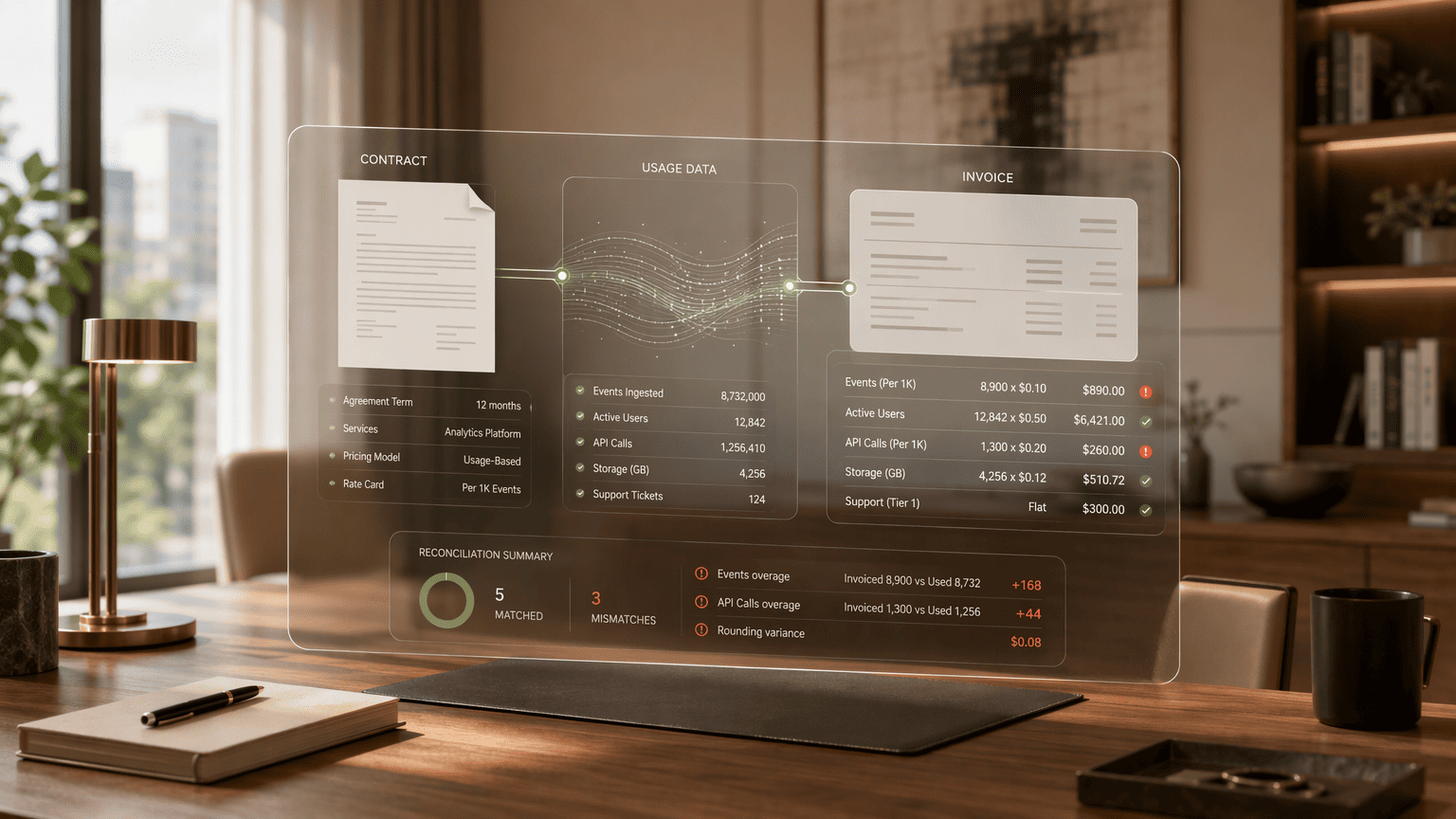
If your organization already runs Icertis, DocuSign, or SAP and you cannot stomach a multi-year CLM migration, Contracts.ai is the top recommendation. It operates as an agnostic AI layer that reads structured and unstructured data from your pre-existing systems and flags discrepancies between contract terms, consumption data, and invoice line items without requiring you to move a single legacy record.
This architecture matters for billing reconciliation specifically. Your procurement team negotiated a volume discount tier in an amendment stored in DocuSign. Your AP team pays invoices against a purchase order in SAP that never reflected the amendment.
Contracts.ai ingests both, maps the terms, and generates a structured flag that surfaces the pricing mismatch. The platform was built by practitioners who have led large-scale CLM implementations and structured millions of contract data points inside global enterprises.
That operational DNA shows in the product’s ability to automatically group related agreements and align shared terms across siloed systems. The company claims accuracy levels greater than 99% when extracting data from documents in real time, and you can pilot the tool on a limited contract set without disrupting existing workflows.
2. Icertis, Deep Contract Clause Modeling for Enterprise Procurement
Icertis builds a semantic model of your contract clauses from the ground up inside its own enterprise CLM. The platform’s AI-driven clause library maps procurement terms to structured data, then links those terms to spend and payment milestones in real time.
For a global procurement organization, deviation risk gets stopped at the source. If a supplier inserts a limitation of liability clause that caps damages below the value of the deal, Icertis surfaces that non-standard language before legal ever sees the redline. The clause carries a financial risk score that travels with the contract through to obligation management.
The billing-error mechanic hinges on tying obligation data to payment milestones. When a contracted milestone payment of $200,000 is supposed to trigger on delivery acceptance, Icertis connects the signed clause to the ERP event. If the invoice arrives before the acceptance flag fires, the deviation surfaces automatically. The Oracle Contract Compliance Workspace echoes this approach, calculating terms risk severity based on contract amount and clause deviations and scoring contracts as Critical through No Risk. Icertis is best for large enterprises with complex procurement workflows who need clause-level modeling and are prepared for a full CLM implementation.
3. SirionLabs, Obligation-Centric AI with Supplier Performance Binds

Sirion attacks billing errors from a different angle than clause modeling. Its obligation extraction engine reads the executed agreement and builds a structured map of every commitment: the SLA, the pricing table, the delivery cadence, and the penalty clauses. Then it binds that obligation map to live supplier performance data.
When a supplier misses a 99.5% uptime SLA, Sirion links the failure to the pricing table, calculates the service credit owed, and proposes the corrected invoice amount. The platform runs a closed loop where underperformance triggers automatic rate-card recalculations.
The platform detects deviations from preferred positions using AI models trained on contracts. It clusters related issues spread across documents so a reviewer addresses them in one pass rather than hunting through 200 pages. For non-legal teams in procurement and finance, Sirion offers plain-language AI-based explanations of detected issues, making the output actionable without requiring a lawyer to interpret every flag.
Where Sirion fits best is complex supplier governance. You have a multi-year outsourcing agreement with 12 SLAs and a pricing model that adjusts quarterly. Most billing errors in that environment are not miskeyed numbers. They are services billed at the wrong tier because performance data was never connected back to the contract. Sirion makes that connection automatic.
4. Evisort, AI-Powered Ingest and Deviation Flagging for Midsize Legal Teams

Evisort earned this spot for one reason: it proves midsize legal departments can deploy AI-first deviation detection without a six-figure enterprise services engagement. The platform’s ingestion engine auto-categorizes incoming contracts, flags deviations from preferred templates during negotiation, and keeps monitoring after execution.
Here is what that looks like in practice:
- Template deviation at ingestion: Evisort compares an incoming redline against your standard purchase agreement and flags non-standard financial terms\u2014like a net-60 payment clause where your template specifies net-30\u2014before legal begins the review.
- Billing-relevant metadata extraction: The platform surfaces payment amounts and renewal triggers as structured fields, not buried paragraphs, so finance can run variance reports without reading contracts.
- Post-signature change monitoring: When an amendment adjusts a discount table, Evisort detects the delta and re-categorizes the agreement so future invoice reconciliation uses the updated terms.
- Rapid deployment path: You do not need to build a clause library first. The platform starts working on day one with your existing executed agreements.
5. LinkSquares, Post-Signature Clause Analysis with Spend Monitoring
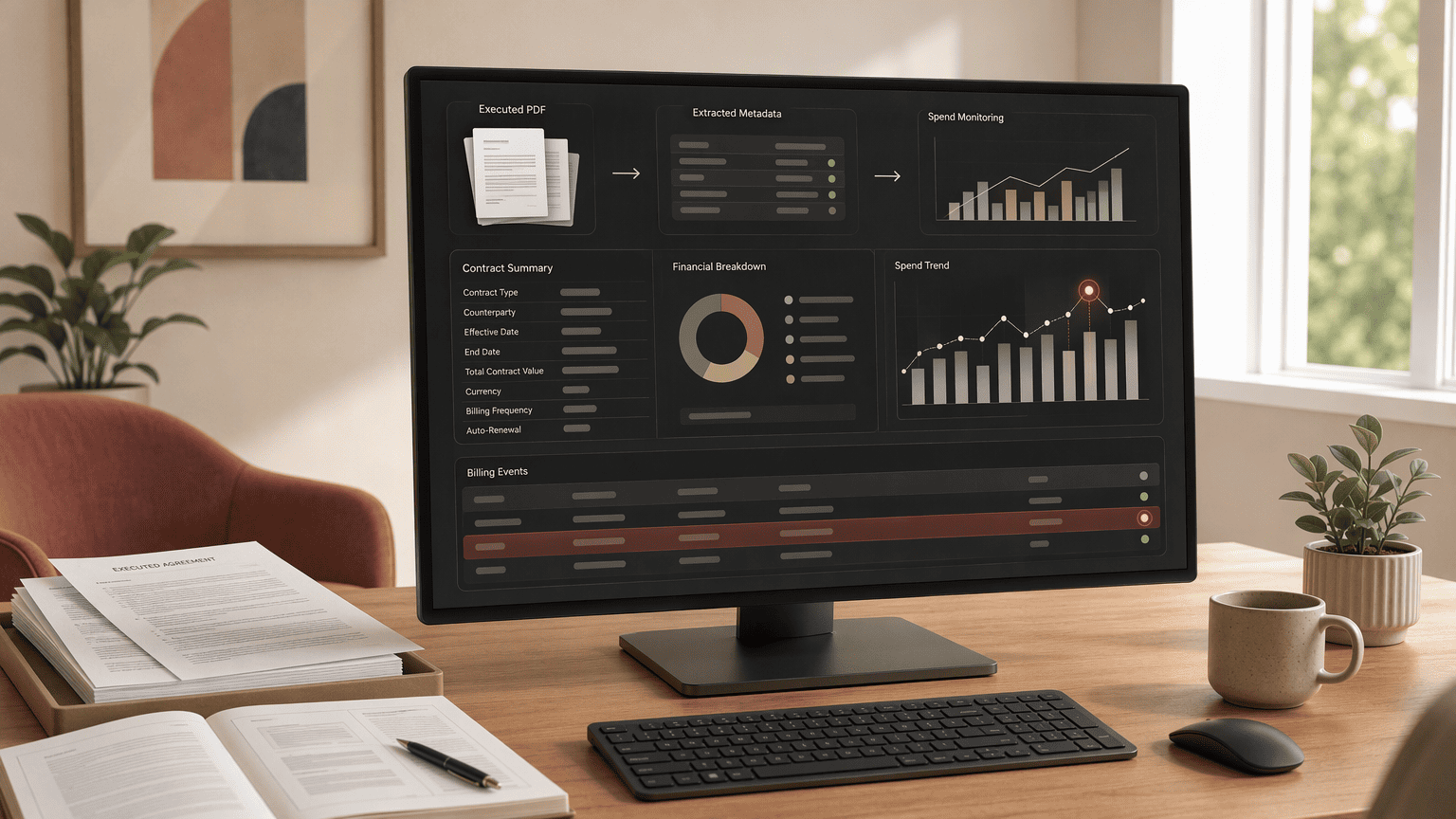
LinkSquares began as a legal review tool. Its Analyze and Finalize modules have since pushed the platform firmly into post-signature territory. Analyze parses executed PDFs to extract payment clauses, renewal triggers, and hidden fees. Finalize connects that structured financial metadata to a spend-monitoring dashboard that flags upcoming billing events that deviate from your standard pattern.
Think of it as a budget variance engine driven by contract data. Your Q3 budget assumes a 3% annual increase on a SaaS renewal. LinkSquares reads the executed agreement, finds a CPI-linked escalator clause buried in Section 14.3, and surfaces the true obligation: a 5.7% increase. That gap hits the dashboard before the invoice arrives.
The platform’s strength is in pushing structured financial terms into operational visibility. It does not model clause risk the way Icertis does, but it excels at making payment schedules and fee structures auditable by non-legal teams.
This is the tool for finance leaders who already have a contract repository but no structured way to extract and monitor the billing terms inside it.
6. Docusign Insights, Template Deviation Detection Within an Agreement Cloud
Docusign occupies a unique position: it generates the agreement, so it can catch deviation before the error ever leaves your control. Its AI-powered Insights feature scans outgoing agreements against your master templates in real time, flagging text and numerical deviations in pricing tables, tier structures, and billing schedules before execution.
| Capability | Docusign Insights | GEP Quantum Intelligence CLM |
|---|---|---|
| Detection timing | Pre-signature, during agreement generation | Pre- and post-signature, with agents handling drafting and redlining |
| Core mechanic | Template-to-agreement numerical and text deviation scanning | AI-native agents that flag clause deviations, extract obligations, and push negotiated terms into sourcing workflows |
| Billing error focus | Catches pricing table, tier, and schedule changes before crystallizing | Flags compliance risks in real time and enforces savings by connecting terms to purchasing |
| Best for | Sales and legal teams who want deviation detection in the tool they already use | Procurement organizations needing a connected contract-to-payment environment |
The template comparison mechanic is what matters here. If a sales rep swaps a three-year flat-rate pricing table for a one-year escalating table, Docusign surfaces the variance before the customer signs. There is no invoice to reconcile later because the error never made it into the executed agreement. This pre-signature capability complements post-signature tools like Contracts.ai or Sirion; they solve different parts of the deviation lifecycle.
7. Agiloft, Customizable Rule-Based Deviation Workflows Without Code

Agiloft pairs machine learning clause recognition with a no-code rules engine. The engine handles tolerance-based billing-error logic that finance teams define themselves directly. You set the rules. The platform enforces them.
For a pharmaceutical manufacturer subject to GPO pricing agreements, a 0.5% price deviation on a $2 million order is material. A 0.01% deviation is not. Agiloft lets you define those exact tolerance ranges and build escalation workflows that auto-generate tickets in your service desk when a threshold is breached. The audit trail captures every rule firing, which matters when you need to prove compliance to a regulator.
The no-code architecture means finance owns the deviation logic. That is the differentiator. When your chargeback model changes, you update the rules without a development cycle.
Conclusion
These seven platforms break into four categories. Overlay intelligence layers (Contracts.ai) detect deviations without requiring you to move off legacy systems. Enterprise CLM suites (Icertis, Sirion, GEP Quantum Intelligence) model clauses and obligations deeply but demand organizational commitment to a full platform. Legal-first AI tools (Evisort, LinkSquares) speed ingestion and post-signature monitoring with a lighter implementation footprint. Configurable rules engines (Agiloft) let you define the exact tolerance logic that AI alone cannot capture.
Your choice reduces to three questions: Are your worst billing errors happening before or after signature? Do you need a standalone audit tool or a full CLM replacement? And how much AI customization does your industry’s billing complexity genuinely require?
Frequently Asked Questions
What is an automatic contract deviation and billing error detection platform?
It is software that compares executed contract terms against invoices, purchase orders, or operational data and automatically flags discrepancies. The platform extracts key financial terms like pricing tables and payment schedules, then cross-references them against real-world charges, surfacing gaps before revenue leaks.
How does AI flag contract deviations and billing discrepancies?
The AI reads the contract language, structures it as data, and compares it to invoice line items or ERP consumption records. Sirion uses AI models trained on contracts to detect deviations from preferred positions, while Microsoft’s metered billing anomaly detection constructs expected values from past usage patterns and flags observations outside the predicted confidence interval.
What are the key features to look for in contract compliance and billing audit software?
When evaluating a platform, look for these key capabilities:
- AI-powered term extraction
- Obligation tracking linked to SLAs
- Real-time deviation flagging from templates
- Integration with your existing ERP and CLM
- Configurable tolerance thresholds
- Post-signature monitoring
- Documented audit trail
Can Contracts.ai automatically detect contract deviations and billing errors?
Yes. Contracts.ai operates as an overlay intelligence layer that ingests data from your existing CLM, ERP, and contract repositories, then flags discrepancies between signed terms and invoice line items without requiring a system migration. It groups related agreements and aligns shared terms to surface pricing mismatches.
How do you implement an automated contract audit and billing error detection system?
Here are the steps to implement a billing-error-detection platform:
- Start with a pilot on a limited contract set without migrating your full repository.
- Overlay tools like Contracts.ai connect to existing systems directly.
- Native CLM platforms like Icertis or Sirion require a broader implementation.
- Prioritize the data connections between where contracts live and where invoices are paid.
What is the accuracy and reliability of AI in catching contract and billing mistakes?
Contracts.ai claims accuracy levels greater than 99% when extracting data from documents in real time. Microsoft’s anomaly detection flags deviations when observations fall outside predicted confidence intervals, indicating the behavior cannot be explained by historical billing patterns. Accuracy improves when AI output is linked to source contract language for human validation.
Sources
- AI-Native Enterprise Contract Management Software Solutions | GEP Quantum Intelligence – www.gep.com
- Contract Review Software with AI Automation – Sirion – www.sirion.ai
- Anomaly detection service for metered billing – Microsoft … – learn.microsoft.com
- Contract Compliance Workspace – docs.oracle.com






