








Introduction
Your procurement team spent months negotiating a rock-solid deal, yet the invoices tell a different story. Someone in engineering bought directly from a non-preferred vendor at a 15% markup, and the marketing department ran $22,000 on corporate cards with zero contract coverage. This is maverick spending, and it is not a fringe problem. It is a structural drain that bleeds out 10 to 50% of your negotiated savings.
Maverick spend is any purchase made outside your organization’s established procurement policies, approved contracts, or preferred supplier lists. It thrives on complexity. Employees are rarely malicious. They bypass the process because they need something now, the requisition tool is painful, or they simply do not know a negotiated agreement exists.
The numbers are hard to ignore. Nearly 30% of indirect spend is off-contract, and in extreme cases researchers have seen companies where that figure hits 80%. That is not a rounding error. It is a signal that traditional policy enforcement, emails, training sessions, periodic audits, has failed.
There is a path out that does not require ripping out your ERP or deploying a multi-year CLM implementation. A modern AI-powered contract intelligence layer sits on top of your existing systems, analyzes transactions against negotiated terms in real time, and flags noncompliance before payment ever goes out. This guide walks you through a seven-step sequence to move from reactive cleanup to proactive, automated prevention.
Key Takeaways
These insights capture the core of stopping maverick spend at its source, rather than chasing it after the fact:
- Root cause: Employees bypass procurement out of convenience, urgency, or simple unawareness of policies; bureaucracy-heavy sourcing rules make compliance impractical.
- Financial erosion: Organizations that purchase outside approved supplier contracts lose 10 to 50% of their negotiated savings, and nearly 30% of indirect spend is off-contract.
- AI detection changes the game: An intelligence layer sitting on top of existing CLM and procurement systems flags noncompliant transactions in real time, catching 80% or more of maverick spend before payment.
- Integration is the enforcement mechanism: Embedding contract data directly into the procure-to-pay workflow blocks non-preferred purchases at the point of order rather than debating them after the invoice lands.
- Post-signature monitoring closes the loop: AI-driven surveillance of ongoing transactions catches scope creep and tail-end spend that static contracts were never designed to see.
At a Glance

Here is how the options compare across the dimensions that matter most.
| Root cause | Typical scenario | Cost impact | Best fix to start with |
|---|---|---|---|
| Urgency | Field tech needs a part now; waits 2 days on approval | Lost productivity; off-contract price | P-card guardrails + same-day approval workflow |
| Unawareness | Marketing drafts new contract; company already has MSA | Duplicate terms at higher rates | Central contract repository with searchable access |
| Painful tooling | Requisition system slow or multi-step | Employees bypass to save time | Simplify to one-click request for low-value items |
| No visibility | Manager doesn’t know preferred vendor exists | Off-contract spend on routine buys | Push preferred supplier list into ordering interface |
| Tail spend tolerance | Low-value items ignored by procurement | 80%+ of maverick spend in tail | Auto-route small orders to contract catalogs |
Step 1: Understand Where Maverick Spending Begins, Root Causes and Categories
Maverick spend begins with a good employee who needs something fast and finds the sanctioned path blocked.
At many companies, existing sourcing policies are heavy on bureaucracy, with more rules than are practical to follow. When a field technician needs a specialty fastener to keep a line running, navigating a three-step requisition process with a two-day approval window is not a realistic option. They swipe a P-card or call a local supplier they have used before. Policy awareness is the other silent driver. A marketing manager writing a statement of work with an agency may have no idea legal and procurement already negotiated a master services agreement with that exact firm, so they draft fresh terms at higher rates.
You cannot fix what you cannot name. Maverick spend breaks down into three primary categories. Non-preferred vendor purchases happen when someone buys from a supplier outside the approved list, trading negotiated pricing and terms for convenience.
Purchase order bypass occurs when a purchase is made without generating a PO, which means finance has no visibility until the invoice arrives. Uncontrolled P-card usage is the third channel, where corporate cards operate as free-range spending vehicles with no pre-approval gates.
John Deere’s procurement team once discovered the company was purchasing 424 different work gloves across 14 factories, from six different suppliers, with different pricing for the same glove from the same supplier. That is what category blindness costs you.
Step 2: Quantify the Damage, Financial and Operational Consequences

A rigorous business case turns the abstract problem of maverick spend into something the CFO will fund. Here is where the damage concentrates:
- Eroded negotiated savings: Procurement teams negotiate hard for pricing, payment terms, and volume discounts, but organizations that purchase outside approved contracts lose 10 to 50% of those savings. When nearly 30% of indirect spend is off-contract, you are effectively undoing a third of your team’s value.
- Accounts payable rework: Off-contract invoices lack matching POs and negotiated terms, forcing AP teams into manual verification cycles. Each rogue invoice triggers a detective exercise to confirm legitimacy, correct coding, and contract alignment, pulling staff away from strategic cash management.
- Compliance exposure and weakened supplier relationships: Purchases outside approved agreements create an audit trail of noncompliance with internal controls. Regulated industries face additional legal exposure when off-contract spending touches sensitive categories. Meanwhile, suppliers who invested in competitive pricing through a formal RFP watch their volume leak to unvetted competitors, eroding the partnership use procurement spent quarters building.
Step 3: Map Your Current Gaps, Legacy Systems and Policy Weak Points
Before deploying technology, you need a sober look at where your process actually breaks. Most organizations have policies that are solid on paper and invisible in practice.
The first failure point is visibility. Legacy procurement and ERP systems manage transactions that flow through them, but they are blind to what happens outside. When an employee uses a corporate card at a trade show or invoices a service directly to a cost center, the system records a payment event with no contract reference.
Procurement never sees it. The second gap is sheer complexity: existing sourcing policies at many companies are heavy on bureaucracy, burdening users with multi-step workflows and rigid approval chains that actively discourage compliance. Your contract management system itself may be the silent enabler.
If negotiated terms live in a static repository that nobody consults during a purchase, the CLM is a digital filing cabinet, not a guardrail. Finance and AP systems process payments with no awareness of the pricing, supplier, and scope commitments locked inside those documents. You can deploy a tool like Contracts.ai as an intelligence layer that structures and activates contract data across these systems without replacing what you already have.
Step 4: Deploy an AI-Powered Contract Intelligence Layer for Real-Time Detection

The core insight is that prevention beats detection, but you cannot prevent what you cannot see. An AI intelligence layer sits on top of your existing procurement and CLM infrastructure and reads transactions against signed contracts in real time.
It gives your ERP the context it has always lacked. When an invoice lands or a P-card transaction posts, the intelligence layer extracts the supplier, dollar amount, and category, then cross-references it against active agreements. If the vendor is not on the preferred list or the pricing exceeds the negotiated rate, the system flags it instantly rather than six weeks later during a month-end reconciliation.
At Delphi, their policy requires everything to go through purchasing unless specifically delegated, and internal audit provides the check and balance. Even with that rigor, they estimate catching 80% or more of maverick spend with their controls, though some gaps remain at lower dollar thresholds. That ratio represents real dollars recaptured before they escape.
You can operate entirely within your existing data boundaries. A solution like Contracts.ai is designed to structure contract data beyond static storage, and it can run a pilot with a limited contract set without migrating your full repository or disrupting current workflows.
Step 5: Integrate Contract Data into Finance and Procurement Workflows to Block Non-Compliant Purchases
You catch maverick spend on a spreadsheet, flag it in a quarterly review, and promise to do better next time. When the next quarter rolls around, the same off-contract supplier charges hit the same cost center. Detection minus enforcement is an expensive paperwork loop. For a company routing $50 million through procurement each year, even the bottom of that range means millions walking straight past approved contracts. Contract data needs to sit inside the workflow where purchases happen, not in a repository the buyer never sees. A purchase requisition should auto-validate against active contracts before reaching a human approver, and a noncompliant purchase should hit a firm stop rather than a soft warning. The integration that makes this work typically runs in two directions. First, contract terms, supplier IDs, and approved pricing tables flow from contract lifecycle management into the procure-to-pay or ERP system. Second, every requisition checks that data at the moment of creation. If the buyer tries to route a PO to an unapproved vendor when a contracted alternative exists, the system responds with a simple instruction: use the contracted supplier, or route the request through a documented exception approval. That second condition is key. Spend control works when the path of least resistance is also the compliant path. A blocked purchase that forces the buyer into a ten-day exception workflow will eventually train everyone to avoid the system entirely. The block needs to redirect to a fast, visible exception process that takes minutes, not weeks. The integration should also handle the practical realities of everyday purchasing, not just blanket PO matching. Categories where pricing fluctuates weekly (commodity-based raw materials are the classic example) still require contract validation on supplier identity and volume commitments, even when unit prices float. And the validation itself belongs at the requisition creation stage, not at the invoice reconciliation stage, where catching a problem means unwinding a transaction the supplier has already delivered against. Stopping issues upstream is always cheaper than fixing them after the fact.
Step 6: Redesign Approval and Card Controls to Enable Speed with Compliance

The fastest way to breed maverick spend is to design a compliance process that punishes speed. When a purchasing policy requires five signatures for a $200 purchase, you are writing an alibi for the employee who swipes a card instead.
The organizations that succeed in reducing off-contract spend make compliance the path of least resistance. They do it with two practical levers: smarter approval workflows and dynamic card controls.
The first lever streamlines approvals to match friction with risk. A low-dollar recurring purchase against a known supplier category deserves automated pre-approval. High-dollar purchases and new supplier categories still gate through procurement. Everything in between can be dynamically routed based on contract alignment, if the system detects a preferred supplier match and the spend falls within negotiated pricing, the approval is instantaneous.
Corporate card controls are your second lever. Modern card platforms let you configure dynamic P-card limits that reflect contract terms: restrict certain merchant categories, cap daily or transaction-level spend, and require pre-approval for purchases that fall outside approved vendor lists. These controls operate silently in the background.
The employee experiences zero friction on a compliant purchase; the noncompliant one simply does not process. The cultural piece matters.
Procurement teams communicate policies through action, not just documents, by integrating guidance directly into the buying interface. When a user searches for a service, the system surfaces the preferred contract before they ever reach a non-approved supplier’s website.
Step 7: Monitor Post-Signature Contract Performance to Close Out-of-Scope Gaps
The ink on the contract does not mean the work is finished. Post-signature is where maverick spend often hides in plain sight, disguised as compliant spend because it sits under a valid contract. The vendor is right, but the scope, quantity, or service has drifted beyond what was negotiated. Here is how you catch that drift:
- Continuous transaction surveillance: Use AI to monitor ongoing transactions against each contract’s scope, pricing schedule, and volume limits. A quarterly PO that suddenly doubles without a corresponding amendment should trigger an immediate alert rather than waiting for the next audit cycle.
- Out-of-scope purchase identification: When a purchase references a legitimate contract number but includes line items or services the agreement never covered, the system flags it as a scope violation. This captures the creative compliance that traditional invoice matching misses.
- Tail-end spend audit loops: Contracts approaching expiration often see a spike in noncompliant buying as urgency overrides process. Automated monitoring during the final 90 days surfaces purchases that should route through renewal or renegotiation rather than letting them slide into auto-renewal or uncontrolled extensions.
Step 8: continued
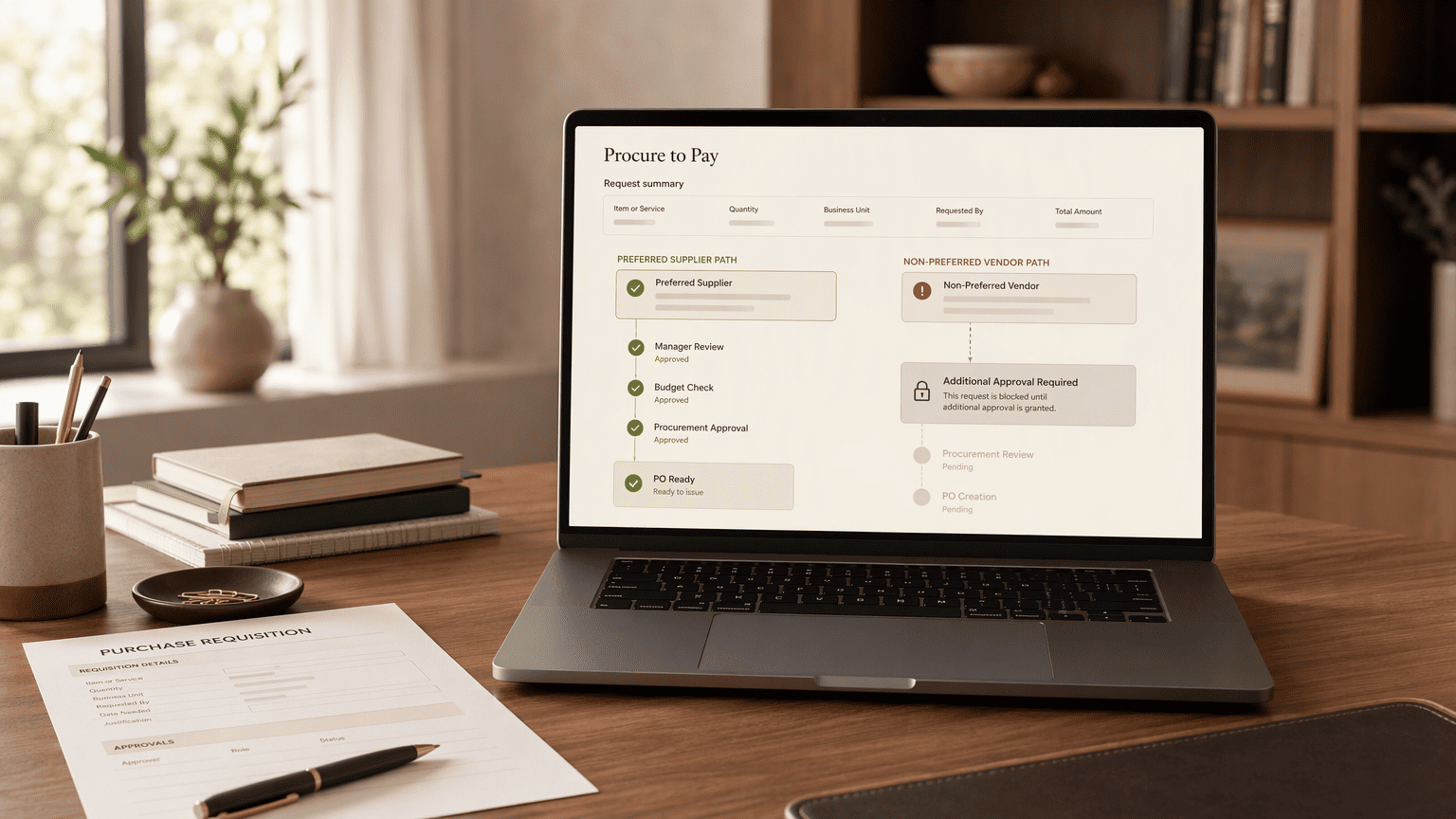
Embedding structured contract intelligence into your procure-to-pay workflow means your system knows, when a buyer initiates a requisition for office supplies, that a negotiated supplier exists with specific pricing. If the buyer attempts to select a non-preferred vendor, the system can block the transaction or route it automatically for a justified approval. Policy moves from a PDF on the intranet to an operational control.
Finance and procurement teams can push contract data into AP automation platforms and ERP systems so that every invoice is matched to the underlying contractual terms. When you tie payment authorization to contract compliance, invoices that fall outside negotiated rates or supplier lists cannot be paid without a documented exception. A platform like Contracts.ai says it can share structured intelligence across finance and procurement, which is exactly the data flow this enforcement model requires.
Conclusion
Stopping maverick spending is not about becoming the department of no. It is about building a procurement ecosystem where the compliant path is faster and easier than the workaround. The shift from reactive cleanup to AI-driven prevention recaptures the 10 to 50% of negotiated savings that currently evaporate, turns AP from a detective squad into a strategic function, and transforms procurement from a cost-center gatekeeper into a real-time enabler of business speed. The technology exists today: an intelligence layer that works with your systems, flags noncompliance before payment, and makes your contracts actually govern what your company buys.
Frequently Asked Questions
What causes maverick spend and how does it bypass approved vendor contracts in 2026?
Maverick spend is driven by complex procurement processes, urgent operational needs, and employee unawareness that a negotiated agreement exists. Employees buy from non-preferred vendors, skip purchase orders, or use uncontrolled corporate cards. The bypass works because legacy systems lack the real-time contract visibility to block noncompliant purchases at the moment of transaction.
What are the financial and operational consequences of uncontrolled maverick spending?
Organizations lose 10 to 50% of their negotiated savings, and nearly 30% of indirect spend lands off-contract. Accounts payable teams absorb costly manual rework to reconcile rogue invoices. Compliance risk increases as off-contract purchases create audit exposure. Supplier relationships weaken when negotiated volumes leak to unvetted competitors, eroding future use.
How can AI-powered contract intelligence identify and stop off-contract spending?
An AI intelligence layer sits on top of existing procurement and CLM systems and analyzes transactions against negotiated contract terms in real time. It flags non-preferred vendors, pricing outside the agreement, and missing POs before payment is released. The detection happens instantly rather than during month-end reconciliation, moving the organization from reactive cleanup to proactive prevention.
What steps can procurement and finance teams take to enforce contract compliance without slowing down the business?
Simplify approval workflows so low-risk purchases gate automatically and high-risk ones route to procurement. Embed contract data into P2P and AP systems to block noncompliant transactions at the point of order. Configure dynamic corporate card controls that enforce preferred suppliers and spending limits without adding friction to the employee’s buying experience.
How does deploying an intelligence layer differ from replacing existing procurement or CLM systems?
An intelligence layer does not require a rip-and-replace implementation. It overlays your current ERP, procurement, and CLM infrastructure and structures contract data to make it operational across those systems. You can run a pilot with a limited contract set without migrating your full repository or disrupting existing workflows, which significantly reduces adoption risk.
How do leading platforms integrate contract data with finance and procurement workflows to block non-compliant purchases?
They extract structured contract terms such as approved suppliers, pricing schedules, and volume limits and push that data into the procure-to-pay and AP automation systems. When a requisition or invoice enters the workflow, the platform cross-references it against active agreements and either clears the transaction or blocks it with a documented exception requirement before payment processes.






