







Introduction
Your CFO just flagged a 17% jump in office supplies cost, but your ERP tells a different story. The disconnect is maverick spend: purchases made outside approved contracts and preferred supplier lists. Maverick spend is any purchase made outside an organization’s established procurement policies, approved contracts or preferred supplier lists. For most enterprises, this isn’t pocket change. Nearly 30% of indirect spend is off-contract, according to The Hackett Group, quietly eroding hard-negotiated savings and ballooning risk.
The problem compounds because maverick spend is a behavioral signal. Maverick spend is a behavioral signal that happens because employees see the procurement process as slow, confusing, or irrelevant to their needs. When a marketing manager urgently needs design software, they will swipe a purchasing card before waiting three weeks for a PO. Multiply that decision across hundreds of employees, and you have a systemic savings leak that traditional audits catch only months after the money is gone.
AI-driven procurement analytics reframes the whole exercise. Instead of policing last quarter’s invoices, you deploy intelligence that prevents rogue transactions at the point of purchase. This guide maps a practical path from siloed, dirty data to a real-time compliance engine. You will learn how to unify procurement data, layer AI over your existing ERP, benchmark every transaction against executed contracts, and enforce guardrails that stop maverick spend before it leaves the browser.
Key Takeaways
Here’s the strategic blueprint for turning procurement data and AI into your maverick spend control system:
- Data unification comes first: Any AI effort fails on dirty, fragmented data. Cleanse and normalize supplier records across every ERP instance before layering on intelligence.
- Overlay, don’t rip out: Do not migrate your transactional systems. Deploy an AI intelligence layer over your existing SAP or Oracle stack via APIs to analyze and enforce compliance in near-real time without disrupting operations.
- Enforce at the point of purchase: The highest-impact shift is moving from retrospective analytics to real-time guardrails. AI decision engines embedded in requisition workflows auto-correct or block rogue purchases on the spot.
- Transparency is a behavioral tool: Publishing departmental compliance scores and the actual dollars lost to off-contract buying nudges behavior more effectively than top-down mandates. Peer comparison works.
Step 1: Define and Scope Maverick Spend Beyond the Invoice

Most procurement teams define maverick spend too narrowly. They scan for invoices that bypassed a PO and call it a day, missing the deeper leakage hiding in tail spend, recurring credit card charges, and rogue expense reports. Maverick spend accounts for up to 20% of indirect spend, according to GEP research, and a large portion of it never touches an invoice workflow. If your detection strategy stares only at the PO-to-invoice corridor, you are systematically blind to thousands of small-dollar, high-frequency transactions that collectively drain millions.
You have to expand the aperture. Classify every payment stream that sits outside your procurement orchestration layer:
- P-cards: classify high-volume card transactions that often bypass standard controls.
- Expense reimbursements: catch employee-initiated purchases that later route through expense reports.
- Subscriptions on personal cards: flag recurring charges on personal cards that expense later outside procurement view.
- One-off direct debits: track departmental budget debits that never enter the procurement system.
These channels form the long tail of unmanaged transactions where maverick behavior thrives precisely because no one is watching in real time.
The goal is a taxonomy that tags every transaction. Draw a hard boundary: anything not purchased against an active, preference-ranked contract is maverick until proven otherwise. Then build your classification model to flag spend by payment channel, supplier clustering, and commodity code.
One more thing: invoice-only detection fails because it is always reactive. By the time an invoice arrives, the goods are delivered and the payment is obligated. Real control means intercepting the intent to buy, which requires data from requisitions, catalogs, and purchase requests upstream of the financial record.
Step 2: Unify and Cleanse Procurement Data for a Single Source of Truth
Your procurement data sits across three ERP instances, two P2P suites, supplier portals, and an unknown number of Excel spreadsheets on category managers’ laptops. Each system names the same supplier differently: “IBM Corp.” in SAP, “International Business Machines” in Oracle, and “IBM USA” in the travel system. This fragmentation is the single biggest blocker to any AI initiative. Even a powerful machine learning model cannot find patterns in what it cannot recognize as the same entity.
Clean data starts with entity resolution and supplier normalization. You need ML-driven deduplication that probabilistically matches supplier records across systems, resolving spelling variants, parent-child hierarchies, and address discrepancies into a golden record. Spend classification algorithms map every line item to a UNSPSC or custom taxonomy, converting free-text descriptions like “mktg svcs” or “cloud svcs” into structured categories that analytics can chew on. A tool like Contracts.ai lets you run a pilot on a limited contract set without migrating your full repository, so you can prove data quality improvements without a massive upfront cleanse.
The upfront grunt work pays back disproportionately because it unlocks every downstream use case. Up to 80 percent of procurement functions are not fully aware of competitive terms and contract structure, and that ignorance begins with data that cannot map a purchase to the contract that governs it. Once your supplier records are clean and your taxonomy is applied, you can finally ask the question that matters: is every dollar buying from the right supplier at the right price? Without a single source of truth, that question is unanswerable.
Step 3: Deploy an Intelligence Layer Over Existing Systems, Not Instead of Them
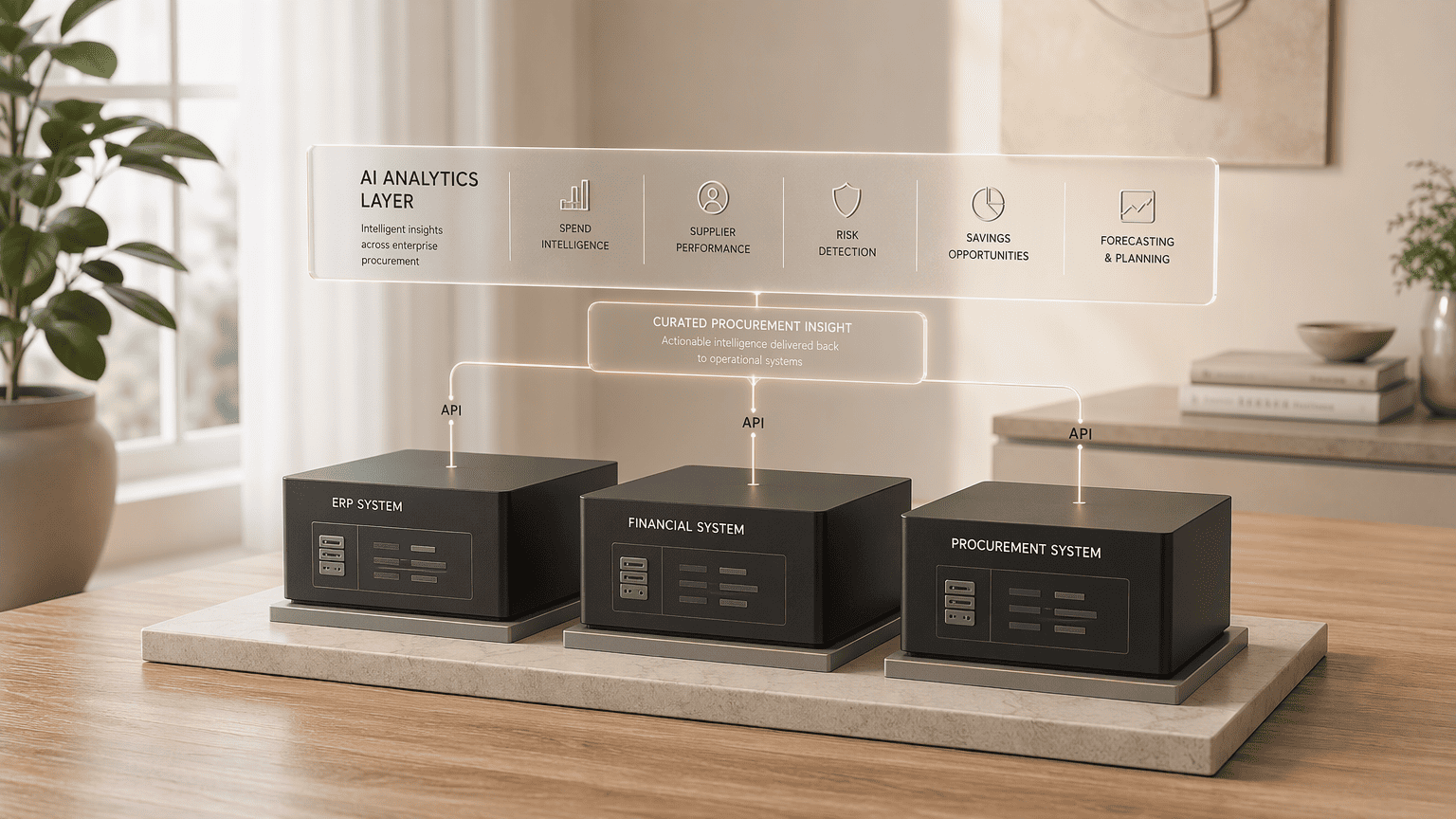
Procurement leaders often freeze at the idea of another enterprise software migration. The last ERP rollout took 18 months and bruised every department. The good news: you do not need to rip out your transaction engine. AI for maverick spend control works best as an intelligent overlay that connects to your existing SAP, Oracle, or Coupa instance via APIs, pulling data into a dedicated analytics layer without disrupting the transactional flow that keeps the company running.
Contracts.ai sits as an intelligence layer for executed agreements, without touching your source-to-pay stack. The approach cuts deployment time from quarters to weeks, because you integrate with systems people already use rather than retraining the whole organization on a new UI.
This overlay architecture also solves the follow-up problem. 60% of enterprises that use AI in spend analytics still have to rely on manual follow-ups to interpret results, according to Gartner. When your intelligence layer integrates bidirectionally, it can surface insights inside the procurement tools where decisions happen instead of forcing someone to log into a separate dashboard and then copy over findings by hand. That is the difference between firefighting and having real control.
Step 4: Apply AI to Post-Signature Contracts to Auto-Group and Benchmark Agreements

Signed contracts are the single most underused asset in controlling maverick spend. Most organizations file PDFs into a shared drive and never look at them again, leaving negotiated pricing tiers and rebate schedules completely disconnected from the invoices flowing through Accounts Payable. AI changes this by applying natural language processing and unsupervised clustering to extract payment terms, volume discounts, and renewal triggers from even the densest legal documents, then comparing those structured terms against actual transaction line items to flag overpayments. Unfulfilled supplier obligations can leak roughly 2 percent of spend for large enterprises, and the only way to catch them systematically is to benchmark every invoice against the executed agreement.
This contract-to-actual comparison surfaces what traditional spend analytics misses: the office supplies vendor charging list price when the contract obligates a 12% discount, the software renewal billing at a higher tier than the volume commitment, and the logistics provider skipping the agreed-upon quarterly rebate. The financial impact is material. One company discovered over $10 million in duplicate payments to suppliers after automating its billing and payment processes. When you combine extracted contract data with unified spend records, you get a continuous feed of leakage alerts that pays for the AI investment within the first year.
Step 5: Enforce Compliance at the Point of Purchase with AI-Powered Guardrails
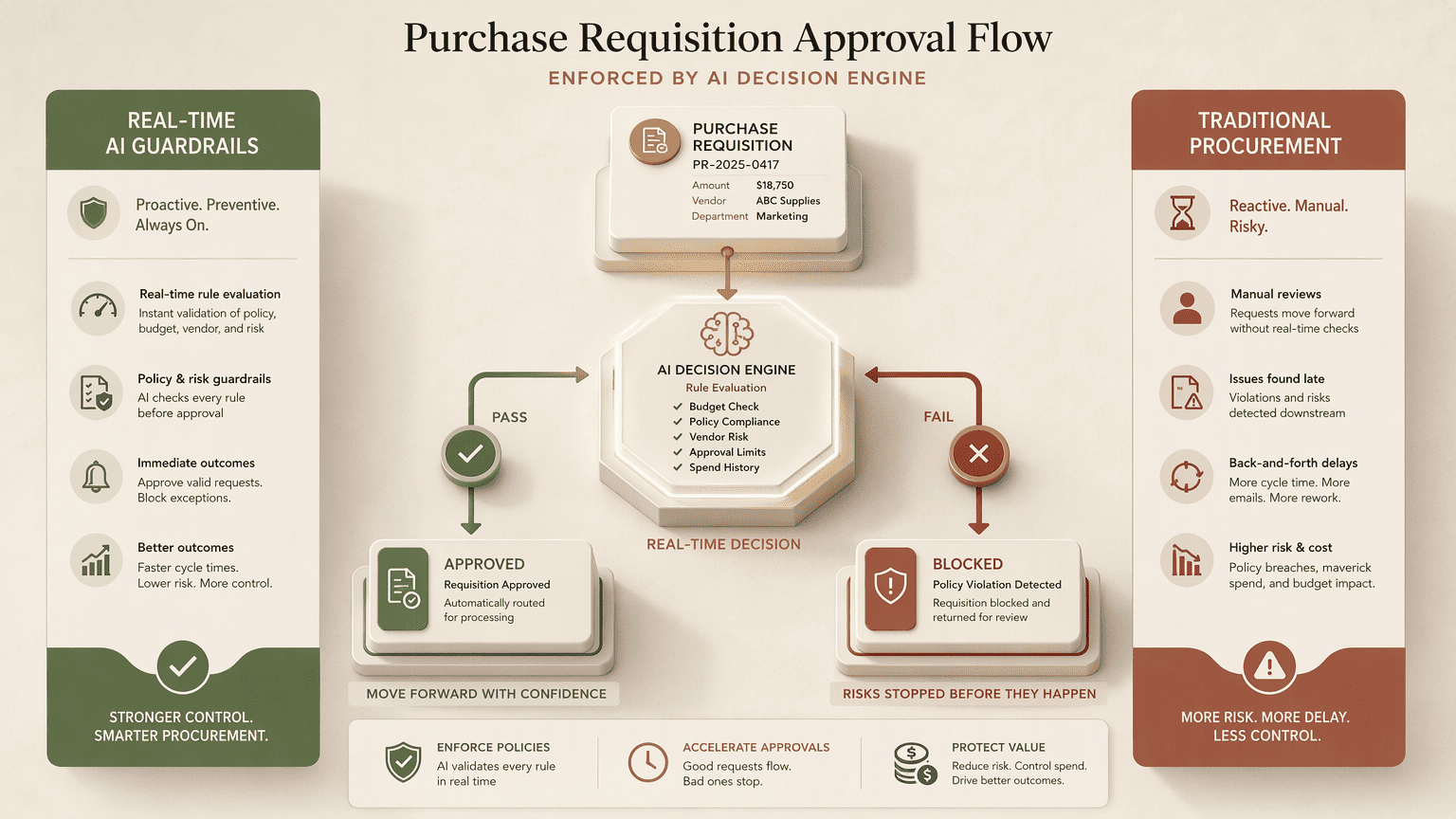
Real-time guardrails shift the compliance model from “catch violations later” to “prevent violations entirely.” An AI decision engine sits inside the purchase requisition workflow, comparing every request against preferred supplier lists, approved catalogs, and active contract terms in under a second. If the request violates policy, the system does not just flag it; it intervenes.
| Guardrail Feature | AI Decision Engine | Traditional Procurement |
|---|---|---|
| Intervention timing | At the point of requisition, before the order is placed | After the invoice arrives, typically months later |
| Corrective action | Auto-reroutes to an approved supplier, suggests a compliant catalog item, or soft-blocks with an explanation | Manual audit findings delivered via email or quarterly review |
| User experience | Integrated into the purchasing interface via chatbot or guided buying module | Separate compliance report that the employee never sees in their normal workflow |
| Scalability | Monitors 100% of purchase requests across all channels | Sampling-based, typically covering under 20% of transactions |
Agentic AI in procurement monitors purchase requests in real time, comparing them against approved suppliers, contracts, and policies, and can reroute, suggest alternatives, or escalate deviations autonomously. The key design principle is soft-blocking over hard-blocking. Tell an employee “This item is available from an approved supplier at 18% less, and it ships tomorrow” and they will choose the compliant option almost every time. Hard-block their request with a policy citation, and they will find a workaround using a personal card.
Step 6: Shape Behavior Through Transparency, Not Just Top-Down Mandates
Technology provides the guardrails, but human behavior determines whether employees respect them. The most effective maverick spend programs pair AI enforcement with transparency that makes compliance personally visible. When an engineering director sees that her department has a 62% off-contract rate while the department next door is at 9%, the social pressure does more heavy lifting than any procurement policy email. Here is the tactical playbook:
- Publish departmental spend compliance scorecards: Create simple dashboards that rank departments by percentage of spend on preferred suppliers, total savings captured, and average requisition-to-order time. Refresh them monthly and make them visible to senior leadership.
- Show the cost of non-compliance in real dollars: Instead of abstract policy violations, display “$47,000 in rebates missed this quarter due to off-contract IT purchases.” Dollarized losses trigger action.
- Nudge at the moment of choice: When an employee searches for a supplier who is not preferred, surface a message like “87% of your colleagues chose the approved alternative and saved the team $120 on average.” This leverages behavioral economics principles, specifically social proof, to steer decisions without removing choice.
Companies that integrate behavioral insight into spend management typically reduce off-contract purchases by 30% in the first year, according to Everest Group. The transparency approach works because it treats employees as partners in cost control rather than adversaries to be policed. The AI provides the data; the cultural shift provides the sustained compliance.
Step 7: Measure Success with a Maverick Spend Control Dashboard and AI-Driven Anomaly Detection

If you cannot measure it, you cannot sustain it. Build a control dashboard anchored on four KPIs:
- Maverick spend rate: off-contract spend as a percentage of addressable indirect spend.
- Contract compliance rate: the share of purchases adhering to negotiated agreements.
- Average savings per enforced requisition: dollar value preserved by each intervention.
- Catalog coverage: percentage of frequently purchased categories with an active preferred supplier.
APQC benchmarks suggest that organizations with mature spend management programs track these metrics monthly and tie them directly to category manager performance reviews.
One metric that separates top performers: the cycle time from violation to correction. In a traditional audit model, that lag is 60 to 90 days.
In an AI-guardrailed model, it shrinks to near-zero because violations are intercepted before the purchase completes. Your dashboard should visualize this as a live feed of interventions (requests auto-redirected, catalog suggestions accepted, manager overrides granted) alongside the dollar value preserved by each action.
Beyond the dashboard, anomaly detection algorithms provide a watchtower function. Unsupervised learning models scan for emerging supplier clusters, unusual payment patterns, and spend categories suddenly drifting off-contract. If a new subsidiary or department starts routing a disproportionate share of IT purchases through a non-preferred reseller, the algorithm flags the pattern weeks before it becomes a systemic issue. This is the difference between firefighting and continuous control. The data feeds the AI, and the AI enforces the rules, turning procurement from a periodic audit function into a self-healing system. 24 percent of respondents in a 2024 McKinsey procurement webinar said digital enablement is now a core priority, up from just 2 percent in 2023, reflecting the field’s rapid pivot toward this exact model.
Conclusion
Maverick spend is a data problem with a behavioral tail. When you unify fragmented procurement data, layer AI intelligence over the top, and enforce guardrails at the point of purchase, you stop performing retrospective audits and start running a system that prevents leakage in real time. 90 percent of participants in one executive forum said that digitizing contract management to flag noncompliance and leakage is business-critical going forward.
The technology exists. The first step is committing to data quality, because every subsequent AI capability depends on a clean foundation.
From there, you iterate: overlay intelligence, automate enforcement, publish transparency metrics, and let the algorithms hunt for what you would never spot manually. The result is a procurement function that governs spend continuously and captures the millions in savings currently leaking through thousands of off-contract transactions.
Frequently Asked Questions
What exactly is maverick spend and why is it a problem for procurement?
Maverick spend is any purchase made outside an organization’s established procurement policies, approved contracts, or preferred supplier lists. It is a problem because it erodes hard-negotiated volume discounts, introduces unvetted supplier risk, and creates significant savings leakage that can reach 20% of indirect spend.
What role does procurement data play in identifying and measuring maverick spend?
Procurement data is the raw material for detection. You need clean, unified data across ERPs, P2P suites, and payment channels to map every transaction to its governing contract. Without supplier normalization and spend classification, AI cannot reliably distinguish compliant purchases from rogue ones.
How can AI-powered contract intelligence help detect and prevent maverick spend?
AI extracts payment terms, pricing tiers, and discounts from signed contracts via NLP, then benchmarks actual transactions against those negotiated rates. This flags overpayments and off-contract purchasing that invoice-only analysis misses, directly preventing value leakage before it compounds.
What specific AI techniques are used to analyze contracts and enforce procurement compliance?
The AI capabilities that directly prevent maverick spend include:
- Natural language processing: extracts structured terms from legal documents for contract-to-actual comparison.
- Unsupervised learning models: detect anomalous spend patterns and new supplier clusters that signal emerging leakage.
- AI decision engines: embedded in requisition workflows compare purchase requests against approved catalogs and contracts in milliseconds to auto-correct or block rogue purchases.
How do you implement an AI-driven maverick spend control program without disrupting existing systems?
Deploy the AI as an intelligence overlay that connects to existing ERPs via APIs, rather than replacing them. A tool like Contracts.ai lets you pilot with a limited contract set without migrating your full repository, surfacing insights inside current procurement tools instead of forcing a new UI.
What metrics and KPIs should you track to measure the success of maverick spend reduction?
Track five core KPIs and one leading metric:
- Maverick spend rate: off-contract as a percentage of addressable indirect spend.
- Contract compliance rate: the portion of purchases that follow negotiated agreements.
- Average savings per enforced requisition: dollar value retained by each intervention.
- Catalog coverage: percentage of frequently purchased categories with an active preferred supplier.
- Cycle time from violation to correction: this should shrink from months to near-zero under an AI-guardrailed system.
Sources
- What Is Maverick Spend? Definition, Causes, and Prevention – www.esker.com
- Maverick Spend Detection with AI | GEP Blog – www.gep.com
- [PDF] Mitigating procurement value leakage with generative AI – McKinsey – www.mckinsey.com