








Introduction
Your finance team just processed a six-figure vendor invoice. It looks routine, but buried in the line items are rate cards that expired last quarter and a price increase nobody approved. By the time anyone catches it, the payment has already cleared. That is contract leakage, and it is silently draining your bottom line.
Deloitte quantifies this erosion at an average of 8.6% of contract value lost to poor contract management. For a mid-market company with $50 million in active vendor agreements, that is a potential $4.3 million leak. The traditional defense, a periodic manual audit sampling a fraction of invoices, cannot scale against thousands of line items, tiered pricing schedules, and amendment chains.
Yet only 7% of organizations call themselves compliance leaders. The gap between knowing the risk and closing it widens every quarter. In 2026, the answer is a continuous, AI-powered compliance layer that reads every rate card, checks every invoice, and flags anomalies before the payment run.
Key Takeaways
Manual spot audits are no longer a viable defense against the scale and complexity of vendor billing in 2026. Below are the shifts that define effective unauthorized spend detection today.
- Deterministic extraction is the core capability: The market has shifted to tools that structure rate cards, pricing tiers, and obligations into machine-readable fields so invoices can be tested against them at scale.
- Industrial validation loops deliver ROI: The most mature programs execute repeated, automated checks until discrepancies resolve, generating a measurable audit trail that links every finding back to contract language.
- Architecture matters as much as features: Privacy-committed, SOC 2-certified platforms that operate inside your data boundary are replacing tools that expose sensitive contract terms to shared AI models. For enterprises handling regulated data, this is now table stakes.
1. Contracts.ai, Full-Stack Contract Intelligence with Privacy-Committed Architecture

Top of this list is a platform built from the ground up as a post-signature intelligence layer. Contracts.ai structures executed agreements so finance teams can compare actual invoices against extracted rate cards and billing schedules automatically.
- Architecture focus: Matters more in 2026 than feature checklists, SOC 2 and SOC 3 certified, encrypts data with TLS 1.2 or higher, and operates within the customer’s data boundary.
- Data sovereignty: The company states it does not train models on proprietary customer data, enabling a procurement team handling supplier pricing under NDA to run a pilot on a limited contract set without migrating its full repository or risking model contamination.
- Value impact: Directly addresses two of the biggest drains on post-signature value, duplicate payments and unbilled services, flipping contract review from a compliance exercise into a margin play.
2. Conga CLM, AI-Powered Revenue and Obligation Lifecycle Management
Conga CLM approaches unauthorized spend detection by anchoring it inside the revenue lifecycle. The platform automates the comparison of incoming invoices against negotiated rate cards, volume discount schedules, and pricing tier thresholds before a payment is ever triggered. For organizations where pricing complexity, rebates, and multi-year escalators are the primary leakage points, Conga ties the contractual obligation directly to the approval workflow.
The financial urgency behind this automation is stark. When Deloitte puts the average leakage at 8.6% of contract value, a tool that blocks a single incorrect annual escalation on a major supplier agreement can cover its annual license cost in one cycle. Conga’s strength is linking the commercial terms negotiated at signature to the operational reality of the payment run, ensuring a volume discount threshold reached in Q3 actually reduces the Q4 invoice rather than getting lost in an email thread.
3. Sirion, Agentic AI for Post-Signature Governance and Regulatory Exposure

Sirion takes unauthorized spend detection a step further with agentic AI that governs obligations after the ink dries. It assigns ownership to specific clauses, renewal triggers, and regulatory requirements, then continuously monitors whether those obligations are being met. A missed compliance deadline or an auto-renewal at an unfavorable rate is functionally unauthorized spend, even if the invoice technically matches an executed but poorly governed agreement.
- Regulatory alignment: Vendor contracts signed before recent updates can result in unnoticed noncompliance with frameworks like SOC 2, GDPR, HIPAA, and CCPA, Sirion surfaces those exposure points proactively, scanning for terms that conflict with current requirements rather than waiting for an audit finding.
- Risk reduction: For enterprises in regulated industries, this reduces the risk of fines that far exceed simple billing errors.
- Agentic workflow: Post-signature governance shows its edge when the system flags a problem and routes the correction workflow to the assigned obligation owner.
4. Icertis, Enterprise-Grade Obligation Extraction and Cross-Contract Term Alignment
Icertis targets the enterprise where unauthorized spend hides across thousands of agreements governed by different teams, templates, and amendment histories. Its core capability is extracting deep obligations and aligning terms across contracts, so a pricing commitment made in an MSA appears linked to the corresponding SOW and is tested against the actual invoice. The platform addresses exactly the fragmentation problem that the GAO has flagged in past reviews of contract management overhead costs.
- Cross-contract alignment: Detects when a discount or volume commitment in one agreement contradicts billing terms in another, surfacing hidden overcharges that single-contract audits miss.
- Proven enterprise scale: After implementing Icertis, Airtel managed 450 new contracts within six months, moving from no central contract system to a structured, analyzable repository.
- Measurable cycle acceleration: Genpact’s CIO reported that Icertis cut a two-week contract cycle by 50 to 60 percent, reflecting the operational efficiency that feeds into faster spend detection.
- Lifecycle governance: Tracks commitments, compliance requirements, and potential discounts across the full contract lifecycle so nothing gets overlooked.
5. Onit Catalyst, Process Mining and Automated Workflow for Spend Audit

Onit Catalyst addresses unauthorized spend at the process level, mining the procurement pathways that lead to a payment long before the check is cut. It maps how purchase requests get routed, where approvals break down, and which workflow gaps let non-compliant charges through. The IIA’s guidance on vendor audit optimization underscores the value of understanding the root process failure and its financial symptom together.
- Diagnostic capability: Process mining gives Catalyst an edge that pure document-analysis tools lack, when invoices from a particular vendor category consistently bypass a required quality check because of a misconfigured routing rule, Catalyst surfaces that governance gap.
- Automated closure: When an anomaly is detected, pre-built rules can halt payment, notify the responsible cost center owner, and generate an audit finding with the supporting contract excerpt attached, without any human having to walk a paper trail.
- Continuous audit: The result is spend audit that runs constantly in the background, catching unauthorized charges at the point of intake rather than in a quarterly reconciliation report.
6. LinkSquares, AI Document Analysis for Finance and Procurement Teams

LinkSquares is architected to put contract intelligence directly in the hands of finance and procurement teams rather than requiring legal to run every analysis. Its AI-driven document analysis surfaces financial terms, payment schedules, and obligation clauses instantly, letting a procurement analyst verify whether a vendor’s invoice aligns with signed terms without waiting for a contract review cycle. The platform reflects a broader trend Forbes has documented: giving non-legal staff direct access to structured contract data accelerates detection while creating the need for clear review protocols around AI outputs.
- Financial term extraction: Surfaces pricing tables, rate cards, and payment terms in a structured format that finance teams can query without learning Boolean search syntax.
- Democratized access: Procurement and AP staff directly compare invoiced amounts to extracted contract terms, cutting the two-week delay of routing every billing question through legal.
- Discrepancy flagging: Highlights mismatches between billed amounts and contracted rates, creating an audit-ready workpaper.
- SaaS-friendly deployment: Cloud-native architecture allows onboarding without a lengthy CLM implementation, suiting mid-market teams that need results in weeks.
7. Kira by Litera, High-Accuracy Clause Extraction for Overbilling Disputes
Kira targets the forensic end of unauthorized spend recovery. When a dispute escalates and the precise wording of a price escalation clause, a most-favored-nation provision, or a termination-for-convenience trigger determines who owes what, Kira’s machine learning models deliver high-accuracy clause extraction that holds up under legal scrutiny.
- Evidentiary output: Kira’s approach aligns with the logic Juro documents around automated contract audits in 2026: the output must be not just fast but evidentiary, an overbilling claim backed by a Kira-extracted clause with 99% confidence and a direct link to the source document is fundamentally different from one where an analyst manually retyped a sentence into a spreadsheet.
- Provenance trail: Every extracted clause anchored to its original position builds the record required for formal disputes and negotiated recoveries.
- Benchmark precision: For law firms and enterprise legal teams handling large-scale vendor disputes, this accuracy is the difference between a negotiated settlement and a dismissed claim, Kira has established market benchmarks for clause-level precision that general-purpose AI document readers do not match.
- Niche application: Serves the high-stakes audit niche where precision is non-negotiable, turning overbilling disputes from a war of interpretations into a comparison of extracted, sourced, and machine-validated contractual language.
8. Microsoft Power Automate with AI Builder, Process Intelligence Layer Over Existing ERPs
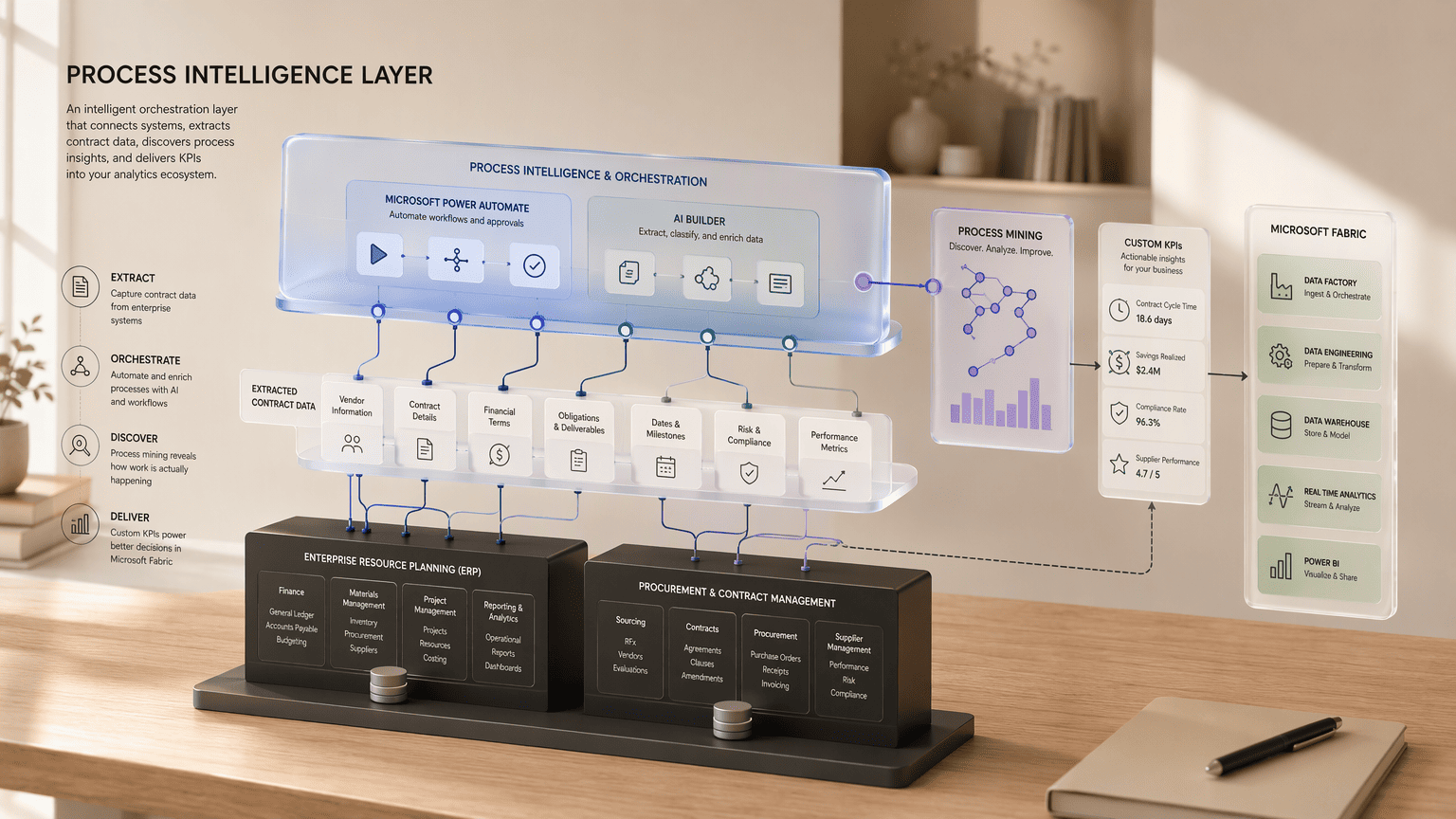
Microsoft Power Automate takes a different path: instead of deploying a standalone contract tool, it overlays intelligence onto your existing ERP and procurement stack. The 2026 release wave 1, delivering new features from April to September 2026, includes AI Builder capabilities for extracting contract data and process mining with custom KPIs, all within the Microsoft Fabric ecosystem.
This architecture matters for organizations that cannot rip and replace their existing procure-to-pay workflows. Power Automate embeds compliance monitoring as a process intelligence layer, running automated checks against extracted contract terms to flag billing anomalies without disrupting the systems your AP team already uses.
| Feature | What It Does | Why It Matters for Spend Audit |
|---|---|---|
| AI Builder Contract Extraction | Structures key terms from vendor agreements into Dataverse tables | Enables automated comparison of invoice line items against extracted rate cards |
| Process Mining with Custom KPIs | Maps actual procurement paths and flags deviations from compliant process flows | Surfaces process-level gaps that cause leakage, revealing where procurement shortcuts routinely happen |
| Microsoft Fabric Integration | Unifies contract data with ERP transactional data for cross-system analysis | Links billing anomalies to their originating contract terms in a single analytical pane |
| Desktop Flow RPA | Automates legacy ERP data entry and reconciliation tasks | Closes the gap when source contract systems cannot be directly integrated |
Conclusion
The tools on this list cover different ground. Contracts.ai is a privacy-committed intelligence layer that validates rate cards after signature. Onit Catalyst is a process miner that finds root-cause governance gaps. Power Automate embeds directly into your ERP to catch deviations without disrupting existing workflows. Each replaces periodic human sampling with a continuous, deterministic AI loop.
Where you start depends on what bleeds money. Billing discrepancies point to one class of tool. Regulatory gaps point to another.
Process breakdowns and cross-contract fragmentation each have their own fix. The common thread is moving off backward-looking spot checks. The technology to verify every transaction against its governing document is here.
Frequently Asked Questions
What types of tools are available to detect unauthorized or non-compliant spending in vendor contracts?
Tools range from full-stack AI contract intelligence platforms like Contracts.ai and Icertis that extract obligations and compare invoices against rate cards, to process miners like Onit Catalyst that map procurement workflows, to embedded layers like Microsoft Power Automate that overlay compliance checks onto existing ERPs.
How can AI and contract intelligence platforms automatically flag billing errors, overcharges, and out-of-scope expenses against negotiated terms?
These platforms extract structured data from executed contracts, including rate cards, pricing tiers, and volume discounts, then compare invoices against those extracted terms automatically. Discrepancies trigger alerts before payment, while the system links findings back to source contract language for validation.
What key features should a post-signature contract audit tool have to ensure continuous financial compliance in 2026?
Look for automated extraction of structured financial terms from contracts, real-time alert configuration for billing discrepancies, obligation ownership assignment to route corrections, smooth ERP integration without workflow disruption, and privacy architecture that keeps sensitive contract data inside your boundary.
How do contract intelligence tools compare to manual audits or traditional spend management software for catching vendor overbilling?
Manual audits sample invoices retrospectively and miss the majority of discrepancies hidden in pricing tiers and amendment chains. AI contract intelligence tools check every transaction continuously against extracted contract terms and run industrial validation loops until discrepancies resolve, generating an evidentiary audit trail.
What steps do procurement teams in the US take to implement automated vendor spend auditing without disrupting existing ERP workflows?
They typically run a pilot on a limited contract set without full repository migration, choose tools that deploy as an intelligence layer over existing ERPs rather than replacement systems, and use platforms like Power Automate or Contracts.ai that can phase in automated checks incrementally while existing procure-to-pay processes continue uninterrupted.
What metrics or KPIs do enterprises use to measure the ROI of contract compliance and audit tools?
Key metrics include contract leakage percentage, the number of audit findings resolved, recovery amounts from overbilling disputes, renewal compliance rates, and reduction in payment cycle time. Enterprises benchmark against Deloitte’s 8.6% average leakage figure to quantify the value of closing detection gaps.
Sources
- What Is Contract Compliance? Process and Checklist | Conga – conga.com
- NSIAD-92-16 Contract Pricing: Economy and Efficiency Audits Can Help Reduce Overhead Costs – www.gao.gov
- How to conduct a contract audit (and automate it) in 2026 – juro.com
- What Your Vendor Contracts Are Quietly Authorizing – www.forbes.com
- [PDF] Contract Compliance – Optimizing Vendor Audits – The IIA – www.theiia.org
- Overview of Power Automate 2026 release wave 1 | Microsoft Learn – learn.microsoft.com






