







Introduction
Your finance team just closed the books, and a familiar frustration surfaces. An engineering manager expensed a five-figure software subscription that overlaps with an enterprise deal your procurement team negotiated at half the price. The money is already out the door, and use you didn’t even know you had evaporated with it. This is maverick spend, sometimes called rogue or off-contract buying, defined as any purchase that sidesteps established procurement rules and procedures. According to GEP research, these unmanaged purchases can account for up to 20% of indirect spend, a number that translates into millions in annual leakage for mid-to-large enterprises.
The problem has historically been slippery because it is a behavioral signal, not just a data anomaly. People buy outside policy for speed, convenience, or simple ignorance of existing contracts, and traditional spend analytics tools only catch the violation months after payment. A staggering 60% of enterprises that use AI in spend analytics still have to rely on manual follow-ups to interpret results, meaning the intelligence exists but arrives too late to stop the transaction. This gap is where a new generation of AI changes the math.
By layering an intelligence platform over your existing ERP, P2P, and CLM systems without replacing them, agentic AI intercepts a free-text requisition the moment a user types it. It instantly classifies what they are actually buying against live contract and supplier data, flags the deviation, and nudges them toward a compliant alternative before anyone clicks “approve.” This guide walks you through the six concrete steps to shift your spend control from a rearview-mirror audit into a preventive, real-time function, using procurement data you already have.
Key Takeaways
Controlling maverick spend with AI means changing when and how you apply control, not just running better analytics on what already leaked. Here are the five strategic shifts that make it work.
- Shift from post-audit to pre-approval blocking: The highest-impact change stops a non-compliant purchase at the requisition point rather than reporting it after the budget is spent.
- Layer AI over existing systems via APIs: A modern AI layer connects to your current ERP and P2P stack through APIs, eliminating any need for a costly rip-and-replace overhaul.
- Classify free-text into UNSPSC instantly: AI converts vague requisition language like “dev tool” into a standardized UNSPSC code, mapping it against your preferred supplier list within milliseconds.
- Use agentic nudges inside the workflow: Instead of a hard block, the AI proactively surfaces a compliant alternative directly inside the user’s buying interface, guiding behavior without creating friction.
- Maintain a human-in-the-loop governance structure: All final decisions stay with a human, but every override is captured as an auditable, structured rationale that strengthens your policy over time.
Step 1: Unify Your Procurement Data Foundation Without a Rip-and-Replace

The intelligence engine is only as sharp as the data it sees. Start by connecting it to what you already run.
An AI-powered control layer ingests information from your ERP, P2P platform, contract lifecycle management (CLM) system, and supplier master files through an API-led, service-oriented architecture. This is the same plug-and-play concept that platforms like JAGGAER ONE rely on, built with service-oriented architecture to enable a plug-and-play environment alongside your current systems. You get purchase requisitions, approved supplier rosters, active contract terms, and historical transaction patterns into a single unified data layer without migrating a single database.
What you target in this aggregation step is the context an AI agent needs to make a real-time call. It must absorb granular records: line-item pricing and expiration dates from your CLM, supplier performance and diversity status from your vendor master, and the 12-month trail of who bought what outside a catalog. Normalizing all of this against an industry standard like the United Nations Standard Products and Services Code (UNSPSC) strips away the free-text ambiguity that maverick buying hides behind.
A tool like Contracts.ai was purpose-built to structure and activate contract data in exactly this manner, connecting the language in your agreements directly to the purchase actions they are supposed to govern. You are not ripping out your ERP core; you are installing a lens over it.
The API-led approach means the AI platform reads and writes data into your existing workflows, with zero need to change the interface your business already knows. This single principle removes the multi-year infrastructure project that routinely stalls procurement transformation.
Step 2: Deploy Real-Time AI Classification and Detection at the Requisition Point

A user types “cloud storage upgrade” into a free-text requisition field. That is the moment of truth where control either exists immediately or fails permanently.
Real-time AI classification intercepts this raw text and assigns it a structural identity, most commonly a UNSPSC code, in milliseconds. The system does not just parse keywords; it reads intent. With the category standardized, the engine instantly cross-references your active contract repository and supplier master file to see if a negotiated agreement already covers this exactly. It surfaces the relevant Preferred Supplier List (PSL) options using category, location, and historical purchase context, making the compliant path visible before the wrong one is committed. This capability converts free-text chaos into a structured decision point, reducing variability and ambiguity before the requisition gains momentum.
When the AI finds that the requested vendor sits outside the PSL, it does not just generate a passive alert for a category manager to investigate next Tuesday. The agent reroutes the request in the interface itself, suggesting a compliant catalog item with the identical specification and known pricing. If no precise match exists and the deviation might represent a legitimate sourcing opportunity, the AI escalates the case with a detailed rationale to an approver instantly. The control point shifts from a monthly compliance report to the requisition itself.
Your approvers stop being forensic accountants. Instead, they manage scored exceptions. The standard transaction conforms automatically.
Step 3: Inject Structured Contract Intelligence to Prevent Spend Before It Happens
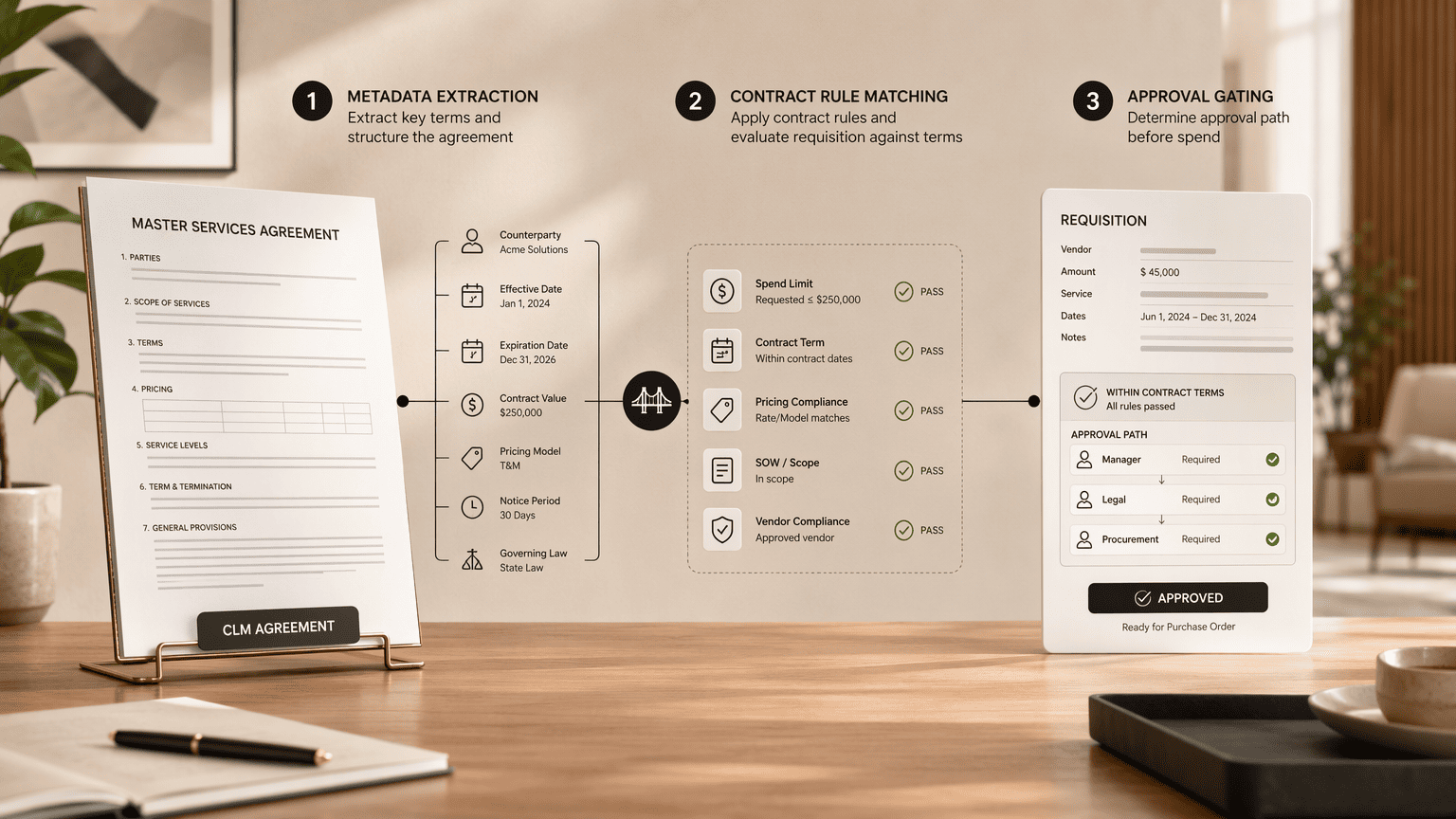
Connect your CLM’s structured metadata directly to the requisition engine, so the approval decision runs against hard contractual reality instead of a stale pricing catalog. Apply this in the following sequence.
- Extract and structure contract metadata: Use AI to pull specific line items from your executed agreements: precise unit pricing, volume tier breaks, effective start and end dates, renewal triggers, and named supplier entities. This structured data is the compliance spine.
- Link CLM terms to the P2P supplier record: Enrich your supplier master with the extracted contract intelligence so the system knows the exact price and scope each supplier is obligated to honor and the date that obligation expires.
- Run a real-time contract match during requisition: When the requisition triggers in Step 2, the AI overlays the structured contract record. If a user selects a preferred supplier but types a dollar figure above the contracted rate, the AI blocks the submission and surfaces the correct tiered price from the negotiated agreement.
- Auto-flag expiring or dead agreements: Prevent the approval of a renewal purchase against a contract that terminates in 48 hours, routing the requisition to a category manager for a renegotiation step instead of allowing an auto-approval into off-contract status.
Step 4: Implement Agentic AI Nudges and Behavioral Analytics in the Approval Workflow
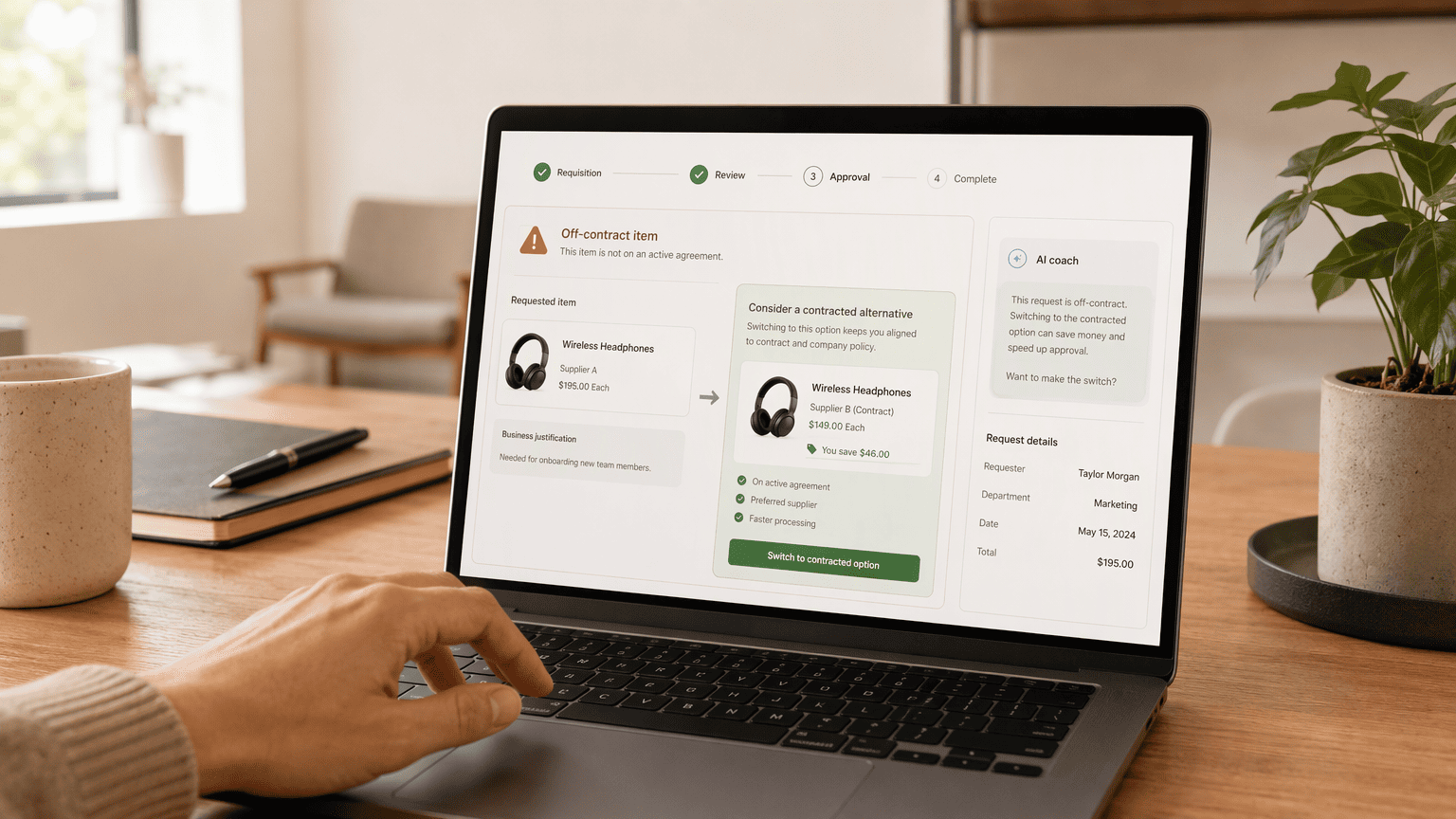
Preventing maverick spend sustainably means changing how people buy, not just erecting hard gates that they will find a way around. Agentic AI repositions the approval workflow as a coaching moment, not an inquisition.
When a user starts a requisition that veers off-contract, an agentic nudge fires immediately. This is not a rejection. It is a message like: “Your requested item is available from a contracted supplier at a 22% lower cost.
Want to switch?” The choice remains with the requester, but the friction shifts toward the compliant option.
Companies that operationalize this kind of behavioral insight see real returns. According to Everest Group, organizations that integrate behavioral insight into spend management reduce off-contract purchases by 30% in the first year.
On the approver side, agentic AI arms managers with a live risk score and a concise policy conflict summary instead of a raw requisition and a gut feel. The AI articulates exactly which contract clause the purchase violates, what the cost differential is, and whether the requesting department has a pattern of maverick behavior. The behavioral analytics layer identifies these patterns at the individual, department, and cost-center level, converting procurement data into a leadership tool.
The key is that the AI acts autonomously on routing and suggestion but never on final authority. The lifetime value of the data improves with every transaction, even the overrides.
Step 5: Establish a Human-in-the-Loop Governance Process for Exceptions

No procurement system catches every transaction perfectly. Legitimate emergencies, one-off innovation buys, and small de minimis purchases will always need a path around the standard workflow. You need a formal, auditable exception pathway.
The AI prequalifies the request, captures the rationale, and routes it based on rules you set. That data becomes a feedback loop: every override teaches the policy what real-world demand looks like, so the policy sharpens over time. Define your routing rules across these three dimensions.
| Exception Type | AI Pre-Qualification Trigger | Routing Action | Governance Outcome |
|---|---|---|---|
| High-value unique specification | Dollar threshold exceeds $X and zero PSL match exists with UNSPSC similarity score < 80% | Routes to Category Director with suggested sourcing event creation | Captures a new potential supplier entry into a formal RFP pipeline |
| Immediate operational necessity | Requisition marked “Emergency” with a documented production impact statement and < 24-hour needed-by date | Auto-approves for one-time purchase with a mandatory post-transaction review within 7 days | Generates a compliance report for leadership without blocking critical operations |
| Pre-approved deviation (de minimis) | Transaction value falls under a defined low-dollar cap and matches an established department micro-budget | Auto-approves with no human touch, but logged in the unified audit trail | Reduces approver fatigue by removing noise while preserving 100% data capture |
| Supplier on a watchlist or expiring contract | Supplier master flagged as “do not renew” or contract has a termination date within 30 days | Hard routes to legal and procurement for a joint review, with the requisition held until re-approved | Prevents the accidental auto-renewal or extension of a supplier you already decided to exit |
This model turns what used to be a shadow operation of one-off emails and hallway approvals into a governed decision log. The AI tags every override with its specific rationale and links it to the transaction. The policy learns. You are codifying procurement judgment at scale.
Step 6: Measure and Audit Outcomes: Savings, Compliance, and Audit Readiness
You invested in an intelligence layer to produce specific, measurable outcomes. The metrics framework must focus on these four key performance indicators:
- Maverick spend rate: the percentage of total indirect purchase value that never touched a negotiated agreement, measured at the time of requisition commit, not just at invoice match
- On-contract spend percentage: the lift in the share of purchases that align with active negotiated agreements
- Realized hard savings against budget: the delta between what a purchase would have cost at the rogue vendor’s rate and what it actually cost when the AI rerouted it to a contracted supplier; this is attributable, reportable value that a CFO can audit
- Policy-compliance rate at the transaction level: the proportion of requisitions that adhere to established procurement rules before commit
These KPIs validate the shift from reactive to preventive control.
Audit readiness changes from a quarterly fire drill into a live-state capability. Because the AI operates as a decision recorder, it creates an immutable, queryable log that links every single committed requisition to a specific policy reference, an active contract clause, or a documented human-in-the-loop exception. Every action, from an automated block to a director-level override, carries a timestamp and a rationale. Companies facing SOX compliance can produce traceable evidence instantly from the spend data rather than stitching spreadsheets.
The goal is to make your procurement function inherently audit-ready. When an auditor asks why a $40,000 purchase cleared without a competitive bid, you point to the specific emergency blockage record and the documented post-transaction review, all logged within the same unified data layer the AI consumes. The daily operation creates the compliance record automatically.
Conclusion
Maverick spend has always been a people problem wrapped in a data problem. For the first time, the technology can address both at the same speed the problem occurs.
You do not need to trash your ERP to get there. The six-step sequence unifies your existing data via APIs, intercepts free-text with real-time UNSPSC classification, injects contract intelligence directly into the requisition, deploys agentic nudges, governs exceptions transparently, and measures it all against real savings. That turns procurement into a strategic compliance function.
Start by evaluating your data readiness. The contract metadata you have today is the raw material for the AI controls you deploy tomorrow.
Frequently Asked Questions
What exactly is maverick spend and how much does it typically cost a mid-to-large enterprise annually?
Maverick spend is any purchase made outside an organization’s established procurement rules and negotiated agreements. According to GEP research, these off-contract purchases can account for up to 20% of indirect spend, which represents millions in annual leakage for mid-to-large enterprises through inflated costs and lost supplier use.
How can AI and procurement data work together to detect and flag off-contract spending in real time?
AI layers over your existing ERP and P2P systems, ingesting contract data, supplier master files, and historical purchases. It classifies free-text requisitions into standardized UNSPSC codes, cross-references them against active contracts, and flags or reroutes deviations automatically before the purchase is committed.
What data sources are necessary for an AI to provide a complete picture of maverick spend?
The AI layer needs this data to function effectively:
- Purchase requisitions from the requisitioning system
- Supplier master files containing performance and diversity status
- Structured contract metadata from the CLM system, including line-item pricing and expiration dates
- Approval workflow records showing historical decision patterns
- Historical transaction logs covering at least the 12-month trail of off-catalog purchases
Normalizing this data via APIs into a unified layer gives the AI the context to distinguish a policy violation from a valid exception.
How do you deploy AI spend control on top of existing ERP and P2P systems without replacing them?
Deploy via an API-led, service-oriented architecture that ingests and normalizes data from your current systems. This approach reads and writes transaction data inside your existing workflows without migrating databases. A pilot can be run with a limited contract set before scaling across the full enterprise.
How can structured contract intelligence prevent maverick spend before it happens?
AI extracts specific pricing, effective dates, and tiered discounts from your executed agreements. When a user submits a requisition against a preferred supplier, the system validates the entered price and scope against the contracted terms instantly, blocking overcharges and expired-agreement purchases at the point of entry.
What measurable outcomes do enterprises achieve when using AI to govern maverick spend?
Key outcomes from deploying AI-based control include:
- A direct reduction in the maverick spend rate
- A lift in on-contract spend percentage
- Realized hard savings from rerouting to contracted rates
- A live, queryable audit trail that links every committed requisition to a policy reference, contract clause, or exception
Companies that integrate behavioral insights into the process typically reduce off-contract purchases by 30% in the first year.
Sources
- Maverick Spend Detection with AI | GEP Blog – www.gep.com
- What Is Maverick Spend and How To Control It – Fairmarkit 2026 – www.fairmarkit.com
- Maverick Spend AI Procurement Solutions | LTM – www.ltm.com
- JAGGAER Introduces the JAGGAER ONE Unified Platform to Address Spend Management – Supply Chain Management Review – www.scmr.com