








Introduction
Your company probably loses 1.8% of its annual purchase value to maverick spend, buying that sidesteps approved contracts and suppliers. That number from the American Productivity and Quality Center means a business with $100 million in yearly spend leaks $1.8 million before anyone notices. The culprit is rarely malice. Slow approvals, confusing policies, and fragmented tools push good people toward workarounds, like expensing that SaaS tool on a personal card or calling a non-preferred vendor to hit a deadline.
This problem compounds silently. A 2024 Gartner analysis found nearly 40% of SaaS spending goes unmonitored across organizations, hidden inside expense reports and credit card statements where finance and IT never see it. By the time procurement audits the books, the money is gone, the contract terms were never negotiated, and the business has zero use.
AI changes where you catch the loss. Instead of finding rogue purchases after payment, you can intervene at the point of requisition, surfacing preferred suppliers and contract pricing while the buyer is still in the shopping cart. This guide maps the six steps to building that capability: cleaning your data and embedding real-time compliance guardrails that cut leakage and supplier sprawl. You can do it without ripping out your existing systems.
Key Takeaways
Here is what controlling maverick spend with procurement data and AI looks like in practice.
- Centralized data is non-negotiable: You cannot enforce policy across fragmented contracts, purchase orders, card transactions, and invoices; AI needs a single source of truth to classify spend and flag non-compliance.
- AI classification removes the guesswork: Transforming free-text requisitions into standardized UNSPSC categories automatically maps each request to your Preferred Supplier List by category and location.
- Real-time decision support redirects buyers before checkout: In-system prompts that surface approved suppliers and contract pricing preserve buyer autonomy while eliminating off-contract purchases at the moment of need.
- Post-signature intelligence catches leakage that CLM tools miss: Comparing requisitions and POs against active contract terms before payment reduces savings leakage by 60% compared to post-payment audit approaches.
- Layering AI over your ERP keeps your current systems intact: Augmentation via API or embedded workflows enforces compliance inside your existing SAP, Oracle, Coupa, or Ariba environment. No migration required.
- Compliance is a feedback loop, not a static rulebook: Real-time dashboards and closed-loop policy updates turn detected spend patterns into continuously refined governance.
Step 1: Centralize and Cleanse Your Procurement Data for a Single Source of Truth

Maverick spend thrives on fragmentation. Vendor contracts sit in one system, purchase orders in another, card transactions in a third, and invoices somewhere in accounts payable. With no single view, you audit the gaps between systems instead of the transactions themselves.
Centralize those data streams into a unified model. Ingest vendor master records, POs, corporate card feeds, invoices, and accounting extracts. Then normalize supplier names, deduplicate records, and map everything to a classification standard like UNSPSC.
Only when the data model is clean can AI reliably compare transactions against policies and flag the delta between what was bought and what should have been bought. Most organizations treat this as a technology project. It is actually a discipline problem first.
The systems exist to consolidate procurement data; what is usually broken is the governance that keeps those feeds clean and current over time. Assign an owner who is measured on data completeness, not just the initial migration.
Step 2: Standardize Demand with AI-Powered Requisition Classification
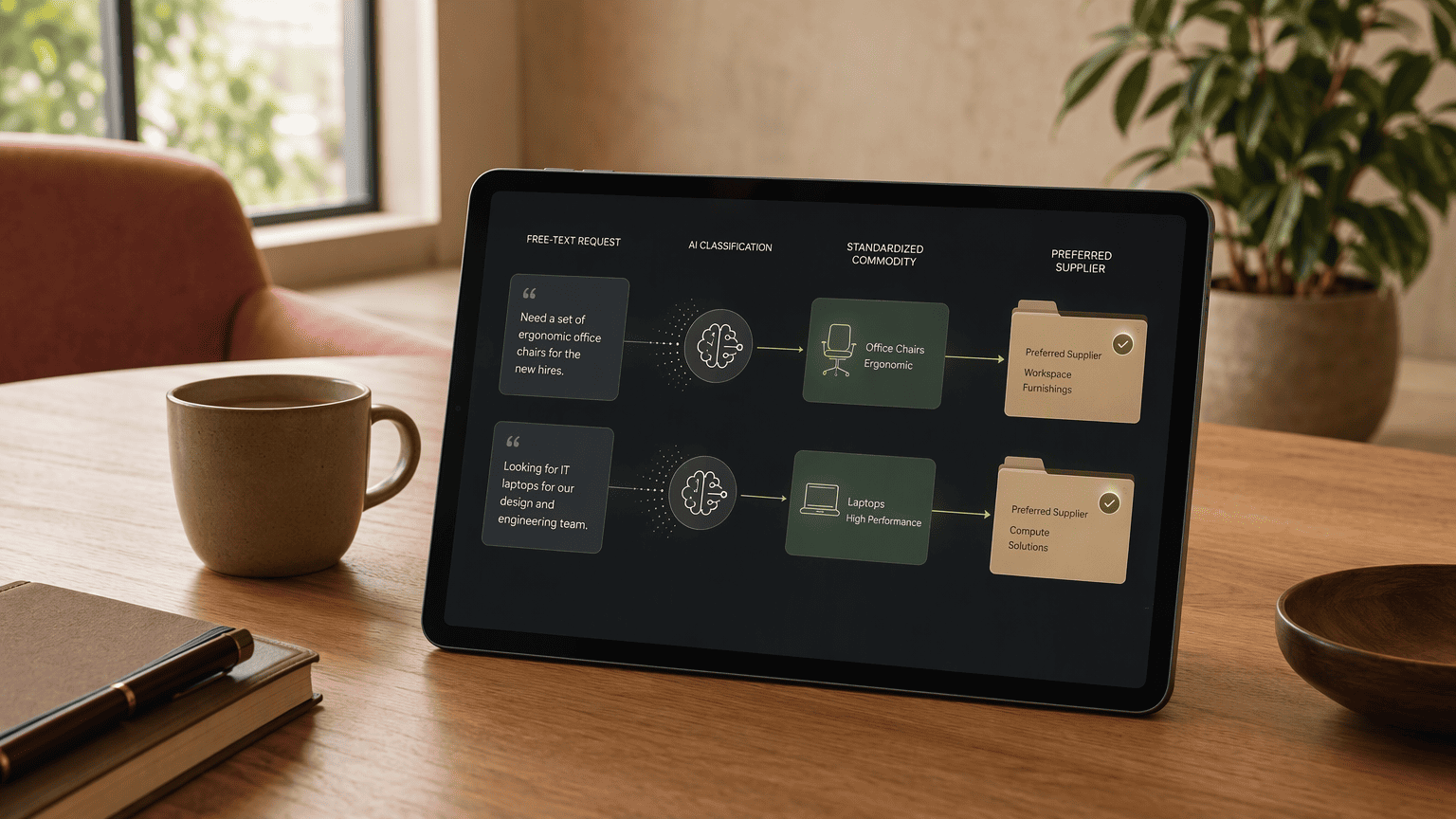
Free-text requisitions create chaos the moment someone hits submit. An employee types “design software” when a preferred Adobe contract already exists. Another requests “cloud storage” while an enterprise Box license sits unused. The system does not know those words refer to the same thing, so the purchase slips past every guardrail.
AI reads that free-text description and maps it to a standardized UNSPSC commodity code, then automatically matches the code to your Preferred Supplier List by category and location. A request for “marketing automation tool” resolves to your contracted HubSpot instance instead of launching a new supplier onboarding workflow. That match connects how people actually ask for things to how procurement governs them.
Classification uncovers tail-spend patterns you would otherwise never see. Hundreds of small, one-off purchases that individually escaped a sourcing event turn into aggregated demand the moment the AI groups them. Five departments bought project management tools from five different vendors last quarter while a single enterprise license sat unused. Exposing that mismatch turns scattered maverick spend into hard negotiation use.
The AI does not block the requester. It surfaces the relevant PSL items and lets the buyer pick, so autonomy stays intact but every choice lands inside a contract. Over time, the engine learns your organization’s buying patterns and sharpens its matching. What starts as a classification step becomes the mechanism that keeps spend on-contract before the purchase order ever prints.
Step 3: Embed AI-Guided Decision Support at the Point of Purchase
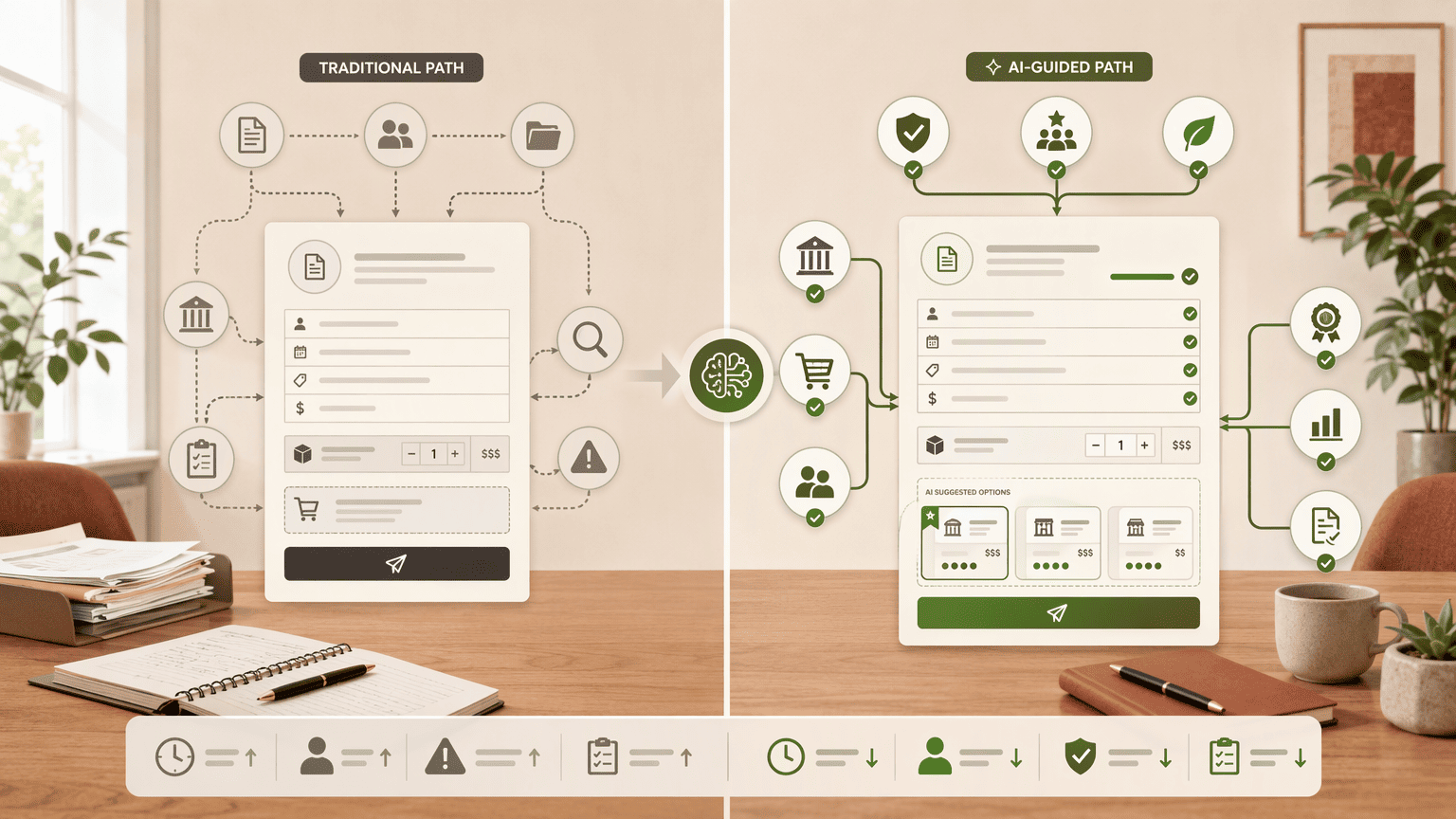
By the time an invoice hits the AP queue, the spending decision was made weeks ago. You catch the off-contract purchase, but you can’t undo it. The moment that matters is when a buyer opens the requisition form or shopping cart.
| Decision Dimension | Traditional Audit Approach | AI-Guided Point-of-Purchase Approach |
|---|---|---|
| Timing of intervention | Post-payment, during reconciliation | During requisition, before commitment |
| Buyer experience | Rejection or rework after the fact | In-system prompts with approved alternatives |
| Preferred supplier visibility | Manual lookup by buyer | Automatic surfacing of PSL options by category and location |
| Policy compliance rate | Average 59.5% (Ardent Partners) | World-class teams reach nearly 75% when combining technology and process discipline |
| Savings leakage | Baseline, varies by audit frequency | 60% less savings leakage than peers (Hackett Group, 2025) |
| Buyer autonomy | Preserved but unguided | Preserved with structured, contract-aligned choices |
Plug the AI into the buying workflow itself. When an employee requests a SaaS analytics tool, the pre-negotiated Tableau license appears on screen with pricing and terms already loaded. The buyer can choose something else, but the friction shifts from accidental to deliberate. Guided buying at the point of purchase surfaces approved suppliers, pre-negotiated prices, and contract-aligned product options while the decision is still in flight, rather than surfacing them in an audit report months later.
Step 4: Deploy Post-Signature Contract Intelligence to Catch Leakage Early

Post-signature contract intelligence closes the gap between what a contract says and what actually gets purchased against it.
Here is the workflow in practice.
- Centralize active contracts: Ingest all executed agreements into an intelligence layer that structures key terms, pricing tables, and supplier rosters, making them machine-readable and queryable. A tool like Contracts.ai lets you run a pilot on a limited contract set without migrating your full repository.
- Map contracts to requisitions: As purchase requests are created, the AI compares the requisition line items against active contract terms in real time, flagging mismatches before a PO is issued.
- Flag off-contract pricing: When a requisition price deviates from contracted rates, the system surfaces the discrepancy immediately. Buyers see the contract price as a reference point while the purchase is still being reviewed.
- Validate supplier eligibility: The engine checks whether the selected supplier matches the contracted roster for that category, blocking supplier sprawl when it starts rather than cleaning it up later.
The result is a compliance check that catches problems before payment goes out the door. Traditional CLM and ERP controls typically find leakage after cash has left the business. Intercepting it at the requisition stage is how world-class teams achieve a 60% reduction in savings leakage compared to peers relying on periodic audits.
Step 5: Layer AI Over Your Existing ERP and S2P Systems Without Rip-and-Replace
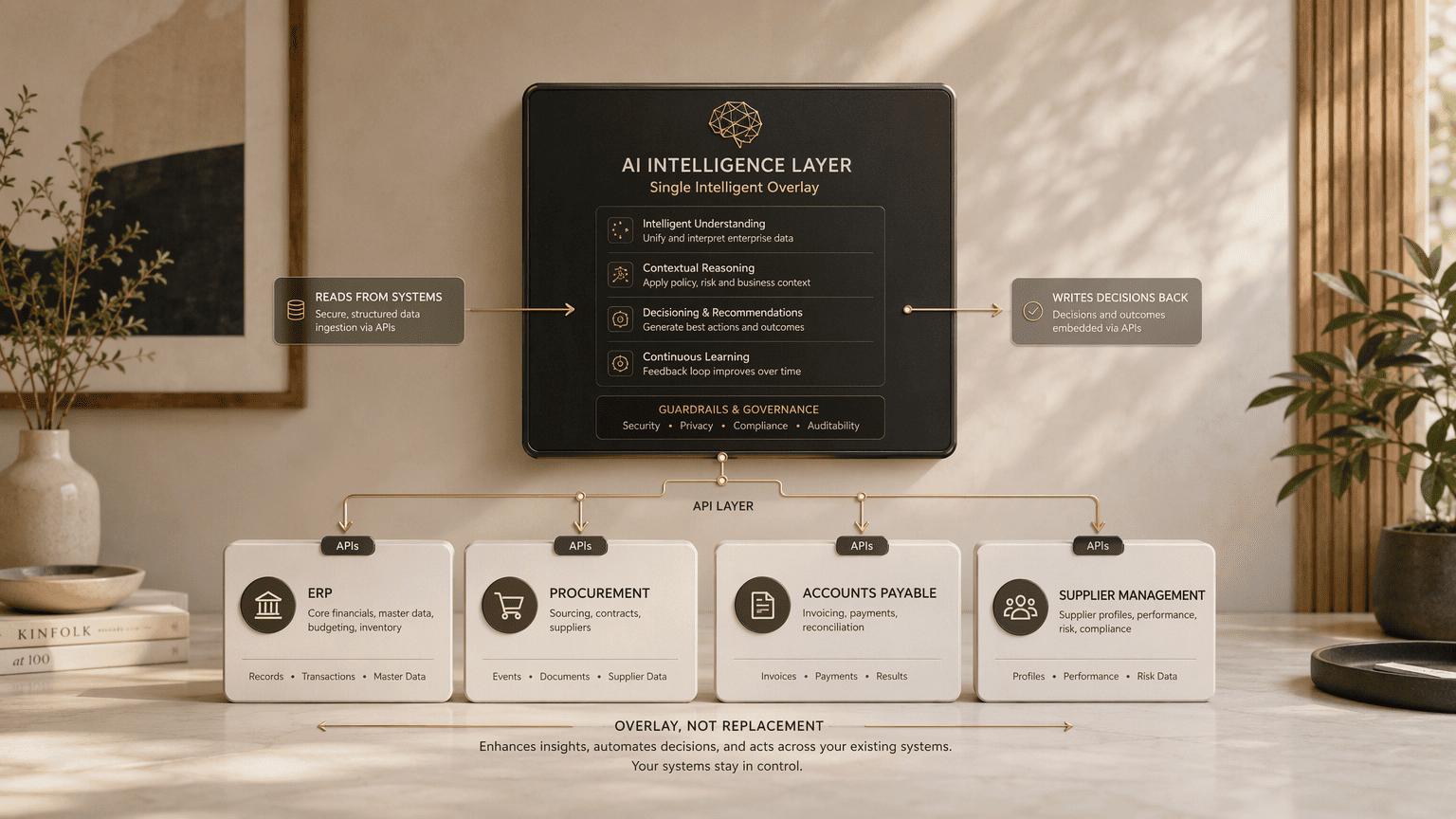
The biggest objection to any procurement technology initiative is the migration. Your SAP, Oracle, Coupa, or Ariba environment represents years of integration work, and nobody wants to touch it.
The good news is that modern AI procurement tools do not require replacing that stack. They sit alongside it.
An intelligence layer like Contracts.ai connects via API or embedded workflow, reading data from your ERP and writing structured decisions back into it. The classification engine, decision-support prompts, and contract-intelligence checks operate as an augmentation layer. Your buyers stay in the same interface they already use; the AI simply adds guardrails that were not there before. It is an overlay that brings structure, consistency, and control to tail spend management without changing how buying or approvals work.
Integration models vary, but the common pattern is straightforward: extract spend data from the ERP, run it through the AI classification and compliance engine, then surface insights and nudges back inside the requisition workflow. Some tools embed directly into the shopping cart. Others present a dashboard that procurement teams monitor while buyers proceed unchanged. Either way, the heavy lift of system migration disappears from the business case.
Step 6: Continuously Monitor, Measure, and Refine Your Compliance Framework
Compliance is not a policy document you publish once and enforce by audit. It is a living feedback loop, and AI gives you the instrumentation to run it.
Start by defining the KPIs that matter: contract compliance rate, savings leakage as a percentage of maverick spend, supplier consolidation ratio, and cycle time from requisition to compliant PO. The Ardent Partners benchmark of a nearly 75% contract compliance rate for world-class teams gives you a target, while Hackett Group data grounds the leakage reduction you should expect. Real-time dashboards surface those metrics as they move.
When a category suddenly spikes in off-contract purchasing, procurement can investigate immediately. You tighten the guided buying rules for that commodity rather than discovering the problem at quarter-end. The policy engine learns from detected patterns.
If a specific department consistently buys outside the PSL for a legitimate business reason, that signals a gap in the preferred supplier coverage. Closed-loop refinement means updating supplier lists, adjusting approval workflows, and retraining the AI models on the corrected data to close the gap between policy intent and purchasing reality.
Conclusion
Controlling maverick spend means moving governance to the decision point, embedded inside the buying flow where it redirects rather than punishes. The APQC baseline of 1.8% maverick spend as a share of purchase value represents a real and addressable cost for most organizations, and the 40% of unmonitored SaaS that Gartner identified shows how far the gap stretches in technology spend alone. AI-driven contract intelligence and real-time decision support can close that gap, cutting savings leakage by 60% according to Hackett Group research, all without ripping out the ERP systems your business already relies on. The six steps outlined here give you a practical path from fragmented data to a compliance feedback loop that gets sharper every quarter.
Frequently Asked Questions
What is maverick spend and why does it matter in procurement?
Maverick spend is purchasing that takes place outside approved channels, contracts, or supplier lists, also called rogue spend or unauthorized spend. It matters because it erodes negotiated savings, increases risk, and hides from standard reporting. According to the APQC, it accounts for 1.8% of annual purchase value across organizations.
How can AI and procurement data work together to detect and prevent maverick spend?
AI ingests centralized procurement data, classifies free-text requisitions against taxonomies like UNSPSC, and maps requests to preferred suppliers in real time. At the point of purchase, it surfaces contract-aligned alternatives before the transaction commits, converting chaotic demand into governed spending without blocking the buyer.
What procurement data sources are needed to identify unauthorized purchasing?
You need vendor contracts, purchase order history, corporate card transactions, invoices, and accounting records centralized into a unified data model. Clean, normalized spend data is the prerequisite for AI to compare actual transactions against approved policies and flag deviations reliably.
What steps can finance and procurement teams take to control maverick spend using AI-driven contract intelligence?
A three-part maverick spend analysis is the foundation:
- Centralize spend data. Pull all transaction sources into a single unified model.
- Define maverick spend per company policy. Specify what counts as unauthorized or off-contract purchasing.
- Compare transactions against policies and contracts. AI automates this comparison at scale, adding contract-term validation pre-payment rather than post-payment.
How does post-signature contract intelligence help enforce procurement compliance vs. traditional CLM or ERP approaches?
Traditional CLM and ERP tools flag non-compliance after invoices are paid. Post-signature contract intelligence compares requisitions and POs against active contract terms before payment, intercepting off-contract pricing and unauthorized suppliers early. This proactive check reduces savings leakage by 60% compared to audit-reliant peers.
What measurable results can organizations expect from using AI to control maverick spend?
Organizations can expect significant savings leakage reduction (60% per Hackett Group), improved contract compliance (world-class teams hit nearly 75% versus a 59.5% average), reduced supplier sprawl, and sharper audit readiness, all without system migration when layering AI over existing ERP platforms.
Sources
- What is maverick spend? How to identify — and how to reduce it | Mercury – mercury.com
- How to Reduce Maverick Spending Across Departments | Procurement Magazine – procurementmag.com
- AI in Procurement: 10 Use Cases and 5 Key Benefits – www.apqc.org
- Maverick Spend AI Procurement Solutions | LTM – www.ltm.com






