








Introduction
Your sourcing team just locked in a 15% year-over-year discount. Weeks later, departments are buying off-contract from familiar suppliers, skipping the new agreement. That erosion is not a fluke. McKinsey research shows organizations lose 10 to 50% of their negotiated savings to maverick purchasing. The American Productivity and Quality Center pegged the cost at 1.8% of annual purchase value across surveyed firms.
This is a systemic process failure rooted in how procurement tools and workflows actually operate. When nearly 30% of indirect spend is off-contract, per The Hackett Group, the problem exceeds any one department’s bad judgment. The frustration is real: long approval chains and invisible catalogs push good employees toward workarounds. A 2024 Gartner analysis found nearly 40% of SaaS spending unmonitored, so the leakage compounds silently.
Shifting from retrospective audit to real-time prevention is what actually closes the gap. The following six steps provide the operational framework to do it, mapping the path from diagnosis to a measurable, defensible return on investment.
Key Takeaways
Maverick spend reduction succeeds when you stop policing individuals and start redesigning the procurement process. These six steps lay out the sequence from detection through cultural change.
- Diagnose the friction first: Root causes like catalog inaccessibility and vague policies drive bypass behavior more than intent, so mapping workflow friction must precede any technology fix.
- Shift to real-time detection: Aggregating ERP, AP, and PO data into live compliance dashboards catches violations before they compound, closing the gap between average (59.5%) and world-class (75%) contract compliance.
- Make compliance the easiest path: Guided purchasing surfaces pre-approved vendors at the point of need, and auto-approval for under-threshold transactions removes the urgency excuse for going off-contract.
- Layer in contract intelligence: Post-signature AI that matches invoices to contract clauses spots off-contract spend embedded in complex billing that dashboards miss.
- Lead with accountability: CFO and CPO sponsorship, paired with department-level compliance metrics, corrects the “hero buyer” mindset that rewards workarounds.
- Build a leakage-based business case: Quantifying lost discounts, reconciliation labor, and audit cost translates compliance gains into hard-dollar P&L impact that secures budget.
Step 1: Define and Diagnose the Root Causes of Maverick Spend

Maverick spend is any purchase made outside established procurement policies, approved contracts, or preferred supplier lists. It is broader than off-contract spending; it includes any noncompliant buying behavior, regardless of vendor status. A wholesale purchase from an unapproved supplier often stems from a different breakdown than a tail-end expense-account bypass of a catalog.
For most organizations, the primary driver is process friction. Enterprise contracts commonly take 24 to 30 weeks to complete and involve more than 80 friction points. When a department needs a specialized tool tomorrow, that timeline guarantees a workaround. Decentralized budgets let teams pay directly, catalog inaccessibility means they cannot find the approved option, and ambiguous policies leave the rules open to interpretation. The diagnosis step means mapping exactly where your requisition-to-PO workflow forces people into an off-ramp so that the fix targets the structure, not the people caught in it.
Step 2: Build a Real-Time Detection Layer with Spend Analytics

Building a detection layer that flags violations immediately requires aggregating data from three systems: ERP transaction logs, AP records, and PO issuance history. Organizations managing this data continuously reach roughly 75% contract compliance, compared with an industry average of 59.5%. The gap comes down to visibility quality.
- Consolidate source data: Feed ERP, AP, and PO logs into a spend analytics engine so every transaction, regardless of payment channel, appears in a single view.
- Identify tail spend and non-PO invoices: Flag high-volume, low-value purchases and invoices with no corresponding purchase order. Together these account for the bulk of undetected leakage.
- Design compliance dashboards: Build real-time views that surface unapproved vendor transactions, off-contract line items, and spend-to-budget variances for each department.
- Set automated alerts: Configure threshold-based triggers that notify the procurement team when a transaction hits a specified dollar limit without a valid contract reference, moving the response window from quarters to hours.
Step 3: Redesign the Buying Process with Guided Purchasing and Intelligent Automation

Guided purchasing turns the compliant path into the only path that makes sense. When employees open a requisition, the system surfaces pre-approved suppliers and pre-negotiated pricing for that exact category.
- There is no hunting through vendor portals or guessing which contract applies.
- The employee clicks the approved option, and the purchase moves instantly into a workflow designed to process it without delay.
Then the automation layer removes the urgency driver that fuels most bypass behavior:
- Routine, under-threshold transactions route through an auto-approval engine that clears them within 24 hours.
- No chasing a manager for a signature, no waiting three days for a procurement ticket.
The Hackett Group found that world-class teams investing in reducing rogue buying record 60% less savings leakage than peers, precisely because they eliminate the “procurement is too slow” justification before it forms.
A tool like Contracts.ai surfaces approved agreements at the point of purchase, linking requisitions directly to the governing contract and its negotiated terms. The result is a closed loop: the buyer sees the right vendor, the finance team sees the right price, and the contract terms enforce themselves.
Step 4: Implement Post-Signature Contract Intelligence to Catch What Analytics Miss
Spend analytics dashboards catch obvious violations, such as a purchase order to a supplier with no contract on file. They miss the subtler leakage that hides inside complex invoices:
- Volume pricing applied incorrectly after a discount tier reset
- Services billed outside scope on a multi-year engagement
- A department renewing a legacy SaaS tool at a rate the parent agreement never authorized
Post-signature contract intelligence catches these deviations by matching invoice line items against specific contract clauses.
AI-driven contract analysis tools, such as Sirion, scan executed agreements and cross-reference every incoming charge to the negotiated terms. Enterprises using this approach report a 6 to 12% average reduction in value leakage by aligning spending and performance to negotiated terms, with the technology accelerating end-to-end cycle times by up to 50% and specialist tasks by 80 to 90% through AI agents. Deploying this layer creates a persistent audit that operates continuously, surfacing off-contract spending in real time rather than waiting for the annual sourcing review.
Step 5: Engineer a Cultural Shift Through Leadership and Change Management

Technology does not fix the “hero buyer” mindset, where a department head takes pride in sourcing a tool on their own. That behavior persists because the organization rewards speed over compliance. Correcting it requires two signals: sponsorship from the top and transparency at the department level.
CFO and CPO sponsorship must be visible and unequivocal. Jon Stegner, who led procurement transformation at Deere and Delphi, advocates a single, senior-backed policy statement that all spend is authorized by purchasing through the Chief Procurement Officer. Pair that directive with department-level accountability dashboards that make every team’s compliance rate visible to their peers.
When a VP sees a 62% compliance score next to a peer’s 89%, the conversation shifts. Deere’s most famous finding was a single student intern uncovering 424 different work gloves being purchased across 14 factories from suppliers charging different prices for the same glove.
The corrective action compressed 424 varieties to 24, cut suppliers from six to one, and lowered glove costs by 50%. That result came from changing behavior, not from installing new software.
Step 6: Quantify and Build the Business Case for Sustainable ROI
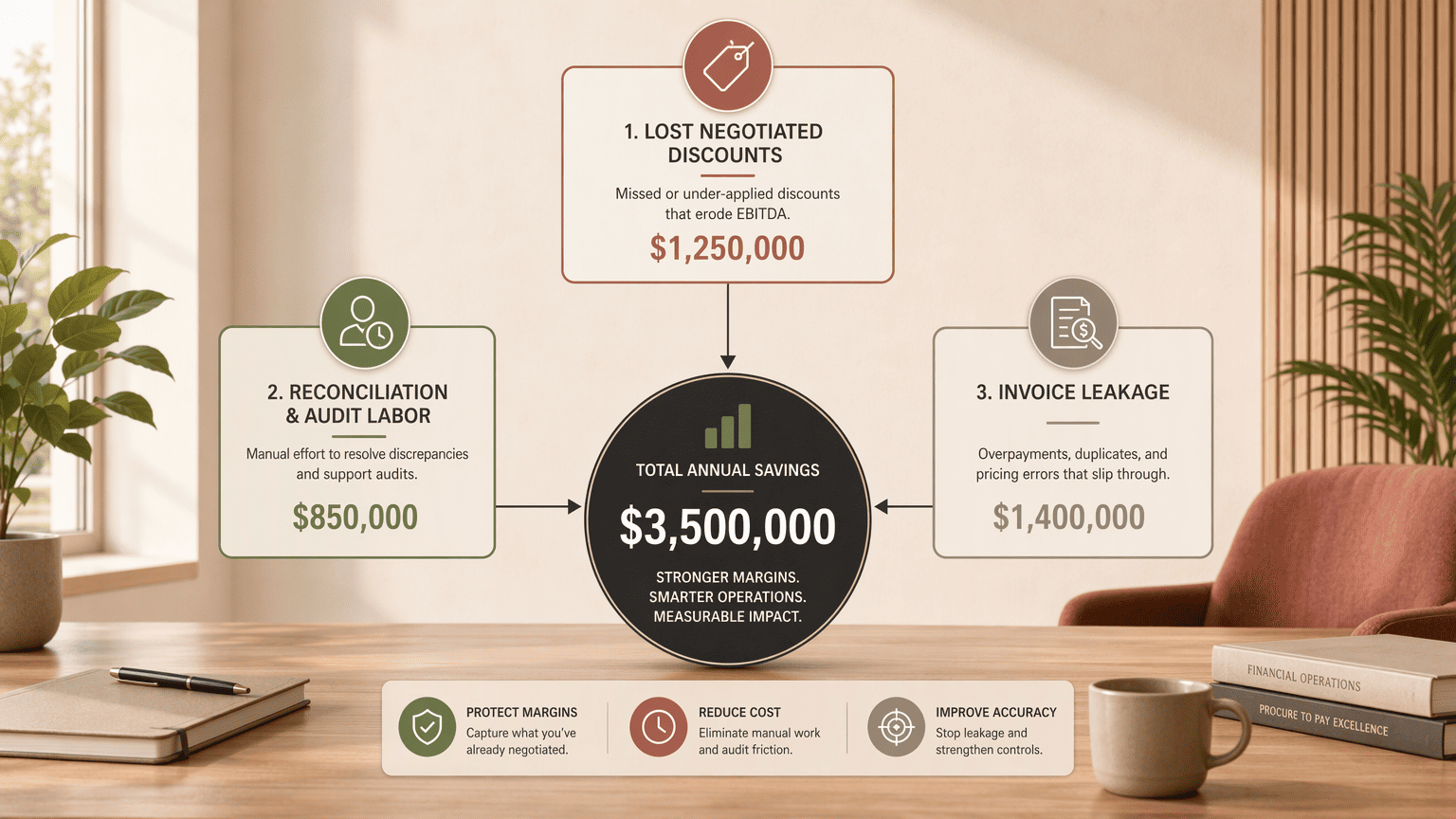
Finance committees approve programs grounded in hard-dollar leakage, not procurement theory. Compute the business case across three cost categories, and the ROI becomes undeniable.
| Cost Category | Calculation Formula | Typical Impact |
|---|---|---|
| Lost negotiated discounts | Off-contract spend volume × average discount negotiated versus actual price paid | 10 to 50% savings erosion on affected categories (McKinsey) |
| Reconciliation and audit labor | Hours spent reconciling non-PO invoices × fully loaded cost per hour × volume of flagged transactions | Reflects the hidden cost of manual audit cycles across AP and procurement teams |
| Compliance risk exposure | Value of contracts with audit failure risk × probability-weighted regulatory or financial penalty | Varies by industry; accounts for audit findings and contractual penalty exposure |
Quantify these three lines for your organization and project the payback period against the cost of implementing steps one through five. In most cases, the first year’s saved discounts alone exceed the investment. Delphi’s benchmark is instructive: an internal audit function catches 80% or more of maverick spend, proving that the detection-to-prevention loop pays for itself within the first measurement cycle.
Conclusion
Stopping maverick spend requires a maturity model built on four pillars: detect through real-time analytics, guide through frictionless purchasing pathways, monitor through post-signature intelligence, and lead through executive accountability. Each step reinforces the previous one. Together they shift the organization from policing transactions reactively to embedding compliance into the buying experience.
When this framework is in place, contract leakage gets measured in days rather than months. The root cause narrows to systems that are hard to use and approvals that take too long. And suppliers deliver exactly the value that was negotiated.
Frequently Asked Questions
What is maverick spend and why does it happen despite approved vendor contracts?
Maverick spend is any purchase made outside an organization’s procurement policies, approved contracts, or preferred supplier lists. It persists because process friction, such as slow approvals and hard-to-find catalogs, pushes employees toward faster unapproved options, rarely out of deliberate misconduct.
How can organizations detect rogue or off-contract purchasing in real time?
Organizations detect it by aggregating ERP, AP, and PO log data into spend analytics dashboards that flag non-PO invoices and unapproved vendor transactions instantly. Automated threshold alerts replace periodic audits, allowing intervention within hours rather than quarterly review cycles.
What strategies and technologies can enforce contract compliance without disrupting procurement workflows?
Guided purchasing surfaces pre-approved suppliers at the point of requisition, while intelligent automation approves routine under-threshold transactions within 24 hours. These approaches make the compliant path the fastest path, removing the justification for bypassing contracts.
How do you build a business case and measure ROI for maverick spend reduction?
Three cost categories drive the financial case for implementation:
- Lost negotiated discounts: recoverable from off-contract spend that missed pre-arranged supplier pricing.
- Reconciliation and audit labor: labor costs incurred for manually processing non-PO invoices, which can be reduced or eliminated.
- Compliance risk exposure: financial penalties and leakage from unaudited contracts that lack proper oversight.
What role does post-signature contract intelligence play in preventing maverick buying?
Post-signature contract intelligence uses AI to match invoice line items against specific contract clauses in real time. It catches off-contract purchasing embedded in complex billing that spend dashboards overlook, such as out-of-scope services or incorrect pricing scales, and triggers immediate alerts.
Sources
- What Is Maverick Spend? Definition, Causes, and Prevention – esker.com
- What Is Maverick Spend? Definition, Causes, and Prevention – www.esker.com
- Contract Platforms to Prevent Unauthorized Commitments – www.sirion.ai
- Spend Management Software: Visibility and Control for Procurement Teams 2026 – www.procurementvms.com
- Managing Maverick Spend at Deere and Delphi – An Interview with Jon Stegner | Supply Chain Resource Cooperative – scm.ncsu.edu
- Identifying and Mitigating Maverick Spend – www.ijoqm.org






