







Introduction
One in four companies uses automated contract tools for compliance, according to Ardent Partners. That leaves three out of four companies leaking revenue every payment cycle, often without realizing it. A single audit of just 30 invoices recently uncovered $515,227 in billing leakage AP automation never looks for, a staggering sum that standard spreadsheet reconciliation would have missed entirely.
When your AP team cross-references invoices against contracts with VLOOKUP and SharePoint searches, they catch maybe the obvious overcharges. They miss the pricing-tier violations, the duplicate line items buried on page six, and the services billed outside scope week after week. That gap between what you agreed to pay and what you actually pay is called contract leakage, and at scale it reaches into the millions.
Specialized software now closes that gap. Automated vendor invoice audit tools ingest your signed contracts alongside incoming invoices and compare every line item against the actual pricing tables, payment schedules, and clause-level rules. They flag discrepancies within seconds of submission, not weeks later during month-end close. In one real-world deployment across 488 invoices, an automated audit surfaced $20,250 in direct overbilling and flagged $40,600 in gross invoice value at risk from business-rule failures. This technology turns invoice review from a reactive, sample-based chore into an always-on compliance engine.
Key Takeaways
- Auditing every supplier invoice against its contract used to be a fantasy. Teams sampled, guessed, and paid bills they shouldn’t have because there simply weren’t enough hours in the month. That constraint is gone.
- Automated audit tools now match line items to contract terms\u2014pricing tables, volume tiers, rebate schedules, and exclusions\u2014across the full invoice population, continuously. The old spot-check model becomes a 100% review model without adding headcount.
- One food-ingredients manufacturer replaced manual Excel reconciliation end-to-end and cut invoice processing time by approximately 95%, freeing AP staff for supplier negotiations and cash-flow work that spreadsheets never touched.
- The same systems flag patterns that manual reviews consistently miss: duplicate submissions, services billed outside scope, missing cost-center codes or plant numbers, and invoices that arrive after the contractual cutoff date. The hard-dollar recovery alone typically pays for the tool within a single quarter.
- Deployment works as an intelligence layer over your existing ERP and contract-lifecycle-management systems. You connect via APIs and can run a three-month pilot on a limited contract set\u2014no full-repository migration, no rip-out of current workflows. That pilot surfaces concrete recovery figures alongside a quantified view of risk exposure, which builds a fast, defensible business case for expanding the program.
- An automated vendor invoice audit tool extracts structured data from executed contracts and incoming invoices, then compares the two at the line-item level before payment is released. It checks the billed rate against the contracted rate, verifies that the service falls within scope, confirms that unit quantities match the agreed pricing tier, and flags anything that deviates. No spreadsheet, no manual lookup.
- Manual reconciliation depends on an AP analyst pulling the contract from a shared drive, locating the relevant pricing schedule, and cross-referencing it against the invoice in Excel. That process is slow, error-prone, and inherently incomplete. It typically covers only a sample of invoices.
- An automated tool ingests every invoice the moment it arrives. Platforms like Portcast, which specializes in freight audit, compare every charge line against negotiated carrier contracts automatically. Tools like ProcureDesk tie automated payment to three-way matching against purchase orders.
- An AI-driven audit catches that same discrepancy plus the dozens of smaller violations scattered across hundreds of lower-value transactions that collectively produce a larger financial hit. One provider reports that its AI processes 2,000x more invoices than manual AP or BPO review, a scale difference that turns audit from a reactive safety check into a proactive financial control.
How AI-Powered Tools Match Invoice Line Items to Your Contracts in Real Time
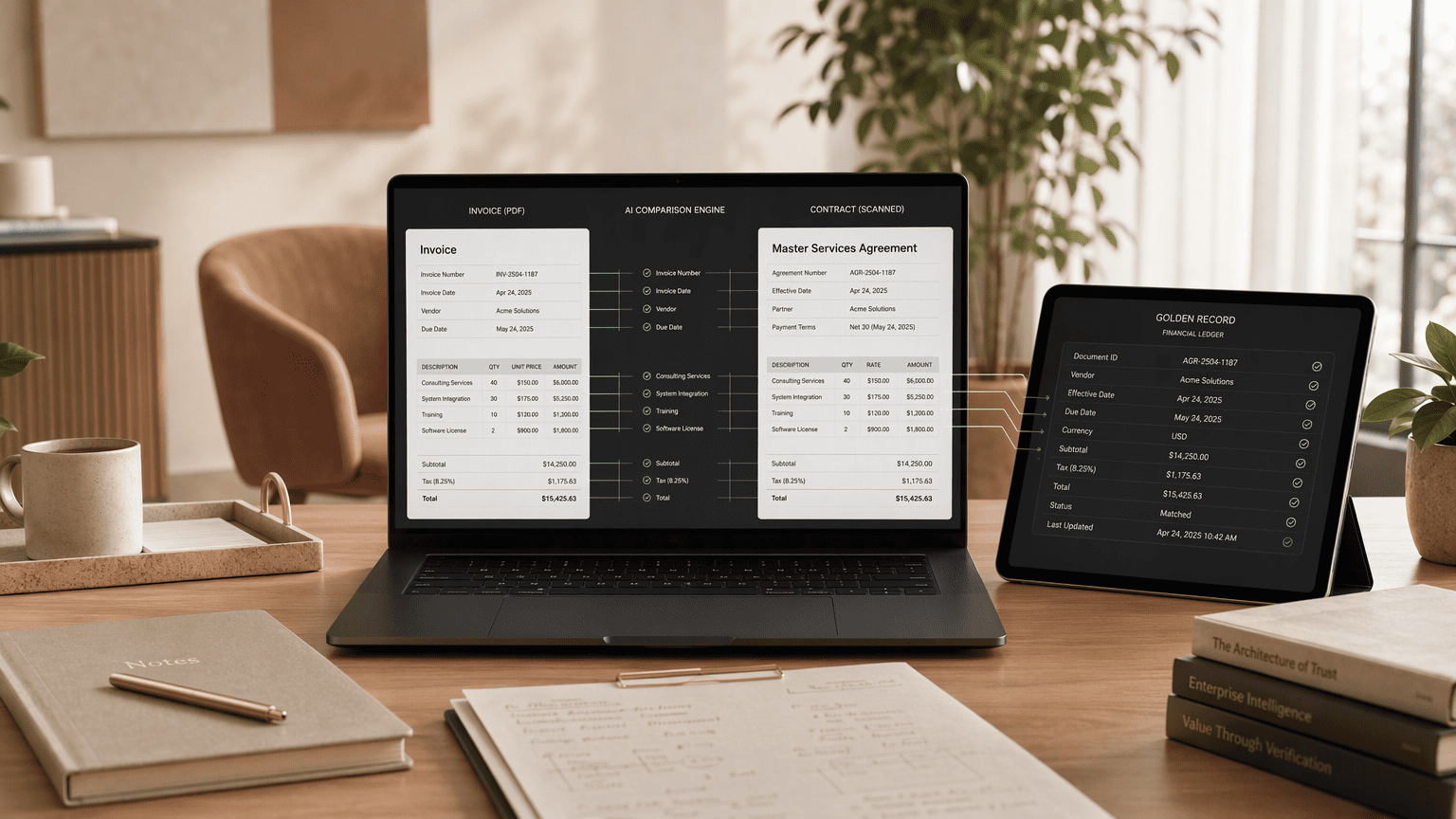
The process begins with ingestion. The tool pulls in PDF and scanned contracts and invoices, then applies intelligent document processing to extract structured data: vendor names, line-item descriptions, unit prices, quantity, payment terms, and dates. For contracts, it goes deeper. It reads payment schedules, tiered pricing tables, service-level agreement thresholds, rebate structures, and clause text that defines scope and exclusions. This extracted data becomes the golden record against which every invoice is measured.
From that golden record, the system constructs a rules engine. It does not just store the contract’s base rate; it encodes the conditions attached to that rate. For example, a logistics contract might specify that fuel surcharges apply only when diesel exceeds a certain index price, or that after 5,000 units the per-unit price drops from $12.40 to $10.10.
A standard AP system sees a unit price of $12.40 on an invoice for 5,200 units and approves it. The rules engine knows to flag it. It understands tiers, floors, ceilings, exclusion periods, and compound conditions that live in contract addendums.
This is where the tool’s logic separates from a simple database lookup. It applies the contract’s business rules as they actually operate.
When an invoice hits the system, the matching engine fires. It performs exact matches on PO numbers and vendor IDs where possible, rule-based matches on structured fields like unit price and date range, and AI similarity matching on line-item descriptions that do not align neatly. That last capability matters.
All of this occurs at submission speed. The invoice arrives, the engine runs its comparisons, and the system returns a clean bill or a discrepancy alert to the AP queue in real time. There is no batch processing overnight, no waiting for month-end reconciliation. That immediacy changes how finance teams operate. They can reject or query an errant invoice before it ever enters the payment pipeline.
The Most Common Contract Violations and Pricing Discrepancies Flagged Automatically
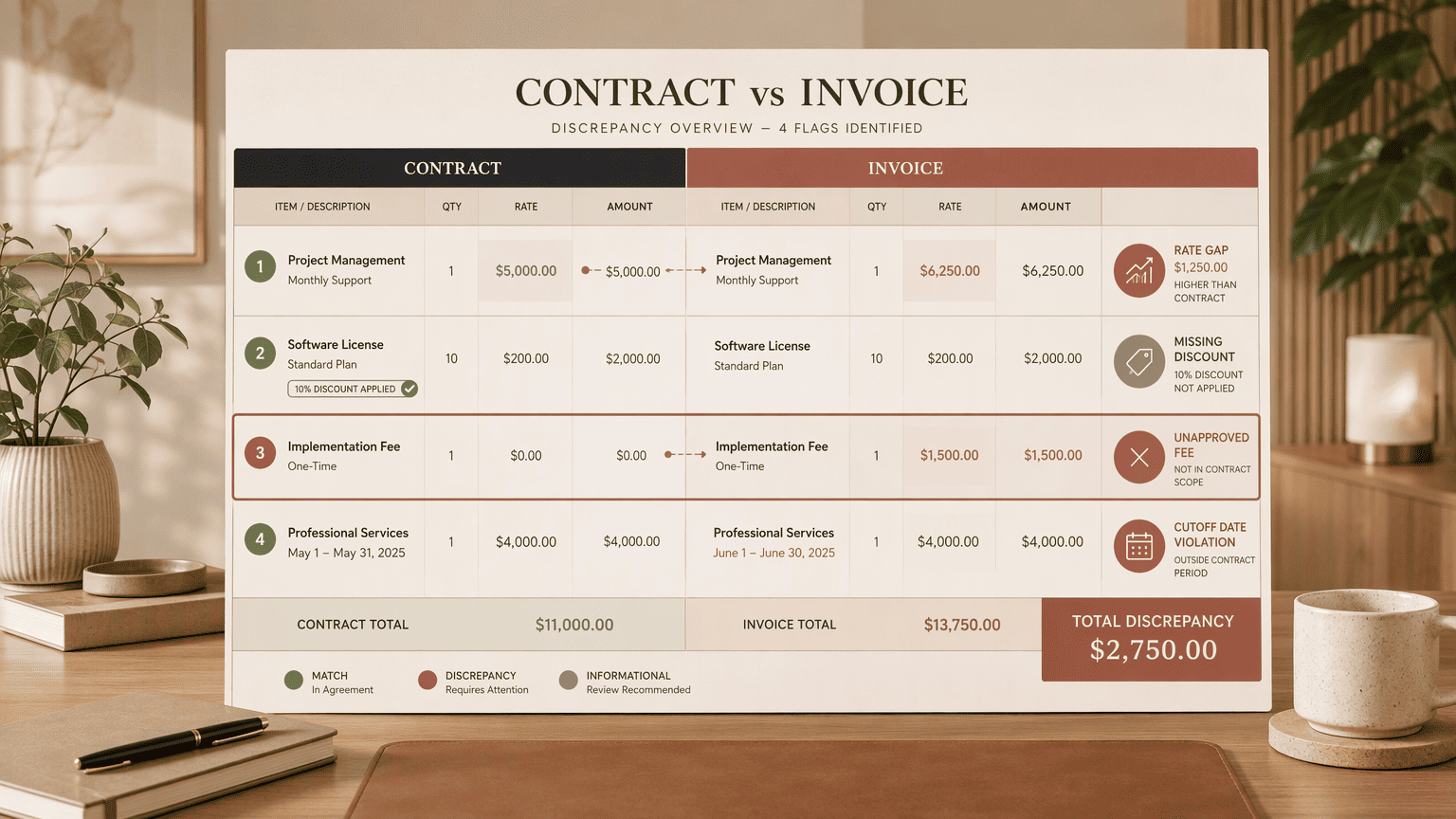
Automated audit tools surface a consistent pattern of violations across industries. Here are the discrepancies you can expect these systems to catch on the first pass.
| Violation Type | What It Looks Like | Business Impact |
|---|---|---|
| Overbilling above agreed rates | Supplier invoices $14.80/unit when the contract rate is $12.40/unit for that volume tier. | Direct cash leakage per invoice line; at scale, large global manufacturers can have tens of millions of dollars in pricing discrepancies annually. |
| Services outside contract scope | Invoice includes charges for “expedited handling” when the SOW explicitly covers standard logistics only. | Unbudgeted spend that erodes margin; often goes unnoticed because the charge description sounds plausible. |
| Duplicate charges | Same line item appears on two invoices issued one week apart, or a charge is embedded in a summary invoice after being billed separately. | |
| Missing metadata or reference data | Invoice lacks a required plant number, cost center code, or system reference that the contract mandates for valid billing. | Compliance failures that create reconciliation work downstream and can hide unauthorized billing. |
| Missed early payment discounts | Contract specifies a 2% net-10 discount, but AP processed payment on day 15 at full price. | Forfeited savings that compound across the payables base; easy to miss when discount terms vary by vendor. |
| Invoices past contractual cutoff | Supplier submits an invoice dated 45 days after the contracted 30-day submission window, but AP lacks a systematic way to enforce the deadline at intake. | Weakens contract enforcement and sets precedent for late billing without penalty. |
Quantifiable ROI: Accuracy Rates, Recovered Revenue, and Risk Exposure
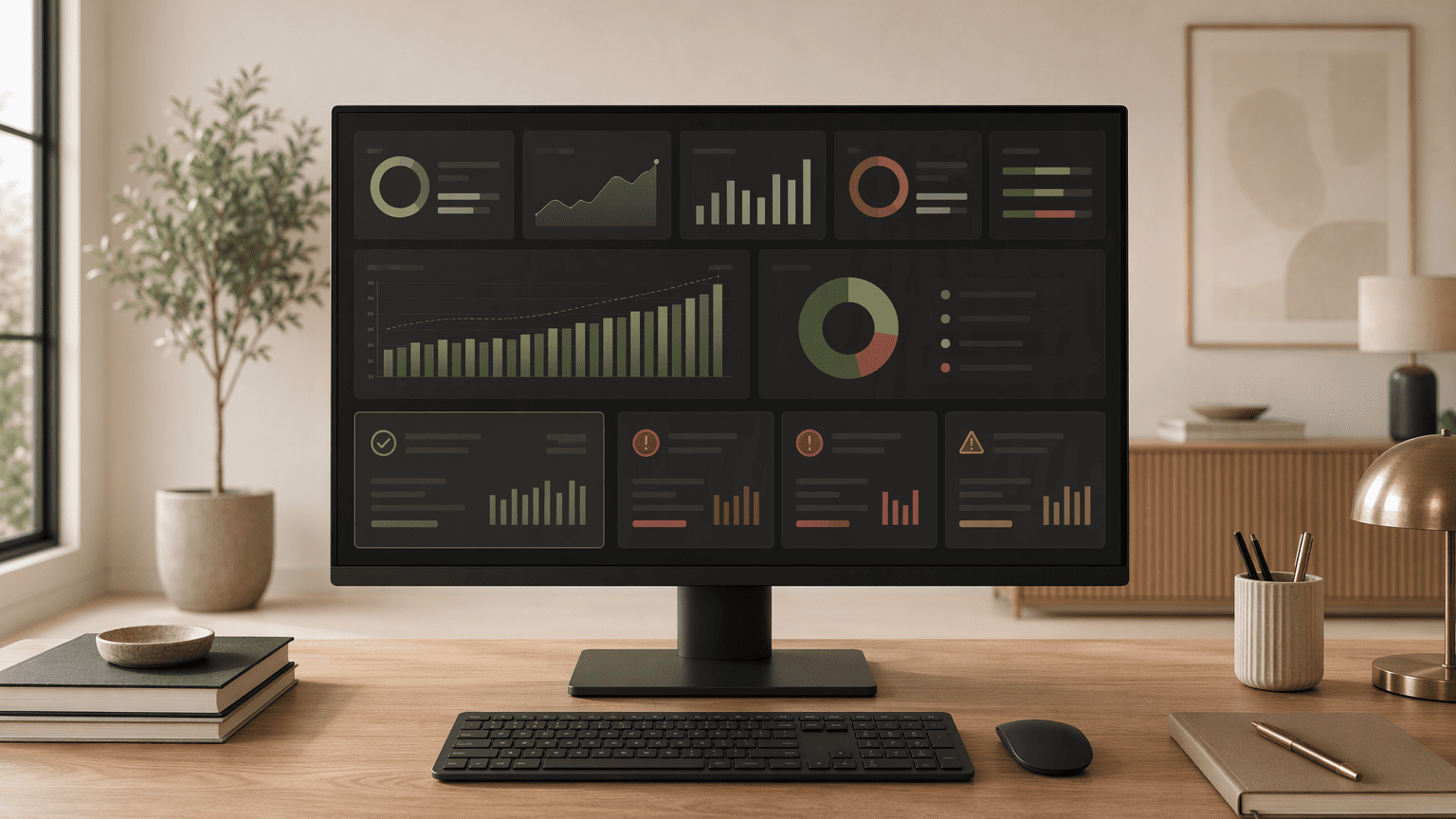
The business case for automated invoice audit rests on numbers you can take to a CFO. In one documented three-month deployment across 488 invoices, the tool identified $20,250 in direct overbilling across 36 invoices, hard dollars recovered by flagging charges that exceeded contracted rates. At the same time, it surfaced $40,600 in gross invoice value at risk from business-rule failures such as invoices submitted past cutoff dates or missing mandatory system references. Those are not theoretical savings; they are amounts the organization was about to pay until the audit engine stopped them.
Accuracy drives trust. One AI audit platform reports extraction accuracy exceeding 99% when pulling data from contracts and invoices, and achieves 90%+ accuracy identifying contract compliance issues. That precision makes automated findings defensible in supplier conversations. The risk dimension is equally compelling: 76% of organizations are exposed to payments fraud, and automated audit provides a systematic control that manual spot-checking cannot match.
Deploying an Intelligence Layer That Preserves Your Existing ERP and CLM Stack
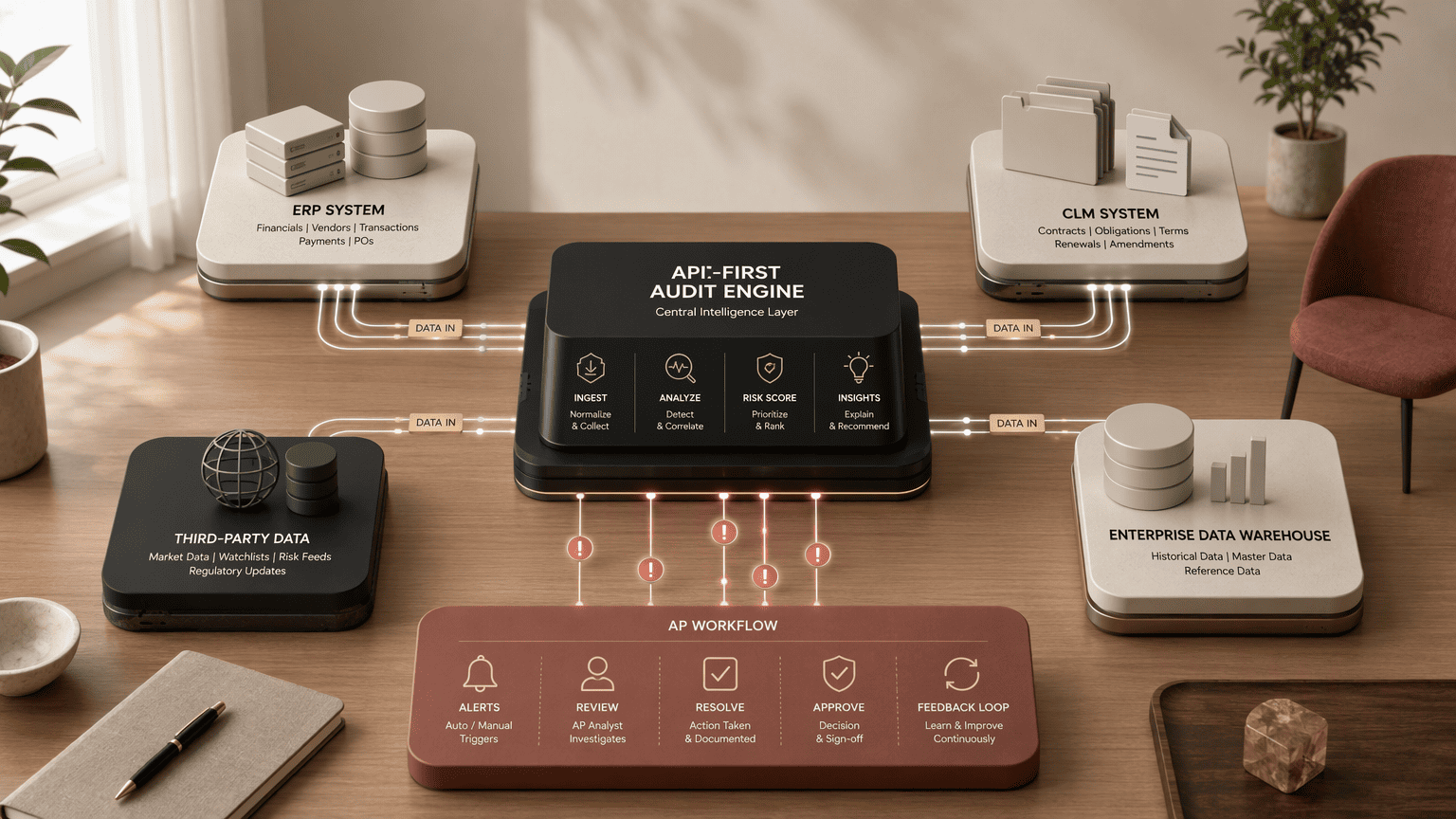
The most common hesitation from finance and IT leaders is the perceived need to replace their ERP. That fear is unfounded.
Modern audit tools overlay your current stack. An API-first audit engine connects to SAP, Oracle, NetSuite, and major CLMs without data migration. It pulls contract data and invoice streams, runs its matching and rules engine, and pushes results back into your AP workflow as actionable alerts and structured reports.
Portcast implements its freight audit engine on top of the customer’s existing ERP and procurement system. ProcureDesk overlays three-way matching onto the current procure-to-pay stack. Enterprise platforms from Esker and Apex Analytix connect contract data with procurement and AP to surface compliance gaps within the workflows teams already use.
This architecture means you can start with a pilot on a limited contract set. Platforms like Contracts.ai let you run an initial audit against a subset of agreements using its intelligence layer, without disrupting active payment runs or migrating the full repository. The intelligence layer enriches current processes rather than displacing them.
Top Contract Audit Software Options in 2026 for Vendor Invoice Compliance

The vendor landscape spans specialized niche tools and broad AP automation platforms. The table below compares the leading options against the dimensions that matter most for contract compliance.
| Tool | Primary Use Case | AI Line-Item Matching | ERP Integration Depth | Estimated Time-to-Value | Best-Fit Company Size |
|---|---|---|---|---|---|
| Portcast | Freight and logistics invoice audit | Yes, automated charge-line comparison against carrier contracts | Overlay; no ERP replacement required | Weeks; pilots use existing data feeds | Mid-market to enterprise with freight spend |
| ProcureDesk | Procure-to-pay with three-way matching | Automated PO-to-invoice matching; ties payment to contract terms | Deep ERP integration for AP workflows | Weeks to deploy; designed for AP teams | SMB to mid-market |
| Esker | Contract management with AP integration | AI-assisted clause flagging and metadata extraction via Synergy AI | Connects contract data with Procurement and AP modules | Months for full suite; modular adoption possible | Enterprise; global shared service centers |
| Apex Analytix | Audit recovery and pricing compliance | Yes, focused on pricing discrepancy detection at scale | Enterprise-grade ERP integration; 35+ years in the space | Varies by scope; typically enterprise cycle | Large enterprise; global manufacturers |
| Paveflow | Contract-invoice compliance AI | Line-item matching against rate cards and related invoices; 90%+ accuracy | API-first overlay | Weeks; designed for speed-to-action | Mid-market to enterprise |
| Contracts.ai | Post-signature contract intelligence layer | Extraction accuracy >99%; linked to source contract language | API-driven overlay; preserves existing ERP and CLM | Pilot-ready with limited contract set | Mid-market to enterprise; finance and procurement teams |
Audit tools that sit as an overlay preserve your existing ERP and CLM investments. You activate the audit layer on your current contract and invoice data instead of replacing systems that already work. That distinction matters when the purchase order and payment run still need to happen on schedule. Overlays shorten the pilot phase and keep your AP team in familiar workflows.
Line-item matching accuracy is the engine underneath every platform on this list. Contracts.ai extracts and links clauses to source language at greater than 99% accuracy. Paveflow reports accuracy above 90% when matching line items against rate cards and related invoices. Those numbers reflect real performance on production data, not curated benchmarks.
Time-to-value splits the field. Some platforms go live in weeks using the data feeds you already run, while full-suite deployments at global enterprises typically take months. Companies evaluating audit software in 2026 increasingly test two or three shortlisted tools with a limited contract set before committing, keeping the procurement cycle tight and the proof concrete.
Conclusion
Manual invoice reconciliation at scale burns money and time you can’t recover. AP staff spend hours chasing spreadsheet errors while real overbilling goes unnoticed. Systematic audits catch what manual checks miss. Deployments surface $20,250 in direct overbilling from fewer than 500 invoices and cut processing time by 95%, shifting staff hours from data entry to actual analysis.
You don’t need to replace your ERP. You don’t need a year-long implementation either. Start with a pilot on a bounded contract set, let the audit engine prove its ROI in your environment, and scale from there.
The tools exist. The economics are clear. What remains is the decision to act.
Frequently Asked Questions
What exactly does an automated vendor invoice audit tool do, and how does it compare to manual invoice review?
It extracts structured data from contracts and invoices, then algorithmically compares every line item against the actual pricing tables, payment schedules, and clause rules to flag discrepancies.
How does an AI-powered tool compare extracted invoice line items against specific contract clauses, pricing tables, and payment terms?
The tool ingests the contract’s full text and structured data, building a rules engine that encodes pricing tiers, discount conditions, cutoff dates, and scope boundaries. When an invoice arrives, the engine runs exact, rule-based, and AI similarity matching to link each billed line to its governing clause, flagging any deviation from the contracted terms in real time.
What are the quantifiable benefits and accuracy rates of using automated audit tools for post-signature contract compliance?
In one three-month deployment across 488 invoices, an automated audit surfaced $20,250 in direct overbilling and $40,600 in gross value at risk. Providers report extraction accuracy exceeding 99% and compliance-issue identification above 90%. Processing time drops by roughly 95% versus manual reconciliation, recovering cash and redeploying staff hours.
Can a tool like Contracts.ai be implemented to audit vendor invoices without replacing the existing ERP or procurement system?
Yes. Contracts.ai deploys as an API-driven intelligence layer over your existing ERP and CLM stack. You can run a pilot with a limited contract set without migrating the full repository or disrupting active workflows. The engine connects to systems like SAP, Oracle, and NetSuite, pulling contract and invoice data and pushing discrepancy alerts back into your AP queue.
What are the most common contract terms and pricing variations that automated audit tools flag during invoice reconciliation?
The most frequent flags are overbilling above contracted rates, services invoiced outside the statement of work, duplicate charges across invoices, missing metadata like plant numbers or system references, missed early payment discounts, and invoices submitted past contractual cutoff dates. Tools also catch tiered-pricing violations and compound condition failures in complex contracts.
What are the top software options available in 2026 for automatically auditing vendor invoices against contract terms, and how do they compare?
Leading options include Portcast for freight audit, ProcureDesk for procure-to-pay three-way matching, Esker for contract-connected AP, Apex Analytix for large-enterprise pricing compliance, Paveflow for line-item rate-card matching, and Contracts.ai as a post-signature intelligence layer. They differ on industry focus, ERP integration depth, and time-to-value, ranging from weeks for API-first tools to months for full-suite enterprise deployments.
Sources
- Product – contracts.ai
- The 30-Invoice Audit | AllCaps – www.allcaps.ai
- B2B Contract Management Automation Software | Esker – www.esker.com
- Paveflow — Contract-Invoice Compliance AI – paveflow.ai
- Pricing Compliance | apexanalytix – www.apexanalytix.com
- Portcast | How a Global Food and Ingredients Manufacturer Replaced Manual Invoice Checks with Automated Freight Audit – www.portcast.io
- Vendor Payment Automation: The Last Mile of Procure-to-Pay – www.procuredesk.com