








Introduction
A vendor overcharges you by 3% each month. Another bills twice for the same service. A department signs an off-contract subscription at triple the negotiated rate. All three keep happening because manual audits scan maybe 20% of vendor agreements, on a good quarter.
Unauthorized spending hides in the gaps between what your contracts say and what your AP team pays. Billing discrepancies, duplicate charges, and off-catalog procurement rarely announce themselves in a spreadsheet. They sit buried in payment schedules, rate-card fine print, and renewal clauses that no one cross-checks against the actual invoice.
Transaction volumes have outgrown the old review process. A modern procurement team processes hundreds of monthly invoices across dozens of vendors. Rules-based checks catch the obvious outliers, but they miss the subtler patterns: the small overcharge that repeats for 18 months, or the related-party billing under a different legal name.
Key Takeaways
- Unauthorized vendor spend rarely announces itself with a single smoking gun. It hides in duplicate charges, expired rates that never rolled off, and contract terms that changed without a billing update. Recognizing the pattern means shifting from reactive invoice approval to systematic, data-driven oversight.
- Gartner predicts that by 2026, AI will transform IT sourcing, procurement and vendor management. That shift is already happening. The tools that expose unauthorized spending do something simple but hard to replicate: they compare what you agreed to pay with what you are actually being billed.
- You need a specific set of capabilities. Look for automated contract-to-bill reconciliation, configurable exception rules that flag anomalies, and the ability to group related vendors so you can spot cumulative exposure. The tools below were selected because each takes a different approach to surfacing hidden leakage.
At a Glance

Here is how the options compare across the dimensions that matter most.
| Tool | Core Approach | Key Unauthorized Spend Detection Feature | Best For Teams That… |
|---|---|---|---|
| Contracts.ai | Continuous contract-to-invoice variance analysis | Auto-groups related vendor entities and links charges to specific clauses | Want real-time, cross-agency spend oversight without full system migration |
| AppZen | Pre- or post-payment AI audit of every transaction | Compares each line against contract terms, policy, and risk databases | Need to audit 100% of transactions instead of a sample |
| Coupa Risk Assess (third-party) | Supplier risk and compliance scoring | Flags billing from unauthorized subsidiaries or unbranded entities | Track spend across a complex, multi-vendor supply chain |
| Icertis Contract Intelligence | Structured term extraction and obligation tracking | Monitors rate cards, auto-pilots, and volume discounts for billing compliance | Operate high-volume procurement with meticulous negotiated terms |
| SAP Ariba (Spend Visibility) | Aggregated procurement analytics with rule-based alerts | Detects duplicate invoices and off-catalog purchases across ERP data | Already run SAP and need to scale oversight without buying standalone audit software |
1. Contracts.ai Enterprise Contract Intelligence Platform
Contracts.ai earns the top spot because of how it handles unauthorized spend: it works as an intelligence layer that surfaces variance continuously instead of waiting for a periodic audit. It does not just flag an overcharge every quarter, it catches the mismatch while it still matters.
The platform auto-groups related agreements and aligns shared terms. This directly addresses charges that spread across family entities under different rate cards.
When you reconcile a vendor invoice, you are not interpreting an abstract summary; you are seeing the exact clause that authorizes or contradicts a charge. The company claims accuracy levels greater than 99% when extracting data from documents in real time.
You can start with a pilot on a limited contract set. No full-repository migration, no rip-and-replace disruption. For finance teams that have been burned by big-bang implementations before, that lowers the barrier to adoption. The platform shares structured intelligence across finance and procurement, giving both teams a single source of truth they can act on.
2. AppZen AI-Powered Spend Audit
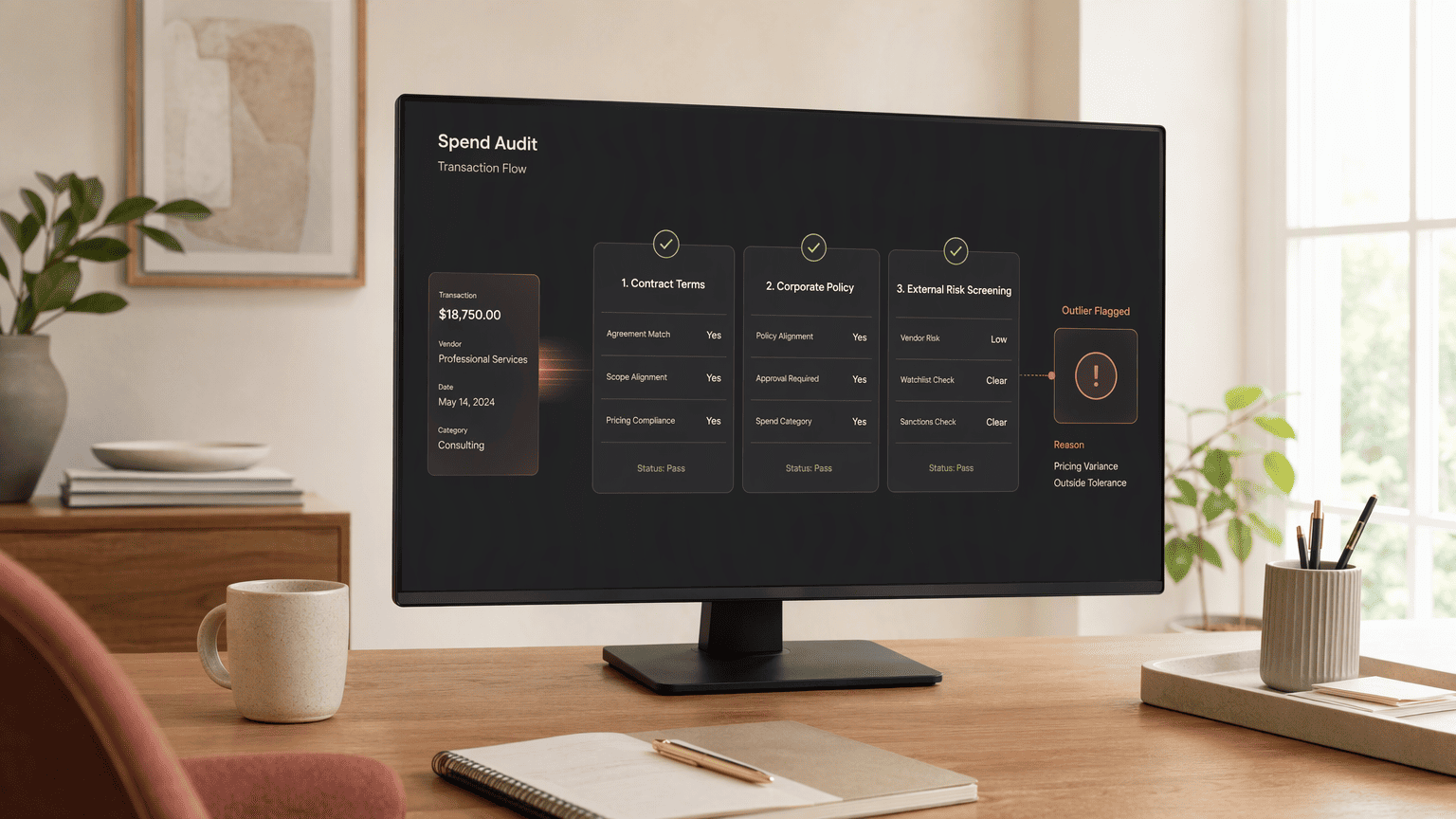
AppZen reads every expense report, invoice, and card transaction before or right after it posts. The AI checks each line item against the actual contract terms, your corporate policy, and external risk databases. It flags only the outliers worth a second look.
High-volume finance teams often sample 5 or 10 percent of transactions because manually reviewing everything is impractical. AppZen lets you audit the full population instead. You stop asking “what did we miss” and start working from a clean list of verified exceptions.
Two large AP groups that adopted the platform reported catching duplicate invoices and non-contracted spend they previously found only by accident, months later. The head of finance at one Fortune 500 company described the pre-payment hold on a six-figure overcharge as the moment the audit AI paid for itself.
The limit is scope. AppZen dominates the transaction layer but does not stitch those line-item findings back into a full picture of your contract obligations. A procurement team that pairs it with a contract intelligence system gets both ends of the leakage problem: what the agreement says and whether every dollar actually follows it.
3. SpendHQ Spend Analysis & Procurement Performance Management
SpendHQ approaches the problem from the spend cube. It ingests, classifies, and normalizes procurement and AP data, then layers contract information on top so you can see where actual spending diverges from negotiated commitments.
The platform’s strength is its ability to unify fragmented data. If your vendor spend is scattered across ERPs, P-cards, and decentralized buying channels, SpendHQ consolidates it into a single, coherent picture. Category managers can then identify off-contract buying and pricing discrepancies that individual transaction reviews would never surface.
SpendHQ is less about clause-level contract analysis and more about answering a straightforward question: are we buying what we said we would buy, from who we said we would buy it, at the price we negotiated? For organizations where maverick spend dwarfs invoice errors, that line of sight is indispensable.
4. Ivalua Source-to-Pay Suite with AI-Driven Compliance

Ivalua embeds compliance monitoring across the full source-to-pay lifecycle. That single design choice lets the platform catch unauthorized spend at two moments where it commonly slips past: during procurement and again during invoice reconciliation.
Its AI models learn from your historical transactions. When a charge breaks from your organization’s established spending patterns, the system flags it. No manual rule-writing required.
The real advantage is the unified architecture. Your team runs a sourcing event on Ivalua and AP processes the resulting invoices on the same platform. Terms and pricing move straight from negotiation to payable without passing through a handoff point where discrepancies creep in.
This approach fits organizations ready to standardize on a single suite. You configure the compliance engine to your policy thresholds and approval hierarchies, so the alerts reflect the risk tolerances your business actually operates under. That is what keeps the signal-to-noise ratio useful: the system screens for the exceptions your finance team cares about.
5. SirionLabs AI-Native CLM with Post-Signature Governance
SirionLabs closes the gap between what your contracts say and what your suppliers actually bill.
Its AI continuously reconciles contractual commitments against invoices and performance data, flagging overpayments, duplicate billings, and missed service credits that procurement teams would otherwise have to hunt down manually.
The platform’s obligation management engine does the heavy lifting. It pulls out pricing tables, rebate thresholds, and SLA penalties from the contract language, then checks the incoming billing stream against those extracted terms. When a supplier charges above the contracted rate cap, Sirion surfaces the exception.
This level of scrutiny makes the most sense in complex services engagements where scope, pricing, and performance shift constantly. For straightforward product procurement, you will probably get more governance overhead than you need. But on a multi-year managed services deal, the discipline pays for itself.
6. Coupa Business Spend Management with Spend Guard

Coupa Spend Guard scans every invoice before it goes out the door, applying pattern recognition to catch fraud, errors, and policy violations. Each invoice gets a risk score, and the high-risk items float to the top of an analyst’s queue.
The real draw is how it fits into Coupa’s existing platform. Companies already running Coupa for procurement and invoicing turn on Spend Guard without another implementation cycle. The system knows your approved vendors, your contracted rates, and your internal rules, so it flags an invoice the second it breaks from what was authorized.
The weak spot is contract digitization. Spend Guard’s ability to enforce contract terms depends entirely on whether those contracts live as structured data inside Coupa. Garbage in, garbage out still holds here: the module needs clean, complete contract records before it can actually hold a supplier to what was agreed.
7. Oversight AI-Powered Spend Risk & Compliance Monitoring
Oversight takes a forensic approach to the payables file. Its AI analyzes 100% of transactions, looking for duplicate payments, split purchase orders, and pricing outside expected ranges. It layers context from OCR-scanned receipts and contract extracts to confirm whether a flagged pattern constitutes an actual loss.
What distinguishes the tool is its behavioral analysis. It learns the normal spending patterns of employees and vendors, then surfaces deviations. An approver who consistently pushes through invoices from one small vendor at amounts just below the audit threshold will get flagged.
This is a back-end defense. Oversight operates after transactions have occurred, so it does not prevent unauthorized spend in real time. What it does well is build a body of evidence that feeds stronger preventative controls going forward.
8. Using Metadata Grouping to Expose Hidden Recurring Charges Across Vendor Families

Standalone audit tools do important work, but some of the biggest recoverable spend hides in a pattern those tools are not tuned for: recurring charges spread across subsidiary entities, each one small enough to fly under the monthly review radar. Metadata grouping is the manual or semi-automated technique that catches this.
Start by extracting every active vendor contract and tagging it by ultimate parent entity, category, and payment cadence. A tool like Contracts.ai can help here by automatically grouping related agreements.
Then cross-reference these groups against the last twelve months of AP data. Look for vendors under the same parent that bill for similar line items at different rates.
One multinational found a software reseller billing three separate operating companies for the same license pool at three different prices; no individual invoice violated the per-entity agreement, but the aggregate overpayment ran into six figures annually. This technique surfaces the pattern that transaction-level audits miss.
Conclusion
Stopping unauthorized vendor spend is a discipline, not a one-time clean-up. The tactics covered here address different layers of the problem, contract intelligence, transaction auditing, spend normalization, and metadata aggregation, and layering two or more of them is where the real defense takes shape.
Your starting point depends on where the leakage is concentrated right now. If your contracts are a black box, start with extraction and structuring. If invoices pass through untouched, add a pre-payment audit. If category managers can’t see off-contract buying, invest in spend analytics.
The goal is breaking the cycle of finding leakage only at the annual review. Ironclad’s procurement team has demonstrated how AI surfaces contract blind spots that manual reviews miss. Make oversight continuous, and the cumulative savings compound faster than any single audit could deliver.
Frequently Asked Questions
What types of tools can automatically detect unauthorized or non-compliant spending in vendor contracts?
You need tools that fall into three camps: AI contract intelligence platforms that extract and compare terms against actual invoices, spend audit solutions with continuous transaction monitoring, and source-to-pay suites with built-in compliance guardrails. Each type automatically flags deviations from contracted rates and terms.
How does AI help in auditing vendor contracts for unauthorized charges and billing discrepancies?
AI extracts structured data like line-item pricing and renewal dates from complex PDFs and compares it against your AP data. This machine-speed reconciliation catches volume overcharges, out-of-contract price increases, and missed discounts that manual reviews often overlook.
What are the key features to look for in a contract audit tool to identify unauthorized spending?
Look for solutions that offer these four core capabilities:
- AI-powered clause and obligation extraction to surface commitments.
- Automated three-way matching between contracts, purchase orders, and invoices.
- Configurable rules engines for non-compliance flags based on your policies.
- An audit trail that tracks every alert and resolution for compliance reporting. A critical feature is the ability to ingest legacy, scanned, and unstructured documents without manual setup.
How can a contract intelligence layer find hidden costs without replacing existing systems?
An intelligence layer sits on top of your current ERP, AP automation, and CLM tools, ingesting data via API. It reads executed contracts and billing histories to surface anomalies, like billing continuing after termination, directly in a dashboard without you having to rip and replace existing infrastructure.
What is the difference between traditional AP audit software and AI-driven contract compliance solutions?
Traditional AP audit checks whether an invoice matches a purchase order. AI-driven contract compliance goes deeper, verifying every line item against the actual negotiated legal agreement terms, catching off-contract spend that a standard three-way match never sees.
Sources
- Find Savings in Vendor Agreements with AI-Powered Analysis – www.docusign.com
- How to Uncover Blind Spots in Your Supplier Agreements with AI| Ironclad – ironcladapp.com
- SpendRule Launches Industry-First AI-Powered Contract Intelligence System to Stop Overpayments in Healthcare’s $323B Purchased Services Market – www.prnewswire.com
- Predicts 2026: AI Transforms IT Sourcing, Procurement and Vendor Management – www.gartner.com
- Contract vs. Billing Reconciliation | Kaana – www.kaana.com






