








Introduction
Your negotiated vendor contracts likely contain significant profit buried in dense language. Rebate clauses for volume commitments, growth tiers, and promotional spend represent real margin, but they sit dormant in dusty filing cabinets. The finance team misses them.
The procurement team has moved on to the next deal. Even best-in-class companies leak 3 to 7% of margin to missed rebates, thresholds, and claim windows after signing, without ever seeing it happen. That is not a rounding error; it is a systematic failure of manual tracking.
Spreadsheets are the culprit. When a category manager spends 60% of time on data prep instead of strategic analysis, rebate deadlines slip silently past. Contracts contain millions in negotiated value, from volume discounts to SLA penalty clauses, yet a 91.3% recovery rate is achievable with automated tracking, while manual processes leave substantial cash unclaimed. You need a system that extracts those complex rebate terms, matches them against live ERP transactional data, and surfaces pending claims before the window closes.
This article ranks seven software platforms that bridge that gap in 2026. You will see options ranging from AI-native clause extraction tools to deeply embedded ERP rebate engines, each evaluated for their ability to automate the tracking of spend against rebate terms and capture every dollar your contracts owe you.
Key Takeaways
The right rebate tracking software stops spreadsheet errors by automating the entire lifecycle, from pulling clauses out of contracts to getting the claim paid. These are the criteria that matter and the top picks for 2026:
- Clause extraction is the critical first step: Software must parse tiered pricing, volume thresholds, growth rebates, and retroactive triggers directly from unstructured contract text.
- Live ERP integration is non-negotiable: You need a platform that pulls purchase data from your live ERP, like NetSuite or SAP, to automatically match spend against rebate terms without manual data wrangling.
- Real-time dashboards prevent leaks: Look for visibility into accrued versus claimed amounts, coupled with near-miss analysis that flags purchases just shy of reaching the next rebate tier.
- Contracts.ai takes an AI-native approach: The platform extracts complex rebate structures from dense contract language and maps them to spend thresholds for downstream financial workflows.
- Phocas Rebates leads in user satisfaction: Rated 4.8 out of 5 on Capterra, it is purpose-built to sync deeply with ERPs for automated rebate lifecycle tracking.
- Vistex delivers enterprise depth: It models complex bill-backs and volume breaks while embedding directly into SAP S/4HANA, covering both the buy-side and sell-side of rebate management.
1. Contracts.ai, AI-Driven Clause Extraction and Rebate Intelligence
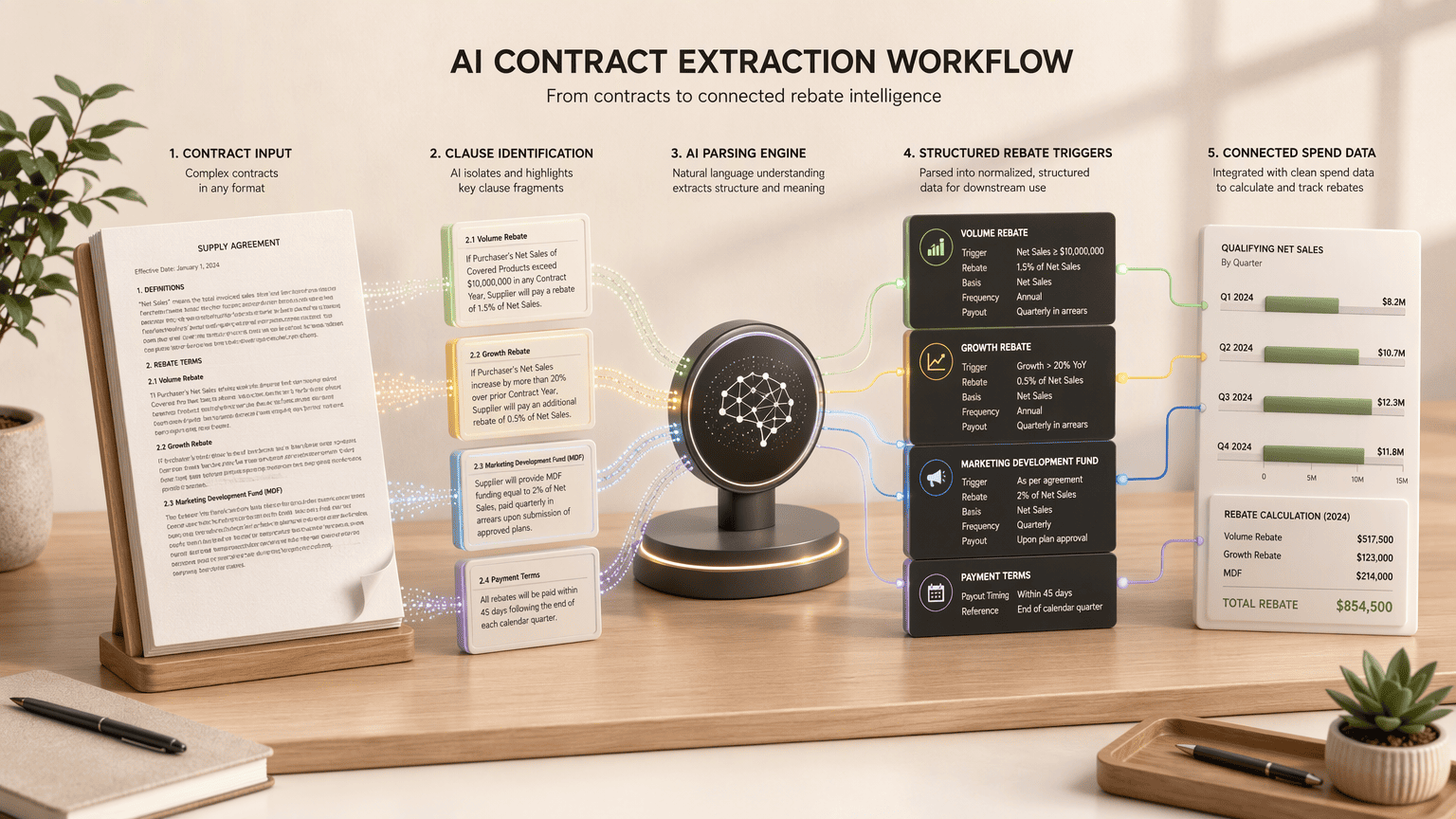
Most missed rebates trace back to a single, stubborn problem: the terms that trigger payment are buried in unstructured contracts. Someone has to read dense clauses, spot the triggers, and connect them to actual spend data. Contracts.ai applies AI to extract complex rebate structures automatically and map them to operational spend, so static agreements become a working intelligence layer. Below is how its approach compares to the manual alternative:
| Capability | AI-Driven Extraction (Contracts.ai) | Manual Spreadsheet Tracking |
|---|---|---|
| Term Discovery | Parses tiered pricing, volume caps, retroactive triggers, and growth rebates from dense clauses in minutes | Requires a human to read every contract line-by-line, prone to oversight |
| Data Structuring | Converts unstructured text into structured fields, preserving source language alongside the normalized data | Data lives in disconnected cells with no link back to the contractual language |
| Spend Mapping | Identified thresholds can be fed into financial workflows or adjacent ERP modules for matching against live purchase data | Spend data must be pulled separately and cross-referenced manually, consuming analyst hours |
| Workflow Disruption | The product is intended to be piloted with a limited contract set without disrupting existing workflows or migrating a full repository | Spreadsheet processes are brittle; any change in supplier terms requires rebuilding cross-references |
Contracts.ai was built specifically for this post-signature gap. Its AI models, drawing from providers like OpenAI and Anthropic, scan legacy and live contracts to identify terms across vendors, regions, or deal types. The extracted data remains under your organization’s control at the clause and document level, and no customer contract data is used to train generalized models unless you explicitly agree to it. By structuring the data first, the platform enables your finance team to then monitor compliance and trigger rebate claims without mining PDFs by hand.
2. Phocas Rebates, Purpose-Built Rebate Management with Deep ERP Ties
Phocas Rebates focuses entirely on the rebate lifecycle after the terms are known, syncing live purchase data from your ERP to automatically calculate accrued versus claimed amounts. With a 4.8 out of 5 rating on Capterra, it is the highest user-rated purpose-built rebate tool in this analysis.
The platform connects directly to ERPs like Infor, Oracle NetSuite, Epicor, and SAP. It pulls purchase order and receipt data in near real-time, then runs that data against your configured rebate agreements to calculate earnings. A standout feature is its near-miss analysis, which flags transactions just below the threshold for a higher tier or a volume break, giving your buyers a concrete target to chase before the period closes. The software is used by over 2,900 businesses, and 97% of those customers renew year-over-year, a signal that the embedded ERP workflow delivers consistent value.
3. ISPnext Rebate Management, Enterprise-Scale Tracking and Compliance

For large enterprises running complex supplier networks, the challenge scales beyond a few key vendors. ISPnext addresses this with an enterprise architecture built on ETL pipelines and out-of-the-box ERP connectors.
Its core workflow tracks spend against supplier contracts and automatically triggers rebate claims when purchase thresholds are met. The system captures growth rebates, retrospective rebates, and flat discounts, then routes claims through a configurable approval process before generating credit memos.
The platform is deployed across more than 450 organizations, placing it squarely in the upper mid-market and enterprise tier. It is engineered for heavy compliance environments. ISPnext maintains a complete audit trail for every rebate calculation, from the initial contract upload to the final invoice posting. When a supplier disputes a claim, the procurement team can trace the exact purchase order lines and terms that triggered the accrual. Spreadsheets cannot provide that forensic capability.
For procurement teams auditing departmental spend, this granularity is a safeguard. The platform enforces segregation of duties so the person who configures the rebate agreement cannot also approve the final payout. This audit-ready design makes ISPnext a strong contender for publicly traded companies and organizations in regulated supply chains where rebate compliance ties directly to internal controls testing.
4. Vistex, Thorough End-to-End Revenue and Rebate Management

Most rebate tools focus exclusively on the buy-side, the money you earn back from your suppliers. Vistex covers that and also models the sell-side, managing the incentives, bill-backs, and chargebacks you offer to your own customers. The financial impact of poor rebate tracking compounds across both sides. When you miss a supplier rebate, your cost of goods sold is artificially high, and the sales commissions calculated on those inflated margins become inaccurate.
Vistex embeds deeply into SAP S/4HANA, operating as a native extension rather than a bolted-on third party. For SAP shops, this eliminates middleware latency and data reconciliation headaches. The platform models complex deal structures, volume breaks, tiered discounts, and retroactive settlements, and ensures that none of these adjustments are missed during the financial close.
Its true differentiator is the unified view it provides across the entire rebate lifecycle. From the initial deal modeling, through accrual postings, to the final settlement and payment, Vistex keeps the finance team on a single source of truth. For a global manufacturer managing thousands of supplier and customer agreements simultaneously, this consolidation is a control requirement.
5. Enable, Collaborative B2B Rebate Management Platform
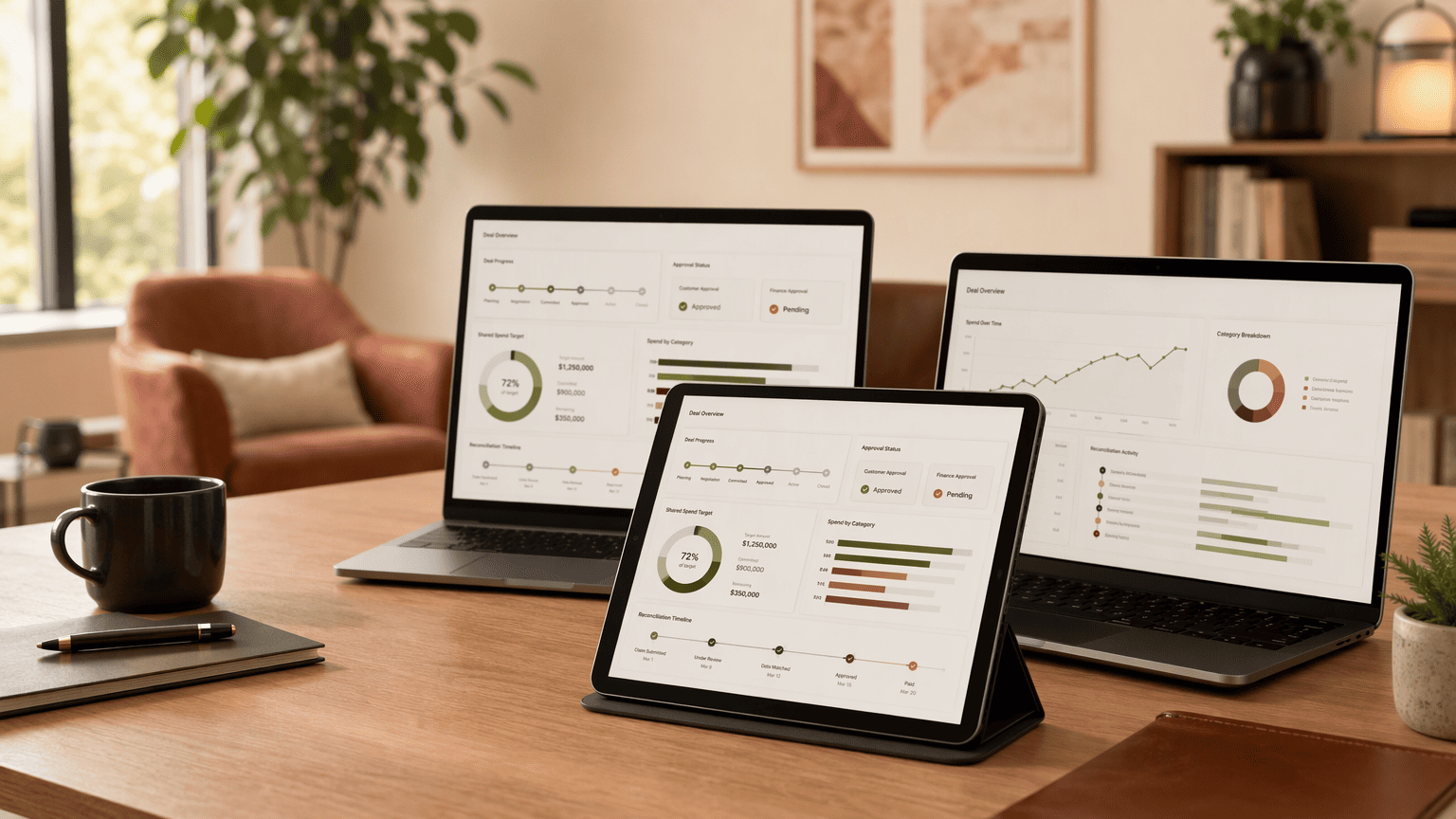
Rebate management becomes a dispute-ridden process when the buyer and supplier operate from different sets of data. Enable tackles this friction directly by providing a shared portal where both parties jointly agree on trading programs and thresholds, eliminating the reconciliation delay that kills claim accuracy.
The platform allows suppliers and buyers to co-create deal sheets, set shared spend targets, and provide dual-sign-off before a program goes live. As purchase data flows in, both sides see the same real-time accrual dashboard, which means the rebate payment at the end of the quarter is a confirmation, not a negotiation. Enable’s collaborative model is particularly effective in industries like wholesale distribution and building materials, where trading programs are complex and relationship-driven.
When a supplier can log in and see that a buyer is 3% shy of hitting a growth rebate tier, they can proactively offer a targeted promotion to close the gap. This transforms the rebate from a retroactive accounting exercise into a forward-looking sales lever. For finance teams tired of defending their rebate calculations against supplier pushback, a shared version of the truth is the fastest path to recovering the 91.3% recovery rate that automation promises.
6. Xactly Incent, Sales Performance and Rebate Automation
Xactly Incent links rebate capture directly to the sales compensation plan, a connection most finance teams overlook. When purchasing volumes drive both supplier rebates and internal rep commissions, a disconnect between the two systems creates errors that compound across the P&L. Xactly unifies these streams through three key capabilities:
- A unified data feed aligns purchasing volumes against target thresholds, calculating supplier rebate earnings and sales rep commissions in a single automated pipeline.
- An earned-versus-unclaimed visibility dashboard shows rebates already captured alongside those still sitting idle, so finance can measure how missed rebates distort commission accuracy.
- Xactly’s incentive plan modeling lets you test how purchase volume target changes affect vendor rebate income and internal commission expense before you commit to a new supplier agreement.
7. SAP Commission & Rebate Management, Native S/4HANA Integration

For organizations running SAP S/4HANA as their core ERP, adding a third-party rebate tool introduces an integration layer that can become a bottleneck during the financial close. SAP Commission & Rebate Management removes that risk by operating natively within the S/4HANA stack. It manages rebate agreements as condition contracts, defining the supplier, the rebate rate, the volume threshold, and the retroactive settlement period all within the same data model that governs your procurement and finance transactions.
When a purchase invoice posts against a qualifying order, the system automatically generates a rebate claim and posts the corresponding accrual. No API call to an external platform, no data transformation between systems, and no reconciliation between your general ledger and a standalone rebate ledger. The approval workflow controls whether claims are accrued automatically or routed through a manager review step, giving you control without breaking the straight-through processing path.
The trade-off with a native SAP solution is configurability outside the SAP ecosystem. If your organization runs a heterogeneous ERP landscape, the tool leaves gaps. But for pure SAP shops, eliminating middleware from the rebate accrual process reduces latency and removes a common point of failure in the month-end close.
Conclusion
Choosing the right rebate tracking software in 2026 comes down to the state of your contract data. If your rebate terms are still buried in unstructured PDFs and scanned documents, an AI-native extraction tool like Contracts.ai is the logical starting point, structuring that data so it can be fed into any downstream tracking system. If your terms are already digitized and your core need is automated lifecycle management, a purpose-built ERP-linked platform like Phocas Rebates or Vistex will close the gap between your purchase data and your rebate claims. Driving your organization toward that 91.3% recovery rate hinges on replacing manual spreadsheets with a system that extracts, matches, and alerts your team before each rebate window closes.
Frequently Asked Questions
Why does capturing rebates from contracts matter for enterprise financial performance?
Missed rebates are a direct margin erosion, not just lost bonus income. Even best-in-class companies leak 3 to 7% of margin through unclaimed rebates, thresholds, and expired claim windows. For a business with thin net margins, recapturing those dollars with automated tracking falls straight to the bottom line.
What specific contract data points and terms does software need to extract to track rebate obligations?
The software must extract tiered pricing structures, volume or spend thresholds, growth rebate rates, retroactive settlement periods, product or category scoping, and claim submission deadlines. Without these structured data points, automated matching against purchase data is not possible.
How does AI-powered contract analysis compare to manual methods for identifying rebate terms?
AI extracts rebate clauses from dense legal language in minutes and structures them for analysis, achieving the speed needed to claim a 91.3% recovery rate that manual spreadsheet tracking routinely misses.
What should you look for when choosing contract software specifically for rebate management?
Prioritize native ERP integration that pulls live purchase data, real-time dashboards showing accrued versus claimed amounts, and near-miss analysis that flags transactions close to hitting the next tier. Also confirm it can handle retrospective rebates and growth-based calculations specific to your supplier agreements.
How do you implement contract software for rebate tracking without disrupting existing workflows in 2026?
Start with a limited contract set pilot. Platforms like Contracts.ai allow you to upload a subset of agreements to test clause extraction without migrating your entire repository or changing current procurement processes. Expand to additional suppliers and ERP connections only after the pilot proves accurate claim generation.
Which contract software solutions in 2026 can extract and monitor spend thresholds, tiered pricing, and rebate clauses?
Contracts.ai uses AI to extract these terms from unstructured contracts. Phocas Rebates and ISPnext monitor thresholds against live ERP purchase data and handle tiered pricing. Vistex and SAP Commission & Rebate Management provide deep, native tracking for SAP S/4HANA environments.
Sources
- Vendortell – Contract Performance Management Software – vendortell.com
- Manage Contracts with Intelligence, Not Folders | suplari – suplari.com
- The Best Rebate Management Software | Phocas – Business Analysis Tools – www.phocassoftware.com






