







Introduction
Your procurement team just negotiated a 23% volume discount with a strategic supplier. Three months later, accounts payable data shows half the business units bought the same items from eleven different vendors at retail price. That money is gone. It left through maverick spend, the everyday purchase decisions that route dollars outside the contracts your team secured.
Most organizations never see the full leak. Contracts hold millions in negotiated value, rebates, volume discounts, service level agreements, penalty clauses, and most of it drains away because no one monitors compliance after the ink dries. Employees are not sabotaging the budget. They click a familiar supplier because the approved vendor catalog sits six folders deep on a shared drive with a search bar that needs the exact item code. They swipe a corporate card because the requisition form waits on a manager who is out until Tuesday.
Every purchase outside the contract chips away at the use your team built.
This problem is measurable and fixable. You stop the leakage by surfacing contract terms the moment someone tries to buy, flagging non-compliant spend as it happens, and making the approved path the easiest one. Here is the framework.
Coherent regional regulatory note: The controls and metrics discussed here apply regardless of geography, but organizations operating in regulated markets should also consider sector-specific compliance requirements beyond the scope of this procurement framework.
Key Takeaways
Here are the eight core moves that form a maverick spend prevention framework:
- Diagnose friction, not blame: Find the specific workflow bottlenecks, catalog gaps, and approval delays that push employees off-contract before writing a single policy.
- Centralize contract data first: Build a single searchable source of truth for commercial terms, pricing, unit of measure, and discount structures, because invisible contracts are broken contracts.
- Layer in spend intelligence: Continuously match purchase order and invoice data against contract repositories so non-compliance surfaces within hours instead of quarters.
- Make the right choice the easiest one: Redesign buying catalogs and dashboards so the compliant path requires fewer clicks than going rogue.
- Enforce in real time: Block non-compliant suppliers and trigger dynamic budget checks at the moment of purchase, not during a quarterly audit.
- Rationalize the supply base: Consolidate fragmented tail spend suppliers onto strategic contracts and standardize catalogs to eliminate confusion that breeds rogue purchasing.
- Educate through value, not restriction: Frame compliance around speed and cost avoidance so stakeholders internalize why the process exists.
- Track the four KPIs that count: Contract attach rate, maverick spend rate, price compliance delta, and on-catalog spend percentage quantify the problem and prove the fix.
At a Glance
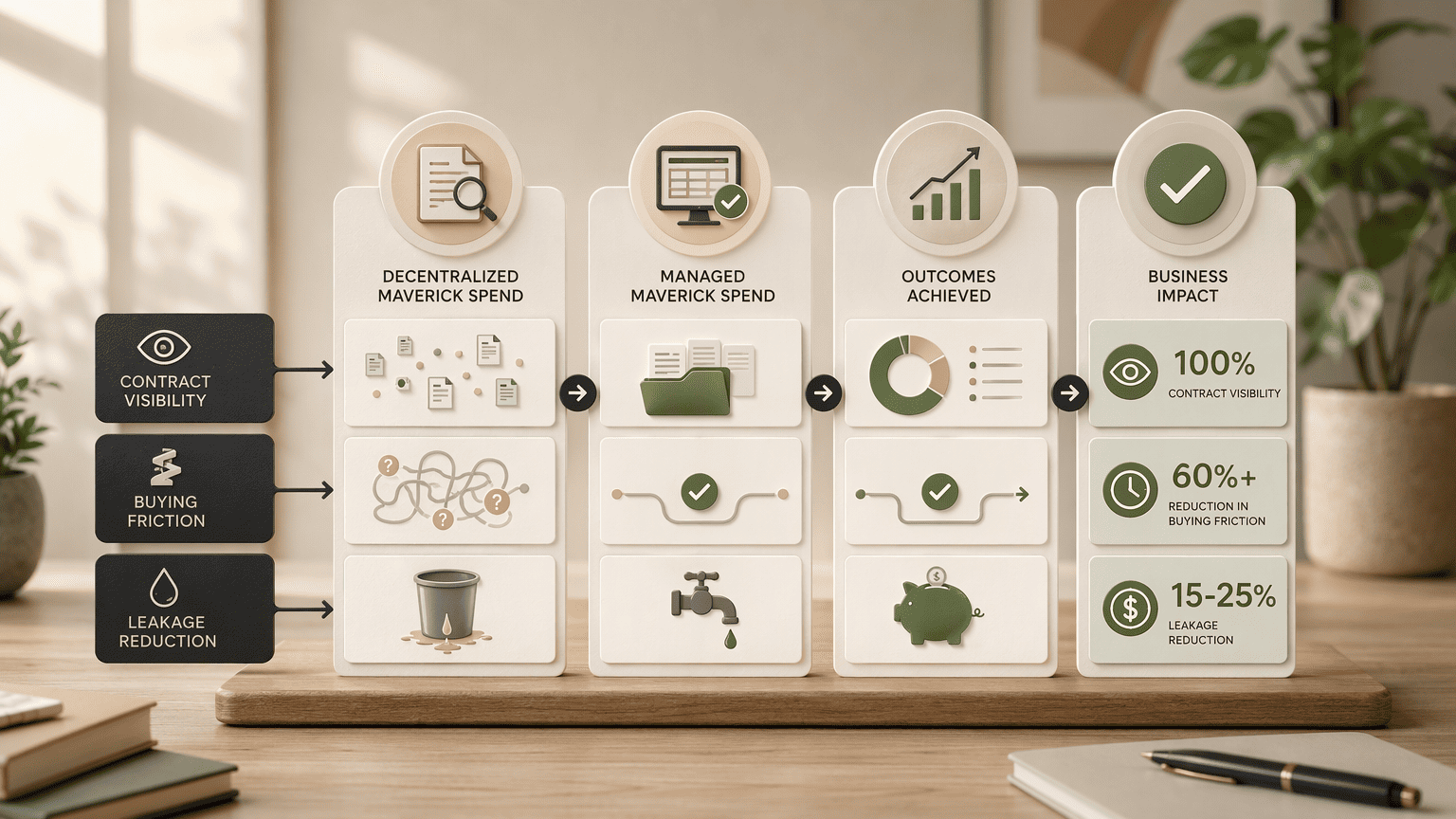
Here is how the options compare across the dimensions that matter most.
| Root Cause | Warning Signs | Fix That Stops the Leakage | Expected Impact on Maverick Spend |
|---|---|---|---|
| Invisible contract data | Buyers can’t find approved vendors; use wrong item codes | Single searchable contract repository accessible at point of purchase | 15 to 25% reduction within 3 months |
| Friction in the buying process | Requisition forms need manager approval; catalogs are hard to navigate | Redesign catalogs and approval workflows so compliant path is fastest option | 20 to 30% reduction within 6 months |
| Lack of real-time enforcement | Non-compliant suppliers are not blocked at checkout; budget checks happen quarterly | Implement purchase-order-level validation that flags or blocks off-contract buys | 30 to 50% reduction in new non-compliant transactions |
| Fragmented tail-spend suppliers | Same items bought from 5+ vendors without a contract | Consolidate supply base onto strategic contracts with standardized catalogs | 10 to 20% reduction in total maverick spend volume |
| No visibility into compliance | Non-compliant spend surfaces only during quarterly audits | Automated spend-intelligence matching against contract terms daily | 40 to 60% faster detection of non-compliance |
Step 1: Diagnose the Root Causes of Your Maverick Spend
Before you touch a single policy or deploy new software, map exactly why your people are stepping around approved contracts. Pull the last six months of purchase orders and compare each transaction line against your active vendor agreements.
- Identify non-compliant purchases: Flag every PO where the supplier name is not on the approved vendor roster for that category, or where the unit price exceeds the contracted rate by more than five percent.
- Map the procurement friction points: Interview three frequent buyers in each department. Ask them to walk through their last purchase and pinpoint where the system slowed them down. Most maverick buys trace back to a moment where procurement felt harder than ordering from a familiar external supplier.
- Quantify the category impact: Sort the flagged transactions by spend volume and count how many unique departments touched each non-compliant supplier. A scattered pattern across marketing and IT points to a catalog usability problem rather than a single rogue manager.
- Calculate the hard-dollar leakage: Multiply the variance between contracted price and actual price paid for each flagged line. This number, attached to a named category, makes the business case before you propose a dollar of technology investment.
Step 2: Map and Centralize Your Contract Data for Total Visibility

Your contracts are the single source of truth for what should be happening with every dollar that leaves the organization. When commercial terms live scattered across SharePoint folders, email attachments, and legal file shares, even well-intentioned buyers cannot find the right price or vendor. Centralizing contract data is the non-negotiable foundation for every control that follows.
You can use a tool like Contracts.ai to extract key terms across legacy and live contracts in minutes. The software:
- Structures negotiated pricing, discount thresholds, and service-level obligations into searchable metadata.
- Identifies terms across vendors, regions, or deal types, building a unified view without migrating your full contract repository at once.
- Uses a pilot approach with a limited contract set to let you validate clean normalized data before scaling.
Step 3: Layer in a Post-Signature Spend Intelligence Engine
Even with centralized contracts, the gap between what was negotiated and what actually gets ordered remains invisible without an engine explicitly designed to monitor that delta. Spend intelligence software continuously matches purchase order data and invoice line items against active contract terms, surfacing discrepancies in pricing, vendor selection, and payment conditions before they compound into year-end write-offs.
Recent performance research from Stanford’s DELM study on multi-agent systems shows that parallel agent architectures can process procurement data 2.49 times faster than traditional sequential methods, turning what used to be a quarterly reconciliation exercise into near-real-time compliance monitoring. The reference study measured agent systems on benchmark tasks where a central agent dispatches work to parallel sub-processors, a model directly analogous to matching thousands of invoice lines against structured contract repositories without creating a processing backlog.
Category managers currently spend 60% of their time on data preparation alone. A spend intelligence layer automates that upstream wrangling so your team spends its hours on decisions, not spreadsheet cleanup.
Step 4: Redesign the Buying Experience with Guided Compliance

Technology enforces compliance when the right path is also the easiest. An employee staring at three nested approval menus while the unapproved vendor sits one click away in a browser tab will pick the browser tab every time.
- Build role-based punchout catalogs: Give each department a curated supplier list that shows only the categories they purchase. Procurement teams report lower maverick rates when buyers are presented with four relevant vendors instead of four hundred.
- Embed real-time guardrails: Show contracted pricing directly on the purchase screen. Flag any line item that exceeds the negotiated rate with an explanation before the requisition routes for approval.
- Reduce clicks for compliant purchases: Audit your requisition path and cut every non-key field. A buyer ordering office supplies does not need to type out the general ledger code the system can pull from their department affiliation.
- Eliminate the out-of-stock escape hatch: The instant a punchout catalog marks an item as unavailable, surface an approved substitute. When the system returns a blank result, buyers fill the gap themselves with whichever supplier they can find.
Step 5: Implement Real-Time Detection and Automated Policy Enforcement
The best time to catch a bad purchase is when someone hits “submit,” not six weeks later in an audit. That means giving your procurement system a spine. A real-time enforcement engine checks three things at the point of requisition: does the budget have room, is the supplier on the approved list for that category, and has the price been pre-negotiated.
If any check fails, the system doesn’t just say no and frustrate the buyer. It returns a concrete action. A line item that misses a contracted rate triggers a prompt showing the compliant supplier and price, with a one-click option to switch. The employee gets what they need. The company stays on contract.
This is where the shift from detection to prevention actually happens. Automated matching paired with an immediate block closes the door on maverick spend, instead of just tallying what already slipped through. Procurement teams that get this layer right report the fastest drop in off-contract buying.
Step 6: Rationalize Suppliers and Standardize Intelligent Catalogs

A sprawling tail of infrequently used suppliers creates exactly the complexity that drives people off-contract. When a buyer faces eight vendor options for IT hardware with no clear difference in catalog descriptions, picking the wrong one is practically guaranteed.
Two actions address this:
- Consolidate fragmented tail spend suppliers onto a handful of strategic contracts.
- Build dynamic catalogs with standardized line-item naming so a search for “laptop” returns one clear, contracted choice rather than a wall of ambiguous SKUs.
Step 7: Embed Compliance Through Stakeholder Education and Change Management
No software fix survives contact with users who do not understand why the process changed. The people bypassing contracts are not the enemy; they are trying to do their jobs quickly, and your compliance program needs to meet them there.
- Frame the message around value, not restriction: Tell department heads that guided buying means faster requisitions and can shrink the average purchase cycle from days to hours when they stay in-catalog.
- Surface the cost leakage in their terms: Show the marketing VP that the team spent eight percent more on creative services by ordering off-contract last quarter, and tie that figure directly to the next campaign budget.
- Build a structured feedback loop: Every time a buyer abandons a requisition or searches for a supplier not in the catalog, log that event. Use the pattern to identify catalog gaps and workflow friction rather than treating resistance as a disciplinary problem.
- Identify and equip internal champions: Train one person per department who can answer procurement questions informally. Peers trust a colleague who sits two desks away far more quickly than a centralized help desk ticket.
Step 8: Measure, Report, and Prove ROI with Targeted KPIs

Your executive team will fund the next phase of procurement transformation when you hand them a dashboard that converts compliance into dollars. A policy compliance percentage makes their eyes glaze over.
Track four numbers monthly, by department and by category. Contract attach rate is the percentage of purchase order line items linked to an active contract. Maverick spend rate is the dollar volume purchased outside approved contracts as a share of total addressable spend.
Price compliance delta captures the variance between contracted unit prices and actual prices paid. And on-catalog spend percentage measures how much transaction volume flows through guided buying catalogs instead of free-form requisitions. Running these four metrics by department and category surfaces the worst offenders and the structural gaps that cause leakage: catalog blind spots in one business unit, or approval loops that slow a specific team.
Present the ROI calculation as a simple equation: the year-to-date price compliance delta multiplied by purchase frequency within each category equals verified savings recovered. That number, not a vague commitment to process improvement, funds the next phase of supplier rationalization and catalog expansion.
Conclusion
Maverick spend is not a procurement failure. It is an information design failure, a system friction failure, and a visibility failure. The organizations that fix it permanently do not waste energy policing every buyer decision. They centralize contract data so commercial terms are impossible to miss, layer in spend intelligence so non-compliance surfaces immediately, and redesign the buying experience so the in-contract path simply wins on speed. That combination of smart technology and behavioral clarity transforms compliance from a quarterly lecture into a default condition.
Frequently Asked Questions
What causes maverick spend on approved vendor contracts?
Three root causes dominate:
- Inaccessible contract data buried in shared drives where buyers cannot find pricing.
- Cumbersome requisition workflows that make compliant purchasing slower than an external order.
- Catalogs with confusing or incomplete line-item descriptions that push employees toward familiar off-contract suppliers.
How can I detect and measure maverick spending in my organization?
Compare every purchase order and invoice line item against your active contract repository. Then:
- Flag transactions where the supplier is unauthorized for the category or the unit price exceeds the contracted rate by more than five percent.
- Aggregate the flagged transactions by department and dollar value.
What strategies and controls effectively prevent off-contract purchasing?
The three most effective controls are pre-purchase guided buying catalogs that make the right choice the easiest one, real-time automated enforcement that blocks non-compliant suppliers at requisition, and post-signature spend intelligence that continuously matches spend data against contract terms.
How does contract visibility and post-signature data analysis stop maverick spend?
Centralized contract repositories surface negotiated pricing, discount thresholds, and approved suppliers in searchable metadata so buyers instantly find the compliant option. Post-signature analysis then monitors every transaction against those terms, flagging discrepancies that quarterly audits miss.
What role does technology play in enforcing vendor contract compliance?
Technology rebuilds the path of least resistance. Spend intelligence engines detect pricing anomalies in real time, automated purchase order matching blocks rogue suppliers, and guided buying interfaces reduce the clicks required for a compliant requisition below the effort of an off-contract alternative.
How do I build a business case to fix maverick spending?
Multiply the price variance between contracted and actual rates by the purchase volume in each affected category to calculate verified savings leakage. Use those hard-dollar figures alongside time-recovery data, like the 60% of category manager hours lost to data preparation, to justify technology and process investment.