






Introduction
Your procurement team signed a deal with a 5% volume rebate kick-in at $250,000 in annual spend. Twelve months later, finance asks why the rebate never hit the P&L. Nobody tracked cumulative invoices against that threshold, and the quarter-close window slipped by.
Now you have left real cash on the supplier’s balance sheet. This scenario plays out repeatedly across businesses that still manage vendor rebates with spreadsheets and ad hoc ERP reports. 2 to 5% of that value is lost to poor tracking, and when vendor rebates represent 10 to 15% of procurement spend, that leakage rapidly erodes margin that your commercial team negotiated hard to win.
The alternative is purpose-built contract software that reads your rebate terms directly from agreements and monitors real-time transaction feeds against those conditions. These platforms do not just store a scanned PDF; they extract tier thresholds, growth targets, and retrospective conditions and turn them into live tracking rules that fire alerts before the quarter ends. This article compares seven platforms, from AI-native extraction engines to deep ERP-embedded solutions, that close the loop between a signed contract and the rebate cash it is supposed to generate.
Key Takeaways
Before diving into the platforms, here are the core findings that shape the landscape:
- Specialized platforms beat manual ERP reports every time: Dedicated rebate software automates accrual calculations, monitors near-miss purchases, and prevents the 2 to 5% value erosion common with spreadsheet tracking. A single forgotten tier jump can wipe out the cost of the tool itself.
- AI contract extraction turns static PDFs into live rules: Rather than manually keying rebate terms from each agreement, next-generation platforms ingest the contract text, classify clause types, and structure obligations into computable fields that feed the calculation engine. This eliminates the setup bottleneck that stalls most rebate programs.
- Near-miss analysis recovers earnings before the period closes: Several platforms alert purchasers when they are within striking distance of a higher rebate tier, enabling a final order that converts a 3% rebate into a 5% rebate across the entire period’s volume.
- Integration depth varies by ERP ecosystem: A platform built natively for SAP embeds rebate logic inside the transactional layer. A mid-market tool connects via standard APIs to Infor, Epicor, and Sage. Match the platform to your ERP.
- Your contract complexity and volume should drive the choice: A manufacturer with 40 tiered-supplier agreements needs a different tool than a global retailer processing hundreds of thousands of retrospective rebate lines or a financial firm tracking subscription-based data entitlements.
1. Contracts.ai, AI-Native Rebate Extraction with Enterprise Security

Contracts.ai ingests a signed rebate agreement and extracts tiered volume rebates, growth rebates, and retrospective adjustments into structured, computable fields. The platform turns executed agreements into post-signature data infrastructure: it preserves the source language alongside the extracted terms so every field traces back to the original clause.
For a rebate program, the engine identifies the spend threshold, the percentage reward, the measurement period, and any exclusion or product-mix condition within minutes of upload. It then monitors ERP transaction feeds against those rules.
Customer contract data remains logically isolated and is never used to train generalized models unless explicitly agreed. The product can be piloted with a limited contract set without migrating the full repository or disrupting existing workflows. It structures agreement economics beyond document storage, so rebate obligations appear across vendors, regions, and deal types next to other financial terms such as pricing, SLAs, and risk allocation.
2. Phocas Rebates, Purpose-Built Analytics for Mid-Market Manufacturers
Phocas Rebates has carved out a strong position among mid-market manufacturers and wholesale distributors for one clear reason: it connects easily to the ERP systems they already run. The platform integrates with Infor, Oracle NetSuite, Epicor, Microsoft Dynamics, Sage, and SAP, pulling transaction data into a rebate calculation engine that automates tiered and retrospective accruals without heavy IT overhead.
User satisfaction scores back up its ease-of-use narrative. Phocas carries a 4.8 out of 5 rating on Capterra and a 4.6 out of 5 on G2, and it is trusted by 2,900+ businesses who make, move and sell products. Perhaps more telling, 97% of customers stay with the platform year-on-year.
The real-world impact shows up in supplier negotiations. Wholesale distributor North Eastern Supply attributes its profitability largely to rebates, noting that “the value of rebates to our company is all in profitability.” Phocas provides real-time dashboards showing accruals by supplier, performance against tier thresholds, and projected period-end earnings. Purchasing teams use that data to push for a final qualifying order and to negotiate better terms at renewal. For a mid-market firm running Infor or Epicor that is currently tracking rebates in Excel, Phocas is the most direct path from manual reconciliation to automated capture.
3. ISPnext Rebate Management, Process-First Platform for High-Volume Enterprises
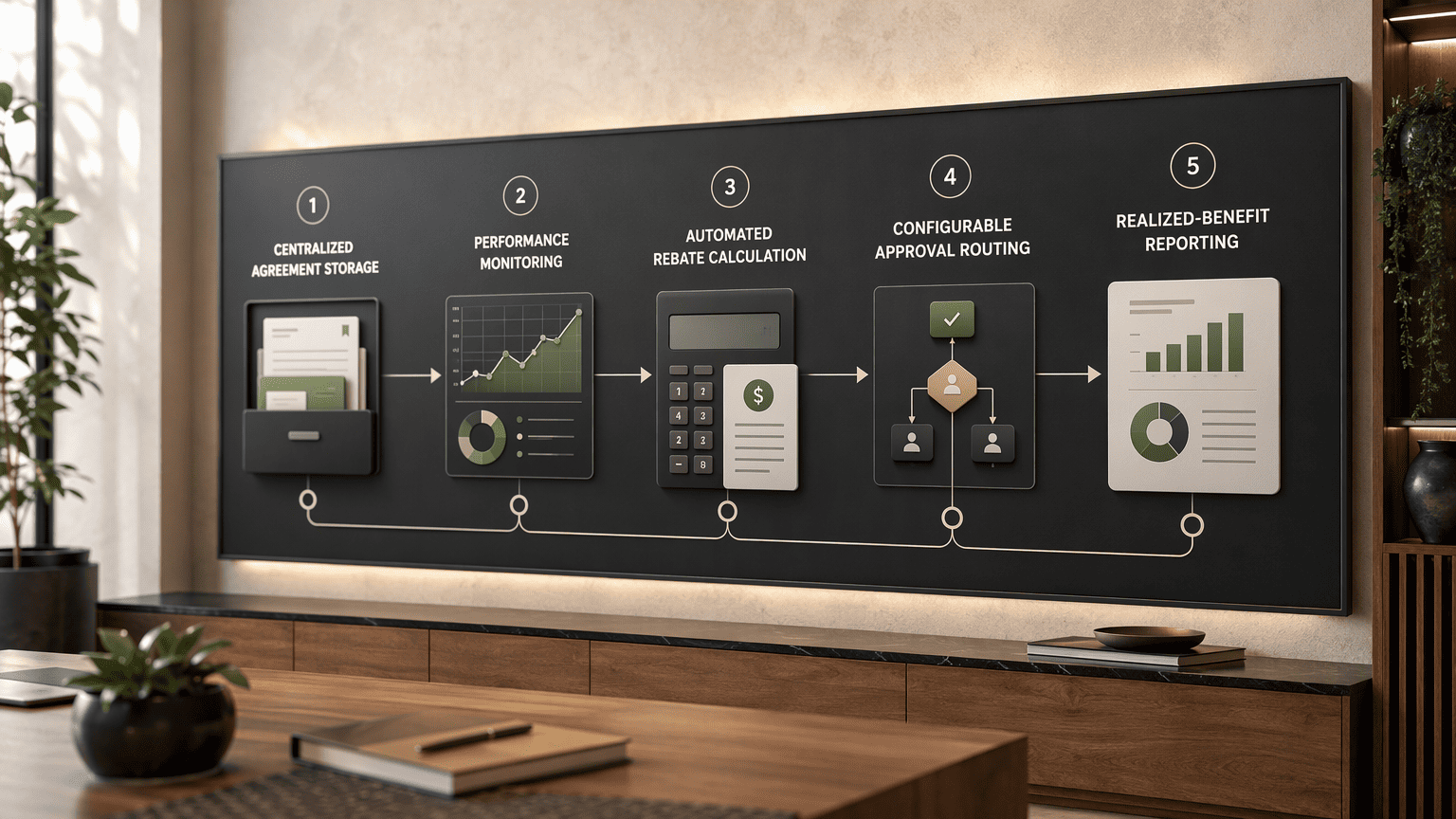
ISPnext approaches rebate management as a compliance and workflow problem first, which distinguishes it in high-volume environments where governance failures cause as much leakage as calculation errors. The platform follows a structured 5-step digitalization methodology that begins with centralized agreement recording, then monitors transaction performance against those terms, calculates rebates automatically, routes claims through configurable approval workflows, and finally reports realized benefits.
This process-first design yields measurable results. The platform reports a 91.3% recovery rate on rebate earnings and a reduction of missed discounts to 0% across 450+ organizations using the system. Those are auditable claims, not projections.
One capability that sets ISPnext apart is its near-miss analysis. As the period-end approaches, the system identifies purchasers operating just below a tier threshold and alerts them to adjust behavior. A single additional order can retroactively lift the rebate percentage applied to all qualifying spend within the measurement window, generating a return that dwarfs the cost of the extra purchase.
Integration breadth matches the enterprise scope. ISPnext supports 30+ standard ERP connectors including SAP, D365, Infor, and Oracle JD Edwards, covering both accounts payable and accounts receivable rebate programs. For a multinational processing hundreds of thousands of transaction lines across legal entities, the combination of automated workflow governance and period-end alerting directly prevents the leakage that manual controls miss.
4. Enable, Collaborative B2B Rebate Management for Complex Trading Programs

Most rebate platforms address the buyer’s side of the equation: tracking internal spend against supplier terms. Enable breaks that mold by providing a shared platform where trading partners negotiate, agree, and monitor rebate programs together. This collaborative model tackles the most common source of rebate disputes: each party holding a different version of what was agreed.
When both supplier and buyer see the same deal structure, the same performance data, and the same accrual calculations, settlement friction drops substantially. Enable handles complex deal structures that simpler tools cannot, including growth rebates linked to year-over-year percentage increases and product mix incentives that reward purchasing specific high-margin SKUs. The deal-building module supports what-if scenario modeling, letting commercial teams model the financial impact of alternative rebate structures before locking in terms.
For B2B enterprises where rebate agreements are negotiated deal-by-deal rather than drawn from a standard rate card, the collaborative architecture closes the gap between earned and claimed rebates without endless reconciliation calls.
5. Vistex, Deep ERP Integration for Large-Scale Retrospective Agreements
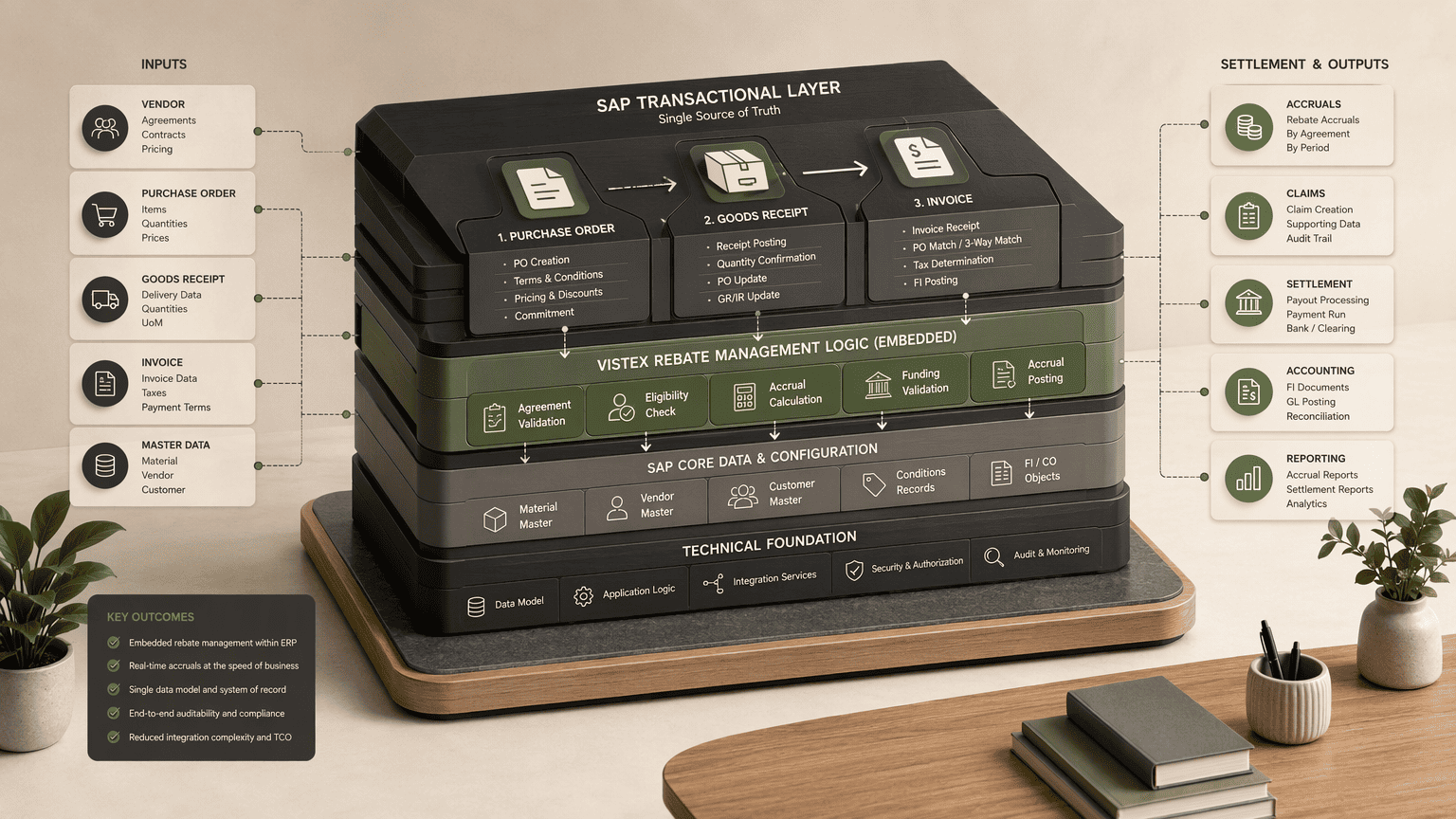
Vistex embeds rebate logic directly within the SAP transactional layer, which matters fundamentally for enterprises running SAP-centric finance operations. Instead of extracting data to an external calculation engine, Vistex sits inside the ERP environment where purchase orders, goods receipts, and invoices are posted, applying rebate rules at the point of transaction. For large enterprises managing composite tier structures, multi-currency settlements, and hundreds of retrospective agreements across global legal entities, this architecture eliminates the latency and reconciliation risk that come with external platforms. The system handles chargebacks, ship-and-debit programs, and layered deals where a supplier rebate depends on overall volume and the mix of specific product families across different regions.
Here is how Vistex compares on the dimensions that matter for SAP-native enterprises:
| Dimension | Vistex SAP-Native | External Platform + SAP Connector |
|---|---|---|
| Transaction proximity | Rebate logic applied at ERP posting moment | Batch extraction to external calculation engine |
| Retrospective complexity | Handles composite tiers, multi-currency, multi-entity | Typically limited to single-entity or single-currency programs |
| Implementation profile | Deep SAP configuration project; high IT involvement | Lighter implementation; governed by connector capabilities |
| Best fit | Global enterprises with dedicated SAP COE | Organizations using SAP alongside non-SAP ERPs or seeking faster time-to-value |
For the multinational retailer processing chargebacks across dozens of supplier agreements and legal entities inside SAP, Vistex is less a software choice and more an extension of the core ERP architecture.
6. TRG Screen, Specialized Visibility for Subscription and Data Rebates
Not all rebate programs involve pallets of raw materials. Financial institutions, law firms, and large corporates spend heavily on market data terminals, software licenses, and information service subscriptions, many of which carry usage-based rebate entitlements. TRG Screen focuses on this niche, tracking actual consumption against vendor agreements for Bloomberg terminals, Reuters feeds, and similar subscriptions, then surfacing rebate opportunities that general procurement platforms miss.
- Subscription-specific tracking: Monitors actual usage against licensed entitlements (not shipped units against a PO), identifying under-consumed subscriptions where rebate or credit claims apply before the license term renews. The economic logic reverses the typical rebate problem: the enterprise claims back on what it over-licensed but never used, rather than buying more to hit a tier.
- Vendor landscape coverage: Designed for the market-data vendor ecosystem (Bloomberg, Refinitiv, FactSet) where pricing and rebate rules follow structures that a standard rebate calculation engine cannot model. These agreements involve exchange fees, terminal counts, and user-type tiers.
- Compliance alignment: For regulated financial firms, documentation of vendor spend optimization and unused-entitlement recovery supports cost-control reporting obligations. Usage audit trails tie consumption data to contract clauses, producing an evidence package that stands up to internal audit review.
- Contrast with general platforms: ISPnext and Phocas handle payable and receivable rebates on purchased goods. TRG Screen addresses the gap where the “product” is an information right, the “volume” is seat licenses, and the rebate depends on consumption measurement rather than invoice accumulation. Applying a general rebate tool to a Bloomberg terminal agreement misses the very mechanisms that determine whether a rebate is owed.
7. Comparing Capabilities: A Structured Feature Table
The following six dimensions are the ones procurement and finance buyers rank highest when shortlisting rebate-tracking platforms. Run each platform against these criteria rather than getting anchored on a single feature such as dashboard design.
- Contracts.ai provides structured extraction with audit-trail preservation. ISPnext, Phocas, and Enable primarily rely on manual agreement recording. Vistex inherits contract data from SAP’s document layer, and TRG Screen focuses on subscription entitlements rather than clause extraction.
- ERP integration breadth: Check named connectors against your current ERP. ISPnext offers 30+ ERP integrations including SAP, D365, Infor, and Oracle JD Edwards. Phocas connects to Infor, Oracle NetSuite, Epicor, Microsoft Dynamics, Sage, and SAP. Vistex runs natively within SAP. Enable and TRG Screen connect to major ERPs but prioritize collaborative and subscription-specific data sources respectively. Contracts.ai monitors ERP transaction feeds as structured data once contracts are extracted.
- Automated calculation engine: Can the system handle tiered volume, growth, and retrospective rebate structures without manual Excel intervention? Phocas, ISPnext, Vistex, and Enable all include calculation engines designed for these structures. Contracts.ai structures the rules for downstream calculation. TRG Screen’s calculation model is consumption-based rather than order-volume-based.
- Near-miss alerts and period-end optimization: ISPnext provides explicit near-miss analysis alerting purchasers before period close. Phocas dashboards surface the same concept visually. Other platforms focus on accurate accrual rather than active purchasing intervention.
- Workflow approval and audit trail: ISPnext’s 5-step methodology bakes compliance into every claim. Contracts.ai provides detailed audit logging. Vistex inherits SAP’s native authorization framework. Enable’s shared-platform model provides bilateral deal acceptance trails. If your rebate program faces internal or external audit scrutiny, this dimension should carry disproportionate weight.
- Best-fit organization profile: Phocas matches mid-market manufacturers and distributors. ISPnext serves high-volume enterprises needing process governance. Vistex fits SAP-native global enterprises. Enable suits B2B trading partners with negotiated deal structures. Contracts.ai addresses organizations wanting AI-driven contract economics extraction. TRG Screen handles subscription and market-data rebate use cases.
8. Use-Case Scenarios: How the Right Tool Captures Rebates Against Live Contracts
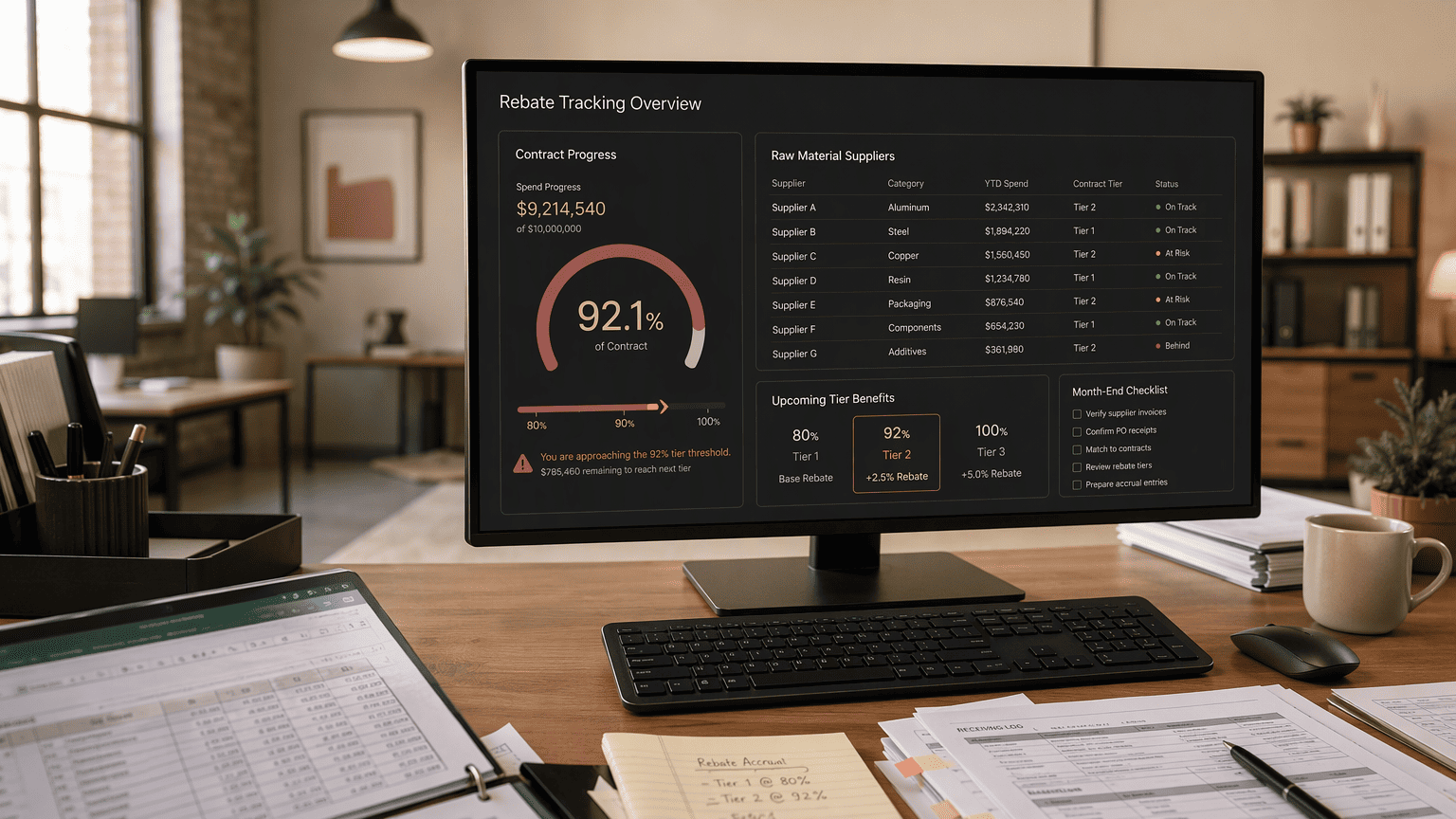
A mid-market industrial manufacturer runs Epicor ERP and buys raw materials from 40 suppliers, most with tiered volume rebates negotiated during annual sourcing events. The purchasing team tracks spend in a shared Excel workbook that the controller updates after month-end close. In Q3, three suppliers had cumulative spend sitting at 92% of the next tier threshold with two weeks remaining in the measurement period. Nobody flagged it. $34,000 in rebate margin was left unclaimed.
A platform like Phocas Rebates would have pulled live Epicor transaction data against the tier thresholds and surfaced all three near-miss opportunities on a dashboard. The procurement manager gets time to route one additional order per supplier and convert a 3% rebate into a 5% rebate across the full period’s spend. The software cost is a fraction of that single quarter’s leakage.
A global retailer operating on SAP processes over 200,000 retrospective rebate lines annually across 12 legal entities and five currencies. Supplier agreements include composite tiers where the rebate percentage depends on both total volume and the mix of promotional versus everyday purchases. Rebate claims are reconciled manually by a shared-services team that spends the first three weeks of every quarter assembling data.
Payment disputes with suppliers routinely delay recognition by an additional 45 days. Vistex, embedded natively in the retailer’s SAP environment, would apply the composite rebate rules at the point of goods receipt posting, accrue earnings in real time across currencies, and generate the settlement documents automatically. The shared-services team shifts from manual reconciliation to exception handling, and cash from earned rebates arrives 60 days faster.
A third scenario runs in the opposite direction: a financial services firm paying for 300 Bloomberg Terminal licenses discovers through TRG Screen that 22 licenses have gone unused for more than four months. The vendor agreement entitles the firm to a usage-based rebate or credit on under-consumed seats, but without consumption monitoring, the entitlement is invisible. TRG Screen surfaces the unused licenses, generates the documentation, and the firm recovers the overpayment before the contract renewal locks in the inflated seat count for another year.
Conclusion
Contracts hold rebate value that manual processes fail to capture. The gap between a signed tiered-volume agreement and the cash that lands in your P&L almost always traces back to systems failing to talk to each other. Purpose-built platforms close that gap by connecting three functions that spreadsheets keep separate: extracting the rebate rules from the contract text, monitoring real-time spend against those rules, and alerting the right person before the measurement period ends.
For mid-market manufacturers and distributors on Infor, Epicor, or Dynamics, Phocas delivers the fastest time-to-value. High-volume enterprises needing process governance and near-miss intervention should shortlist ISPnext. SAP-native global operations with composite retrospective agreements fit Vistex.
AI-first contract extraction with enterprise security points to Contracts.ai. And subscription or market-data rebate recovery belongs to TRG Screen.
Run a proof of concept on your own contract set and one quarter’s transaction data. The ROI will be visible before the pilot ends.
Frequently Asked Questions
What capabilities does Contracts.ai have for tracking financial obligations and rebate terms?
Contracts.ai ingests contract PDFs and extracts financial terms including tiered rebate thresholds, pricing schedules, SLAs, and risk allocations into structured, computable fields. It preserves source language alongside extracted clauses for audit trails and monitors ERP transaction feeds against those rules.
How can contract software automate the capture of rebates and prevent revenue leakage?
Specialized rebate platforms connect to your ERP, pull live transaction data, and compare cumulative spend against tier thresholds defined in supplier agreements. These platforms deliver three key outcomes in rebate management:
- Near-miss alerts: When spend approaches a tier jump, alerts prompt purchasers to place qualifying orders before the measurement period closes.
- Automated accrual calculations: The system replaces manual spreadsheets to prevent the 2 to 5% value erosion common with manual tracking.
- Real-time visibility: Cumulative spend is continuously compared to tier thresholds, surfacing opportunities that manual processes miss.
What specific features should enterprises look for in spend-tracking-and-rebate contract software?
Prioritize five capabilities when selecting a rebate management platform:
- AI-powered clause extraction: Automatically pull contract terms from signed documents.
- Direct ERP integration: Connect to your existing transaction data source.
- Automated calculation of tiered and retrospective rebates: Eliminate manual spreadsheets.
- Real-time dashboards: Show accruals and tier proximity at a glance.
- Configurable approval workflows with audit trails: Ensure governance and traceability.
Near-miss alerts that prompt purchasing action before period-end can generate returns that exceed the software cost in a single quarter.
How does AI-powered contract analysis identify and extract monetary terms relevant to rebates?
AI contract analysis ingests agreement text and classifies clauses by type, tiered volume, growth, retrospective, product-mix incentive. The system then structures those clauses into computable fields through three steps:
- Threshold extraction: Pull the numerical spend or volume thresholds from contract language.
- Rate and period capture: Identify percentage rates, measurement periods, and exclusion conditions.
- Engine integration: Feed the structured fields directly into the rebate calculation engine, eliminating the manual setup bottleneck.
What are the benefits of using specialized contract software for rebate management vs. generic CLM tools?
Generic CLM tools store and route contracts but do not calculate rebate accruals. Specialized rebate platforms provide three distinct advantages:
- ERP data connection: They link to transaction data rather than relying on separate manual entry.
- Tier calculation: They apply tier rules to actual purchase volumes and compute earnings automatically.
- Opportunity surfacing: They surface near-miss opportunities that would otherwise go unnoticed.
These capabilities prevent the revenue leakage that occurs when signed rebate agreements sit in a repository while purchasing decisions happen without visibility into tier economics.
What is the typical process for implementing rebate-tracking contract software in a US enterprise?
Implementation follows a staged path: centralize existing supplier agreements, connect the platform to your ERP system for transaction data access, configure rebate calculation rules for each agreement, set up approval workflows aligned with your delegation of authority, and run a pilot on one quarter’s data to validate accrual accuracy before expanding to all suppliers.
Sources
- Contract Performance Platform | Vendortell – vendortell.com
- The Best Rebate Management Software | Phocas – Business Analysis Tools – www.phocassoftware.com
- Supplier rebate management | claim every rebate you earn – www.ispnext.com