







Introduction
Your procurement team negotiated a 2/10 net 30 discount with a critical supplier. The contract is signed. But three months later, treasury reports show you captured less than half of the available savings.
The terms are right there in black and white. The cash was available. What happened?
This gap is systemic. Most AP departments identify available early-payment discounts only after invoices are already paid. Payment data flows through the business in millions, yet AP processes millions in payments, but payment data is rarely analyzed for optimization. The result is a quiet, relentless leak of working capital.
The financial opportunity cost is staggering. Enterprises that close the execution gap between negotiated terms and actual payment behavior routinely capture savings equivalent to 2 to 5% of annual spend from discount capture alone, and they reduce Days Payable Outstanding by 10 to 15 days. That is not a rounding error. For a company with $200 million in addressable spend, it represents millions in recovered cash.
This ranking evaluates seven platforms purpose-built to solve this specific problem. The best of them extract dynamic discount terms from live agreements, cross-reference those terms against real-time AP payment schedules, and trigger alerts before the discount window closes. The terms live in the contract as executable data.
That is the line between an anecdotal claim and a modeled, defensible return. We assessed each platform on its AI-native extraction capability, real-time alerting architecture, security posture, and measurable cash impact. Here are the seven platforms that move the needle on discount capture in 2026.
Key Takeaways
The platforms that deliver the highest discount capture share a common architecture. Here are the selection criteria that mattered most in our evaluation:
- Real-time discount-window triggers: The platform must scan every invoice batch against live contract terms and flag expiring discount windows before payment runs execute.
- AI-native extraction: Look for post-signature AI that reads dynamic discount terms directly from executed agreements, a capability separate from static metadata fields populated at signing.
- Measurable ROI timing: The strongest platforms demonstrate cash impact within the first payment cycle. Suplari reports that most organizations see ROI within the first payment cycle by capturing previously missed discounts.
- Supplier-side adoption mechanics: A discount engine is worthless if suppliers do not participate. Platforms with integrated onboarding and non-recourse early pay programs close the loop on the supplier side.
1. Contracts.ai: Post-Signature AI That Ties Negotiated Discount Terms to Actual Invoice Performance

Contracts.ai converts executed agreements into post-signature data infrastructure that continuously cross-references extracted discount terms against AP payment data. The platform pulls dynamic terms from live supplier contracts and flags instances where actual payment behavior violates the negotiated schedule.
The engine is built to extract key terms across legacy and live contracts in minutes, preserving source language alongside structured fields. Because it operates on post-signature contracts rather than templates, it catches the discount clauses that were customized during negotiation and buried in a redlined PDF.
Customer data is logically isolated. The company states that customer data is never used to train public or shared models, which matters when your payment terms are commercially sensitive.
For a US enterprise running a pilot, the platform can be tested with a limited contract set without migrating the full repository or disrupting existing workflows. When an AI agent flags a negotiated discount term in a payment batch before the wire goes out, the value shifts from storing a clause to recovering cash.
2. Suplari: AI Agents That Scan Every Invoice Batch for Discount Opportunities Before Payment
Suplari deploys Digital Workers that do what a human AP analyst cannot: scan every invoice batch, map terms to payment schedules, and prioritize payments by discount rate and cash position before the payment run locks. The system targets 80%+ capture of available discount value automatically.
- Batch-scanning AI agents: Suplari’s Digital Workers ingest invoice batches and flag every expiring 2/10 or 3/15 term window before the invoice is paid instead of after the fact.
- Discount-rate prioritization: The engine ranks payment candidates by effective annualized return, letting treasury route cash to the highest-yield discounts first.
- Rapid intelligence delivery: Most organizations see initial payment optimization intelligence within two weeks and full real-time monitoring within 30 days.
- ROI within the first cycle: Suplari reports cash impact inside the first payment run by surfacing previously invisible discount opportunities.
- Analyst workload reduction: The platform claims over 40% reduction in manual analytical work through automation, freeing category managers who currently spend 60% of their time on data prep.
- Market validation: Suplari holds a 4.8 out of 5 stars rating on Gartner Peer Insights.
3. Coupa: Granular Access Controls and Data Isolation for Early-Pay Discount Workflows

Coupa addresses the security problem that keeps treasury teams up at night. When an AI model ingests supplier payment terms, who can see that data, and when? Coupa’s supplier documentation describes separate data handling for early-pay discounts before and after invoice approval. That distinction matters. A discount term extracted from a contract and used to trigger an accelerated payment should not sit in the same access bucket as a fully approved and settled invoice record.
The platform enforces this separation through a dedicated tenant architecture with encryption at rest and in transit. That means supplier contract data is not commingled across tenants, and the discount identification workflow operates within a bounded permission set. It marks the boundary between a defensible compliance posture and a finding on the next audit report. Procurement teams that handle sensitive pricing data can configure granular access controls that lock the discount analysis layer down to a named set of treasury and AP users, while the broader contract record remains accessible to the sourcing team.
4. Tropic: Dynamic Discount Capture Across Supplier Portfolios with Real-Time Window Alerts
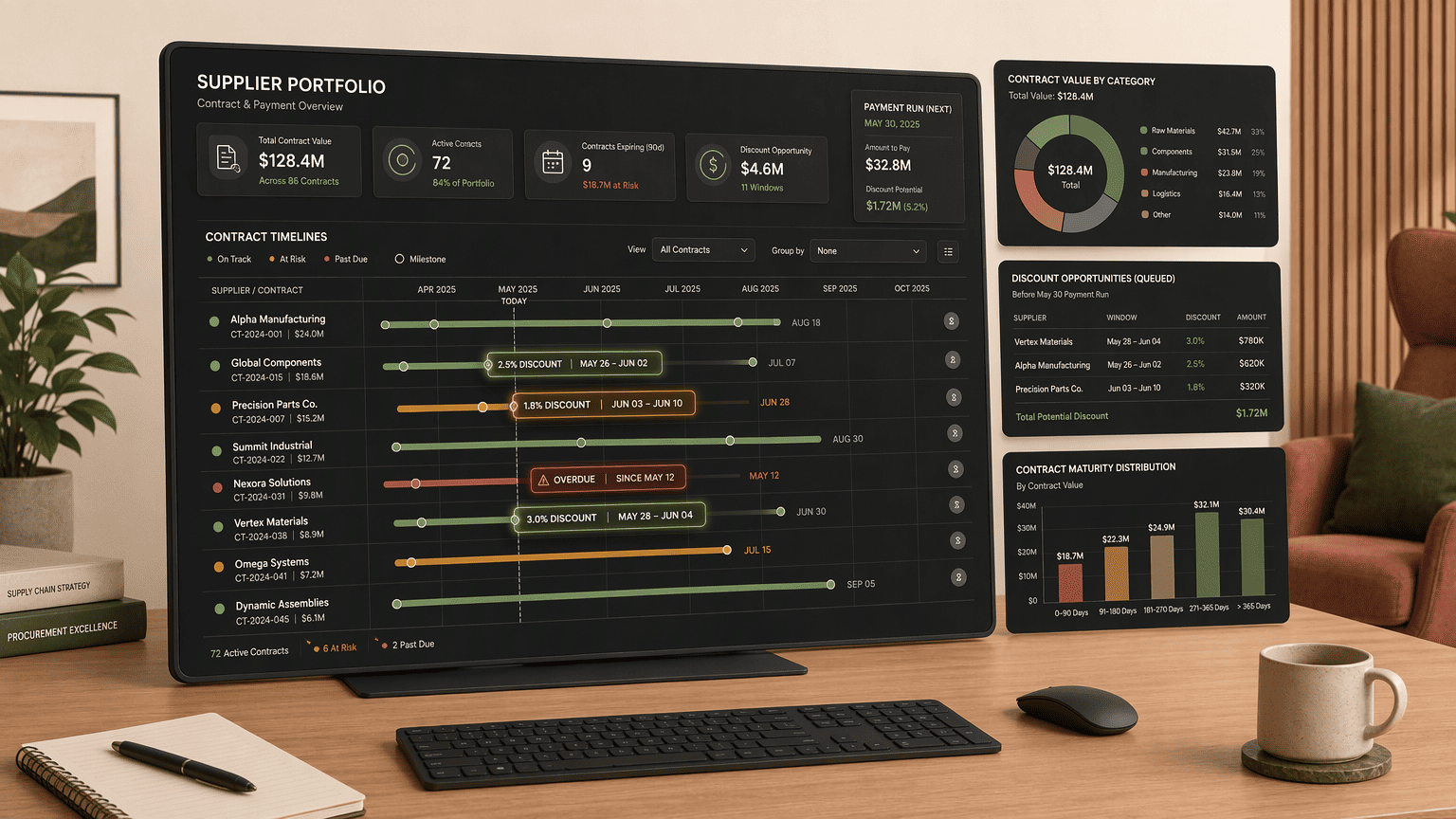
Tropic scales early-pay discount capture across hundreds of supplier relationships with automated timing triggers. The platform’s real-time alerting system surfaces approaching discount deadlines, and its portfolio-level analytics surface the highest-value discount opportunities before a payment run.
| Capability | Tropic Approach | Why It Matters |
|---|---|---|
| Real-time window alerts | Automated deadline triggers tied to each supplier contract | Prevents a discount from expiring inside a batch processed overnight |
| Portfolio analytics | Ranks discount opportunities by value across all suppliers | Lets treasury allocate cash to the highest-return payments first |
| Deadline tracking | Sliding-scale timing based on discount rate and days remaining | Captures partial discount value even when the full window narrows |
| Supplier coverage | Designed for portfolios ranging from dozens to thousands of relationships | Avoids the common failure mode where only the top 20 suppliers get optimized |
A dynamic discounting model allows paying on a sliding scale at any time before the invoice is due. Tropic operationalizes that flexibility across the entire supplier base. That shift separates a defensible compliance posture from a finding on the next audit report. The analytics engine models the return on each available discount opportunity, so treasury teams move beyond anecdotal claims. The system also flags a negotiated discount term in a payment batch before the wire goes out, which is the practical difference between storing a term in a digital filing cabinet and having an AI agent intercept it in time.
5. Ivalua: Payment Term Compliance Monitoring and Working Capital Impact Modeling

Ivalua approaches the discount capture problem from a working capital angle. Rather than simply flagging a missed 2/10 net 30 opportunity, the platform models the cash impact of capturing that discount against alternative uses of the same capital. This shifts the conversation from a binary “pay early or don’t” decision to a strategic allocation analysis.
The modeling engine projects how a specific discount capture decision affects Days Payable Outstanding. Research indicates that enterprises with active payment term compliance monitoring can reduce DPO by 10 to 15 days while simultaneously capturing discount yield, an unusual dual improvement that most treasury teams assume involves a trade-off.
The platform runs what-if scenarios before a payment run executes. Treasury can see the projected working capital impact of capturing a specific supplier’s 2% discount versus extending the payment to net 30 and deploying that cash elsewhere.
For finance leaders who need to justify early-pay decisions to a CFO, this capability is the difference between an anecdotal claim and a modeled, defensible return. It also prevents the perverse outcome where an AP team aggressively captures discounts on small invoices while ignoring a larger working capital squeeze from top-tier suppliers.
6. Medius: Duplicate Payment Detection and Privacy-Safe Intelligence for AP Discount Engines
Medius addresses two problems that compound each other: duplicate payments and the privacy risk inherent in running AI across supplier invoice data. Duplicate payment errors are remarkably common in high-volume AP environments, and every dollar paid twice is a dollar unavailable for discount capture.
Medius’s detection engine identifies duplicate invoices before they reach the payment batch, preserving cash that can then be routed toward discount opportunities. The ROI is straightforward. A single duplicated six-figure payment erases the yield from capturing a 2% discount on a typical invoice.
On the privacy side, Medius applies privacy-safe AI techniques that analyze invoice data for discount pattern recognition without exposing supplier-confidential line-item detail. For enterprises with suppliers who are direct competitors, or those that process invoices containing proprietary pricing structures, this prevents the situation where an AI model trained on one supplier’s data inadvertently surfaces that supplier’s cost structure to a rival. That scenario creates real legal exposure.
The platform reduces both error-rate leakage and privacy exposure in the discount capture process. Most pure discount-yield optimization tools ignore these two risk vectors.
7. Taulia: Supplier Onboarding for Digital Payments and Non-Recourse Early Pay Programs

Even the most sophisticated discount identification engine fails if suppliers do not opt in. Taulia focuses on the supplier-side barrier. Its platform streamlines supplier onboarding into digital payment programs and supports non-recourse early pay structures. For the supplier, this means they receive accelerated payment without waiting for the buyer’s internal approval chain to greenlight every early-pay election.
For the buyer, non-recourse financing mechanics mean the early payment is funded without permanently altering the company’s DPO profile. You capture discount value while Taulia’s financing arm carries the cash-flow impact.
Conclusion
The shift from static CLM to post-signature contract intelligence turns the contract into a live financial instrument. When an AI agent flags a negotiated discount term in a payment batch before the window closes, the discount lands in your bank account. Without that trigger, the same term sits in a digital filing cabinet while the payment processes at full price.
The platforms in this ranking succeed to the degree that they close that loop.
A 2% discount captured on millions in annual spend generates hundreds of thousands in savings. The platform you choose determines whether those hundred grand land in your cash flow or vanish in a batch payment run.
Frequently Asked Questions
What AI-native features should an AP team look for in a contract analytics platform to capture early-payment discounts?
Look for three capabilities. First, automated extraction of dynamic discount terms from executed agreements rather than static metadata. Second, batch-scanning AI agents that map those terms to real-time AP payment schedules. Third, prioritization logic that ranks payment candidates by effective annualized return so treasury captures the highest-yield discounts first.
How does post-signature contract intelligence differ from traditional CLM analytics for discount capture?
Traditional CLM extracts terms at contract signing and stores them as static obligations. Post-signature intelligence continuously connects those extracted terms to live AP payment data, catching discount windows before the invoice is paid. It closes the execution gap between what was negotiated and what actually happens in the payment run.
What data architecture safeguards prevent supplier contract data from being commingled or exposed during automated discount identification?
Dedicated tenant architecture with encryption at rest and in transit ensures data isolation. Granular role-based access controls separate the discount-analysis layer from the broader contract record. The platform should also state explicitly that customer data is not used to train shared or public AI models.
What measurable financial benefits do enterprises see from deploying specialized early-payment discount analytics?
Procurement and treasury data indicates enterprises capturing early-payment discounts can reduce Days Payable Outstanding by 10 to 15 days and generate savings equivalent to 2 to 5% of annual spend from discount capture alone. Platforms like Suplari report ROI within the first payment cycle.
Sources
- Payment Intelligence to Capture Value, Not Just Process Invoices | suplari – suplari.com
- Dynamic Discounting & Supply Chain Financing – go.apexanalytix.com






