Finance teams lose visibility into vendor obligations when contracts scatter across email inboxes, shared drives, and departmental folders, creating renewal surprises and compliance exposure.
Centralizing vendor contracts requires more than storage—finance teams need platforms that extract obligations, trigger renewal alerts, and integrate with ERP systems.
Key Takeaways
- Vendor contracts fragment across predictable hiding places—email attachments, shared drives, and procurement folders—defeating search and automated tracking
- Finance teams must track five obligation categories: payment terms, auto-renewal clauses, termination notice periods, compliance requirements, and performance obligations
- AI-powered contract intelligence platforms automatically extract obligations from legacy PDFs, while traditional CLM systems require manual tagging at contract creation
- Spreadsheet adequacy ends when managing more than 50 active vendor contracts or when three or more team members need concurrent access
- Repository architecture choice—shared drive, traditional CLM, or AI-powered intelligence—depends on contract volume, legacy portfolio size, and automation requirements
Finance teams struggling with scattered vendor contracts should evaluate contract intelligence platforms that combine centralized storage, AI-powered obligation extraction, and automated alert systems — with platform selection driven by contract volume (hundreds vs. Thousands), obligation complexity (simple renewals vs. Multi-tier SLAs), and whether the team needs real-time extraction or can batch-process legacy agreements.
The Four Hidden Repositories Where Vendor Contracts Live
Vendor contracts fragment across predictable hiding places that defeat search and tracking. Research shows 90% of professionals struggle to locate specific contracts when needed, and the fragmentation follows a consistent pattern:
- Email attachments, Signed agreements buried in reply chains, often stored in individual inboxes rather than shared repositories
- Shared drives, PDFs scattered across department folders with inconsistent naming conventions that block keyword search
- Procurement system exports, Contract metadata trapped in ERP systems that finance teams can’t query without IT support
- Legal file cabinets, Physical originals or scanned copies archived separately from the operational data finance needs daily
The anti-pattern: treating contract storage as an IT problem rather than an obligation-tracking problem. Organizations invest in enterprise content management systems that store every PDF but provide no mechanism to surface renewal dates, payment terms, or performance clauses when finance teams need them. The result is a repository full of unsearchable documents with no alert systems, agreements scattered across email threads, shared drives, and filing cabinets that legal can archive but finance cannot operationalize.
The True Cost of Missed Auto-Renewals and Payment Term Conflicts
When vendor contracts remain invisible to finance operations, three cost drivers materialize: missed contractual obligations, unclear pricing, and forgotten renewals drain resources. Organizations lose approximately 9% of revenue to contract leakage, a silent profit drain that compounds across hundreds of vendor relationships.
Missed auto-renewals trigger unplanned budget overruns when contracts automatically extend at rates negotiated 12-36 months prior, often at terms less favorable than current market pricing. Finance discovers the renewal only when the invoice arrives, eliminating the renegotiation window.
Payment term conflicts expose finance to duplicate payments or missed early-payment discounts when contract clauses aren’t visible to accounts payable. A vendor agreement may specify net-60 terms while the ERP default remains net-30, causing either premature payment or late fees depending on which system governs the transaction.
Compliance gaps materialize when regulatory obligations embedded in vendor contracts, data residency requirements, audit rights, breach notification timelines, remain invisible to the compliance function. Finance lacks a mechanism to flag these obligations at contract signature, and legal lacks visibility into whether finance is monitoring them post-execution.
Understanding where contracts hide reveals why tracking failures occur, but solving the problem requires defining what obligations finance teams must monitor across every vendor agreement.
The 5 Types of Obligations Finance Teams Must Track
Finance teams managing vendor contracts face five core obligation categories that determine cash flow, compliance exposure, and operational risk. Modern AI-powered contract platforms automatically extract these obligation types from legacy agreements, transforming buried contractual commitments into operational intelligence. Platforms like Contracts.ai, Ironclad, and Icertis use machine learning to identify and classify these obligations in minutes, while basic CLM systems require manual tagging during upload.
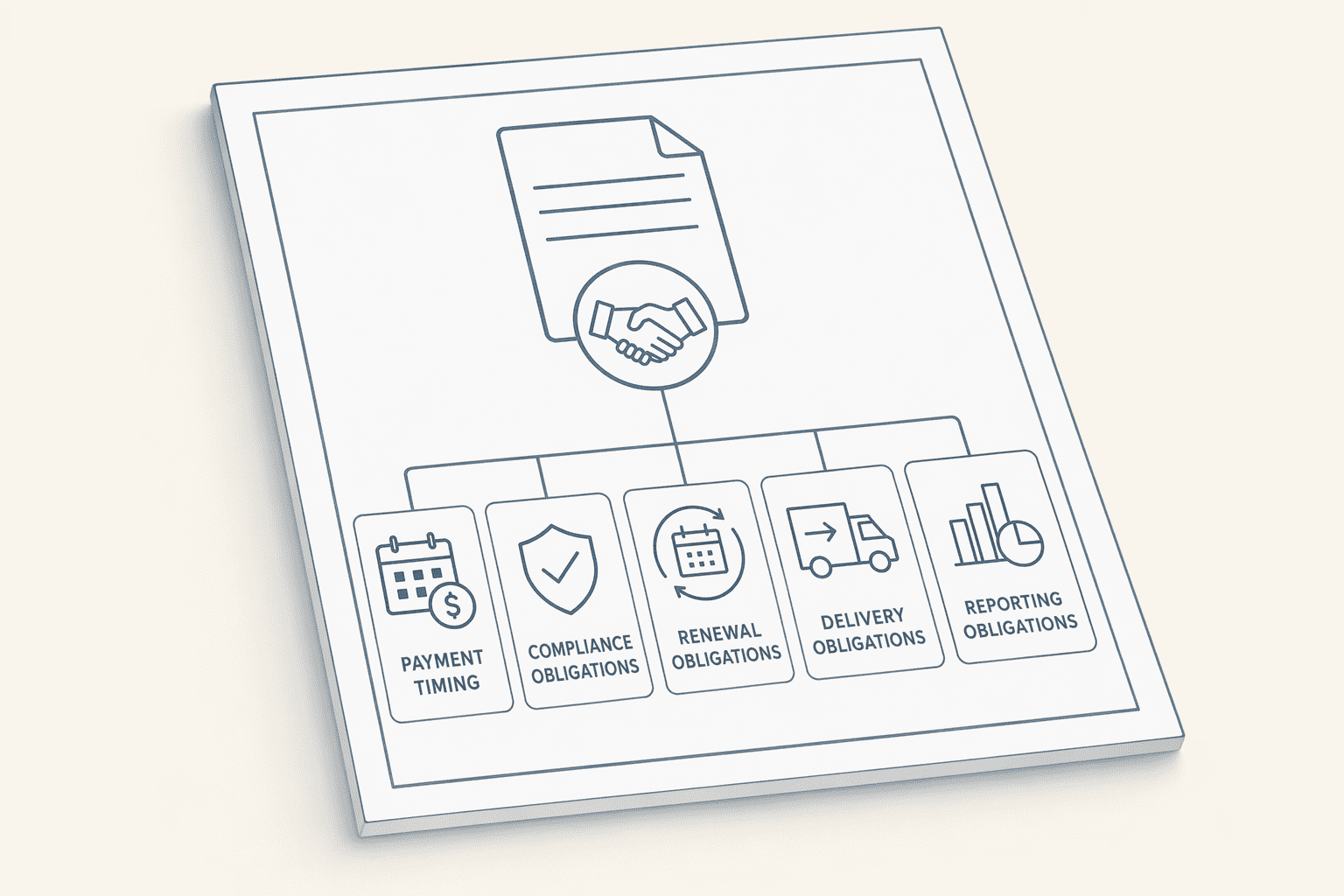
The five obligation types finance teams must monitor:
- Payment terms and invoice schedules, net-30, net-60, net-90 payment deadlines; milestone-based payment triggers; early payment discounts; and late payment penalties
- Auto-renewal and termination notice periods, automatic renewal clauses; required notice periods (30-day, 60-day, 90-day); termination-for-convenience windows; and contract expiration dates
- Compliance obligations, GDPR data processing commitments; SOC 2 audit requirements; regulatory reporting deadlines; and data residency restrictions
- SLA and performance commitments, uptime guarantees (e.g., 99.9% availability); response time requirements; performance credits for SLA breaches; and service-level reporting cadences
- Warranty and indemnification terms, warranty periods and exclusions; indemnification caps and carve-outs; insurance coverage requirements; and limitation of liability thresholds
Payment Terms and Invoice Schedule Obligations
AI clause detection platforms automatically identify and extract payment deadlines from vendor agreements, surfacing net-30 to net-90 payment windows, early payment discount percentages (typically 1 to 2% for payment within 10 days), and late payment interest rates. Finance teams use extracted payment terms to forecast cash outflows, prioritize early payment discounts, and flag contracts with unfavorable payment conditions during renewal negotiations.
Auto-Renewal, Termination Notice, and Expiration Date Tracking
Auto-renewal clauses and termination notice periods represent distinct obligation types that determine contract lifecycle control. Modern AI systems extract renewal terms and termination rights to flag contracts requiring 60- or 90-day advance notice before expiration. Finance teams tracking these obligations avoid unwanted renewals, eliminate surprise expenditures, and preserve termination-for-convenience rights during vendor consolidation initiatives.
Compliance Obligations: GDPR, Data Processing, and Regulatory Requirements
Finance teams managing financial risk must monitor contractual commitments including compliance obligations embedded in vendor agreements. These obligations include GDPR data processing annexes specifying data retention periods, SOC 2 audit frequency requirements, regulatory reporting deadlines tied to contract milestones, and data residency restrictions that constrain where vendor systems may process customer data.
SLA and Performance Commitment Tracking
Service-level agreements define ongoing performance obligations distinct from one-time deliverables. Finance teams track uptime commitments (99.9% availability translates to ~8.7 hours annual downtime), response time requirements (e.g., critical issues resolved within 4 hours), performance credit schedules triggered by SLA breaches, and monthly service-level reporting cadences that validate vendor compliance.
Before selecting a centralization platform, finance teams must inventory the existing contract chaos, a structured audit that reveals hidden obligations and prepares legacy agreements for migration.
How to Audit Existing Contracts for Hidden Obligations
Most finance teams discover their vendor contracts are buried in inboxes, spreadsheets, and shared folders, a fragmentation that obscures renewal dates, auto-escalation clauses, and termination notice windows. A systematic audit surfaces these hidden obligations before they trigger unplanned spend or expose compliance gaps.

Step 1: Inventory All Contract Storage Locations
Begin by cataloging every repository where executed agreements might reside:
- Email archives, search Finance, Legal, and Procurement inboxes for attachments with “signed,” “executed,” or “countersigned” in the subject line
- Shared drives, scan departmental folders (Procurement, Legal, IT) for PDFs, Word documents, and scanned images
- ERP / procurement systems, export purchase orders with attached terms and conditions
- Legal document management, query existing repositories for vendor agreements, master service agreements (MSAs), and statements of work (SOWs)
- DocuSign, Adobe Sign, or e-signature platforms, pull completed envelopes for the trailing 24 to 36 months
Log each location in a master spreadsheet with columns for repository name, access owner, and estimated contract count. This inventory reveals gaps, contracts lost to employee departures or retired file shares, that require vendor outreach to reconstruct.
Step 2: Prioritize High-Value and High-Risk Contracts First
When the portfolio exceeds one hundred agreements, sequence the audit by financial and operational exposure. Prioritize contracts with:
- Annual contract value above $100,000
- Auto-renewal clauses with notice periods shorter than 90 days
- Personal data processing (GDPR, CCPA obligations)
- Service-level agreements tied to financial penalties
- Multi-year terms nearing their first renewal window
Tagging each contract by risk tier (critical / moderate / routine) ensures the team extracts key fields from high-impact agreements first, deferring low-value NDAs and one-time purchase orders to later phases.
Step 3: Extract Key Data Fields from Each Contract
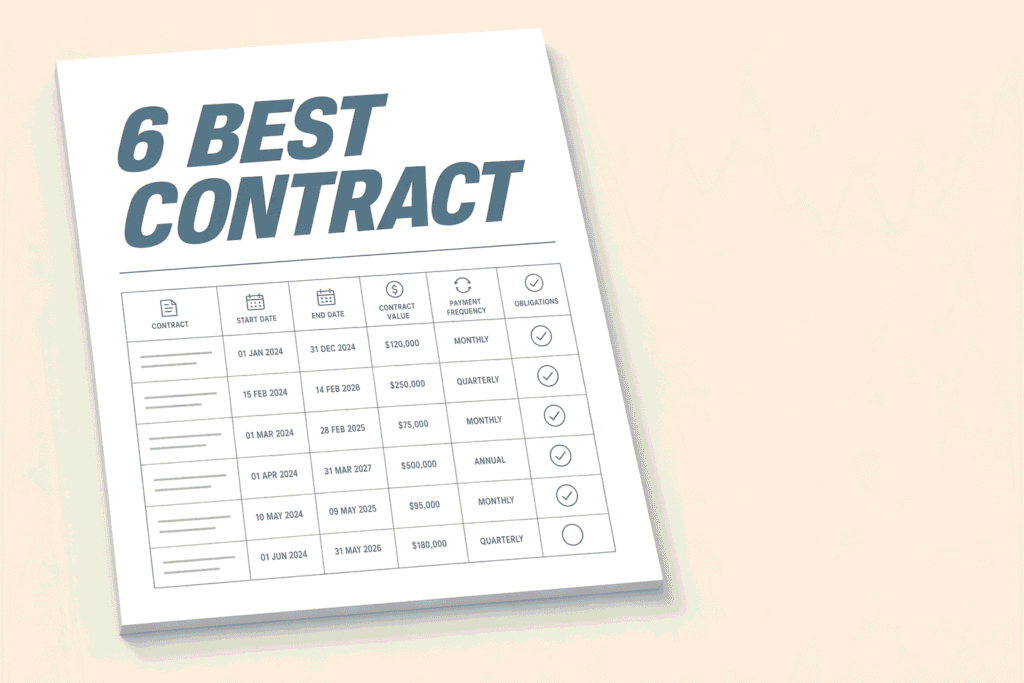
For every prioritized agreement, capture these six core fields:
- Counterparty, legal entity name and primary contact
- Effective date, when obligations commenced
- Expiration date, end of the initial term
- Auto-renewal terms, whether the contract renews automatically and notice period required to cancel
- Payment schedule, billing frequency, amounts, escalation clauses
- Termination notice period, days or months of advance notice required by either party
Manual extraction, reading each PDF and copying terms into a spreadsheet, remains feasible for portfolios under fifty contracts. Beyond that threshold, AI-powered extraction accelerates the process significantly. Contracts.ai can extract key terms across legacy and live contracts in minutes, claiming more than 99% accuracy when extracting data from documents in real time. The platform preserves source language alongside structured fields, enabling finance teams to validate extracted obligations against the original contract text before loading the data into downstream systems. Organizations using AI-powered contract management reduce contract processing time by up to 65%, making automated extraction the pragmatic choice for portfolios spanning hundreds of vendor agreements.
After cataloging scattered contracts, finance teams face a foundational architecture choice: where to store agreements and how much automation the repository should provide.
Centralization Strategies: Repository Models Compared
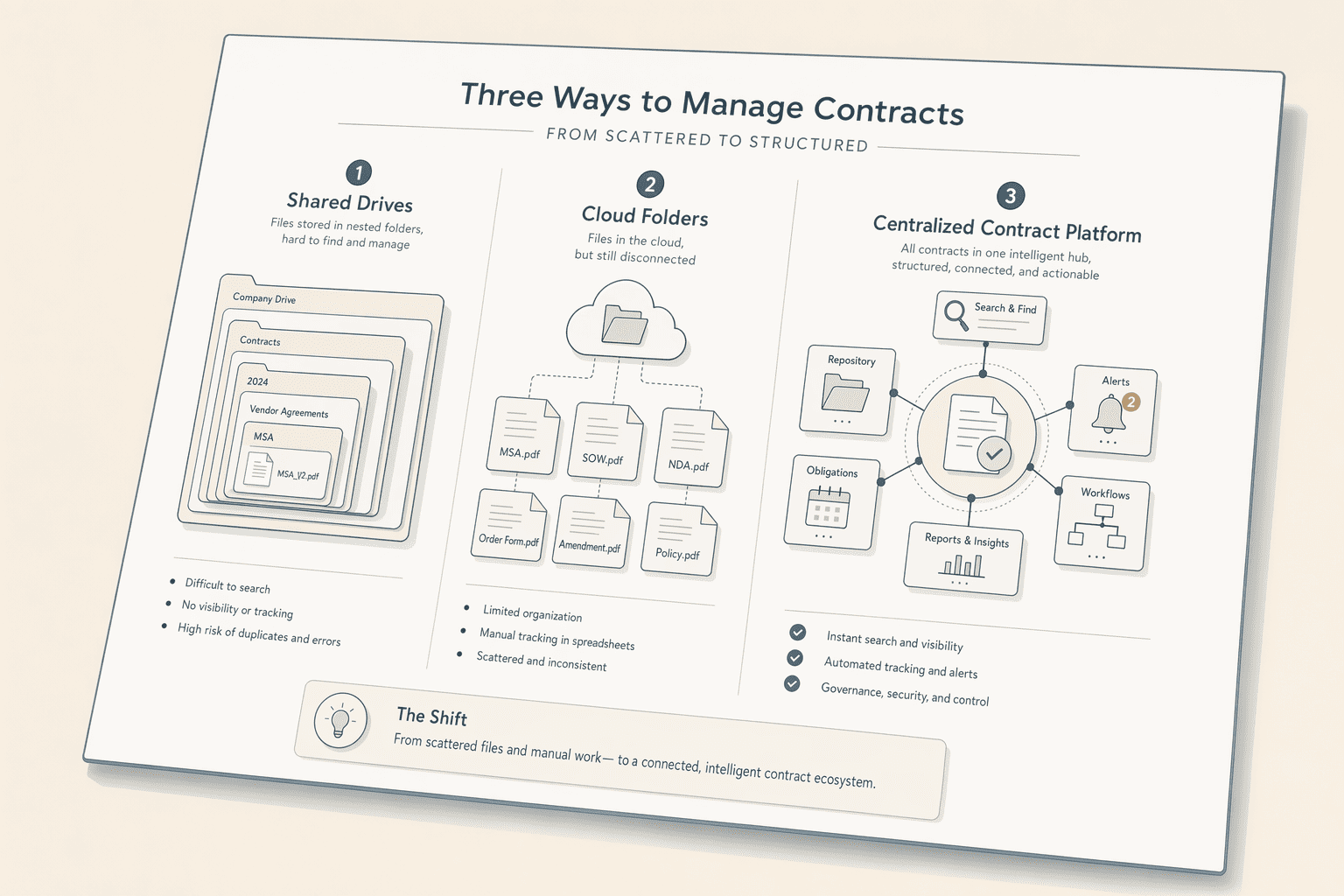
Before evaluating specific platforms, finance teams must choose between three foundational repository architectures, each offering distinct trade-offs in automation, search precision, and operational overhead.
Shared Drive Repositories: When Simple File Storage Is Enough
Shared drives, Dropbox folders, SharePoint libraries, or Google Drive hierarchies, serve as the default repository for many small teams. They offer zero upfront cost and familiar workflows but impose severe limitations at scale: no automated renewal alerts, keyword-only search that misses semantic context, and brittle version control that depends on manual file-naming discipline. When a finance analyst needs to verify payment terms across fifty vendor contracts stored in nested folders, the search degrades to file-by-file inspection. Multi-user collaboration fails without explicit locking mechanisms, creating duplicate edits and conflicting versions.
Traditional CLM Repository: Structured Data with Manual Tagging
Traditional contract lifecycle management platforms, exemplified by solutions that manage contracts from creation through renewal, introduce structured metadata fields, approval workflows, and obligation calendars. Users manually tag each uploaded contract with counterparty names, renewal dates, and key obligations during intake. This structure enables filtered searches and deadline dashboards but demands consistent tagging discipline across the team. Legacy contracts require retrospective tagging, often consuming hours of paralegal time per hundred agreements. The repository remains reactive: obligations surface only when someone remembers to tag them.
AI-Powered Contract Intelligence: Automated Obligation Extraction
AI-powered contract intelligence platforms read legacy contracts at upload and extract obligations, renewal terms, liability caps, and payment schedules without manual tagging. Contracts.ai and Icertis lead this category, analyzing content in minutes rather than hours. Contracts.ai’s post-signature intelligence layer structures contract data beyond static storage, enabling operational integration across ERP and finance systems. DocuSign CLM and Ironclad occupy a middle ground, offering traditional CLM repositories with selective AI features that still depend on upfront tagging workflows. The intelligence layer transforms repository queries from keyword matching to natural-language questions, “Which vendor contracts auto-renew in Q3 with payment terms over sixty days?”, answered instantly by structured clause extraction.
These three models represent sequential maturity stages rather than discrete alternatives. Finance teams drowning in unstructured email attachments typically migrate from shared drives to traditional CLM, then adopt AI-powered intelligence as legacy contract volumes and cross-system integration demands exceed manual tagging capacity. The repository choice precedes platform selection, shared drives suffice for teams managing fewer than fifty active agreements with minimal cross-functional collaboration, while AI-powered intelligence becomes key when legacy contract volumes exceed a thousand documents or when obligation data must flow into procurement, accounting, and compliance workflows without re-keying.
Repository architecture selection hinges on recognizing the inflection point where manual spreadsheet tracking becomes costlier than automated platform adoption.
When to Move from Spreadsheets to Contract Intelligence Platforms
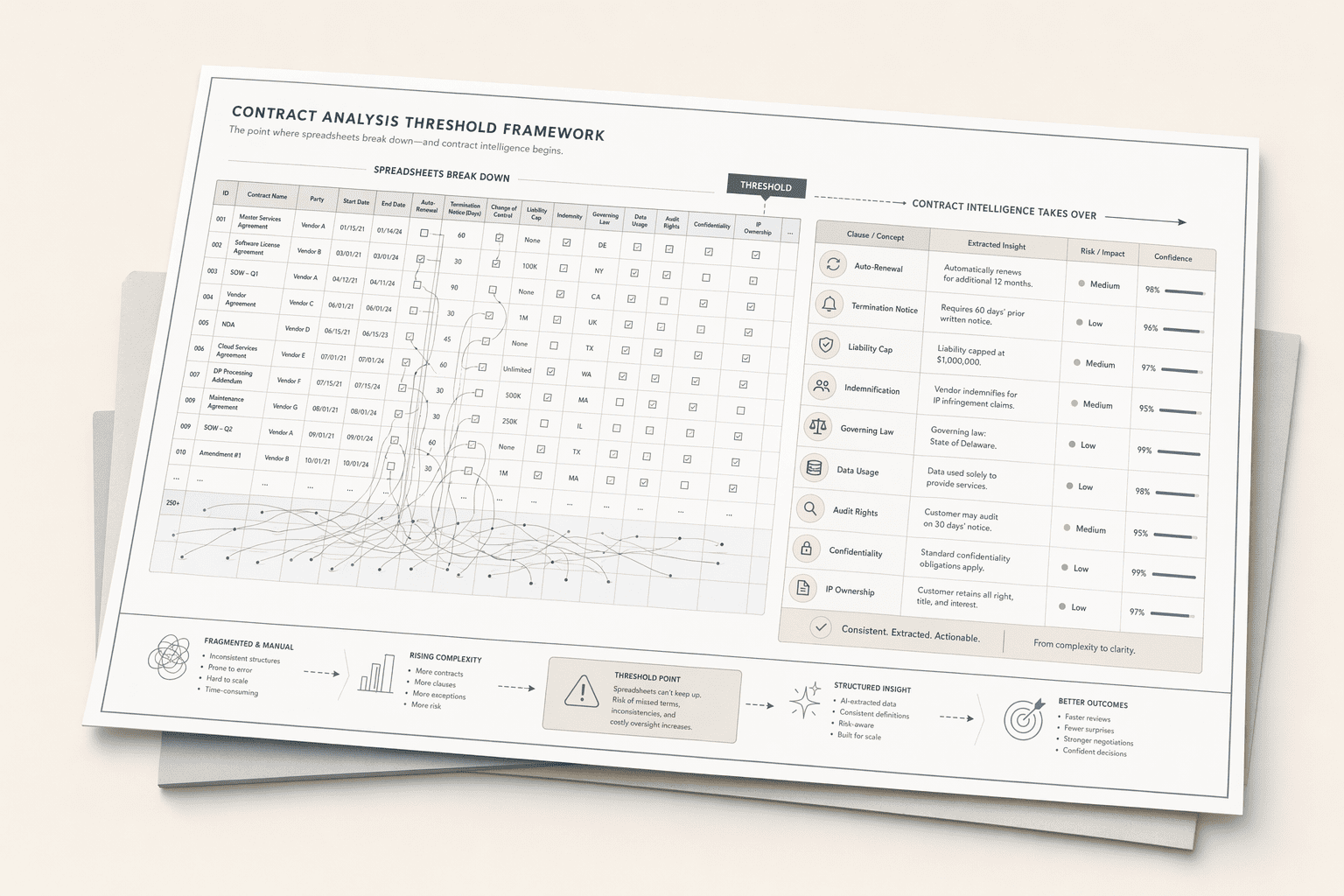
Finance teams often cling to spreadsheets for vendor contract tracking until the volume, complexity, or collaboration demands make the workaround costlier than the cure. This section defines the concrete decision thresholds, active contract counts, obligation types tracked, and multi-user collaboration requirements, that signal it’s time to adopt a contract intelligence platform.
Volume and Complexity Thresholds
Spreadsheet adequacy typically ends when your finance team manages more than 50 active vendor contracts. Beyond that volume, manual entry errors compound, renewal dates slip through quarterly checks, and compliance audits expose gaps in obligation tracking. Complexity amplifies the threshold: if you track payment schedules, performance SLAs, auto-renewal clauses, termination provisions, and liability caps for each contract, even 30 agreements can overwhelm a shared Excel file. The US AI-powered contract management market was already worth around $1.18 billion in 2025, reflecting enterprise recognition that legal, finance, HR, and operations teams need structured workflows for contracts that are easier and faster to draft.
The Collaboration and Alert Automation Breaking Point
Spreadsheets break when three or more finance team members need concurrent access to the same contract repository, and when renewal alerts must fire automatically at 90-day, 60-day, and 30-day windows. Shared-drive versioning conflicts erase updates; email-based reminders rely on calendar discipline rather than obligation-driven logic. If your team has missed a single auto-renewing contract that cost five figures to exit mid-term, the collaboration and alert automation gap has already materialized. Platforms in this category embed role-based permissions, audit trails, and obligation-triggered notifications that spreadsheets cannot replicate without brittle macro scripting.
Piloting a Contract Intelligence Platform Without Full Migration
Risk-averse finance teams pilot before migrating the full repository. Start with your 10 to 20 highest-value vendor contracts, those with the largest annual spend, most complex obligations, or shortest renewal windows. Upload these to the platform, configure obligation alerts, and run parallel to your spreadsheet for one renewal cycle (typically 90 days). Measure extraction accuracy, alert reliability, and user adoption during the pilot. Contracts.ai’s approach lets enterprise customers use their own models with BYO keys, which supports phased rollout without re-training on your full corpus. Ironclad, Icertis, DocuSign CLM, and Coupa each offer pilot-tier engagements; the table below compares their repository tracking, renewal alerts, and ERP integrations to help you scope your proof-of-concept.
| Platform | Pricing (starting) | Repository/Obligation Tracking | Renewal Alerts | ERP Integrations | User Rating |
|---|---|---|---|---|---|
| Contracts.ai | Contact for pricing | AI extraction with >99% accuracy; obligation-level tagging | Automated, obligation-triggered | NetSuite, others via API | Not publicly disclosed |
| Ironclad | Contact for pricing | Workflow-native CLM with AI features | Yes | Available | Not publicly disclosed |
| Icertis | Contact for pricing | Enterprise CLM | Yes | Available | Not publicly disclosed |
| DocuSign CLM | Contact for pricing | Workflow-native CLM with AI features | Yes | Available | Not publicly disclosed |
| Coupa | Contact for pricing | Procurement-centric CLM | Yes | Native | Not publicly disclosed |
When your pilot confirms that the platform catches renewal obligations your spreadsheet missed, and your team prefers the structured workflow, schedule full migration. If the pilot reveals gaps, extraction errors, missing integrations, or poor user adoption, either refine configuration or evaluate a different vendor before committing your entire repository.
When spreadsheet workarounds break, finance teams turn to specialized platforms that combine centralized storage with obligation intelligence and automated alerts.
Best Platforms to Centralize and Track Vendor Contract Obligations
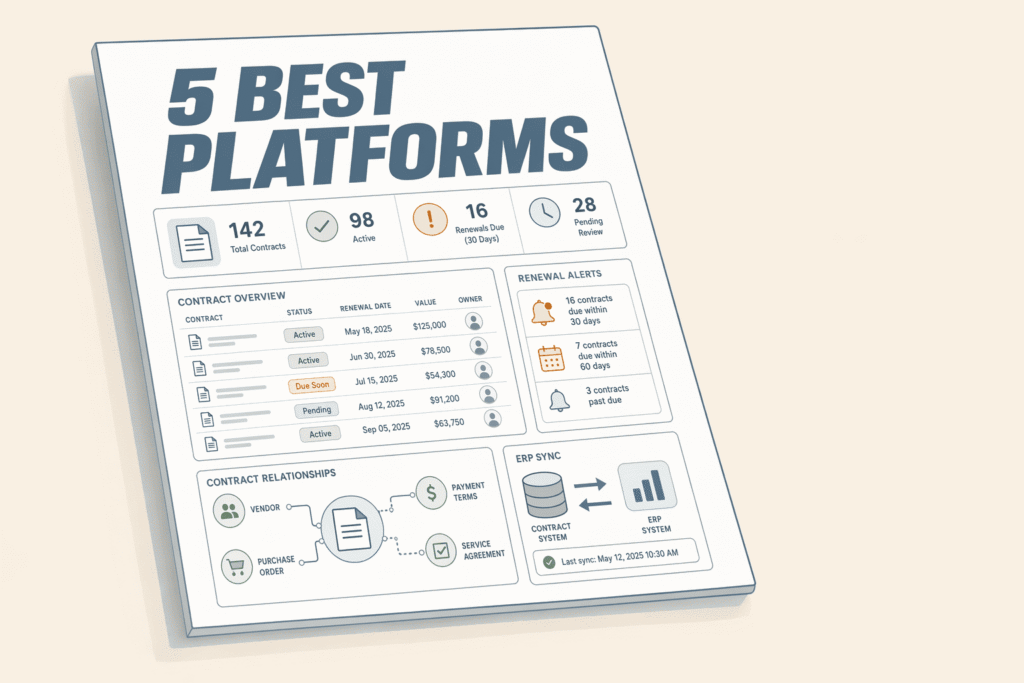
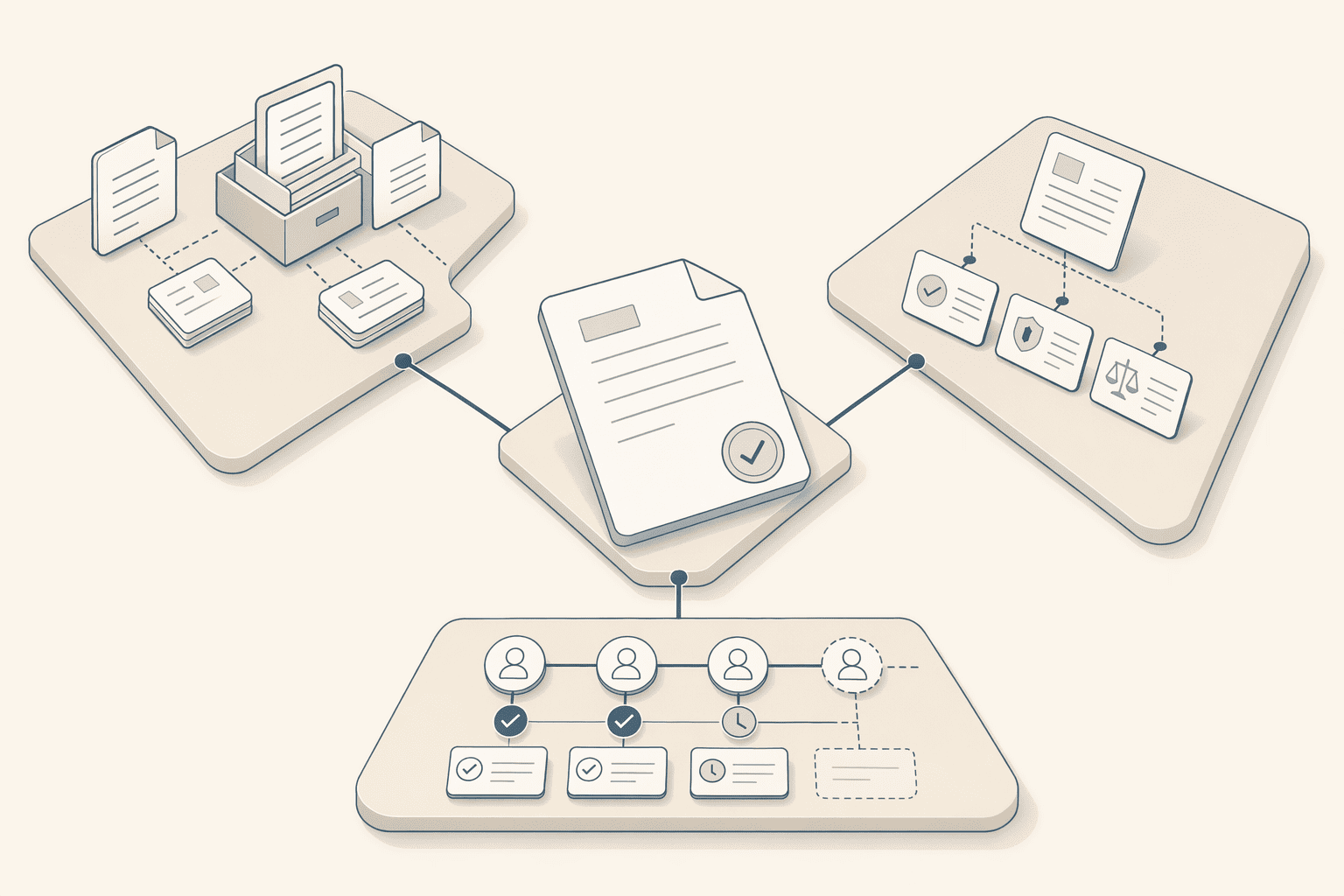
Finance teams managing vendor portfolios across emails and shared drives face missed renewal deadlines, limited visibility into supplier obligations, and approval delays. Modern contract management platforms solve these challenges by bringing contracts, approvals, and vendor oversight into centralized repositories. The right solution depends on portfolio size, AI requirements, and existing enterprise infrastructure.
AI-Powered Contract Intelligence Platforms
Platforms like Contracts.ai and Evisort use machine learning to automatically extract key terms, obligations, and renewal dates from legacy vendor contracts. Contracts.ai transforms executed agreements into structured, operational intelligence that flows across finance, procurement, and legal teams, with natural-language querying and obligation tracking that doesn’t require contract approval workflows. These tools shine when teams need to centralize scattered historical contracts and surface buried terms quickly.
Enterprise CLM Platforms for Large Vendor Portfolios
Organizations managing hundreds of vendor contracts often turn to enterprise CLM solutions like Icertis, SAP Ariba, and Coupa. Gartner defines CLM as solutions that manage contracts from initiation through renewal, providing role-based access to terms and obligations with third parties. These platforms integrate deeply with ERP systems, finance teams using Oracle or SAP can route vendor invoices directly against contract terms through Oracle integrations and SAP integrations. Best for teams prioritizing ERP alignment over AI-driven extraction.
Mid-Market CLM Tools with Finance-Team Focus
Mid-market platforms such as Ironclad, DocuSign CLM, and ContractWorks target finance operations teams with simpler workflows and lower implementation overhead. These tools centralize vendor agreements in searchable repositories and automate renewal alerts, but typically lack the AI extraction depth of intelligence platforms or the ERP-native features of enterprise CLM suites. Pricing varies widely, teams should evaluate based on contract volume, approval complexity, and the need for AI-assisted obligation tracking versus manual tagging.
AI-powered contract intelligence platforms like Contracts.ai and Evisort accelerate legacy contract audits but cost more than traditional CLM tools, while mid-market platforms like Ironclad and DocuSign CLM require manual obligation tagging but offer lower entry pricing for teams with structured contract intake processes. The best platform for centralizing vendor contract obligations depends on whether you need to audit a legacy portfolio requiring AI-powered extraction or simply organize new contracts going forward where traditional CLM suffices.
As finance teams adopt AI-powered contract intelligence, the competitive advantage will shift from simply having a contract repository to predicting obligation conflicts and renewal risks before they materialize, obligation tracking is becoming a strategic finance capability, not just a compliance checkbox.
Audit your scattered vendor contracts using the 3-step methodology from section 3, then explore Contracts.ai’s AI-powered obligation extraction to see how quickly you can centralize your legacy portfolio. Start by inventorying your contracts and defining the five obligation types you must track before selecting software.
Frequently Asked Questions
What are the most common vendor contract obligations that finance teams miss?
Finance teams most frequently miss auto-renewal clauses and termination notice periods, obligations that determine contract lifecycle control. The five critical obligation types are payment terms, auto-renewal clauses, termination notice periods, compliance requirements, and performance obligations. Modern AI systems extract renewal terms automatically, reducing the risk of missed notification deadlines.
How do I extract obligations from vendor contracts that weren’t created with tracking in mind?
AI-powered contract platforms like Contracts.ai use natural language processing to automatically extract payment schedules, renewal terms, liability caps, and compliance obligations from legacy PDFs. This approach scales for portfolios exceeding fifty contracts, where manual extraction becomes infeasible. The platforms identify obligation clauses without manual tagging, accelerating audit timelines from weeks to days.
Should I use a shared drive, a CLM system, or a contract intelligence platform?
Shared drives suffice for fewer than 20 contracts with minimal auto-renewal risk; traditional CLM systems handle 20-100 contracts when teams can manually tag obligations at creation; AI-powered intelligence platforms become key for 100+ contracts or legacy portfolio audits requiring automated extraction. These three models represent sequential maturity stages rather than discrete alternatives.
Can I pilot a contract intelligence platform with just my highest-value vendor contracts?
Yes, finance teams typically select 10-20 high-value vendor contracts for initial platform testing before full migration. Manual extraction remains feasible for portfolios under fifty contracts; beyond that threshold, AI-powered extraction accelerates the process significantly. This pilot-first approach validates obligation extraction accuracy and workflow integration before enterprise deployment.
What’s the difference between contract management software and contract intelligence platforms?
Traditional CLM requires manual obligation tagging and structured data entry at contract creation; AI-powered intelligence platforms like Contracts.ai and Icertis automatically extract obligations, renewal terms, liability caps, and payment schedules from legacy contracts without manual tagging. Intelligence platforms analyze content in minutes rather than hours, enabling rapid legacy portfolio audits.
How do contract intelligence platforms integrate with ERP and procurement systems?
Contract intelligence platforms use API connections to pull metadata from Oracle, SAP, and Coupa; webhook alerts notify finance systems of upcoming renewals; and export capabilities generate payment term calendars for ERP import. Contracts.ai and Icertis lead integration capabilities, extracting obligations and syncing renewal data across enterprise systems automatically.
What key data fields should I track for every vendor contract?
Finance teams must track six key fields: counterparty name, effective date, expiration date, auto-renewal terms, payment schedule, and termination notice period. These fields enable cash flow forecasting, renewal calendar generation, and termination deadline compliance. Manual extraction remains feasible for portfolios under fifty contracts; beyond that threshold, AI-powered extraction accelerates data capture significantly.