Introduction
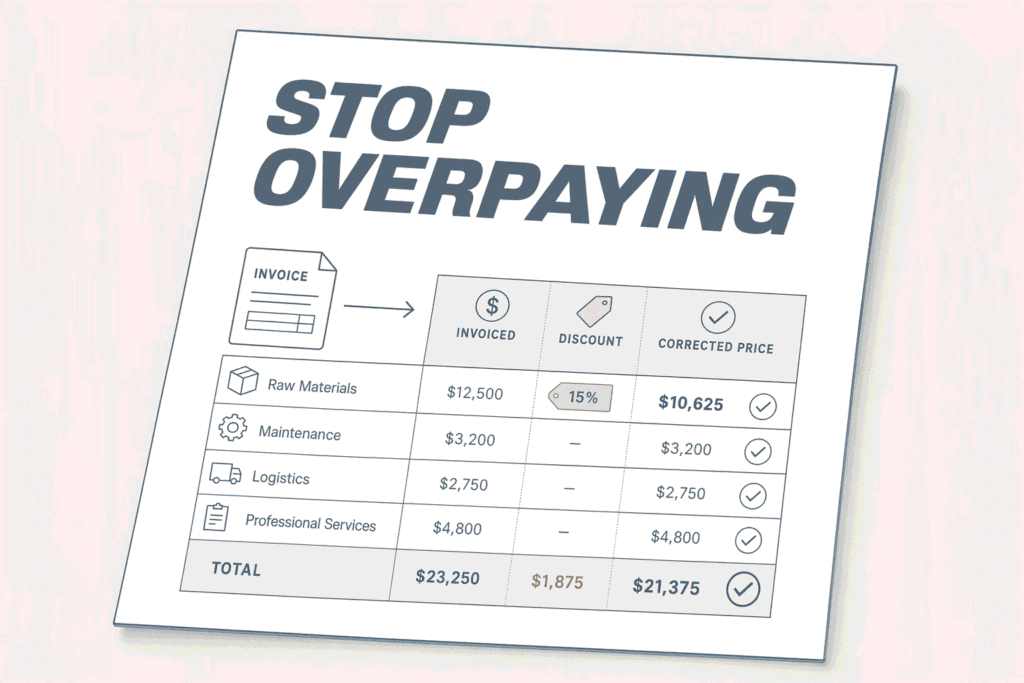
Your finance team approved a budget based on negotiated discounts, but the invoices arriving in AP tell a different story. Those promised tiered rates are missing, the volume rebate wasn’t applied, and you only discover the leakage months later during a manual audit. Vendor discount non-compliance is a silent margin killer, bleeding cash from organizations that still rely on retrospective, sample-based invoice reviews.
This broken model leaves money on the table. Manual reconciliation can’t scale across thousands of line items, layered agreements, and complex rebate structures that involve thousands of transactions. The gap between what you negotiated and what you actually pay widens with every invoice cycle, eroding procurement’s credibility and the P&L.
There’s a better way. AI-powered contract intelligence platforms now automate the comparison of contracted pricing against every invoice line item, flagging discrepancies right away instead of months later. This article maps the exact seven-step journey from opaque, static contracts to continuous, automated surveillance of vendor compliance, giving you real-time financial control over every dollar spent.
Key Takeaways
Here are the seven core outcomes you gain by implementing real-time vendor discount visibility:
- Digitized contracts: OCR and NLP extract every discount term from static PDFs, building a dynamic, machine-readable database of what vendors actually owe you.
- Single source of truth: Contract data merges directly with your ERP and AP systems, eliminating the silos that make reconciliation impossible.
- Line-level matching: Every invoice SKU and price is algorithmically compared against your contracted rates, with matches auto-approved and deviations quarantined immediately.
- Continuous audit trail: A timestamped, tamper-proof log captures every match, discrepancy, and resolution, satisfying both internal governance and external audit requirements.
- Real-time dashboards: Discount utilization metrics and objective vendor scorecards translate raw compliance data into actionable business intelligence.
- Secure access controls: Granular role-based permissions protect the integrity of compliance data while routing review tasks to the right people.
- Proactive alerts: Automated notifications for invoice anomalies, contract renewals, and expiring discount windows prevent leakage before it happens.
Step 1: Digitize and Extract Discount Terms from Every Contract
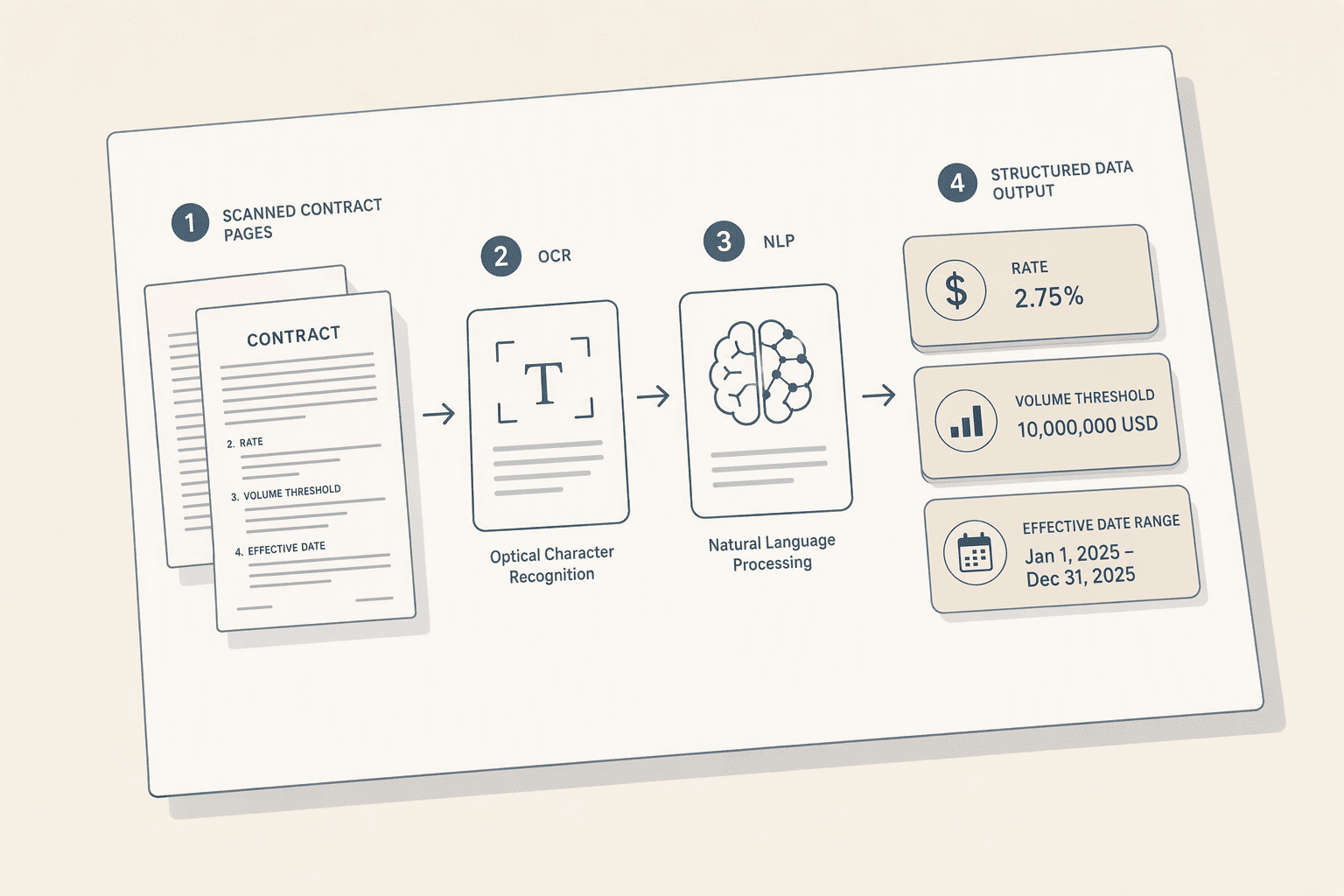
Your first move is to stop treating contracts as documents and start treating them as structured data. You achieve this by running every relevant vendor contract through a pipeline that combines Optical Character Recognition (OCR) and Natural Language Processing (NLP):
- OCR and NLP pipeline: OCR renders scanned PDFs and images into text, then NLP interprets that text, identifies specific discount structures, and extracts exact values, percentages, volume thresholds, and effective date ranges.
- Context-aware AI models: Modern AI models trained on procurement documents distinguish between a one-time promotional discount and a standing tiered pricing commitment, understanding context rather than just keyword matching.
- Enterprise-grade accuracy: This extraction must hit enterprise-grade accuracy, Hyperbots, for example, demonstrates 99.8% extraction accuracy for unstructured data, a threshold that makes the resulting database trustworthy for financial decisions.
- Inference-time learning: Inference-time learning pushes that accuracy higher over time.
- Pilot platform example: A tool like Contracts.ai lets you ingest a limited contract set first, piloting the extraction on one vendor category without disrupting your legal or procurement workflows, structuring findings from term length and renewal dates to liability caps and service level agreements.
Step 2: Centralize Contract Data with Your Invoice and Procurement Systems
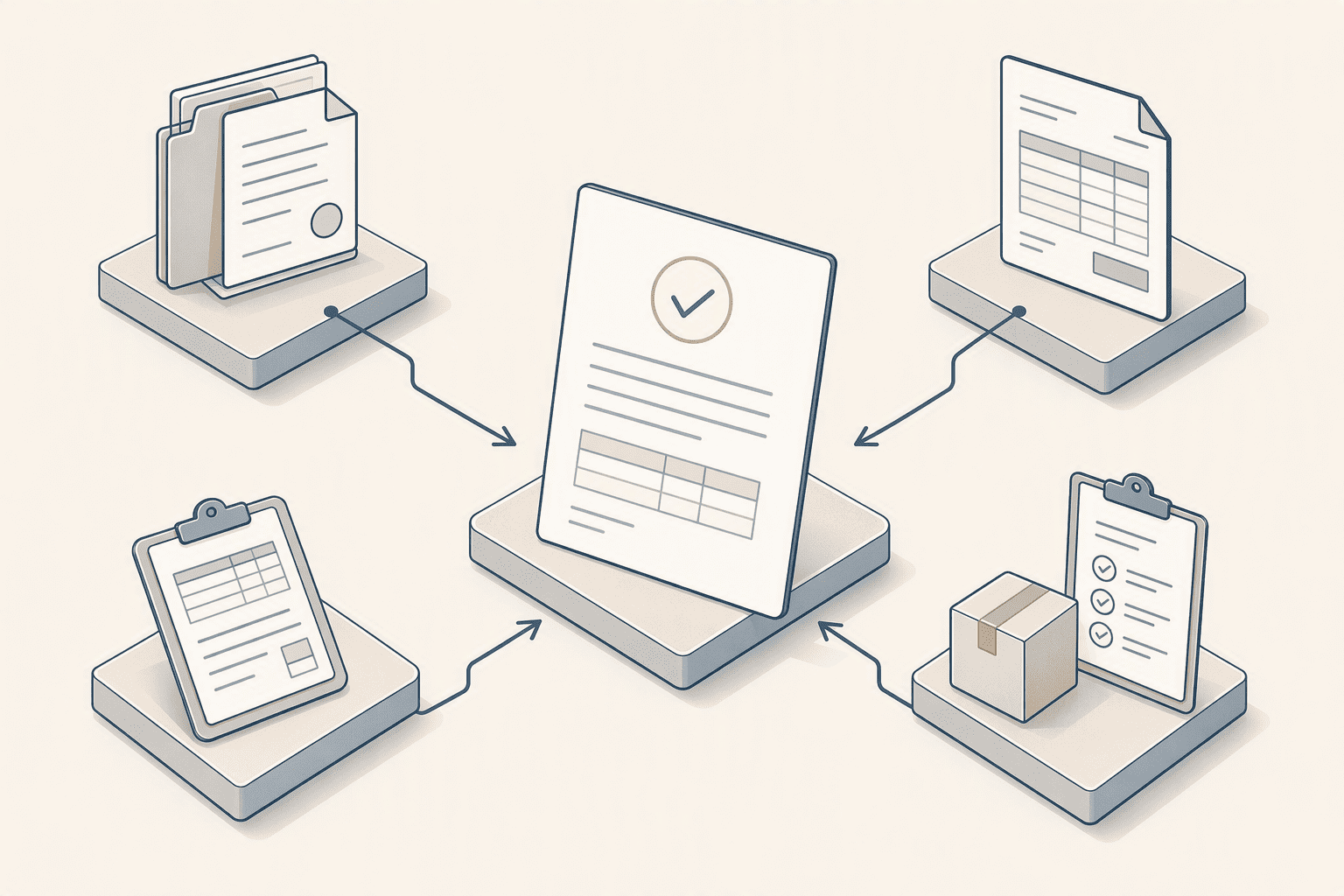
Extracted discount terms are only half the picture. To catch non-compliance, that structured data must collide with your live transactional reality, meaning every invoice, purchase order, and receiving record in your AP, ERP, and procurement systems. Here is the integration sequence for marrying them into a single source of truth:
- Map your source systems first: Identify every platform where invoices land, contracts are stored, and procurement events are recorded. This includes your ERP (NetSuite, SAP), AP automation tool (Bill.com, Ramp), and any dedicated CLM repository.
- Deploy pre-trained API connectors: Rather than building custom integrations from scratch, use a platform with pre-built connectors, which Covasant reports accelerates build time by 80%. Contracts.ai similarly offers an API-first approach that connects to existing procurement systems without a rip-and-replace.
- Cleanse and standardize the data: Raw invoices and contracts use inconsistent vendor names, SKU formats, and unit-of-measure codes. A data quality engine must auto-deduplicate, normalize, and enrich records so your system recognizes that ‘ABC Corp’ and ‘ABC Corporation’ are the same entity with the same discount obligation.
- Establish a unified vendor master record: The final state is a single record per vendor that links the extracted discount schedule to every inbound invoice line, creating a permanent, auditable bridge between what was promised and what is being billed.
Step 3: Configure Automated, Line-Level Invoice Matching Against Extracted Rates
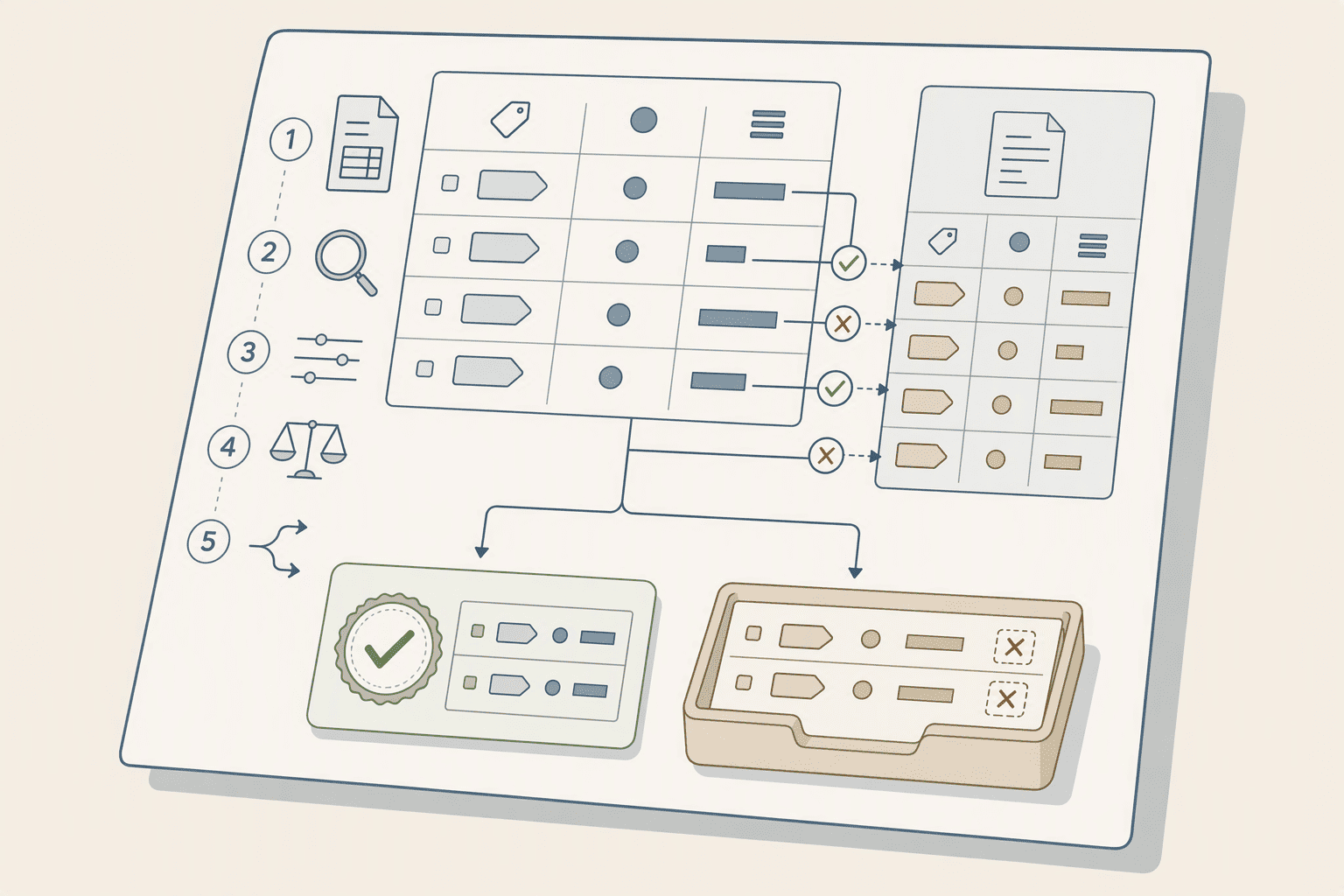
Now you build the engine that actually catches the leakage. The system algorithmically compares every invoice line item, SKU, unit price, and quantity against the corresponding contract clause extracted in Step 1 in a rigorous, automated process touching every single line on every single invoice:
- Auto-approval for perfect matches: When a match is perfect, the invoice auto-approves without human intervention, flowing straight through to payment.
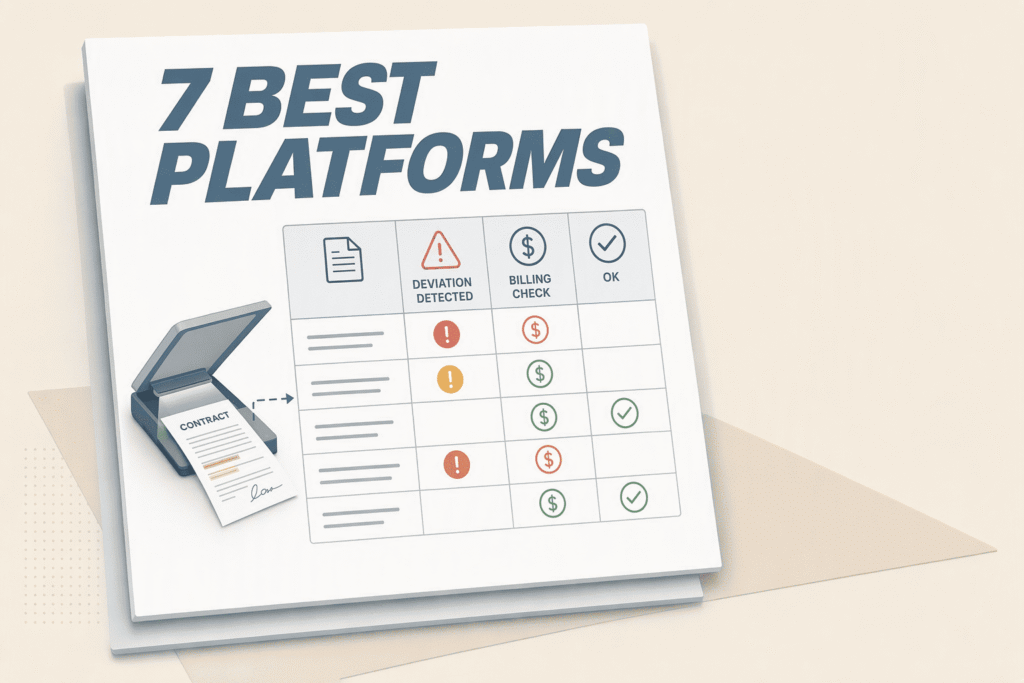
- Quarantine for discrepancies: When the system detects a discrepancy (a price 2% above your negotiated rate, a volume discount tier not applied, a surcharge not authorized), it instantly quarantines that transaction; the invoice does not proceed until a human reviews the exception, equipped with a direct link to the contract clause dictating the correct price.
- Complex logic configuration: You can configure the matching logic to handle complexity like tiered discount thresholds dependent on cumulative quarterly spend or SKU bundles with blended pricing.
- Rebate calculation capability: The system must be able to calculate whether a volume rebate is earned against pre-agreed terms such as volume, growth targets, or product mix, not just a static unit price.
Step 4: Establish a Continuous Audit Trail Across All Discount Events
The system must record everything. Every match, every flagged discrepancy, every user action, and every resolution needs a timestamped, tamper-proof entry in an immutable log. This shifts your compliance posture from a periodic, stressful scramble to produce documentation for an audit, to a continuous control environment that is always audit-ready. The evidence exists in real time, not as a post-hoc reconstruction of what might have happened.
That is the shift: continuous, automated surveillance instead of reactive sampling.
For teams subject to SOX compliance or SOC reporting, this auditability is a control requirement. You must prove that discount verification was performed consistently and that exceptions were handled through a governed process. Contracts.ai provides granular role-based access and full auditability, with detailed logging across all system activity. An auditor can trace any discount discrepancy from the original invoice line back to the contract clause, through the review and approval decision, all with a timestamped chain of custody. The trail matters as much as the catch itself.
Step 5: Build Real-Time Dashboards for Discount Utilization and Vendor Scorecards
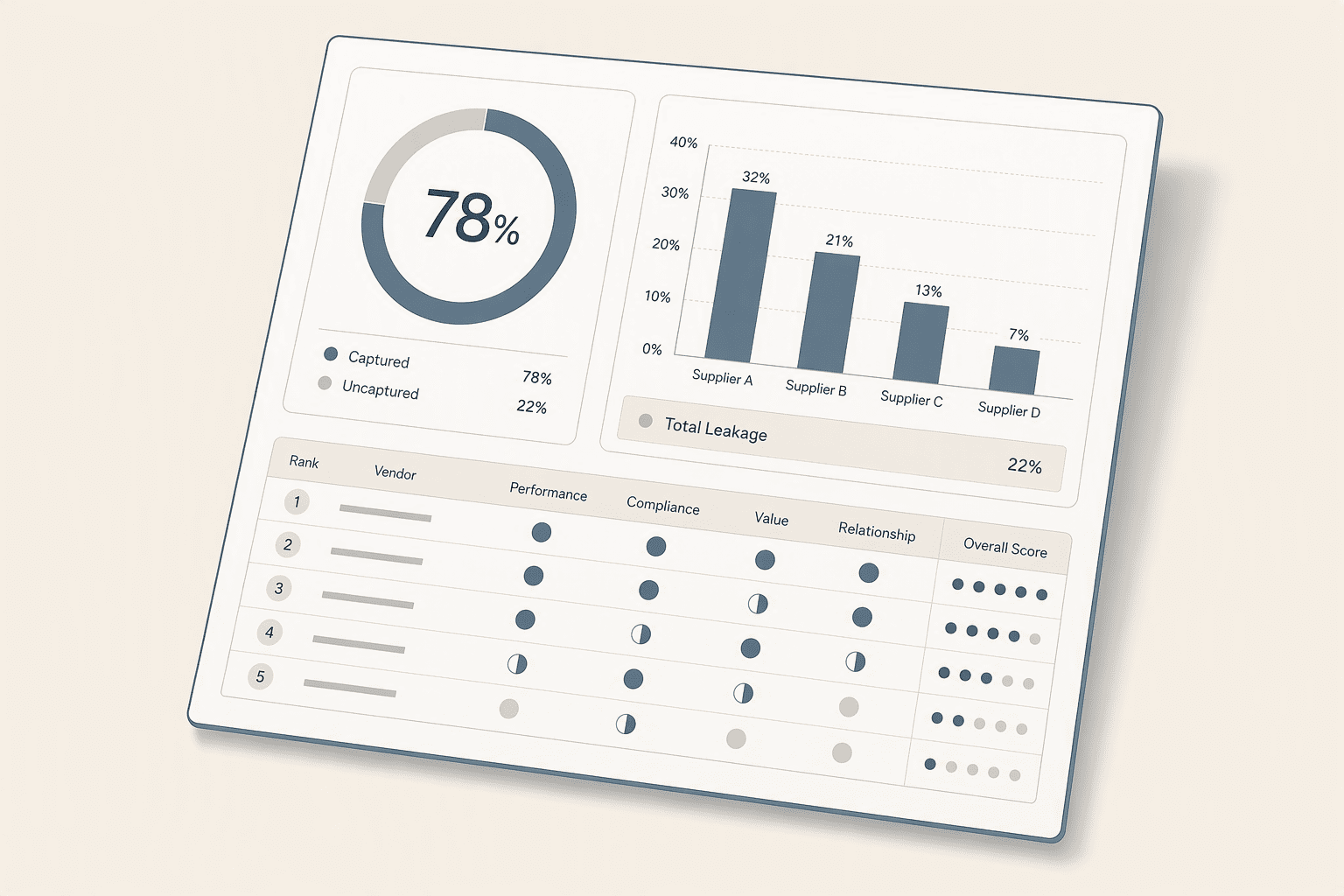
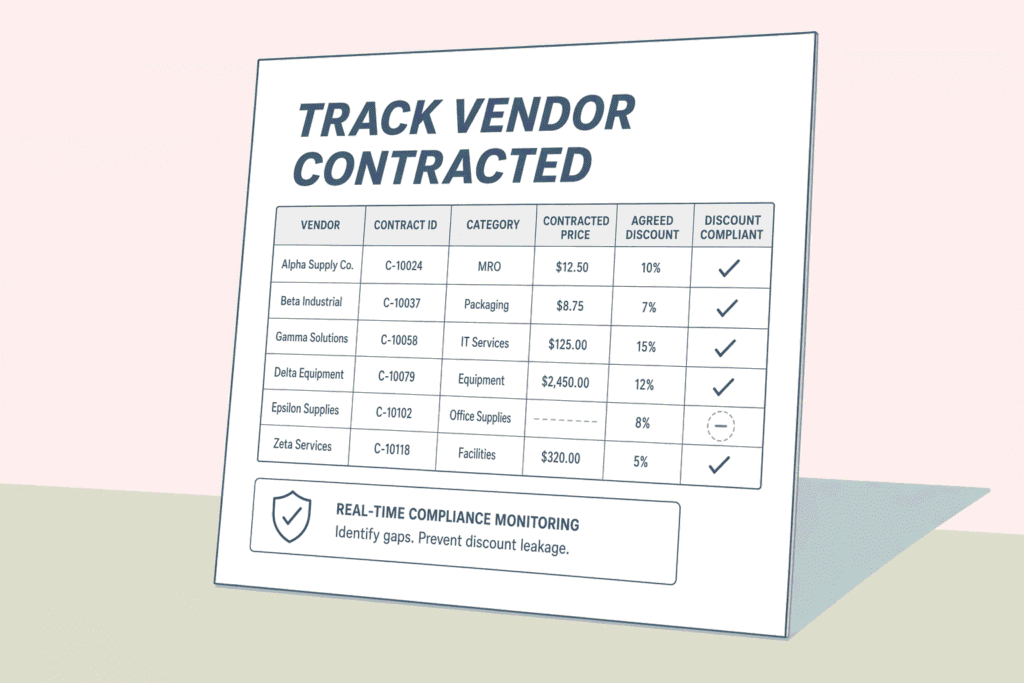
Raw compliance data won’t hold a category manager’s attention for thirty seconds. You have to shape it into the handful of numbers someone can actually act on. Build a dashboard that surfaces three things immediately: the percentage of negotiated discounts your team captured versus lost, the hard-dollar leakage broken out by supplier, and an objective scorecard that ranks each vendor on invoice accuracy and contract adherence over time.
The table below maps the dashboard dimensions worth building, the specific question each view answers, and the business move it makes possible:
| Dashboard Dimension | What It Answers | Business Action It Enables |
|---|---|---|
| Discount Utilization Rate | What percentage of negotiated discounts were actually captured vs. missed? | Identify which vendor relationships are generating real savings and which need renegotiation or enforcement. |
| Monetary Leakage by Vendor | Which suppliers are costing the most through non-compliance, in hard dollars? | Prioritize vendor audit and recovery efforts on the largest sources of leakage. |
| Discrepancy Resolution Time | How long does it take to resolve a flagged price deviation? | Measure AP team efficiency and identify bottlenecks in the review and approval workflow. |
| Vendor Invoice Accuracy Score | What is the objective error rate for each vendor’s invoices over the last 12 months? | Provide objective, quantitative evidence for quarterly business reviews and vendor performance management. |
| Discount Window Calendar | Which active discount periods or rebate windows are closing in the next 30 to 60 days? | Trigger proactive purchasing decisions to capture expiring incentives before they lapse. |
One dashboard build that tries to serve everyone ends up serving nobody. AP clerks need a queue of their open exceptions. Category managers need a portfolio view of vendor health. Each user should be able to configure their own view without waiting on an admin. Get this right, and the invisible cost of non-compliance becomes visible and actionable for the first time.
Step 6: Implement Granular Role-Based Access for Secure Compliance Reviews
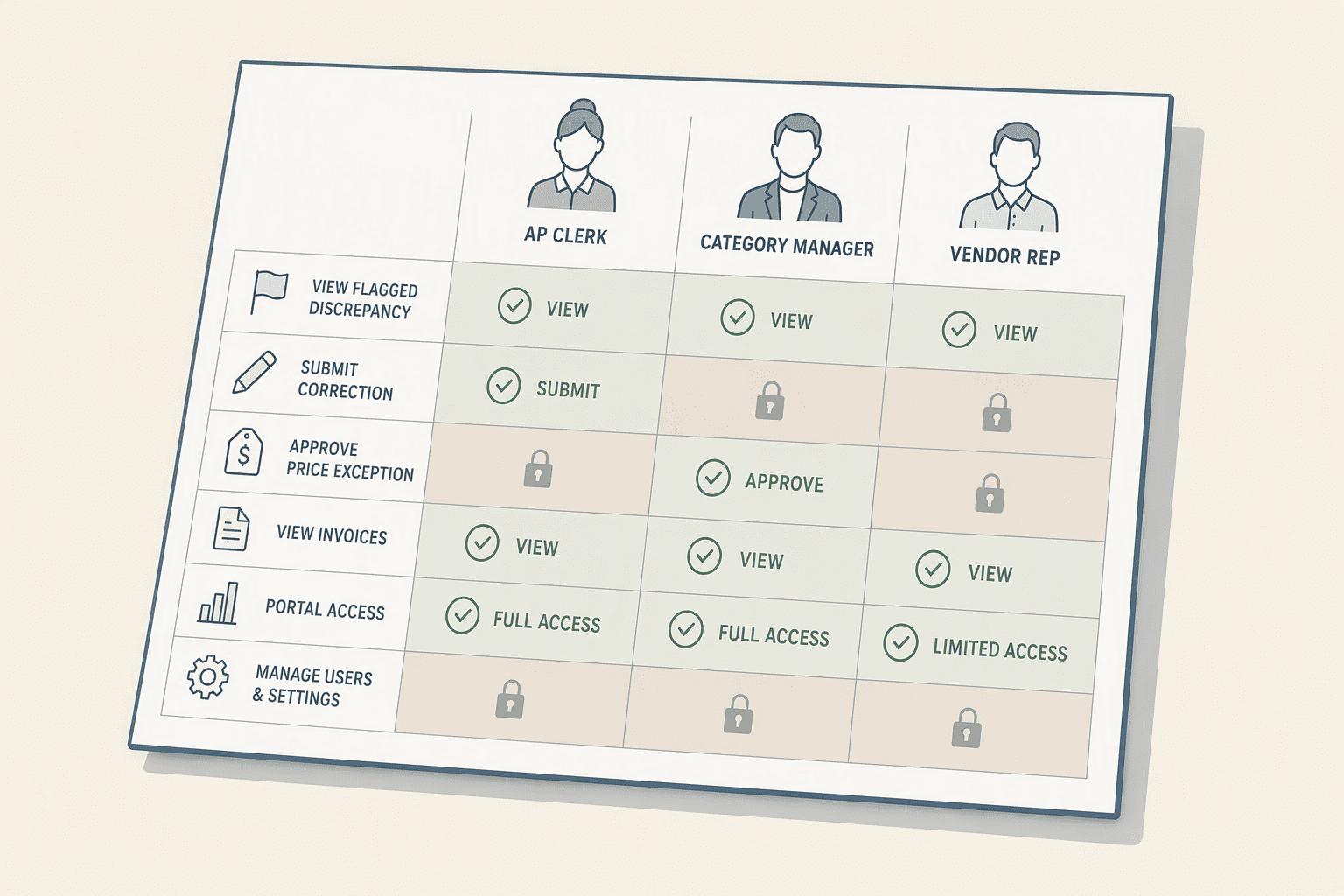
Compliance work that touches vendor payments and contract pricing deals with sensitive information. Not everyone should see everything. You need to segment visibility and permissions so each role gets exactly what it needs and nothing more.
An AP clerk can view flagged discrepancies and submit corrections, but cannot override a contracted rate. A category manager can approve a price exception but cannot touch the underlying contract clause. When you give vendor reps limited portal access for self-service invoice tracking, they see only their own transactions and never another supplier’s rates.
This hierarchy keeps the control environment intact. Contracts.ai, for example, enforces granular role-based access controls that let you decide who can view discrepancies, approve exceptions, or update terms.
A deviation then follows a governed path from detection through authorized review to final disposition. You don’t create a backchannel for unauthorized rate changes, and you don’t expose sensitive pricing data to the wrong person, inside or outside the organization.
Step 7: Set Up Automated Alerts for Anomalies, Renewals, and Discount Windows
With real-time matching and a continuous audit trail running, you shift from chasing past errors to preventing future leakage. You configure the system to push notifications, not require ad-hoc report pulls. Two classes of alerts matter most:
- Operational alerts: These fire on threshold-based anomalies, a single invoice exceeds the contracted price by a configurable percentage, a vendor submits an invoice against a contract not in the system, or a discount that should have been applied on a high-volume SKU goes missing for two consecutive billing cycles; these alerts route directly to the responsible AP analyst and category manager, enabling same-day resolution instead of quarter-end discovery.
- Commercial alerts: These protect you from missed opportunities and blind risks by monitoring every contract for approaching renewal dates, auto-renewal windows, and the expiration of strategic discount periods, and flagging problematic terms like discount decay clauses, auto-renewal windows shorter than 60 days, or uncapped overage provisions.
Conclusion
Real-time vendor discount visibility works when you digitize contract terms, connect them to your transactional systems, and automate the line-item comparison. The seven steps above turn a manual, leaky, after-the-fact process into a control that catches a price deviation right as it happens.
Start with one vendor category. A platform like Contracts.ai lets you run a pilot on a small set of contracts without replacing your current infrastructure. The margin you recover from that pilot will fund the rest, shifting procurement compliance from a cost center to a line item that puts money back on the P&L.
Frequently Asked Questions
What technologies enable real-time tracking of vendor contract compliance and discount application?
The core stack combines Optical Character Recognition (OCR) to digitize contract documents, Natural Language Processing (NLP) to interpret and extract discount clauses, and AI models that automatically compare those extracted rates against invoice line items from your AP and ERP systems. API-first integration layers connect these components to your live transactional data.
How do AI-powered contract analysis platforms automate discount verification against invoices?
They perform automated, line-level matching where every invoice SKU, unit price, and quantity is algorithmically compared to the corresponding contract clause. Perfect matches auto-approve for payment. Deviations are instantly quarantined and routed to a human reviewer, who sees the specific contract language dictating the correct price.
What key features should enterprises look for in a contract intelligence tool to ensure vendor price adherence?
Look for high extraction accuracy (99.8% on unstructured data), pre-built API connectors to reduce integration time by up to 80%, granular role-based access controls, a continuous and immutable audit trail, real-time anomaly alerting, and dashboards that quantify discount utilization and vendor invoice accuracy as objective scores.
How does a structured approach to contract data differ from manual spend analysis for catching overcharges?
Manual spend analysis is periodic, sample-based, and retrospective. You catch errors months after payment. A structured, AI-driven approach provides continuous, automated surveillance of every single invoice line in real time, flagging discrepancies before payment leaves your organization and creating an audit trail from the moment of detection.
What are the primary challenges in achieving real-time visibility into vendor discount honoring?
The two main challenges are integrating data from disparate sources (extracting complex, unstructured discount terms from PDFs and merging them with live ERP invoice data) and handling contract complexity such as tiered volume thresholds, bundled pricing, and decaying discount schedules that simple rule-based systems cannot process.
How can organizations pilot a contract intelligence solution without disrupting existing procurement workflows?
Start with a single vendor category and a limited contract set. Use a platform with pre-trained API connectors that integrates with your existing ERP and AP systems, avoiding rip-and-replace. Run the pilot on that narrow scope to demonstrate recaptured margin, then expand:
- Single vendor category pilot: Start with a single vendor category and a limited contract set.
- Pre-built API integration: Use a platform with pre-trained API connectors that integrates with your existing ERP and AP systems, avoiding rip-and-replace.
- Demonstrate value first: Run the pilot on that narrow scope to demonstrate recaptured margin, then expand.
- Pilot support example: Contracts.ai, for example, supports a limited-contract-set pilot approach.
Sources
- AI Contract Summary & Vendor Intelligence – Ramp Help Center – support.ramp.com
- Vendor Cost Compliance | AI Vendor Spend Governance and Contract Monitoring – www.covasant.com
- Supplier Rebates: Strengthening Partnerships and Driving Growth – IMA360 – ima360.com
- Vendor Portal for Payment and Approval Tracking – www.hyperbots.com