








Introduction
Your finance team closed the books last quarter, but something gnawed at you. You approved a vendor invoice that looked inflated, yet chasing down the original contract language to verify the terms would have taken hours your team didn’t have. That quiet suspicion is a massive, quantifiable problem. In just six months, a single AI auditing platform reviewed $34 million in AI spending across 60 companies and found $1.7 million in overcharges.
This is about the gap between what your team negotiated and what your accounts payable system actually processes. Every misaligned invoice, missed credit, and unoptimized renewal contributes to a silent revenue leak that compound interest can never fix.
A new category of software has emerged to close this gap. Agentic post-signature auditing platforms operate as an intelligence layer over your existing ERP and CLM, continuously comparing executed contracts against billing events. They don’t just store contracts; they activate them. This article maps the most capable options for US enterprise procurement teams ready to stop guessing and start auditing.
Key Takeaways
The platforms in this list share a common architecture: they overlay your existing setup with intelligence that catches what you would otherwise miss. The core systems stay put. Before you start an evaluation, weigh these five findings.
- The intelligence layer architecture wins: You skip the rip-and-replace migration. Contracts.ai and Vaudit sit above your current billing and CLM systems and pull the data they need.
- A pilot proves the value in weeks: Connect a platform to your live billing feeds and a subset of contracts to validate error detection rates without disrupting any workflow.
- Verifiable ROI data exists: Vaudit’s TokenAudit recovered 80% of identified overcharges, while Agree reports a measurable leakage reduction across its customer base.
1. Contracts.ai, Agentic Post-Signature Auditing with Zero-Training Privacy Architecture

Contracts.ai was built by operators who spent 30-plus years installing CLMs, ERPs, and procurement systems inside global enterprises. That experience shapes the product’s focus: the post-signature chaos that starts the moment an agreement is executed and filed away. The platform runs an agentic workflow that continuously scans signed agreements against your actual billing, flagging overcharges and scope creep as they appear.
Architecturally, it connects to your existing systems without demanding a full repository migration. You keep your data boundaries intact.
The privacy model is just as specific. Contracts.ai states that its CTO and engineering leadership directly oversee the privacy and data protection program, and the company does not train generalized models on proprietary customer data. For a finance chief weighing the risk of exposing sensitive commercial terms to an AI system, a zero-training posture removes the biggest adoption barrier in one stroke.
The platform automatically groups related agreements and aligns shared terms, then links every answer to source contract language. You see the exact clause behind each flag. A procurement team member can validate a finding in under a minute and escalate to the supplier with the contract language in hand. Run a pilot on a limited contract set without touching the full repository, and the proof-of-concept phase becomes operationally trivial.
2. Vaudit, AI-Native Intelligence Layer with TokenAudit Precision

Vaudit’s architecture is the purest expression of the intelligence layer philosophy. It operates independently of your existing billing and CLM systems, auditing the data flowing through them without requiring any data migration. The platform’s headline product, TokenAudit, published results from March to September 2026 that reset expectations for what an audit layer can deliver: across 60 companies, it reviewed $34 million in AI spending and identified $1.7 million in overcharges. Critically, hyperscalers including AWS and Google Cloud credited 80% of those identified overcharges back to the customers.
That 80% recovery figure is the statistic procurement teams should cite in their internal business case. It proves that the gap between error detection and cash recovery is not theoretical. For a US enterprise spending heavily on AI inference and model access, this is not an audit tool, it is a direct margin lever that pays for itself inside a single billing cycle.
3. LinkSquares, AI-Powered Contract Analysis with Automated Payment Flagging

LinkSquares puts automated financial oversight inside a contract lifecycle management platform that legal teams already use. Instead of handing off a signed contract to the billing team and hoping for the best, the system reads the payment terms and monitors invoices against them.
- Automated payment term extraction: The AI pulls payment obligations directly from negotiated contract language, creating a machine-readable set of expected billing events without manual data entry.
- Deviation flagging: LinkSquares flags invoices that diverge from the agreed-upon amounts, schedules, or conditions.
- Post-execution CLM extension: LinkSquares extends the same CLM used for authoring and negotiation into the post-signature financial oversight phase.
- Analyst coverage: LinkSquares is regularly cited in CLM market analysis, providing procurement teams with a referenceable vendor that has an established track record in enterprise legal departments.
4. Evisort, Enterprise CLM with Real-Time Revenue Recovery Workflows
Evisort embeds revenue recovery directly into the contract lifecycle workflow, it shows up as a native step, not an add-on module. Its real-time monitoring engine scans for billing discrepancies against negotiated terms and triggers correction processes that route straight to the relevant finance or legal team member. For a large enterprise where the gap between detecting an overcharge and getting a credit memo issued can stretch across multiple approval layers, that automated workflow routing collapses a process that otherwise relies on someone remembering to follow up.
Evisort’s real-time monitoring flags mismatches between invoiced amounts and contracted rates, then pushes a correction task to the person who can actually act on it. The workflow auto-routes to finance or legal depending on the nature of the discrepancy, so a billing error does not sit in an inbox waiting for the weekly reconciliation meeting.
Evisort’s heritage as an enterprise-scale CLM matters here. The platform was built to handle the contract volume and complexity that Fortune 500 legal departments generate, so when it extends into financial oversight, it does so with a data model that already understands multi-entity corporate structures, complex amendment chains, and localized billing terms. An enterprise with operating subsidiaries in multiple jurisdictions gets a system that maps to that structure from day one, without a separate integration to hold the hierarchy together.
The financial recovery use case is increasingly the differentiator in a crowded CLM market. Evisort has moved early to embed billing discrepancy correction into its core workflows, positioning the platform as a governance solution that bridges legal and finance.
5. Lexion, AI-Driven Audit Scope Expansion Across Agreement Groups
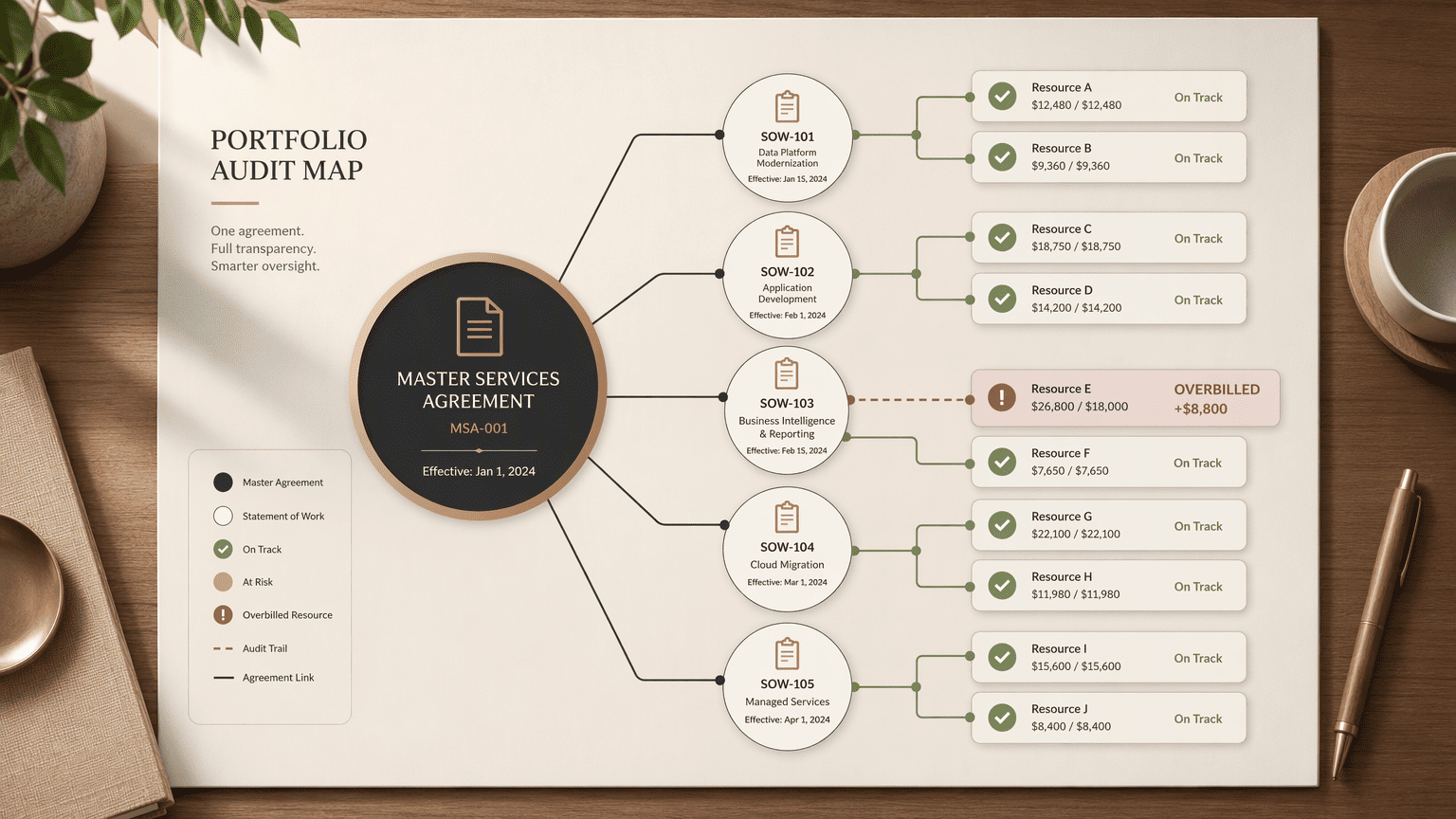
Lexion takes audit beyond line-by-line invoice matching and into portfolio-scale deviation detection. The platform groups related agreements and runs audit queries across them, surfacing billing inconsistencies that hide when you inspect contracts one at a time. A master services agreement might be billed correctly while a related statement of work on a different system is overcharging for the same resources.
Single-contract matching tools flag a deviation inside one contract-to-invoice pair and stop. That catches the individual overcharge. Lexion’s agreement group approach pulls every SOW, renewal, and subsidiary agreement into one view, which surfaces systemic billing misalignment across a supplier relationship that runs for years.
Legal and finance teams run natural-language queries across the grouped agreements instead of working through a queue of pre-flagged alerts. That shift changes the work: you stop reacting to one flagged line item at a time and start asking questions about an entire supplier portfolio. For a multi-SOW program where billing errors repeat across renewals, the difference matters.
| Audit Capability | Single-Contract Matching | Lexion’s Agreement Group Approach |
|---|---|---|
| Scope of detection | Flags deviations within one contract-to-invoice pair | Surfaces inconsistencies across a family of related agreements |
| Common use case | One-off invoice verification | Multi-SOW programs, renewal chains, subsidiary agreement portfolios |
| Risk addressed | Individual overcharge | Systemic billing misalignment across a supplier relationship over time |
| User query model | Inspector reviews a pre-flagged alert | Legal and finance teams run natural-language queries across grouped agreements |
6. SirionLabs, Clinical Trial and Regulatory Compliance Billing Guardian

For life sciences enterprises, SirionLabs addresses a risk that dwarfs financial leakage alone: regulatory billing compliance. When a clinical trial agreement governs payments tied to specific protocol milestones, a billing error is not just a cost problem. It is a potential compliance finding that can surface on a regulatory audit.
SirionLabs applies its CLM engine to clinical trial agreements specifically, flagging discrepancies between invoiced amounts and what the trial protocol and sponsor agreement actually authorize. Academic medical centers acting as trial sites have missions that include independent research and patient care, making them structurally misaligned with a sponsor’s goal of paying the minimal necessary amount for the trial. That inherent tension makes manual invoice reconciliation against CTAs an exercise in recurring conflict. SirionLabs automates the comparison against both the contract and the protocol, surfacing misalignments before a payment goes out the door.
Conclusion
The market has split into two architectures that deliver the same outcome. Platforms like Contracts.ai and Vaudit sit on top of your current stack as an intelligence layer, no migration required. Embedded CLM players like Evisort and LinkSquares extend the contract tools your legal team already uses into financial oversight. Both routes work. The right one depends on whether your procurement evaluation puts more weight on a pilot-first standalone auditor or native capability inside an existing contract platform.
Run a proof of concept on a defined contract set and your live billing feeds. Let the first weeks of data decide: how many dollars did you recover? The platforms worth keeping will surface that number clearly. Running security review on a separate, parallel track keeps it from blocking implementation.
Frequently Asked Questions
What is automated contract deviation detection and how does it work?
The platform extracts payment obligations, discount schedules, and credit terms from your signed agreements, then matches them against incoming billing data to flag overcharges, scope creep, and missed credits automatically.
Which platforms are available in the US in 2026 for flagging billing errors?
The 2026 US market is split between purpose-built intelligence layers (Contracts.ai, Vaudit) that sit atop your current systems, and established CLM platforms that have extended into post-signature auditing (Evisort, LinkSquares, Lexion, SirionLabs). Agree offers a unified invoicing and contract storage platform with measurable leakage reduction data.
How does an intelligence layer compare to rip-and-replace contract management software?
An intelligence layer audits billing feeds and contracts without migrating any existing system data. Unlike traditional rip-and-replace platforms that require a full CLM repository migration before delivering value, an overlay approach lets you connect to your current billing systems and start surfacing errors in weeks.
What measurable impact does automated billing error detection deliver?
Vaudit’s TokenAudit reviewed $34 million in AI spending across 60 companies between March and September 2026, identifying $1.7 million in overcharges with 80% credited back by providers. Agree reports a 20% reduction in revenue leakage from errors and manual follow-up across its platform.
How can a US enterprise run a pilot without migrating its full contract repository?
Connect the auditing platform to your current billing feeds and a representative subset of executed contracts. Neither a full repository migration nor a workflow disruption is required. This generates an error detection rate and a dollar figure for recoverable overcharges that finance can validate before any enterprise-wide rollout decision.
What certifications should an automated contract audit platform hold?
- Security: safeguards information against unauthorized access and breaches.
- Availability: ensures systems are accessible for operation and use as committed.
- Processing Integrity: guarantees system processing is complete, valid, accurate, timely, and authorized.
- Confidentiality: protects confidential information as agreed during processing.
- Privacy: addresses collection, use, retention, disclosure, and disposal of personal information in accordance with commitments.
Sources
- Vaudit Launches TokenAudit to Recover Millions in Enterprise Token Spend Billing Errors From Anthropic, OpenAI, and AI Providers | Morningstar – www.morningstar.com
- Vaudit Launches TokenAudit to Recover Millions in Enterprise Token Spend Billing Errors From Anthropic, OpenAI, and AI Providers – www.businesswire.com
- AI Review for Clinical Trial Agreements (CTAs) – www.legalontech.com






