







Introduction
Your procurement team negotiated hard for those volume rebates. Then the agreements got filed away, and the tracking fell to a forgotten spreadsheet that nobody updates. One missed threshold, one expired claim window, and the money vanishes.
That leakage is not pocket change. Vendor rebates represent 10 to 15% of procurement spend, yet 2 to 5% of that value is lost to poor tracking. For a company spending $50 million annually with suppliers, that is a potential $750,000 walking out the door every year. The problem is not the negotiation. It is the disconnect between the signed PDF and the live purchase data sitting in your ERP.
The shift in 2026 moves contract software from static storage to active financial intelligence. Instead of relying on someone to remember a clause buried on page 34, AI-powered platforms extract the terms, match them against transaction records, and alert you before a deadline passes. This article ranks the seven platforms that close that gap, with a focus on tools that connect signed agreements to real spend data for automated rebate capture.
Key Takeaways
Here are the most critical findings for procurement and finance teams evaluating rebate tracking software this year:
- Missed rebate cost is quantifiable: Poor tracking erases 2 to 5% of vendor rebate value, which itself represents 10 to 15% of total procurement spend.
- Post-signature intelligence layers like Contracts.ai and Vendortell connect executed contracts directly to ERP transaction data, automating rebate calculation without replacing your existing systems.
- Enterprise CLMs like Sirion and Icertis embed rebate management natively into the full contract lifecycle, ideal for large-scale operations needing end-to-end control.
- Customizable platforms like Agiloft let organizations build bespoke rebate workflows without code, fitting unique tier structures and approval chains.
- Implementation does not require a rip-and-replace: Several platforms support pilot programs with limited contract sets, letting you prove value before expanding.
1. Contracts.ai, The Post-Signature Intelligence Layer for Live Rebate Tracking

Contracts.ai functions not as a traditional contract lifecycle management tool, but as an intelligence layer that activates your executed agreements. It extracts rebate terms (tiers, percentages, expiration dates) from signed PDFs using AI, then matches those obligations against live ERP purchase data. You see which rebates are accruing, which thresholds are approaching, and where you are leaving money unclaimed.
This matters because most rebate programs die at the filing cabinet. 71% of businesses cannot locate at least 10% of their contracts, making obligation tracking functionally impossible without a system that structures the terms automatically.
Contracts.ai was built specifically for this post-signature reality. Founded in 2025 by Jenn McCarron and Phani Gunturu, operators with a combined 30-plus years of enterprise CLM and ERP implementation experience, the platform claims accuracy levels greater than 99% when extracting structured data from documents in real time. It operates within the customer’s data boundaries, and there is no model training on proprietary customer data. For a procurement team, that means you can run a pilot on a limited set of agreements without migrating your full repository or disrupting existing workflows.
The practical workflow is straightforward. You import executed contracts, and the AI groups related agreements automatically, aligning shared terms across the portfolio. When a threshold approaches, you get an alert.
When a claim deadline nears, the system flags it before it passes. Instead of chasing numbers across spreadsheets and ERP screens, you see structured intelligence that finance and procurement can both act on.
It is not a rip-and-replace system; it layers on top of what you already use.
2. Sirion, Enterprise CLM with Native Incentive and Rebate Management
Sirion embeds rebate tracking directly into its broader contract lifecycle management platform, rather than treating it as a separate bolt-on. You get a native incentive and rebate module that surfaces unclaimed rebates, tracks tier attainment against live data, and manages the full claims process from identification through settlement.
For organizations already running Sirion as their enterprise CLM, this removes the integration friction. The same platform that handles drafting, negotiation, and signing also monitors whether the financial terms you negotiated are actually being honored. Manual rebate processes increase errors, disputes, and audit burdens, and platforms like Sirion automate calculations to reduce that human error. If your procurement operation spans thousands of supplier agreements with complex, multi-tier rebate structures, having it all live in one system with a single source of truth for compliance is the primary draw.
3. Vendortell, Financial Contract Intelligence for Unclaimed Rebate Recovery

Vendortell takes a fundamentally different approach from a traditional CLM add-on. It is built as a Financial Contract Intelligence layer, its entire reason for existing is to analyze the economics of your contract portfolio and recover money you are owed. It does not manage the signature workflow. It manages what happens after.
Vendortell’s AI reads each contract in under three minutes, structures the financial terms, then connects them to actual transactions flowing through your ERP. The platform tracks thresholds so you know exactly where you stand against every target. It alerts you before deadlines pass. And it produces accrual-ready reporting that cuts out the quarterly scramble.
The cross-agreement portfolio analysis is where this diverges sharply from per-contract CLM views. Instead of inspecting one agreement at a time, Vendortell looks across your entire supplier portfolio to surface patterns. You might discover a single vendor owes rebates under three separate agreements. Or that you are $200,000 away from a volume tier that unlocks across multiple business units. That portfolio-level visibility turns rebate capture from a clerical task into a strategic finance function.
4. Icertis, AI-Driven Contract Compliance and Obligation Management

Icertis uses AI to pull specific obligations out of contract language and connect them to live performance data. For rebates, that means the system reads the exact clauses that set your entitlement, then watches for the conditions you need to hit before you can file a claim.
The platform links a term directly to a compliance trigger.
You negotiate a rebate that pays at $2 million in annual volume. Icertis ties that threshold to real-time purchasing data, tracks your progress, and sends automated alerts as you get close. If a deadline is approaching and spend is just short, the system flags it so you can place last-minute orders or push for an extension while the claim window is still open.
That matters most in organizations where rebate leakage doubles as a compliance failure. Unclaimed rebates are not just lost cash; they represent contract terms your own team fought for and then left unenforced. Icertis treats obligation management as the mechanism for catching those misses at scale. Companies already operating inside Microsoft or SAP environments can pull purchase data straight into the compliance framework, which makes the platform a practical fit for high-volume procurement teams that need rebate tracking to work inside broader contract governance.
5. Agiloft, Customizable CLM with Spend and Rebate Workflow Automation
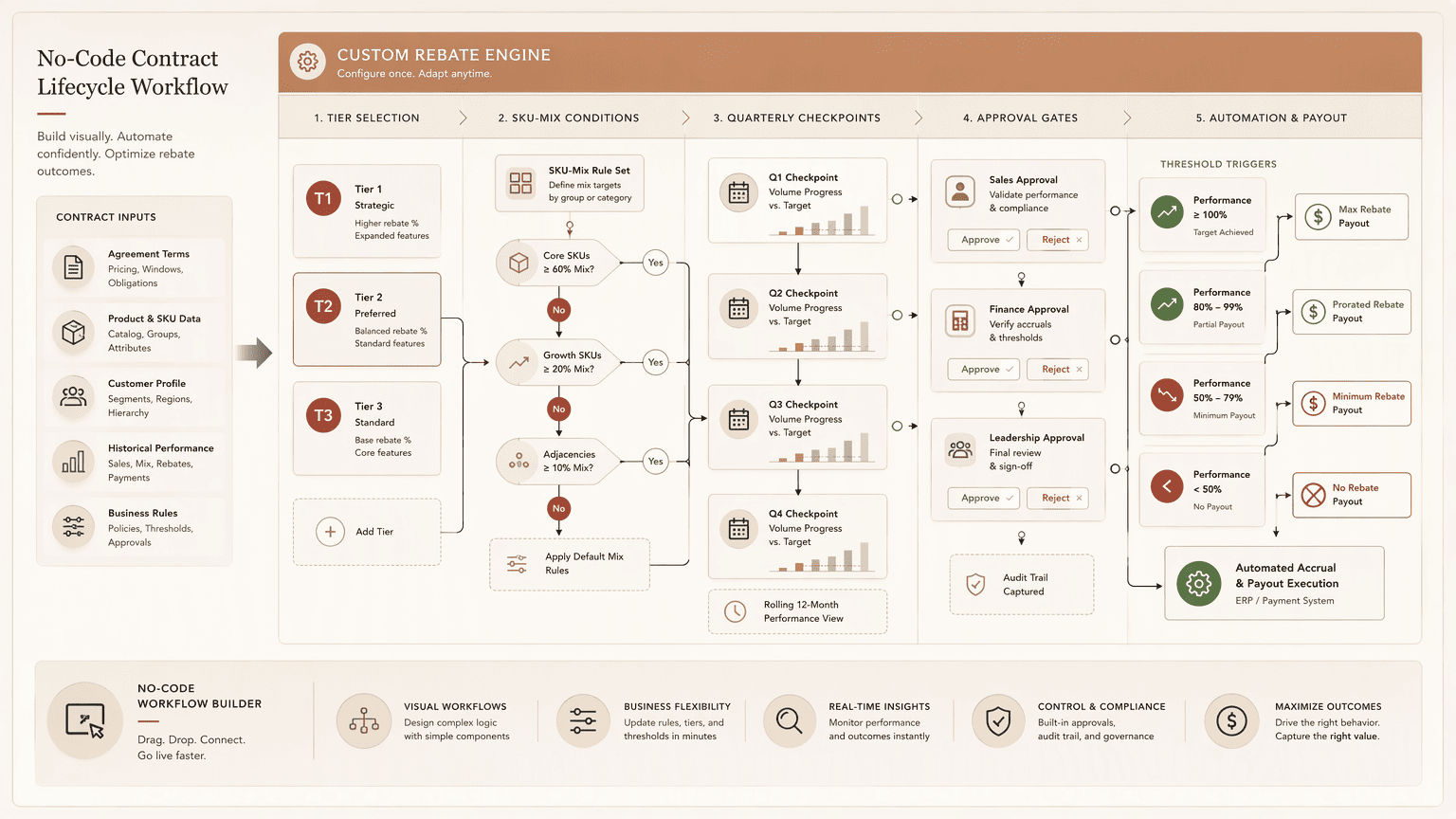
Most rebate software assumes your deals look like the vendor’s template. When they do not, you spend more time fighting the system than using it. Agiloft skips the assumptions. Its no-code platform lets you model the exact agreement you signed, not the one a product manager imagined.
You build custom tier tables, conditional approval chains, and automated triggers that fire when spend data crosses a threshold. If your rebate hinges on a specific SKU mix paired with quarterly volume and a manual sign-off by two regional directors, you can wire that logic in. No developer required.
| Feature | Agiloft Approach | Typical Pre-Built Module |
|---|---|---|
| Workflow design | No-code custom builder | Fixed process steps |
| Rebate tier structure | User-defined tables and rules | Standard tier templates |
| Approval logic | Conditional chains based on any field | Linear or role-based only |
| Spend data integration | Configurable API connections | Pre-set ERP connectors |
The trade-off is real. You supply the design and the discipline to maintain the workflows. A mid-market procurement team that already documents its agreements carefully and just wants a platform that bends to that reality will find a rare fit here. If you are waiting for a turnkey button, keep scrolling.
6. Conga, Revenue and Rebate Management for Complex Tiered Agreements
Conga addresses rebate complexity from the revenue side. The platform models multi-tier, volume-based agreements and automates the full claims lifecycle, giving both sellers and buyers a single place to see where every rebate stands without chasing spreadsheets.
Tiered agreement modeling is the foundation. Conga’s Revenue Management module lets you define structures like 2% at $1M in purchases, 3% at $5M, and 5% at $10M, then calculates attainment automatically as transaction data arrives. You set the tiers once, and the system tracks progress across every active agreement without manual lookups.
On the accrual side, the platform eliminates end-of-month guesswork. Instead of manual journal entries that lag weeks behind reality, Conga generates accruals from live tier progress. Finance teams get a current view of expected rebate income, which makes period-end close faster and reduces surprises when a big program crosses a threshold mid-quarter.
Settlement and claims follow the same automated path. When a rebate tier is reached and a claim window opens, the system assembles the submission documentation, cutting the administrative lift that typically falls on a handful of staff. The biggest value here is deadline risk: missing a claim window on a high-value tier erases margin you already earned.
Conga was built primarily for sellers who run rebate programs for their own customers, but the engine is bidirectional. Procurement teams managing incoming supplier rebates with similar tiered complexity can use the same logic in reverse, so a single platform handles both outgoing programs and what you are owed from vendors.
7. LinkSquares, AI-Powered Analytics for Rebate Term Extraction and Reporting

LinkSquares solves the problem every rebate tracking effort hits first: getting structured data out of unstructured PDFs. Before you can track a rebate, you have to know what the contract actually says.
The platform’s AI pulls rebate terms (percentages, volume tiers, expiration dates) from signed agreements, including legacy contracts that exist only as scanned documents. It does this at scale, turning a stack of PDFs into a structured dataset your finance and procurement teams can query. Once extracted, the terms populate reporting dashboards that let you compare rebate structures across your supplier base. You might see that Supplier A offers 3% back at $500,000 in volume while Supplier B, in the same category, requires $750,000 for the same 3%, a gap you only spot with cross-contract analysis.
For a procurement team sitting on years of signed agreements and nobody who has read every clause, LinkSquares is the extraction engine that makes tracking possible in the first place. It is an analytics-first approach, prioritizing visibility over workflow management. That’s a fit for organizations that need to understand their rebate landscape before they automate it.
Conclusion
The choice comes down to a straightforward split. If your primary objective is recovering lost cash from existing agreements immediately, a post-signature intelligence layer like Contracts.ai or Vendortell gets you there by connecting signed terms to live ERP data without replacing your current systems. If your organization is ready for a broader transformation and wants rebate management embedded into the entire contract lifecycle, an enterprise CLM like Sirion or Icertis provides end-to-end control. Either path closes the 2 to 5% spend gap that manual tracking leaves open. The only wrong move is leaving those rebate terms locked in a PDF.
Frequently Asked Questions
What contract management software features are necessary to track spend against rebate terms?
You need automated financial clause extraction from signed agreements, the ability to match those terms against live ERP purchase data, threshold monitoring with alerts, and accrual or claim generation. Manual entry and static contract storage cannot keep up with the volume and complexity of multi-tier rebate structures.
How can AI-powered contract intelligence automate the detection and calculation of rebates from executed agreements?
AI reads the contract language including volume tiers, percentages, and expiration dates and structures that data in minutes. It then connects those structured terms to real-time transaction records from your ERP, automatically calculating earned rebate value without waiting for someone to run a spreadsheet.
What are the top-rated contract analytics platforms that help procurement teams capture missed rebates in 2026?
Leading platforms include Contracts.ai and Vendortell for post-signature intelligence that links contracts to live spend, Sirion and Icertis for enterprise CLMs with native rebate modules, Agiloft for customizable workflow automation, Conga for complex tiered structures, and LinkSquares for AI-powered term extraction and cross-contract analysis.
How does post-signature contract analysis compare to traditional CLM modules for rebate tracking?
Traditional CLM modules focus on drafting and signing with rebate tracking as a secondary feature, often manual or basic fields. Post-signature intelligence layers are built specifically for live contract-to-transaction matching, offering automated threshold alerts and cross-agreement portfolio analysis that CLM modules typically lack.
What is the process for setting up a rebate tracking program without migrating a full contract repository?
Start by importing a limited set of executed agreements into a platform like Contracts.ai or Vendortell via email or cloud storage. The AI extracts and structures key financial terms. You can then run a pilot that validates recovery against live ERP data before deciding whether to expand the scope.
What metrics and data points should a business monitor in contract software to ensure rebate compliance and maximize recovery?
Monitor threshold progress (how close spend is to the next tier), tier attainment status, accrued rebate liability, claim submission deadlines, and expiration dates. Cross-agreement visibility also reveals where spend across business units could be combined to unlock higher rebate tiers.
Sources
- Contract Performance Platform | Vendortell – vendortell.com
- How Contract Management Tracks Rebates and Incentives – www.sirion.ai