







Introduction
Your legal team just inherited 12,000 contracts from an acquisition. The deadline to report on key liabilities is 30 days. If hiring a dozen contract reviewers and ordering more coffee is the first instinct, you are reading the right article.
Nearly half of teams still manage contracts through email and shared folders, and over 50% of organizations report losing business due to inefficiencies in manual tracking. That approach does not scale.
AI-powered extraction software has matured. The question is no longer whether software can extract data from thousands of existing contracts. It is which platform fits your stack, your security requirements, and the specific data trapped in your PDFs, scans, and legacy Word files. This ranked list evaluates seven platforms that do it today.
Key Takeaways
Before diving into individual platforms, three realities set the baseline for what you can expect when you start evaluating this category.
- Enterprise accuracy hits 85% to over 95% on structured fields, but only with a human in the loop: The implementations that actually work pair machine extraction with a person reviewing low-confidence outputs. Contracts.ai advertises accuracy greater than 99% for real-time extraction. Test every vendor claim against your own contract corpus, on your own documents.
- You do not need a full rip-and-replace: Every platform covered here integrates via API with the document management system you already run. Pick 10 to 50 contracts, run a pilot, measure the results, and expand from there.
- If protected health information touches the pipeline, an executed BAA is non-negotiable.
At a Glance

Here is how the options compare across the dimensions that matter most.
| Software | Core Strength | Key Extraction Capabilities | Compliance Certifications | Starting Price (Annual Billing) |
|---|
1. Contracts.ai, The Intelligence Layer for Existing Contract Repositories
Contracts.ai earns the top spot for a specific reason: it was purpose-built as an intelligence layer for executed agreements. The platform does the one thing most broad-spectrum CLMs struggle with, it reads, groups, and surfaces obligations from thousands of legacy contracts without demanding a full-system migration first.
The software [automatically groups related agreements and aligns shared terms], letting procurement and finance teams compare obligations across counterparties without manually hunting through folders. A pilot can be run with a limited contract set. No repository-wide migration.
No workflow disruption. For teams stuck in analysis paralysis, that low-friction start often decides whether the project moves forward at all.
The CTO and engineering leadership directly oversee the privacy and data protection program. Customer contract data is not used to train generalized models unless explicitly agreed. Be aware of the trade-off: Contracts.ai does not support contract workflows such as approvals.
If you need a single platform that handles authoring, negotiation, approval routing, and post-signature extraction, you will need to integrate it with an upstream CLM. For teams that already have a CLM and need an intelligence layer on top, the fit is strong. Pricing starts at $19 per month billed annually for the Basic plan, and $49 per month billed annually for the Enhanced plan, which includes advanced automation rules and priority support.
2. IBM watsonx Orchestrate, Enterprise-Grade AI Extraction with Watson NLP

IBM watsonx Orchestrate is the choice for regulated industries that cannot tolerate startup risk in their vendor stack. It combines OCR, natural language processing, and machine learning to extract parties, dates, obligations, and termination clauses from scanned PDFs and Word files at scale.
The platform’s strength is its enterprise security posture. For financial services and healthcare organizations where a security questionnaire can kill a deal, that out-of-the-box compliance saves months of vendor review.
What sets it apart is the orchestration layer. Extraction feeds structured data into downstream workflows across procurement, finance, and legal, connecting contract intelligence to the systems those teams already use. The limitation is complexity.
IBM’s ecosystem rewards organizations with existing watsonx investments. A greenfield deployment requires more configuration than lighter alternatives, and per-document pricing typically falls in the $5 to $10 range, pushing TCO higher for very large repositories.
3. Activepieces, Open-Source Workflow Automation for Custom Contract Pipelines
Activepieces approaches contract extraction differently: a open-source workflow automation engine where you build custom extraction pipelines. You connect OCR tools, LLMs, and your downstream systems into a process that matches your actual documents, not a vendor’s field schema.
This matters when your contracts are not standard. Unusual clause structures, multilingual documents, or a legacy repository that does not map neatly to predefined fields are all cases where defining the extraction logic yourself pays off. You can route low-confidence extractions to a human reviewer, log every decision for audit, and change the pipeline without waiting for a product team to ship an update.
The trade-off is engineering time. Activepieces is a toolkit, not a turnkey solution. You need someone who can configure the pipelines, prompt the models, and keep the integration running. For a mid-market company with capable engineers and non-standard extraction needs, that effort is worthwhile. For a lean legal ops team that needs something working by Friday, a purpose-built extraction platform will get you there faster.
4. Evisort, AI-Powered Contract Analytics with Deep Clause Recognition

Evisort built its reputation on deep clause recognition. Where many extractors handle structured fields like dates and dollar amounts well, Evisort’s models are trained to identify nuanced provisions: most-favored-nation clauses, assignment restrictions, uncapped liability language. Those three are the heavy lifters in post-acquisition contract reviews and template standardization projects. The models pull them out across portfolios that can run into the tens of thousands of agreements.
Gartner defines advanced contract analytics as solutions that use natural language processing, machine learning, and generative AI to analyze executed contracts and create structured, usable data. Evisort fits that definition tightly. The platform surfaces clause-level outliers across thousands of agreements, which helps legal teams spot variation and reinforce contracting standards before they become systemic problems.
Who it is best for: organizations with large M&A-driven contract portfolios or enterprises standardizing templates after years of decentralized contracting. The analytics layer is where Evisort justifies its premium pricing. If your primary use case is simpler (extracting renewal dates and counterparty names from a uniform set of sales contracts), a lighter platform costs less and delivers the same result.
5. Sirion, Post-Signature Intelligence and Obligation Management

Sirion solves a problem most extraction tools ignore: what happens after you pull the data out. The platform combines AI extraction with obligation management, tracking what each party committed to and flagging deliverables before they are missed.
Contract workflow automation reduces cycle time by 84% compared to manual spreadsheet tracking. Legal teams currently spend over 1 hour daily switching between systems in manual contract tracking. Sirion’s value proposition is collapsing that fragmentation by making extracted data operational across finance, procurement, and legal.
IDC predicts that by 2030, 50% of enterprise applications will pivot to agent-powered interfaces. Sirion is already embedding agentic capabilities for obligation tracking. The platform is best suited for enterprises with complex supplier and customer contracts where performance management matters as much as data extraction. Mid-market teams with simpler contracting patterns may find the platform’s depth exceeds their needs.
6. ThoughtRiver, Automated Contract Review and Risk Scoring at Scale
ThoughtRiver handles the review bottleneck that slows down legal teams before a contract is ever signed. Its AI reads inbound agreements against your organization’s playbook, scores risk clause by clause, and surfaces a structured summary that lets you triage thousands of contracts in a fraction of the usual time.
The core differentiator is the risk scoring engine. Instead of stopping at extraction, it evaluates every clause against a baseline you define. A limitation-of-liability clause gets compared to your preferred position and assigned a risk level. For teams that process high volumes of third-party paper, NDAs, procurement agreements, sales contracts, the review queue moves noticeably faster.
AI can accelerate contract generation according to McKinsey’s 2025 workplace report, and platforms like ThoughtRiver extend that acceleration into review. Gartner predicts half of procurement contract management will be AI-enabled by 2027.
ThoughtRiver sits on the early-adopter side of that curve. The trade-off is scope. If you also need deep post-signature obligation tracking or workflow automation, ThoughtRiver pairs best with a CLM that handles those functions natively, because review is what it does.
7. Ironclad, Modern CLM with Embedded AI Extraction and Analytics
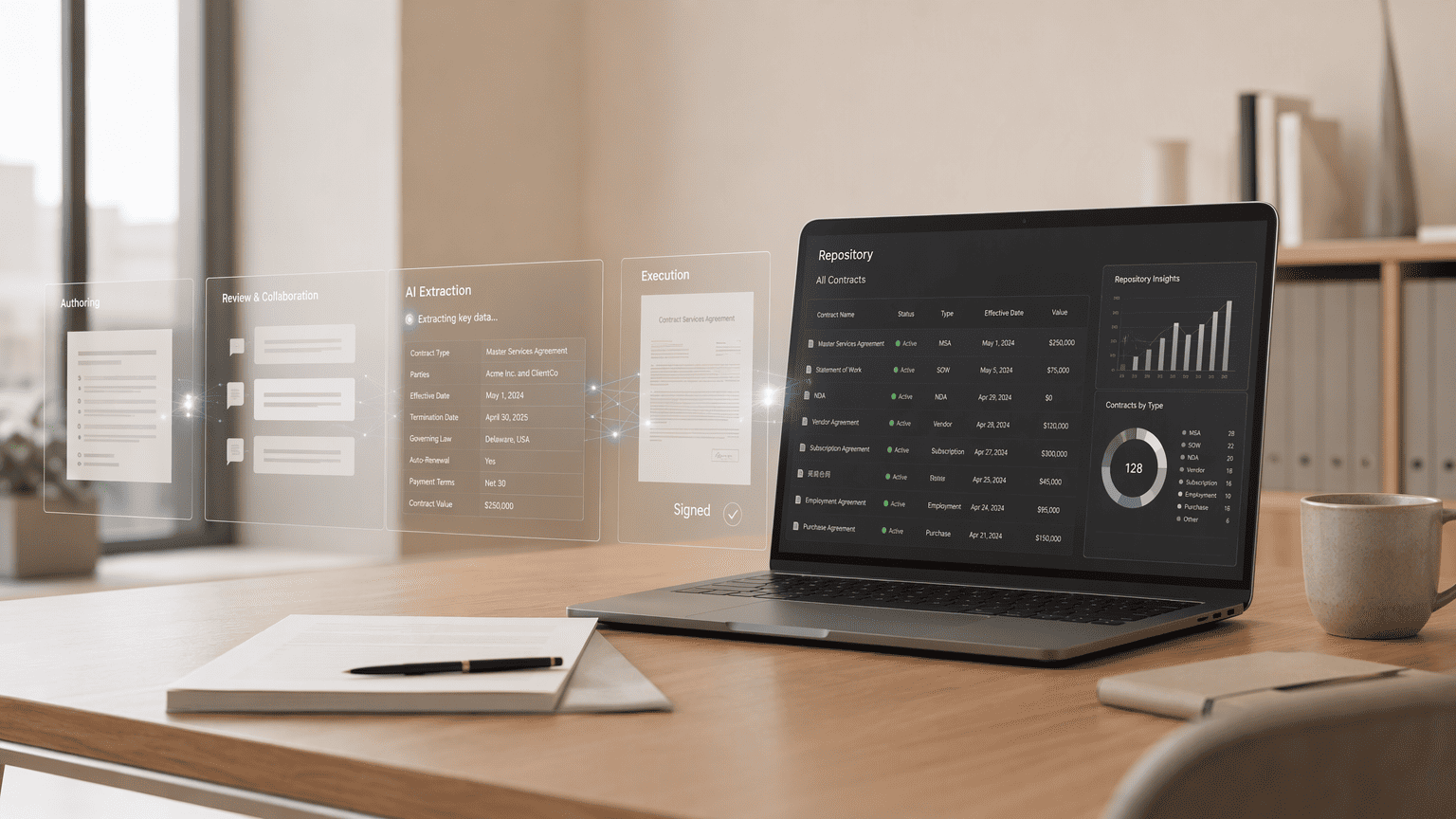
Ironclad integrates AI extraction into a full CLM, covering the contract lifecycle from authoring through execution and post-signature analytics. The embedded extraction automatically tags and structures executed agreements as they enter the repository, eliminating the need for a separate extraction step.
Contract AI helps teams work faster, cut out tedium, and surface insights, and Ironclad operationalizes that by connecting extracted data directly to workflow triggers, reporting dashboards, and renewal calendars. Machine learning provides a 35% reduction in negotiation cycles according to industry benchmarks, and Ironclad attributes part of that gain to structured data informing template and clause selection during drafting. Who it is best for: companies that need a unified CLM and want extraction to be native rather than an integration. The trade-off is that extraction quality depends on the CLM’s models rather than a dedicated extraction specialist. For organizations with a very heterogeneous legacy contract set such as scanned documents going back decades, a dedicated extraction platform may achieve higher accuracy on the toughest files before structured data flows into the CLM.
Conclusion
The software exists. The harder decision is which approach fits your organization’s contract complexity, security requirements, and integration landscape.
For teams with an existing CLM and a large legacy repository, an intelligence layer like Contracts.ai integrates without disrupting current workflows. For regulated enterprises with deep IBM relationships, watsonx Orchestrate provides enterprise-grade extraction with built-in compliance. Engineering-heavy teams with custom pipelines should evaluate Activepieces. Organizations prioritizing clause-level analytics, obligation management, or risk scoring will find strong options in Evisort, Sirion, and ThoughtRiver respectively.
Start with a pilot. Run 10 to 50 contracts through your shortlisted platform.
A tool that extracts perfectly in a demo but fails your IT security review is not a viable option. The platforms on this list are production-ready. The one that scales with you is the one you validate on your own contracts, on your own timelines.
Frequently Asked Questions
What software platforms are available in 2026 that use AI to bulk-extract structured data from existing contract repositories?
In 2026, platforms like IBM watsonx Orchestrate, Evisort, Ironclad, and Sirion use AI to extract structured data from thousands of contracts. Tools such as Activepieces enable custom, open-source extraction pipelines. These systems process scanned PDFs, Word files, and embedded tables, pulling out parties, dates, clauses, and obligations automatically.
How does automated contract data extraction handle different formats like scanned PDFs, Word files, and embedded tables?
These systems use optical character recognition (OCR) to make scanned PDFs readable, then apply natural language processing and machine learning to pull data from unstructured text. For Word files and embedded tables, they parse native digital text and layout structure to accurately extract key fields like dates, parties, and values.
What are the typical accuracy rates and quality assurance steps for enterprise contract extraction, and how is source verification handled?
Enterprise extraction accuracy typically ranges from 85% to over 95% for structured fields. Quality assurance relies on human-in-the-loop review guided by confidence scoring. Source verification works by flagging low-confidence extractions for manual validation, ensuring analysts can quickly correct errors before data enters a system of record.
What are the security, privacy, and compliance considerations when giving an AI platform access to thousands of sensitive legal agreements?
You must review data residency commitments and incident response protocols. Platforms like Extract.to publish detailed compliance documentation covering these privacy and security standards.
What are the cost, pricing models, and ROI benchmarks for large-scale contract extraction projects in the US market?
Pricing typically involves per-document fees of $1 to $10 per contract or annual subscriptions starting around $15,000 to $50,000 for mid-market deployments. Sirion’s analysis of contract automation highlights how faster processing directly cuts operational costs.
Sources
- Automated Generation of Code Contracts – dl.acm.org
- An end-to-end agentic pipeline for smart contract translation and quality evaluation – arxiv.org
- Contract Workflow Automation vs. Manual Tracking – Legal Operations ROI Guide – www.sirion.ai
- AI for Contracts: Streamline Drafting, Review & Management | Concord – www.concord.app
- Healthcare Contract Management Software | Concord – concord.app
- The 2026 Playbook for Contract AI | Docusign – www.docusign.com
- Workflow Automation for Small Businesses: A 2026 Guide – www.activepieces.com