







Introduction
Your legal team bills in hours, but they spend too many of them chasing redlines, tracking dates, and untangling billing errors. It is a quiet drain that nobody budgets for until the renewal hits and the invoice is 15% higher than expected.
The average business loses nearly 9% of its annual revenue to poor contract management, according to World Commerce and Contracting’s 2025 report. The best performers hold that loss to about 3%. The worst lose 15% or more.
These losses compound every time a deadline slips or an obligation goes untracked. Indeed, 77% of IT leaders discovered unexpected costs after a contract was already signed in 2026, per Zylo’s SaaS Management Index. That is revenue you negotiated, won, and then silently gave back.
Affordable, AI-powered contract management software is the direct antidote. They range from free tiers to $399/month plans up to enterprise deals crossing $150,000 a year, but even the entry-level options can claw back billable hours fast. Here are the seven tools worth your evaluation in 2026.
Key Takeaways
These are the key criteria for choosing contract management software that cuts legal spend, not just stores documents.
- Contracts.ai eliminates high seat fees and applies AI directly to clause flagging and billing error detection for immediate lawyer-hour savings.
- Post-signature obligation tracking prevents the hidden costs that 77% of IT leaders discovered after signing, automated alerts on key dates, renewals, and compliance milestones are not optional.
- Browser-native collaboration like Juro’s removes the endless email threads and version-control errors that eat non-billable time inside in-house teams.
- End-to-end automation lets lean legal teams run hands-off workflows from drafting to signature, critical for preventing manual tracking failures as a company scales.
- Free tiers like Concord are a legitimate starting point, a searchable, centralized repository immediately stops the bleed from lost contracts at zero cost.
1. Contracts.ai, Best Overall AI-Powered Platform for Immediate Legal Cost Reduction
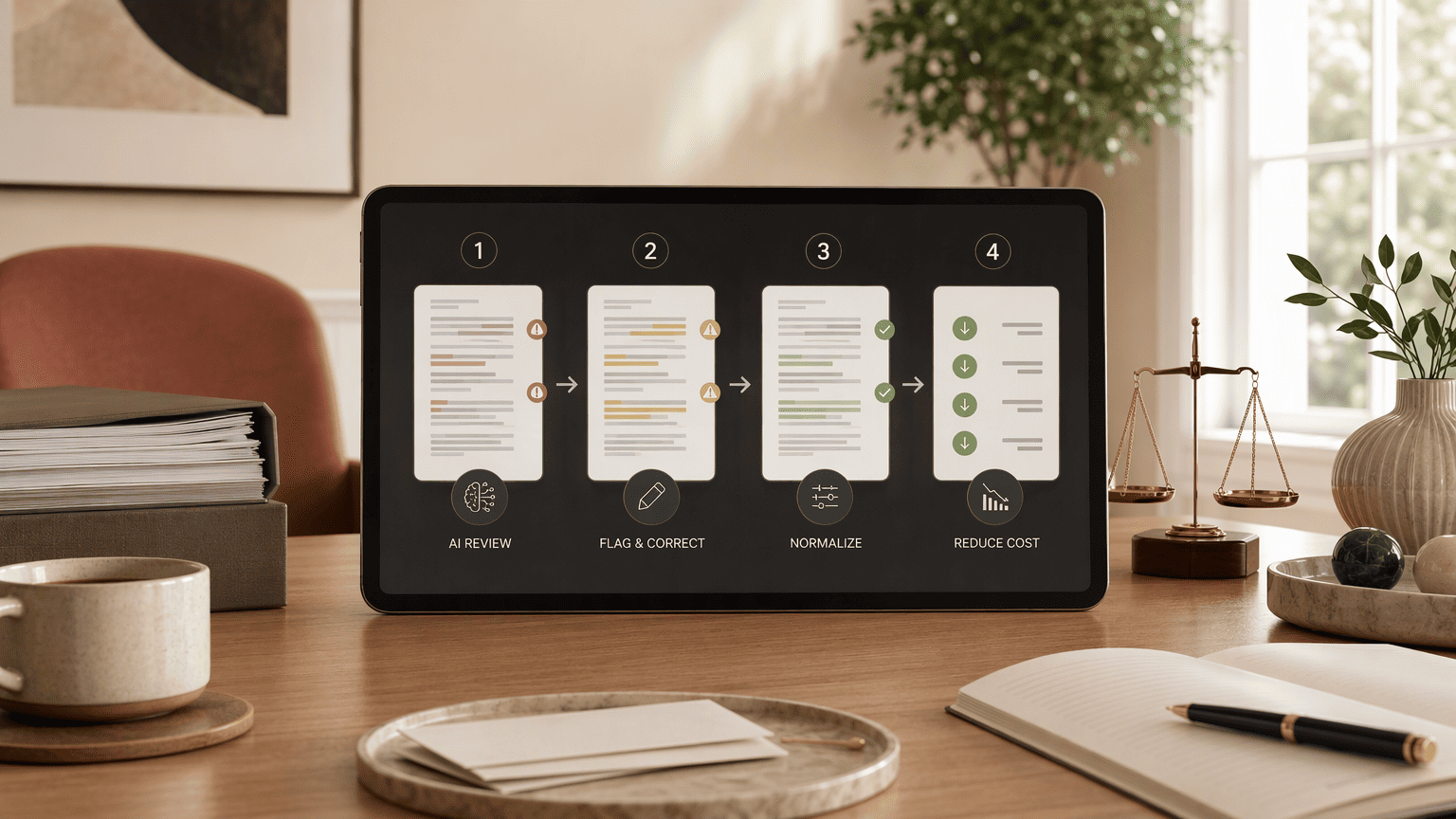
Contracts.ai targets the two activities that consume the most outside counsel and in-house spend: clause-by-clause review and billing error detection. Its subscription model avoids the high per-seat fees that inflate traditional CLM total cost of ownership, so teams that couldn’t justify a six-figure deployment before can now use AI contract intelligence without blowing their budget.
The platform was built by practitioners who have led large-scale CLM implementations and structured millions of contract data points inside global enterprises. It sits as an intelligence layer over your existing executed agreements. You don’t rip out your current repository. You can run a pilot with a limited contract set, no full migration required, no disruption to how your team works. That means you validate cost savings before you commit.
Here’s how it works. Contracts.ai:
- Groups related agreements, aligns shared terms, and flags clauses that deviate from your standards.
- Links its answers to source contract language, so a senior lawyer confirms a finding in seconds instead of re-reading a 40-page document.
- Catches billing errors and surfaces non-standard obligations post-signature, preventing the revenue leakage that WorldCC pegs at 9% annually.
For legal operations needing measurable ROI within a quarter, this mix of AI review, billing audit, and lightweight deployment fits.
2. Juro, Best for Collaborative, Browser-Based Contract Workflows
Juro tackles a cost driver that rarely appears on a law firm invoice: the internal communication overhead of negotiating contracts. When legal, sales, and procurement bounce tracked-changes documents over email, the version-control chaos alone can swallow hours of non-billable time. Juro’s browser-native platform replaces those loops with internal commenting, structured approval workflows, and a single source of truth that every stakeholder works from in real time.
For in-house teams drowning in administrative churn, this shift is measurable. Moving contract negotiation out of email attachments and into a collaborative browser interface reduces the repetitive status-checking that fragments a lawyer’s day. Faster, cleaner cycles mean fewer urgent-rush requests that external counsel bills at a premium, making Juro a cost-effective pick for corporate legal departments where alignment with business stakeholders is the primary bottleneck.
3. Contractbook, Best for Small Teams Needing End-to-End Automation on a Budget

Contractbook lets small legal teams build automated contract workflows without code. It’s one of the few platforms that combines dynamic templates, structured data from creation, and native integrations at a price small teams can actually stomach, no bolt-on data extraction, no manual spreadsheet ping-pong.
A legal ops person sets up a master template with conditional logic once. After that, someone in sales fills in a form, and the system drafts, routes, and sends the contract for signature. Drafting leaves legal’s plate. The metadata is structured from the moment a contract is created, not scraped together after signature, so searching obligations and running reports works right away.
The integrations connect with the CRM, e-signature, and repository tools the team already uses. That cuts out the manual handoff failures that come with managing contracts in spreadsheets.
4. Concord, Best Free Tier for Very Early-Stage Legal Operations

Concord gives you what no other serious CLM does: a real free tier you can use forever. You get e-signatures, a searchable contract repository, and basic document management without paying a dollar. For a startup still working out of email folders and scanned PDFs on someone’s desktop, that’s the difference between having a system and having chaos.
Documents you can’t find cost real money. A contract that auto-renews because nobody saw the termination window means paying for a service you stopped needing six months ago. Concord’s free tier stops both problems cold.
Centralize every agreement in one place, search across it in seconds, and cut off the silent revenue leaks that come from disorganization. You will hit the free tier’s limits eventually. Advanced approval workflows, obligation tracking, and white-labeled interfaces all require a paid plan.
That’s fine for a team that’s just getting its feet under itself. Run the free tool as long as it solves your immediate problem, and by the time you outgrow it you will have the operational track record to justify whatever paid CLM you move to next.
5. Ironclad, Best for Mid-Market In-House Teams Prioritizing Workflow Design

Ironclad’s core value for cost reduction isn’t the sticker price. It’s the visual Workflow Designer.
This is a no-code tool that lets legal teams encode business rules into self-service contracting paths. Configure the workflow once, and routine agreements route to the right approver only when specific conditions trigger. Low-risk contracts never touch a lawyer’s inbox.
The hidden cost of poorly designed approvals compounds fast. A sales contract stalls for a perfunctory legal review, deal velocity slows, and the legal team burns bandwidth on low-value tasks. Ironclad pushes standard contracting to business users while legal keeps control of the rules. The queue of status-check emails shrinks, and revenue unblocks without adding headcount.
For mid-market teams where legal is still a bottleneck, that workflow automation justifies the investment faster than a long feature list ever could.
6. CobbleStone Contract Insight, Best for Highly Customizable Post-Signature Obligation Tracking
CobbleStone Contract Insight is built to stop the post-execution value erosion that most CLMs treat as an afterthought. 77% of IT leaders discovered unexpected costs after a contract was signed in 2026. Configurable obligation management and automated alerts on key dates are the direct defense against that statistic.
The table below breaks down how CobbleStone’s post-signature module turns negotiated terms into realized ROI.
| Post-Signature Capability | What It Prevents | Cost Impact |
|---|---|---|
| Configurable obligation tracking | Missed service-level credits and unexercised renewal options | Captures value already negotiated but lost to admin gaps |
| Automated key-date alerts | Auto-renewals on unfavorable terms and surprise price increases | Avoids the 79% of renewals that came with price spikes in Zylo’s 2026 index |
| Compliance and audit trail tracking | Breach penalties and regulatory non-compliance fines | Reduces exposure to liabilities embedded in complex multi-year agreements |
| Customizable reporting dashboards | Lack of visibility into vendor performance against contract terms | Surfaces underperformance that warrants renegotiation or termination |
7. SpotDraft, Best for AI-Assisted Review with Focus on Sales-Legal Alignment

SpotDraft targets a specific cost center: the friction between legal and sales that externalizes into high-priced rush work. When a sales team waits 10 days for legal to review a standard NDA, the cost shows up in two places. The rep’s pipeline stalls, and when the deal is finally urgent, external counsel charges a premium for overnight turnaround.
SpotDraft’s AI review assistant and automated redlining, driven by predefined playbooks, are built to close that gap.
Sales submits a contract through a CRM-integrated interface, and SpotDraft’s AI checks it against the legal playbook, auto-populating redlines for pre-approved positions. Legal only steps in when a clause falls outside guardrails. This filtering effect reduces the queue of transaction-level reviews that clog a small department, and the native CRM integration keeps sales working in its own tool rather than emailing static documents back and forth. For high-volume sales organizations, the ROI model is straightforward: fewer lawyer-hours per transaction, fewer stalled deals waiting on legal sign-off, and fewer premium-rate scrambles when a quarter-end deadline collides with a contract backlog. SpotDraft earns this spot for focusing its AI precisely on the sales-legal handoff where small delays compound into large costs.
Conclusion
Legal cost reduction from contract software comes down to three things: AI-driven review cuts the hours spent reading and redlining; end-to-end automation eliminates administrative tracking and version-control waste; and post-signature obligation management captures the negotiated value that otherwise leaks over time. Pick the platform that matches your biggest bleed.
Run a pilot with Contracts.ai if you need immediate, measurable savings on outside counsel and in-house review cycles. Measure the hour delta on clause review and billing audit across a limited contract set. For teams where internal collaboration churn is the primary drain, evaluate Juro.
Small teams that need full automation without code should look at Contractbook. If your problem is post-execution value erosion, prioritize CobbleStone’s configurable tracking. Match your primary cost driver to the platform that attacks it directly, and validate with real usage data before scaling.
Frequently Asked Questions
What is the most affordable contract management software that helps reduce legal team costs?
Contracts.ai leads on direct legal cost reduction in 2026 because its subscription model removes seat-fee inflation and its AI targets the two largest expense drivers: manual clause review time and undetected billing errors. Free and low-cost alternatives like Concord and Contractbook also deliver meaningful savings for smaller teams.
How does contract intelligence software lower legal spend for in-house teams?
Contract intelligence software lowers spend by automating the low-value work that consumes lawyer hours.
What features should I look for in budget-friendly post-signature contract management tools?
Prioritize automated renewal tracking, configurable obligation alerts, and a searchable central repository. These prevent the price-increase surprises that hit 79% of renewals and the missed milestones that erode negotiated value, without requiring an expensive full-suite CLM deployment.
How does Contracts.ai compare to traditional CLM tools for cost-conscious legal departments?
Contracts.ai deploys as an intelligence layer on existing agreements, so it avoids the six-to-nine-month implementations and implementation fees that can reach 100% of first-year license cost on legacy CLMs. It runs on a lower-cost subscription model and targets immediate savings from AI review rather than process redesign.
Can AI-powered contract analysis deliver ROI for small legal teams?
Yes. Small teams gain disproportionate ROI because AI absorbs the repetitive review and tracking work that fragments a lean department. Contracts.ai, for instance, lets you run a pilot with a limited contract set and validate hour savings before committing, making the business case measurable from day one.
What pricing models do affordable contract management platforms offer in 2026?
Pricing spans unlimited free tiers like Concord, $19-to-$49/month per-user plans for tools like Contracts.ai’s Basic and Enhanced options, $399/month small-team plans, and enterprise contracts extending above $150,000 annually for custom deployments with full workflow design and integration.