








Introduction
Your finance team just discovered an auto-renewal you budgeted $0 for. It happened 90 days ago. This isn’t rare. Manual contract tracking bleeds cash and compliance in dozens of small, quiet ways.
You know the drill. Someone saved a PDF in a folder. A renewal date lived in a spreadsheet someone else owned. By the time the invoice hit, you were locked into another year. The only surprising part is how long organizations tolerate it after knowing there is an automated fix.
Affordable has changed. A few years ago, proactive contract intelligence required enterprise budgets, six-figure implementations, and months of professional services. Now, tools that extract critical dates, link obligations across agreements, and push 30-day renewal warnings cost less per user than a monthly parking spot. You can afford it; you just need a tool that fits how your team actually works.
Small legal teams need something different from a mid-market procurement function with hundreds of active vendor relationships. One size fits nobody. The seven picks below each earn their place for a specific use case, and each carries real trade-offs we’ll name openly.
Key Takeaways
Before you commit to any one tool, a few ground truths will save you from buying the wrong thing. This list is built around practical, mid-market procurement realities rather than feature-sheet fantasy.
- Headline price is misleading: The real cost drivers are implementation speed, user limits, and whether support comes standard or costs extra. A focused $19/user/month system that launches in days often costs less than a heavyweight suite needing months of configuration.
- Automated renewal alerts are the highest-ROI feature: The core value sits in structured extraction of dates and obligations, combined with alerting at least 30 days before a deadline. One solo consultant using email-based contract monitoring saved $4,800 in year one purely on avoided auto-renewals.
- Integration with your existing stack matters more than price: If your team lives in Salesforce, pick tools with native CRM integration. If procurement runs through Microsoft 365, prioritize there. The tool your team ignores was never affordable, no matter what it cost.
At a Glance

Here is how the options compare across the dimensions that matter most.
| Tool | Starting Price | Best For | Key Limitation |
|---|---|---|---|
| Contracts.ai | $19/month (annual) | Post-signature date extraction and alerts | Enhanced plan required for automation rules |
| Obliguard | Free tier available; paid from $9/month | Solo consultants and small teams monitoring renewals | Limited to email-based monitoring |
| CobbleStone | $30/user/month (annual) | Mid-market procurement with obligation tracking | Onboarding complexity for small teams |
| Evisort | Custom quote only (under $10K/year for small firms) | AI-driven clause extraction across contracts | Vendor lock-in with long-term contracts |
| ContractSafe | $49/user/month (annual) | Simple repository with renewal alerts | Minimal integration options |
| Lexion (now part of DocuSign) | Custom quote (estimated $50+/user/month) | Enterprise contract lifecycle management | Price jumps after initial discount |
| Gatekeeper | $70/user/month (annual) | Compliance and obligation monitoring at scale | Overkill for small or simple repositories |
1. Contracts.ai, The Intelligence Layer for Post-Signature Monitoring
For teams that already have a contract repository but no reliable way to monitor executed agreements, Contracts.ai earns the top spot by operating as a dedicated intelligence layer over your existing contracts rather than demanding you rip out and replace what is already in place.
The product was built to structure and activate contract data beyond static storage. It automatically extracts key dates, obligations, and renewal terms from executed agreements, then surfaces alerts and structured intelligence your finance and procurement teams can act on. Contracts.ai claims accuracy levels greater than 99% when extracting data from documents in real time, and every answer it provides is linked back to source contract language for validation.
That traceability matters for audit-ready operations. Pricing starts at $19 per month billed annually for the Basic plan, with the Enhanced plan at $49 per month billed annually. The Enhanced tier adds automation rules and team collaboration tools.
A pilot can be run with a limited contract set without migrating your full repository or disrupting existing workflows, which changes the evaluation game for risk-averse procurement leaders. The company was co-founded by operators with 30-plus years of combined experience implementing CLMs, ERPs, and procurement systems inside global enterprises.
For privacy-conscious teams, Contracts.ai uses encryption of data in transit via TLS 1.2 or higher, role-based access controls, and does not train models on proprietary customer data. The trade-off to understand: Contracts.ai does not support contract workflows such as approvals. Think of this as a monitoring layer that adds intelligence on top of your existing CLM or repository.
2. Zoho Contracts, Affordable Ecosystem-Dependent CLM

If your team already lives inside the Zoho ecosystem (CRM, Books, Desk), Zoho Contracts is the most affordable integrated CLM option at $25/user/month on the Standard plan with a free trial available. Outside that ecosystem, the value proposition weakens considerably.
The platform ties contract obligations, renewals, and vendor data into the same interface your CRM and finance teams already use. Standard features include automated renewal alerts, a clause library, and basic contract analytics. G2 rates it 4.5/5 from 13 reviews, with 53.8% of users in mid-market companies, though the G2 comparison shows Zoho Contracts scoring 7.8 on Reporting & Dashboards vs DocuSign CLM’s 8.8.
The ecosystem tie is the real headline. If you use Zoho CRM, the bidirectional sync means vendor contract data flows into deal records without middleware. This alone eliminates one of the most common failure modes in affordable CLM: the monitoring tool sits siloed from the systems people actually open every day, and alerts get ignored. But if your procurement stack runs on something else, you are paying for integration depth you will never unlock.
Best for teams already committed to Zoho One. Not the right fit for shops on Microsoft 365 or Salesforce. The $25 price point is very fair, but only if the native integrations serve your actual workflow. With just 13 G2 reviews as of this writing, vendor validation is thinner than peers like PandaDoc with 3,494 reviews.
3. Concord, Unlimited E-Signatures and Straightforward Pricing
Concord wins on a single, cost-saving dimension many vendors quietly cap: e-signatures. Its pricing tiers (roughly $17 to $49 per user per month) include unlimited electronic signatures at every level, which makes it a strong candidate for teams that send a high volume of vendor agreements for countersignature alongside their monitoring needs.
The platform combines a searchable contract repository with automated deadline alerts and approval workflows. Concord’s approach leans toward collaborative contract lifecycle management rather than pure post-signature intelligence, so teams get drafting, negotiation, and e-signing capabilities alongside the monitoring features. This broadens its utility. For procurement functions looking strictly for monitoring, it means paying for tools they may never open.
Where Concord fits best: a lean legal-and-ops team of three to ten people managing vendor relationships from onboarding through renewal, with no appetite for managing a separate e-signature subscription. The unlimited signatures remove a variable that can quietly inflate costs at DocuSign-dependent organizations. The trade-off is that Concord’s alerting and obligation-tracking features are functional rather than best-in-class. For teams with complex multi-tier vendor relationships and contract hierarchies, a more specialized intelligence tool will surface deeper insights. For straightforward small-business vendor management with heavy signature volume, Concord is very hard to beat on value per dollar.
4. PandaDoc, High-Rated Document Automation with Contract Alerts

PandaDoc starts at $35 per month and carries the strongest peer validation of any platform in this list with 3,494 G2 reviews. If your team’s contract monitoring requirement starts from a document-heavy sales-and-procurement workflow, PandaDoc’s tight document-generation-to-alert loop makes it a practical, high-adoption choice.
The platform excels at turning templates into signed agreements and then tracking those agreements through their lifecycle. Automated reminders for renewals, expirations, and key milestone dates come standard. PandaDoc’s primary identity is document automation, so the contract monitoring features sit inside a workflow your team likely touches daily anyway if you send quotes, proposals, and vendor agreements through the system.
This embedded approach addresses a persistent adoption problem in contract monitoring. The tool that sends an alert nobody sees because they never log in to that specific dashboard delivered zero value. PandaDoc’s alerts reach users inside a system they already use.
The limitation is depth. Obligation extraction, cross-agreement term analysis, and AI-powered risk flagging are not PandaDoc’s core strengths.
For teams that need intelligence-layer depth (see Contracts.ai above), PandaDoc is a document tool with monitoring. For sales-and-procurement teams where contracts begin in PandaDoc anyway, the pairing is natural and cost-effective.
5. Agiloft, Free Tier for Compliance-Focused Teams
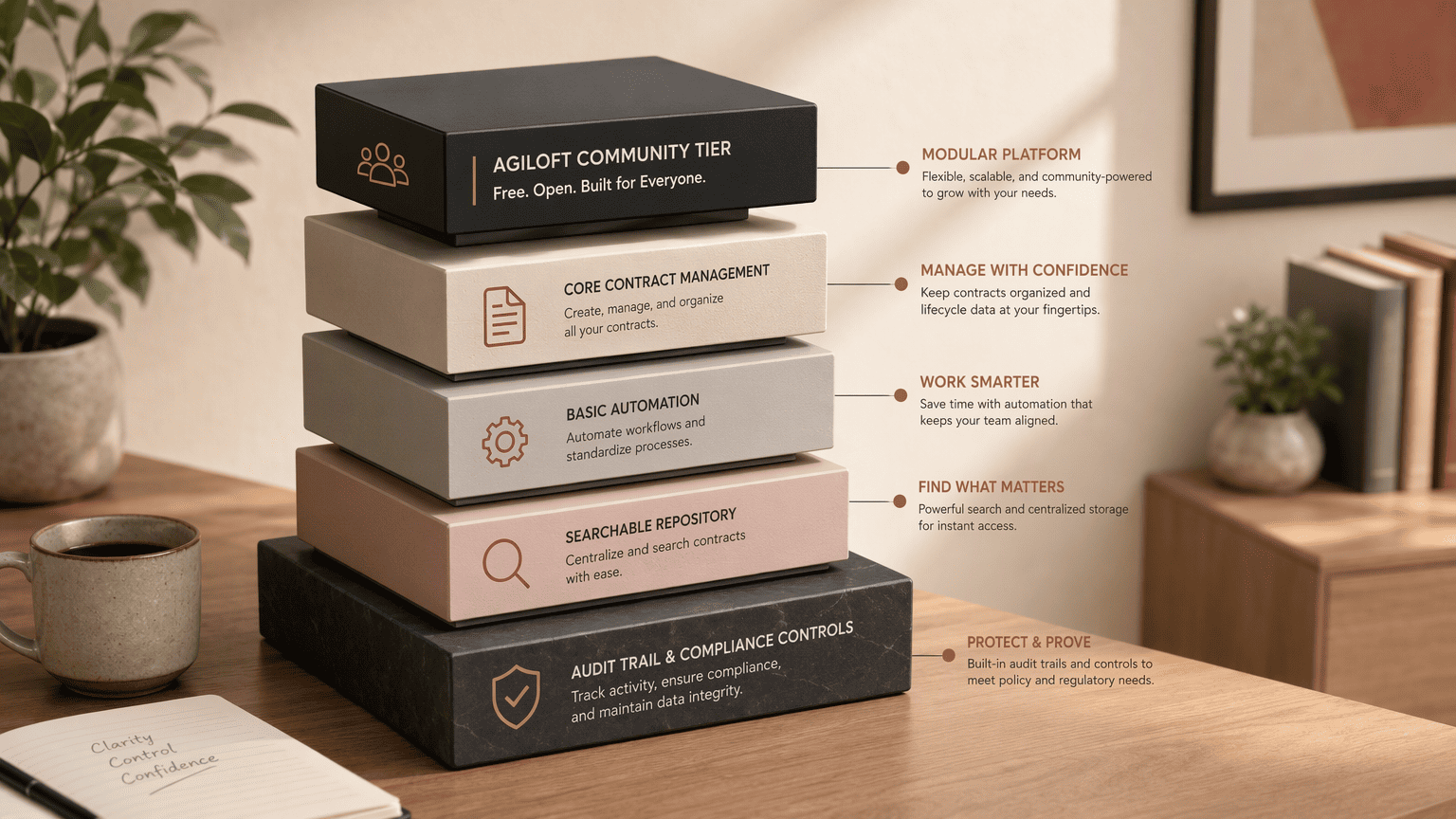
Agiloft is the only pick here with a genuinely free community tier, which makes it the entry point for compliance-heavy small teams that cannot secure budget for a paid tool but still need structured vendor contract monitoring today.
The free tier covers core contract management, basic automation, and a searchable repository. The platform’s lineage is enterprise legal-contract management, so the compliance and audit trail architecture runs far deeper than most inexpensive tools. Agiloft isn’t the prettiest or fastest to deploy, but its configurability is well-known in the CLM space, and the free tier gives you enough to monitor renewal dates and basic obligations across a modest vendor portfolio without spending a dollar.
The catch is the learning curve. Agiloft rewards configuration effort, and teams expecting an intuitive zero-training experience will struggle. Free means your time becomes the investment.
But for a regulated small business or nonprofit with a compliance mandate and no procurement software budget, a free Agiloft instance staffed by one detail-oriented administrator can replace a mess of spreadsheets and at-risk auto-renewals. When the team is ready to scale, paid tiers unlock conditional logic, integrations, and advanced reporting. Until then, the price is right.
6. HyperStart CLM, 94% AI Accuracy and Fast Deployment
HyperStart CLM targets the mid-market sweet spot where AI extraction accuracy directly determines whether your monitoring actually catches the obligations that matter.
- 94% AI extraction accuracy: The platform claims 94% extraction accuracy, narrowing the hidden cost of manual correction. If monitoring misses a termination-for-convenience clause or misreads a renewal deadline, the alert never fires and you pay the price in auto-renewals or lapsed SLAs.
- 4-week deployment goal: HyperStart targets 4-week deployment with native integrations into Salesforce, HubSpot, and Pipedrive, so extracted contract data flows directly into the CRM and procurement systems your teams rely on.
- Volume-based pricing: Teams with a few hundred contracts pay for what they use, not a seat count, making cost predictable for smaller contract volumes.
- Trade-off in peer validation: HyperStart is relatively new to the market, so long-term peer reviews and independent benchmarks are thinner than those for DocuSign or PandaDoc. It pairs well if you value speed and extraction accuracy; choose PandaDoc or Agiloft if deep public peer validation matters more.
7. DocuSign CLM, Enterprise-Grade Integration for Complex Stacks

DocuSign CLM lands at spot seven not because it is weak, but because enterprise-grade integration and broad deployment in 483+ G2 reviews comes at a price point and implementation complexity that stretches the definition of affordable for many buyers. For a complex procurement stack, it may be the most cost-effective choice when total cost of ownership is factored in.
The platform links contract monitoring directly into DocuSign’s e-signature and agreement cloud ecosystem. For organizations already standardized on DocuSign for signature workflows, that native connection eliminates integration middleware, data sync failures, and the operational friction of maintaining a separate monitoring tool. DocuSign CLM’s automated workflows, obligation tracking, and reporting capabilities are mature and well-tested across thousands of implementations.
The affordability case only holds under specific conditions: your organization already runs DocuSign at scale, your contract volume justifies the enterprise pricing, and the alternative costs of integration middleware and custom development push a cheaper standalone tool’s total cost of ownership past DocuSign’s sticker price.
For smaller teams, DocuSign CLM is likely overpriced and overconfigured relative to the monitoring outcome they need. A focused system will deliver more value per dollar spent for teams under a few hundred contracts. For procurement leaders inside large enterprises where the DocuSign footprint is already a sunk cost, extending into CLM is the path of least operational resistance.
Conclusion
The right affordable contract monitoring tool for your team depends on a single honest assessment: where does your contract data live today, and who needs to act on it?
If your answer is a shared drive and a spreadsheet, do not overthink this. Start with a focused intelligence layer like Contracts.ai at $19 per month, run a pilot against 50 contracts, and let the avoided auto-renewals fund your next move. One startup founder using structured monitoring cut software costs by $18K per year by renegotiating terms with 60-day windows. That math works at nearly any scale.
If your team already lives inside a CRM or document platform ecosystem, loyalty pays off. Zoho shops gain more from Zoho Contracts than from bolting on an external tool. DocuSign-heavy enterprises waste money on integration middleware when DocuSign CLM already connects.
Concord beats PandaDoc on signatures. PandaDoc beats Concord on document automation. Each pick has a home team it serves best.
The single most expensive mistake is waiting until the next board meeting to ask for budget while another quarter of vendor auto-renewals silently clears your procurement buffer. Start a pilot with any tool on this list within two weeks. That pilot will either prove the ROI or give you the data to justify the next tier up.
Frequently Asked Questions
What is automated vendor contract monitoring and how does it reduce risk?
Automated vendor contract monitoring uses AI to scan agreements for critical dates, obligations, and renewal terms, then sends automatic alerts. It eliminates manual spreadsheet tracking, preventing missed auto-renewal deadlines and payment triggers. This reduces financial leakage and compliance gaps by ensuring you never lose sight of a contractual commitment.
What are the most affordable tools for vendor contract monitoring and alerts in 2026?
The most affordable options are Zoho Contracts at $25/user/month, Concord at roughly $17 to $49/user/month with unlimited e-signatures, and PandaDoc starting at $35/month. Agiloft also provides a free community tier, making it a zero-cost entry point for basic compliance tracking.
How do I choose between a standalone contract intelligence tool and a full CLM suite for monitoring?
If you manage fewer than a few hundred contracts, select a focused standalone tool that deploys in days instead of a suite requiring months of configuration. Standalone solutions provide deep monitoring features without the heavy setup costs and complexity that full CLM suites typically demand.
What features should a small business prioritize in a contract monitoring tool?
Prioritize unlimited users, included implementation, automated renewal alerts, and exportable reports. The hidden costs often come from per-user fees and paid onboarding add-ons, so avoiding these traps ensures the tool stays genuinely affordable as your team grows.
Can AI contract monitoring tools integrate with existing ERP and procurement systems?
Yes, modern tools integrate natively with major systems. HyperStart CLM and DocuSign CLM connect directly with Salesforce, Microsoft 365, and HubSpot. These integrations push contract metadata and status updates into your existing workflows without requiring manual data re-entry.
Sources
- ObliGuard – Contract Obligation Tracking – www.obliguard.com
- Affordable Contract Management Software in 2026 – www.contractsafe.com
- 10 Best Zoho Contracts Alternatives and Competitors in 2026 – www.hyperstart.com






