







Introduction
Your AP team just processed another quarter’s worth of supplier invoices. Somewhere in that batch, a vendor billed you at last year’s rate, a volume discount never applied, and a duplicate charge sailed through because no one had the contract handy. This isn’t a one-off headache. It’s a steady, quiet drain on margin that most finance teams accept as the cost of doing business.
Manual invoice reconciliation is broken. When negotiated pricing sits buried in static PDFs while invoices flow through a separate system, the gap between what you agreed to pay and what you actually pay widens every cycle. The shift toward AI-driven auditing changes that equation entirely. Solutions now exist that can extract structured pricing terms, payment schedules, and discount structures directly from executed contracts and compare them line-by-line against supplier invoices, flagging overbilling, duplicate payments, and compliance gaps automatically.
The efficiency gain is material. Industry data shows these tools can reduce manual audit effort by up to 70 to 80%, turning what was once a sampling exercise into thorough coverage. That is the category this article maps: AI for contract analysis, automated invoice audit, and the contract compliance platform layer that makes true invoice reconciliation software work. The picks that follow range from dedicated post-signature intelligence layers to enterprise source-to-pay suites, each designed to close the gap between your signed agreements and the invoices your team pays.
Key Takeaways
- Contract pricing term extraction and automated invoice auditing divide broadly into two solution categories, each serving a different owner inside the enterprise.
- Contract intelligence platforms like Icertis and SirionLabs structure negotiated rates, payment schedules, and obligations from executed agreements. That structured data becomes the compliance-ready source of truth auditors need.
- Audit analytics tools like Lumina by Auditoria.AI and Coupa take that benchmark and run line-level transaction reconciliation, flagging overbilling and missed credits for cash recovery.
- Extraction accuracy sits at 95 to 99% for standard clauses but can drop to 60 to 70% when pricing structures get complex. That gap makes your contract portfolio type the critical selection filter.
- You don’t need a rip-and-replace to start. A focused pilot on 500 to 1,000 invoices with high-risk suppliers establishes a baseline overpayment rate and proves value inside 60 to 90 days, well before anyone asks for the full-portfolio business case.
- Finance teams gravitate toward recovery rate dashboards and automated exception flagging. Procurement teams want negotiation use and supplier scorecards. The platform that fits is the one that maps to whoever owns reconciliation.
1. Contracts.ai, Post-Signature Contract Intelligence Layer for Audit-Ready Reconciliation
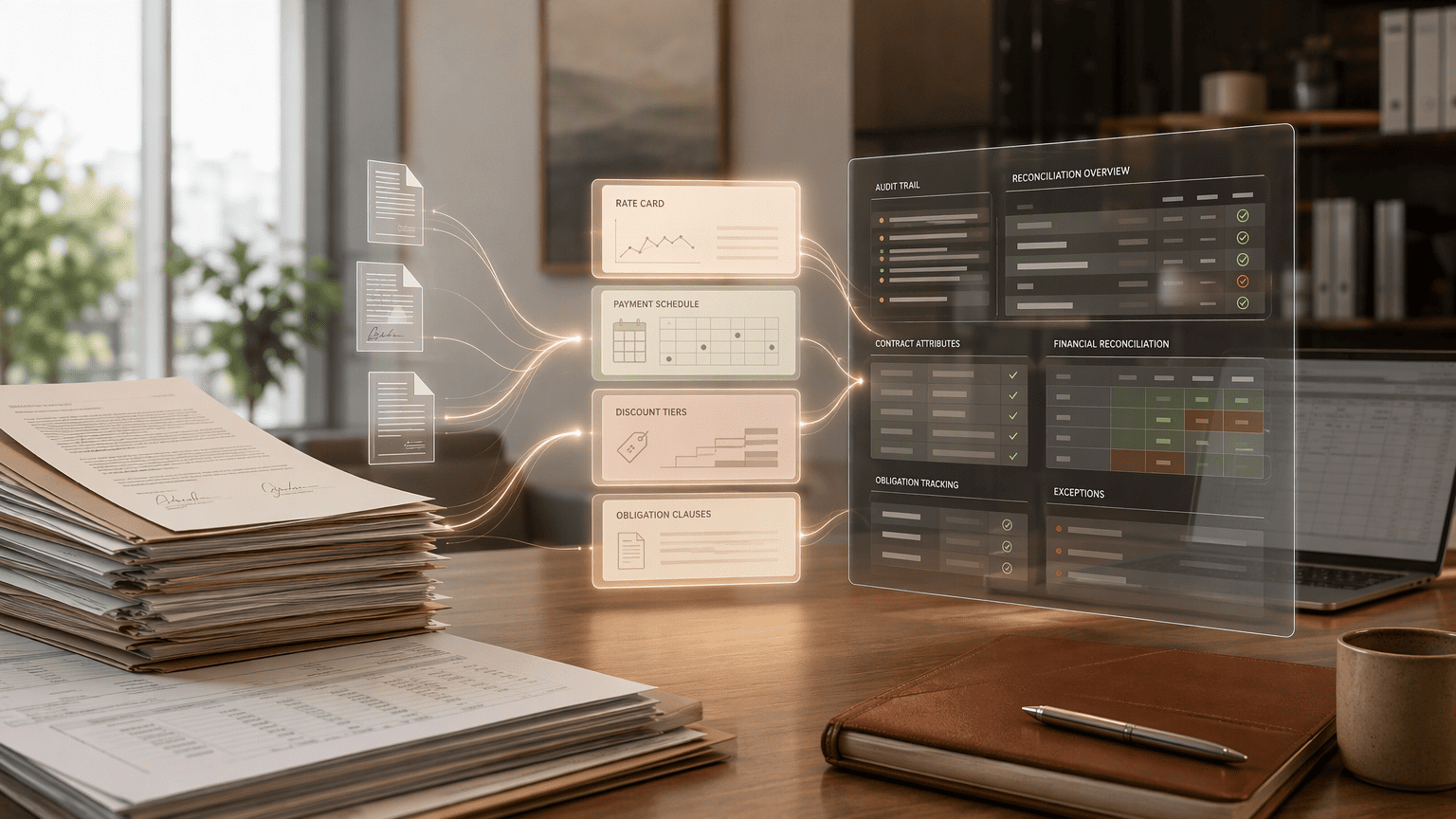
Contracts.ai functions as an intelligence layer deployed over executed agreements to structure pricing terms for audit-ready reconciliation, without requiring the organization to migrate its existing contract repository or replace current systems.
- Extraction engine parses executed contracts: The platform extracts rate cards, payment schedules, discount tiers, and obligation clauses from signed PDFs and scanned documents, with published accuracy above 99% on structured data fields.
- Related agreements are grouped automatically: The system clusters master agreements, amendments, and SOWs together and aligns shared pricing terms across the full agreement family so no version confusion slips through.
- Source language linkage for validation: Every extracted financial term is linked back to its source contract clause, letting your audit team verify the benchmark directly before a dispute or recovery action.
- Structured intelligence is shared across teams: The platform makes extracted pricing data consumable by both finance and procurement, enabling the AP team to match invoices against contract rates while procurement monitors supplier compliance against negotiated terms.
- Pilot deployment with a limited contract set: You can run a proof of concept on a subset of agreements without touching the full repository, establishing accuracy and recovery metrics inside your existing invoice workflow.
2. Icertis, Enterprise CLM with Deep Obligation Management
Icertis earns its spot on this list because its structured contract data and obligation extraction engine create the source of truth that finance teams need before any automated invoice comparison can operate at scale.
- Obligation Management: identifies, classifies, and tracks every commitment in a contract, surfacing pricing schedules, payment terms, and rebate conditions as structured data.
- Market position: holds a longstanding Leader position in Gartner’s Magic Quadrant for Contract Lifecycle Management, signaling maturity and a broad integration ecosystem.
- Capability boundary: does not perform line-level invoice matching, but feeds obligation data into downstream audit tools and ERP systems as a clean, validated benchmark.
- Governance role: alerts finance and procurement teams when actual spend or supplier performance diverges from contracted terms, making the CLM an active governance layer instead of a static filing cabinet.
3. SirionLabs, AI-Native Contract Management for Performance and Financial Compliance

SirionLabs solves the reconciliation problem by not creating it in the first place. Contract extraction and invoice audit are not separate steps here. They run inside one buyer-supplier workbench, drawing from the same data. The AI engine pulls negotiated pricing, service levels, and delivery milestones straight from executed contracts and makes that parsed data the system of record. Every supplier invoice that follows is validated against it.
Financial compliance, supplier performance scorecards, and relationship health metrics share the same screen. An overbilling flag doesn’t appear in isolation. It sits next to the delivery-window miss and the quality shortfall from the same month.
When the team that governs supplier performance also owns financial reconciliation, that connection matters. The handoff gap between systems disappears, and pricing deviations stop surviving across reporting cycles. Teams that used to catch a 5 percent overbilling on one dashboard while a separate tool showed on-time delivery of 94 percent now see both signals together and can act on the pattern rather than chasing individual line items.
4. Evisort, Search-Driven Contract Analytics for Rapid Pricing Term Extraction
Most invoice reconciliation projects stall before they start for one reason: your pricing terms are buried across thousands of contracts in formats no query tool can open. Evisort eliminates that bottleneck. Its no-code search engine lets finance teams query the full contract portfolio for specific clauses, payment terms, rate escalation formulas, early-payment discount language, without a data team or a long implementation cycle. Pre-trained AI models identify financial metadata out of the box, so a team can surface every contract with a volume-based pricing table in hours rather than months.
The platform works best as a discovery and benchmark layer. When you need to assemble the golden-record pricing dataset that an audit tool will later compare against incoming invoices, Evisort collapses the extraction timeline. It does not handle the line-level invoice match itself. What it does is remove the single largest manual obstacle to getting that process off the ground: knowing what your contracts actually say suppliers should charge.
5. Lumina (by Auditoria.AI), Dedicated Invoice Audit with AI-Driven Cash Recovery
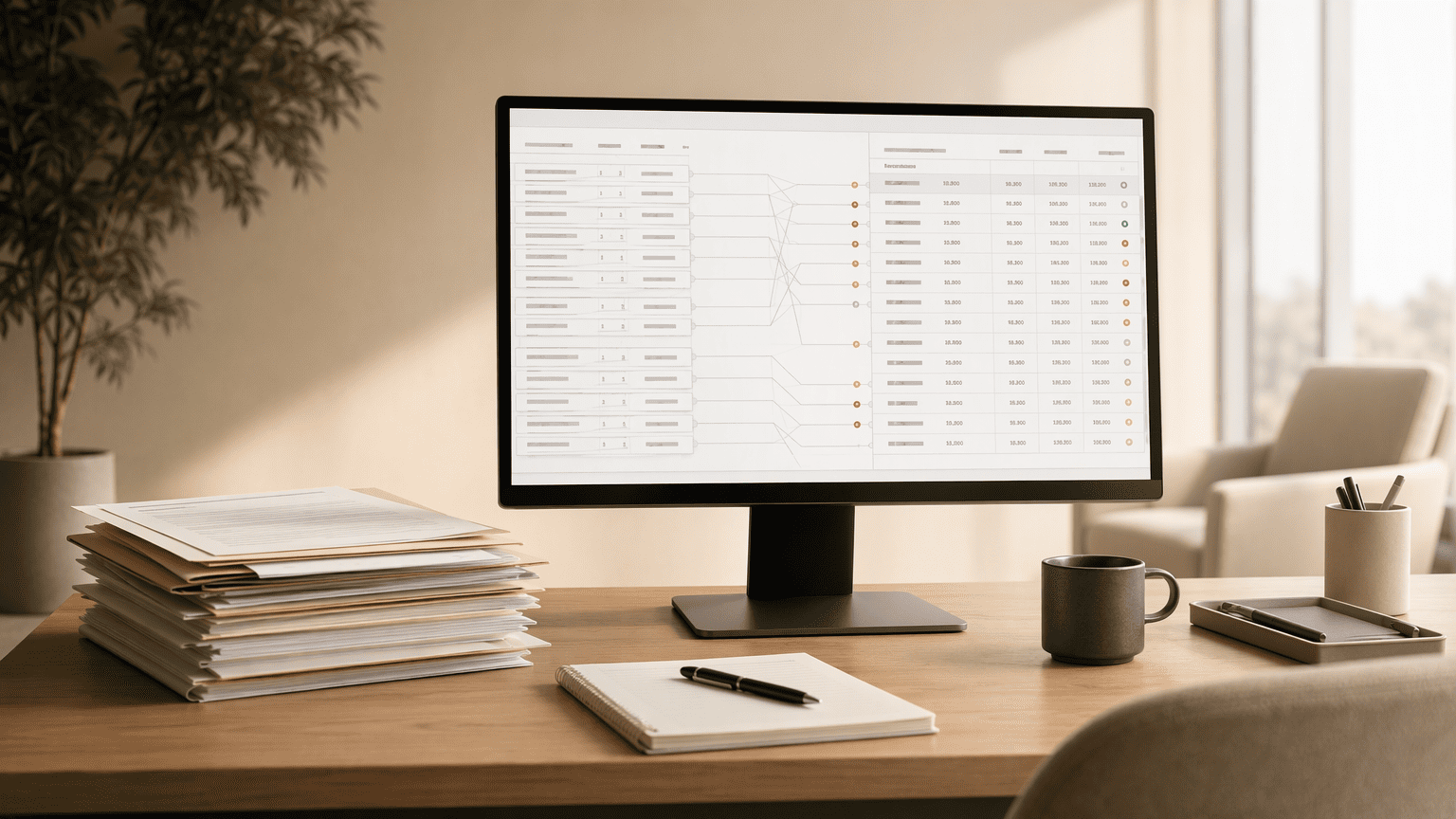
Lumina is the finance team’s sharpest tool for cash recovery. Where broader CLM platforms structure contract data as one capability among many, Auditoria.AI built Lumina to do one job: ingest contracts and purchase orders, benchmark the exact pricing and payment terms they contain, then reconcile every incoming invoice line-by-line against that baseline to flag overbilling, duplicate payments, missed early-payment discounts, and unapplied credits.
The output is not a compliance report. It is a prioritized list of recoverable dollars. The platform automates the full audit trail from contract clause to flagged transaction, generating the evidence package that an AP analyst can send directly to a supplier with a repayment demand or a deduction notice. For organizations where invoice reconciliation is owned by the shared services or finance ops function, with a mandate to recover cash rather than manage supplier relationships, Lumina aligns precisely with that chart of accounts.
No independent recovery-rate benchmarks have been published across the category. The only reliable way to forecast what Lumina can recover inside your specific supplier portfolio is to measure your own baseline overpayment rate on a pilot batch of invoices.
6. Coupa, Source-to-Pay Suite with Embedded Invoice Reconciliation

Coupa reframes the invoice reconciliation problem as a process design issue rather than a standalone audit exercise. Its Business Spend Management platform already captures purchase orders, receipts, and contract terms inside the same system. When an invoice arrives, Coupa’s native matching engine validates it against all three data sources automatically using pre-built rules and the platform’s community intelligence, AI models trained on patterns from the broader Coupa user base.
The advantage is structural. Because the contract, the PO, the receipt, and the invoice all live in one data model, reconciliation stops being a periodic audit project with data extract-transformation handoffs. It becomes a continuous, in-process control that blocks a non-compliant invoice from reaching the payment run. The 3-way match operates on invoice line items, not header totals. That catches the most common leakage pattern: a supplier bills the correct total at the summary level but applies an outdated unit price or omits a contracted discount on individual line items.
For organizations already on Coupa for procurement or AP, activating its contract compliance and reconciliation capabilities may require less implementation lift than adding a separate audit analytics platform that must be integrated with both the contract repository and the ERP. The trade-off is that Coupa’s matching logic works best on PO-backed, catalog-based spend. Complex services contracts with milestone-based payment schedules or rebate structures defined in prose rather than structured fields can still demand manual configuration to fully capture the negotiated terms.
7. SAP Ariba, Integrated Procurement and Supply Chain Invoice Matching
SAP Ariba addresses the reconciliation problem from the incumbent’s position: most large enterprises already run SAP as their ERP backbone, and many already use Ariba for procurement and supplier collaboration. Its automated invoice management layer validates incoming invoices against contracted catalogs, purchase orders, and goods-receipt data before the transaction ever posts to the financial ledger.
The integration architecture is what earns it a spot here. When an invoice line item hits Ariba, the system checks it against the supplier’s contracted catalog pricing and the specific purchase order terms. If those check out, the invoice passes through and posts directly to SAP ECC or S/4HANA with a clean audit trail. If a price deviates, the invoice is blocked or routed for exception handling, before payment, not after. For organizations whose master supplier data, contract terms, and financial systems already live inside the SAP ecosystem, adding a third-party extraction tool introduces data synchronization complexity that activating Ariba’s native matching may avoid entirely.
The limitation is catalog dependency. Ariba’s contract enforcement logic works best on structured, catalog-based pricing. Supplier agreements with complex, prose-based rate cards, tiered volume discounts applied quarterly, rebate conditions that adjust pricing retroactively, may not map cleanly to the catalog framework without custom configuration.
Still, for the large enterprise segment where SAP is the system of record, using Ariba’s embedded matching engine as the first line of defense before layering on a specialist audit analytics tool for complex services spend is a pragmatic deployment sequence.
8. Conga, Contract Lifecycle Management with Revenue Compliance Focus
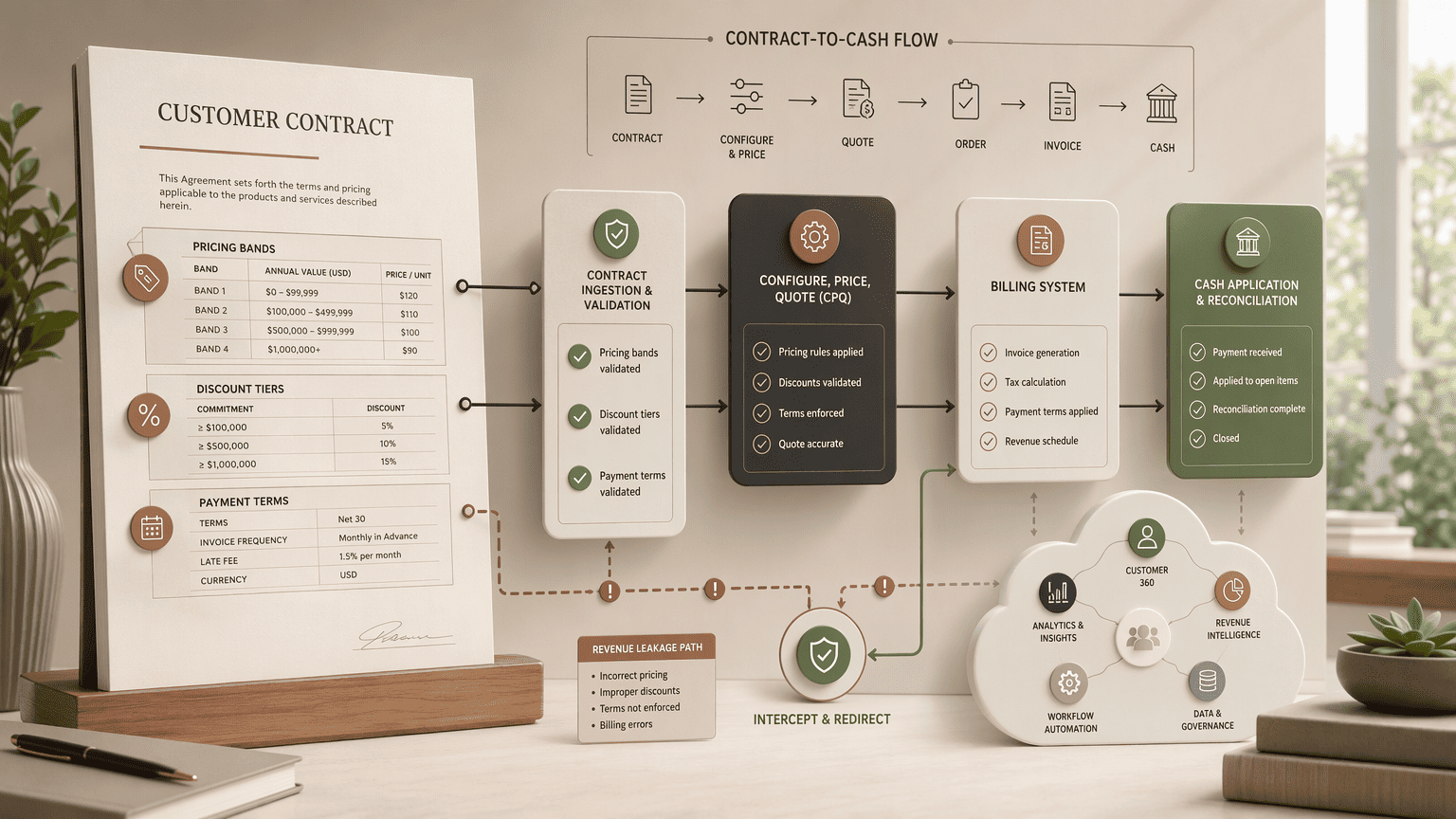
Conga earns the final spot by offering a dual-lens view of the contract-to-cash reconciliation problem. Most tools on this list look exclusively at supplier-side costs. Conga starts from the revenue side: its CLM extracts pricing structures, discount schedules, and payment terms from customer contracts and ties them directly to billing systems and CPQ platforms in the Salesforce ecosystem. For organizations with recurring revenue models, preventing revenue leakage is the mirror image of the supplier overbilling problem. The most common leaks are billing the wrong rate and missing a contracted price escalation.
Conga’s applicability to the supplier-cost audit use case comes from that same extraction architecture applied in reverse.
| Dimension | Conga Revenue-Side Use | Conga Supplier-Side Use |
|---|---|---|
| Primary extraction target | Customer pricing, discount structures, renewal schedules | Supplier rate cards, payment terms, rebate conditions |
| Downstream system connection | Salesforce CPQ and billing engines | ERP and AP systems for invoice validation |
| Compliance focus | Revenue recognition and billing accuracy | Spend governance and overbilling detection |
| Core platform strength | Deep Salesforce integration for pricing data flow | Contract data structured for cost-side audit consumption |
| Best-fit organization profile | Companies auditing both customer collections and supplier payments from a single CLM | Organizations with significant recurring-revenue billing complexity that also want cost-side compliance |
This bidirectional capability is most valuable when a single legal or commercial operations team owns contract integrity across the full buy-side and sell-side portfolio. Conga can surface when a customer is being underbilled and when a supplier is overcharging from the same contract intelligence layer, giving the office of the CFO a consolidated view of contractual financial compliance.
Conclusion
Choosing between a contract intelligence platform and a dedicated invoice audit tool is really a choice about who owns the process. When procurement or legal runs reconciliation, a CLM like Icertis or SirionLabs is the natural fit because its core output is structured obligation data. When finance operations runs it and the target is cash recovery, the job calls for a tool like Lumina or Coupa that excels at flagging individual transactions.
Either route starts the same way: a 60-to-90-day pilot on 500 to 1,000 high-risk supplier invoices. That pilot establishes your real overpayment baseline. Once you scale, it typically cuts manual audit effort by 70 to 80%.
The two categories are already converging. Platforms like Contracts.ai layer audit-ready extraction directly onto executed agreements. The direction is clear: the contract itself, not a separate reconciliation process, ends up governing every payment.
Frequently Asked Questions
What types of software can automatically extract pricing terms and payment details from executed contracts?
Two categories serve this function. Contract intelligence platforms like Icertis, SirionLabs, and Evisort use AI to pull rate cards, payment schedules, and discount structures from signed PDFs and scanned agreements. Dedicated audit tools like Lumina and Coupa then consume that extracted data to benchmark invoices.
How do contract intelligence and invoice audit tools compare when reconciling supplier invoices against contract terms to prevent overbilling?
Contract intelligence tools structure obligations and pricing into a compliance-ready source of truth but typically do not perform line-level invoice matching. Invoice audit tools ingest that benchmark data and reconcile every transaction line-by-line to flag overbilling and missed discounts for cash recovery.
What are the key accuracy benchmarks and data security requirements for financial contract extraction solutions in the US enterprise market?
Extraction accuracy sits at 95 to 99% for standard clauses but drops to 60 to 70% for complex pricing structures.
What steps should a company follow to pilot or deploy a solution that matches extracted contract rates to actual supplier invoices?
To implement, follow a three-phase deployment sequence:
- Audit a representative sample of 500 to 1,000 invoices to establish the baseline overpayment rate.
- Configure the chosen platform to extract pricing from relevant contracts and match those rates against invoice line items.
- Run a 60-to-90-day phased pilot starting with high-risk suppliers before expanding.
What are the leading alternatives to manual contract-to-invoice reconciliation, and how do their capabilities differ for finance vs. procurement teams?
Finance teams gravitate toward dedicated audit analytics tools like Lumina and Coupa that prioritize cash recovery rates and automated overbilling flags. Procurement teams tend to favor CLM platforms like Icertis and SirionLabs that deliver negotiation insights, obligation tracking, and supplier performance scorecards.
Sources
- B2B Contract Management Automation Software | Esker – www.esker.com
- Contract vs. Billing Reconciliation | Kaana – www.kaana.com