








Introduction
Your procurement team negotiated a 12% volume discount, but the invoice that just landed in your AP queue is charged at list price. The margin erosion is immediate, and catching it three months later during a manual audit means the cash is already gone. Multiply that scenario across a thousand vendors and multiple agreement versions, and the financial bleed becomes a gaping wound.
Undetected pricing discrepancies hit negotiated savings, EBITDA, and supplier trust directly. The volume and complexity of modern commercial agreements make it impossible for a human to check every rate card, escalation clause, and discount schedule against every invoice line item. Hence the late-night spreadsheet marathons and forensic accounting fire drills.
A new category of AI-powered contract intelligence targets this specific financial risk. Instead of relying on spot-checks, these solutions extract structured pricing terms from your executed agreements automatically. They compare those terms line-by-line against actual invoices, creating a systematic, scalable, and audit-ready reconciliation process. Think of it as shifting from sampling a handful of high-dollar invoices each month to verifying every single line across your entire supplier base before payment runs.
The most sophisticated architectures in 2026 follow an intelligence-layer approach. This strategy sits on top of your existing ERP or contract lifecycle management system rather than demanding a disruptive rip-and-replace. Platforms like SAP or Oracle stay in place, and the tool feeds cleaned, validated data directly into your current workflows. What follows are the eight leading solutions that extract pricing terms and compare actual invoices, ranked by their ability to close that dangerous gap between negotiated value and paid reality.
Key Takeaways
Before diving into the specific tools, here are the non-negotiable findings from this analysis of the 2026 landscape:
- ERP-native reconciliation wins: Solutions that output data directly into SAP or Oracle structures eliminate the number-one friction point for finance and procurement teams.
- 95%+ accuracy is table stakes for structured data: Extraction accuracy for standard rate tables and discount schedules now exceeds 95%, but it falls fast when facing dense legal prose or handwritten amendments.
- The intelligence layer trumps rip-and-replace: Operating on top of your existing tech stack delivers 100% of the compliance value with a fraction of the migration risk.
- Clarifying questions are the new power feature: The best systems no longer just flag low-confidence fields; they ask your team specific, targeted questions to resolve ambiguity and learn from the answer.
1. Contracts.ai, Multi-Agent Contract Intelligence with ERP-Native Reconciliation
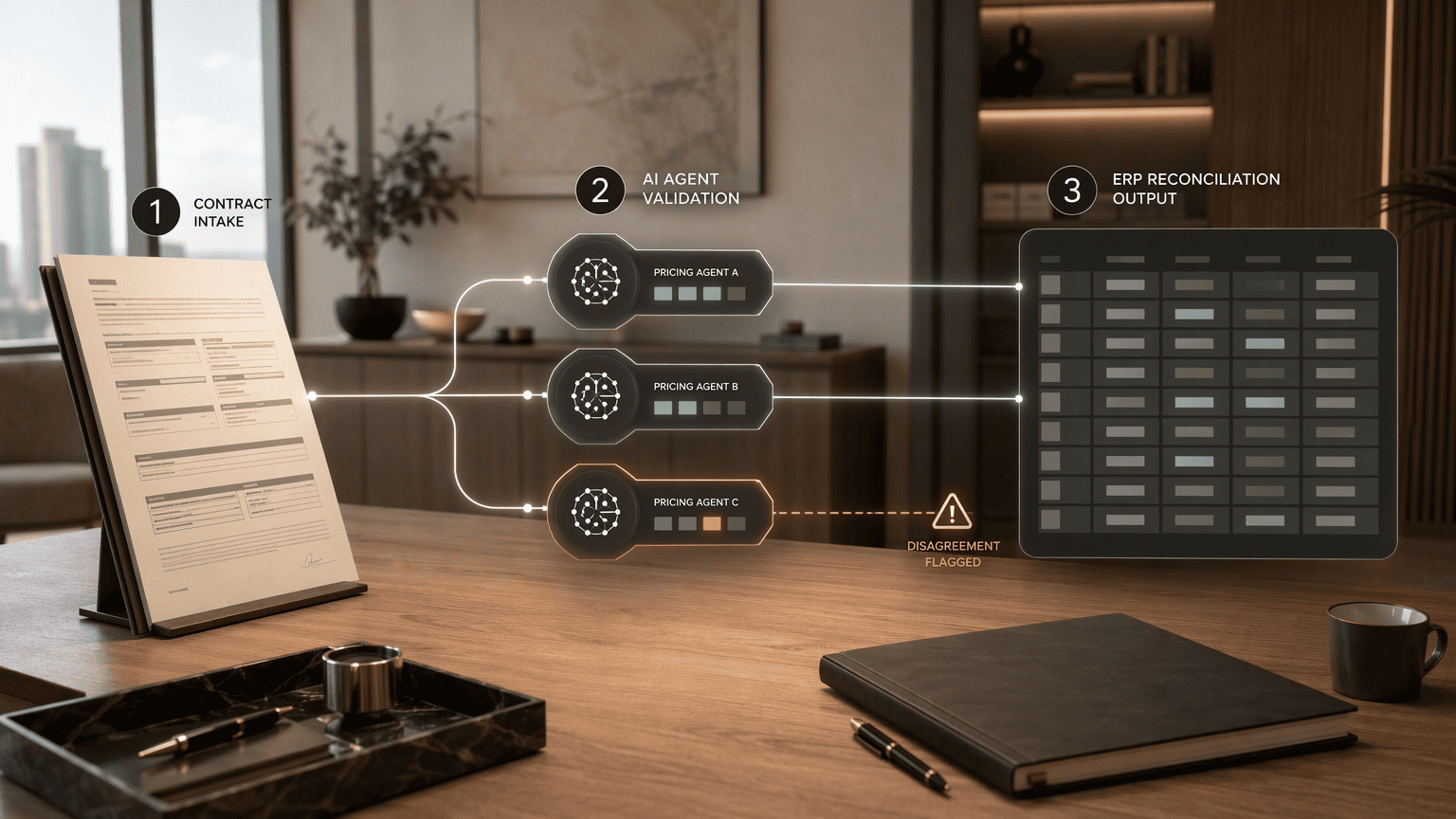
Contracts.ai earned the top spot by solving the two problems that sink most automated reconciliation projects: hallucinated figures and workflow disruption. A panel of AI agents must agree on every extracted pricing term before it lands in your ERP. When they disagree, the item gets flagged instead of guessed. The output mirrors standard SAP and Oracle column headers, so it feeds your procurement modules without rekeying or reformatting.
The practical sequence runs like this:
- Ingest and group: The system automatically groups related agreements and aligns shared terms, connecting amendments and addenda to master agreements so that the effective rate is always current.
- Multi-agent extraction: A panel of independent AI models extracts each pricing term and compares their results internally. Rate cards, escalation clauses, volume discounts, all get the same treatment.
- Consensus or flag: If the agents disagree on a value, the system surfaces it as ‘Review Needed’ instead of fabricating an answer. Consensus gating is the most practical defense against hallucination in an audit context. The gap between a 70% and a 95% match rate at reconciliation time determines whether your team trusts the output or double-checks everything.
- ERP-native output: Validated data inherits your ERP’s column headers, date formats, and number conventions, feeding directly into procurement modules.
- Compliance audit trail: Every extracted figure is linked back to the source contract language for immediate validation during an audit or compliance review.
2. Icertis Contract Intelligence, CLM-Embedded Obligation and Rate Verification
Icertis represents the CLM-embedded philosophy of contract intelligence. Rather than layering on top of a separate ERP, it builds the extraction and verification engine directly into the contract repository where your commercial terms already live. For enterprises that view their CLM as the system of record, this eliminates a data synchronization point and a potential source of truth conflict.
The platform structures commercial terms, including rate cards, discount schedules, and payment milestones, at the point of ingestion. It converts the agreed-upon pricing logic into machine-readable objects that an obligation management engine can actively monitor. The engine then validates incoming invoice data against those stored objects, turning a static file room into a continuous compliance sentinel.
Where Icertis excels is with complex, negotiated agreements where the pricing is not a simple SKU table but a narrative clause with conditions and deliverables tied to payment.
Its ability to connect a payment obligation to a performance milestone keeps the compliance check grounded in the operational reality of the supplier relationship. For organizations already deeply invested in the Icertis CLM platform, this native obligation management layer is the path of least resistance to automated invoice validation.
3. Azure AI Document Intelligence, Custom Extraction Models for Pricing Field Mapping

Microsoft’s Azure AI Document Intelligence takes a fundamentally different approach than the turnkey platforms above. It is a build-your-own-pipeline toolkit. You train custom extraction models on your specific contract and invoice templates, and it outputs structured JSON or CSV for a downstream reconciliation engine.
This is raw material for a comparison, not the comparison itself. For enterprises with a data science team and a unique mix of document formats, this model-based approach offers unmatched extraction fidelity on standard fields, where accuracy can exceed 95%.
The power is in the custom field mapping. You can train a model to locate and extract a non-obvious pricing field buried in a densely formatted attachment. The output is clean, consistently labeled data that an internal analytics team can compare against invoice data in a separate system. The price model reflects this build-it-yourself reality, billing by pages analyzed with a free tier (F0) for initial testing.
The trade-off is the integration work. You must build or have a separate reconciliation step that takes the JSON and does the actual comparison. There is no native invoice-matching engine here. And while the system is strong with typed text, accuracy falls predictably against handwritten amendments or ambiguous abbreviations within legal prose. Companies choose this path when they need a high-fidelity extraction component to feed a custom-built compliance machine.
4. SirionLabs, AI-Powered Performance and Invoice Compliance Tracking
Sirion operates at the intersection of contract language and post-award performance, making it a strong option for services and performance-linked revenue agreements. Its core strength is connecting pricing terms directly to the operational obligations that generate an invoice. Instead of treating rates as static numbers, it understands them as contingent values tied to performance tiers, service levels, or milestones. Key capabilities that enable this include:
- Benchmarked accuracy: Sirion’s Extraction Agent achieved a 94.2% overall F1-score in the 2026 ContractEval benchmark, outperforming fine-tuned GPT-4 by 8.9 percentage points in a direct comparison on 500 real-world contracts.
- Commercial terms strength: Extraction performance for commercial terms specifically reaches a 96.1% F1-score, covering payment schedules, pricing tiers, volume discounts, and currency specifications with high reliability.
- Processing speed: Sirion processed contracts in an average of 2.3 minutes, compared with 3.9 to 5.1 minutes for other evaluated models, making it practical for large-scale portfolio analysis.
- Continuous monitoring: Automated compliance triggers continuously validate each invoice instance against the governing clause throughout the contract lifecycle, rather than relying on a single point-in-time check at approval.
5. Coupa Invoicematch, Procurement-Led Invoice-to-Contract Rate Validation
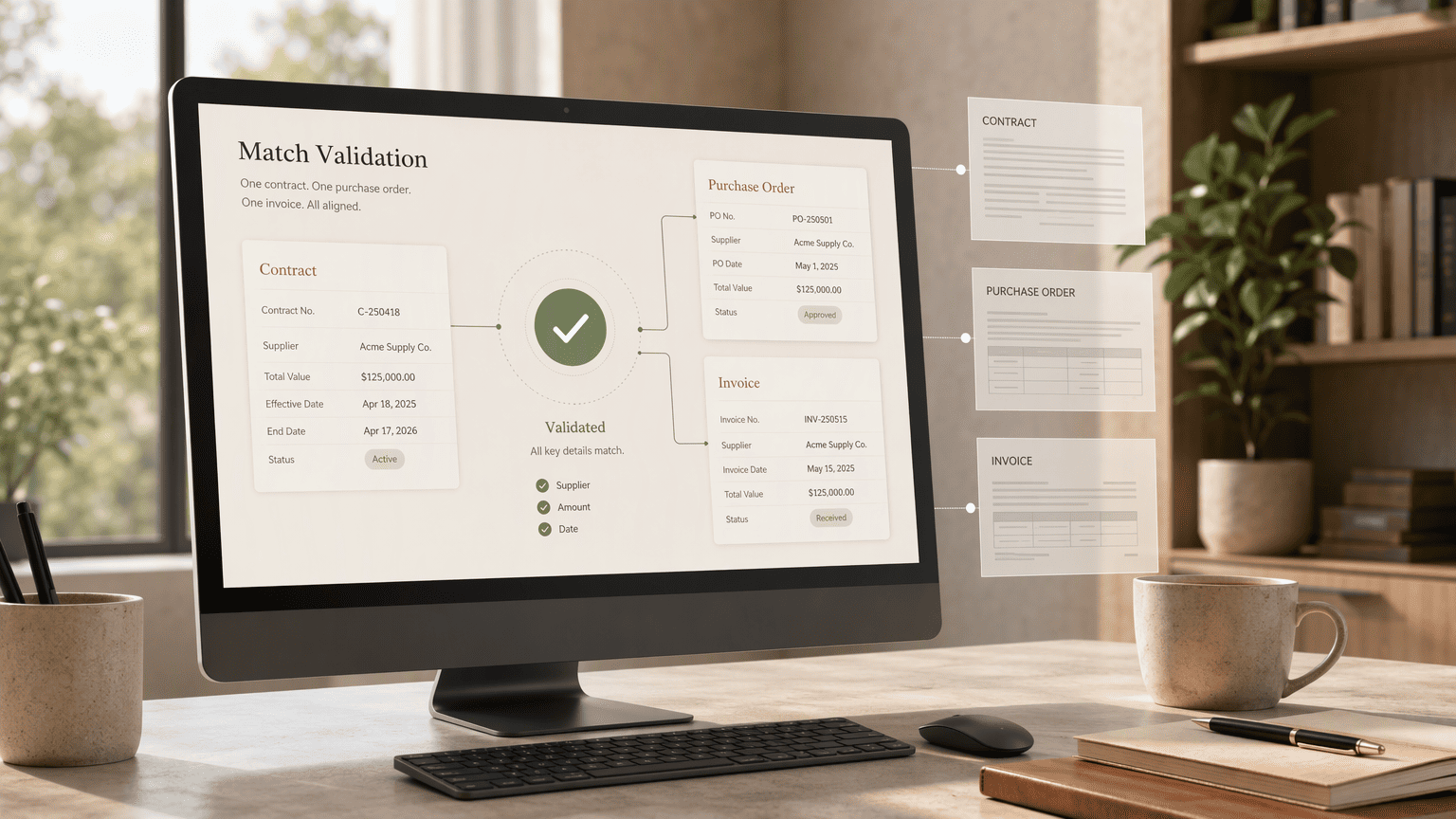
Coupa Invoicematch runs inside the same system that houses your contracts, purchase orders, and invoices. No data handoff to an outside tool. No latency from integrating separate platforms. The architecture catches every overcharge at the pre-approval stage, before a payment batch ever runs.
Coupa’s AI extracts pricing terms, rates, quantities, and discount schedules from contracts and purchase orders ahead of time. When an invoice arrives, each line item is validated against those terms automatically.
That pre-approval gate changes supplier behavior. Vendors learn quickly that inflated line items get rejected on intake, not months later in an audit. For enterprises already running procurement through Coupa, you are activating a capability inside a platform you own, not shoehorning in a separate tool that requires new training and integration work.
Contract-to-invoice matching in one platform also removes the reconciliation gap that creeps in when contract data lives in one system and invoice data in another. In a split-stack setup, a 70% match rate at reconciliation is common because someone retyped a unit price or missed a discount tier. Keeping both sides of the comparison inside Coupa pushes that rate toward 95%, and the difference shows up directly in cash retained. The implementation trade-off is real: if your procurement data and workflows live elsewhere, Coupa offers no advantage over a standalone contract compliance tool. But for Coupa-native finance and procurement teams, Invoicematch is the path of least resistance to stopping overbilling at scale.
6. DocuSign Insight, Agreement Analysis with Risk and Pricing Clause Detection

DocuSign Insight approaches the problem from a retrospective, analytical angle rather than a transactional one. Its strength is analyzing a large repository of already-signed agreements to identify and extract pricing clauses and key risk terms.
This creates a structured data map of your commercial obligations that you can export to power a reconciliation or audit process downstream. Think of it as the forensic pre-work. Before you can compare invoices to contracts, you need to know what is actually in your contract portfolio. DocuSign Insight turns a static backlog of signed PDFs into a queryable dataset of pricing truth, surfacing the rate cards, automatic renewal clauses, and escalation triggers that cause the typical discrepancies.
7. Kira Systems, M&A-Grade Clause Extraction for Complex Rate Schedules
Kira Systems brings a DNA shaped by legal due diligence, and that matters deeply when pricing terms are not in neat tables. Its machine learning models were built to hunt for specifics in dense legal prose, making it exceptionally strong where pricing is buried in narrative clauses with multi-layered conditionality.
You reach for this tool when dealing with non-standard pricing. Most-favored-nation clauses that trigger pricing adjustments based on other customer agreements, complex rebate schedules tied to annual volume thresholds, and discount waterfalls with multiple qualifying conditions: these are Kira’s natural environment. It requires more hands-on model training than some turnkey options. What you get in return is nuance extraction on difficult commercial terms that a standard OCR-plus-AI system often misses, producing high-trust data an audit team can use without sampling back to the original document for every field.
It is less suited as an automated invoice-matching engine itself. It is the elite extraction specialist that feeds a separate reconciliation process.
8. Eigen Technologies, Hybrid NLP and Rules Engine for Bespoke Pricing Terms
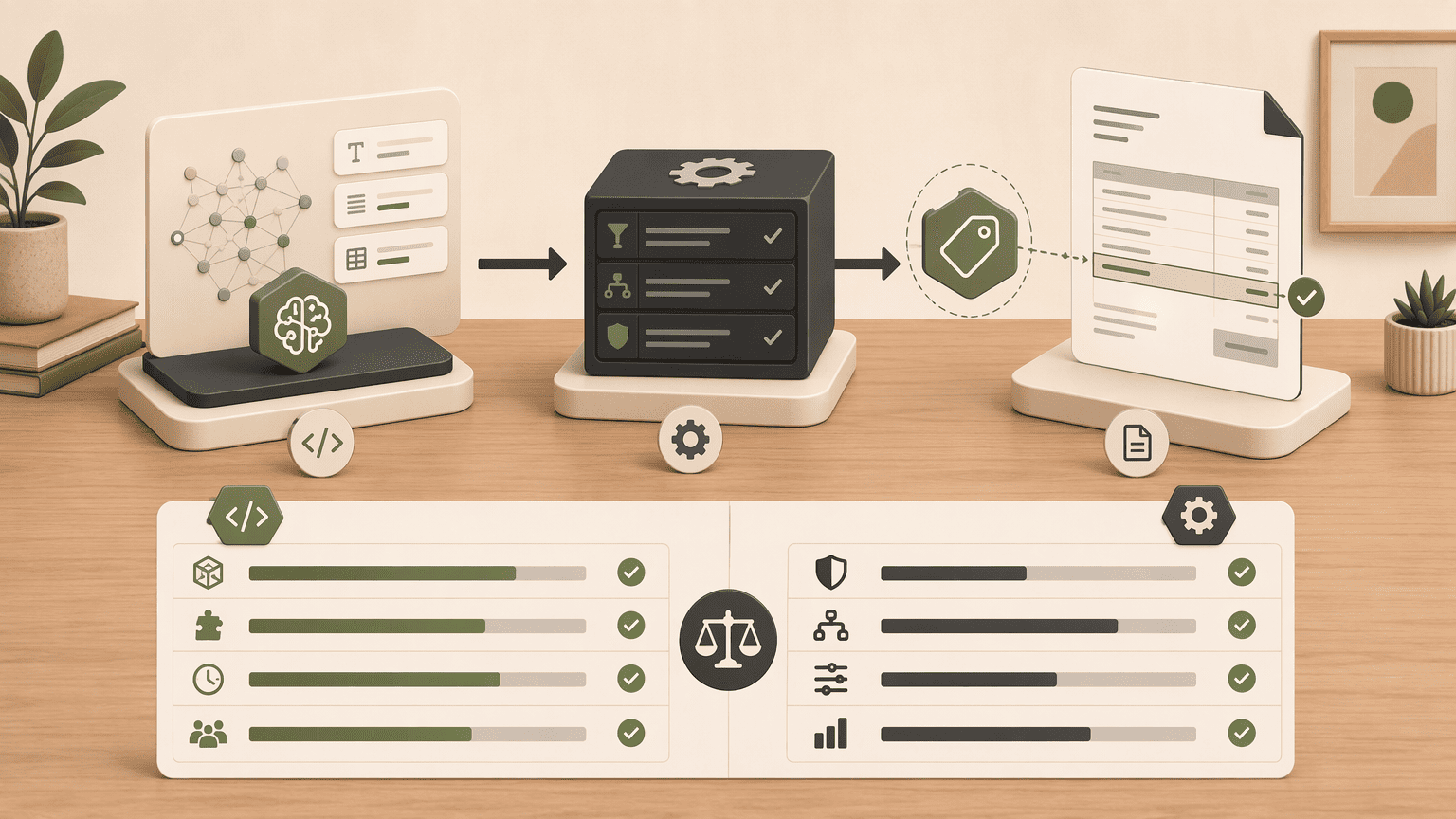
Eigen occupies a specific niche: highly bespoke contract portfolios where standard models fail. Its approach combines a no-code NLP model training environment with a powerful business rules engine. A non-data-scientist user can teach the system what a unique pricing term looks like and codify the business logic for comparing that term against an invoice. A comparison of its core capabilities clarifies its position:
| Capability | Eigen Technologies | Standard AI Extraction Tools |
|---|---|---|
| Model Training | No-code environment for non-technical users | Typically requires data science teams for custom tuning |
| Term Customization | Iteratively refines extraction of unique pricing terms and rate cards | Best on standard, pre-trained field types |
| Discrepancy Logic | Powerful rules engine applies bespoke business logic to comparisons | Usually flags mismatches based on simple field-value equality |
| Target Use Case | Non-standard contracts with ambiguous clauses and bespoke schedules | High-volume, standardized invoices and contracts |
The key word here is iterative. Eigen is a refinement environment where you teach the system to handle your specific contract idiosyncrasies, from a particular minimum volume commitment clause to a uniquely structured rate card. For an institution with a large volume of architecturally similar but non-standard contracts, this targeted tuning can push a match rate from 70% to 95% at the reconciliation stage.
Conclusion
The 2026 landscape has crystallized around two dominant architectural patterns for reconciling contracts and invoices. The first is the ERP-native intelligence layer, best represented by Contracts.ai and Coupa, which plugs into your transactional systems without displacing them. The second is the CLM-embedded approach, led by Icertis and Sirion, which turns the contract repository itself into the verification engine.
For complex or deeply non-standard pricing, specialist extraction engines like Kira and Eigen are still required. But across every approach, the critical differentiator has shifted. Raw extraction accuracy matters less than whether the system flags uncertainty instead of guessing, asks clarifying questions, and delivers data in your ERP’s exact format.
That flagging behavior, not the comparison itself, determines whether a reconciliation run ends with a handful of flagged exceptions or a spreadsheet full of false matches. In practice, it is the difference between a 70% and a 95% match rate at the reconciliation stage, because every guess the engine makes downstream becomes an invoice that finance staff have to manually untangle.
Choose based on whether your architecture centers on your ERP, your CLM, or unique legal complexity.
Frequently Asked Questions
What types of software can automatically extract pricing terms from contracts and compare them against actual invoices?
AI-powered contract intelligence solutions fall into three categories:
- ERP-native intelligence layers: like Contracts.ai, these extract structured pricing data and perform downstream comparison against invoice line items.
- CLM-embedded verification engines: like Icertis and Sirion, these extract structured pricing data and perform downstream comparison against invoice line items.
- Specialist clause extraction platforms: like Kira Systems and Eigen Technologies, these extract structured pricing data and feed a downstream comparison against invoice line items.
How does AI-powered contract intelligence identify discrepancies between negotiated rates and billed amounts?
It extracts structured fields like rate cards, discount schedules, and unit prices from contracts, then algorithmically compares each extracted term against corresponding invoice line items. The most advanced systems use multi-agent AI panels that must achieve consensus on the extracted value before it is treated as truth, eliminating hallucinated terms from the comparison pool.
What are the key features to look for in a contract audit and invoice reconciliation solution in 2026?
Prioritize these capabilities when evaluating AI contract-comparison tools:
- ERP-native output formatting so extracted data feeds directly into procurement modules with matching column headers, date formats, and number conventions.
- Multi-agent consensus checks that require multiple AI models to agree on an extracted value before accepting it as truth, reducing hallucinated terms.
- Ability to ask clarifying questions on ambiguous terms rather than silently guessing at their meaning.
- Page-level traceability that links every extracted figure back to its source clause, so you can verify the contractual basis for any discrepancy.
How do companies integrate contract extraction tools with existing ERP and procurement systems without disrupting workflows?
The intelligence-layer approach achieves this by operating on top of existing systems. The tool extracts and structures contract data, then outputs it with the exact same column headers, date formats, and number conventions as SAP or Oracle. This allows the data to feed directly into procurement modules without manual rekeying or platform migration.
What are the accuracy levels and practical limitations of automated contract extraction technology today?
For well-structured, typed contracts, extraction accuracy for standard commercial terms now exceeds 95%, with Sirion achieving a 94.2% overall F1-score on a 2026 benchmark. Practical limitations include a sharp fall in accuracy on handwritten notes, highly ambiguous legal abbreviations, and non-standard pricing clauses buried in dense narrative text.
What distinguishes an intelligence-layer approach from a traditional rip-and-replace CLM contract analysis method?
Choose an intelligence-layer approach over a rip-and-replace CLM because it delivers compliance outcomes with far less business disruption:
- An intelligence layer sits on top of your existing ERP and contract management systems to extract and compare data without migrating repositories or re-implementing core platforms.
- A rip-and-replace CLM requires moving your entire contract portfolio and workflows into a new system-of-record, causing significant operational friction.
Sources
- 2026 Clause Extraction Accuracy: Sirion vs Open-Source – www.sirion.ai
- Audit Every Vendor Invoice Against the Contract | AllCaps – www.allcaps.ai
- Pricing – Azure Document Intelligence in Foundry Tools | Microsoft Azure – azure.microsoft.com






