








Introduction
Your team locked in a 12% volume discount and a $110 hourly rate during a brutal three-month negotiation. Six months later, you discover every project invoice has been billed at $125 per hour with no discount applied. The savings existed on paper, never in your ledger.
This is not a rare oversight. Industry research consistently shows negotiated savings erode before invoices are paid, with organizations leaking 2 to 5% of total contract spend to billing errors and non-compliant charges. The culprit is almost always the same: manual three-way matching cannot scale across hundreds of active agreements with complex, variable pricing structures.
AI-driven contract extraction tools now close this gap. They read your executed agreements, pull structured pricing data from dense legal language, and compare every invoice line item against the actual contracted terms. The result is not a better contract repository. It is cash recovered that you already earned.
Key Takeaways
Here are the key findings from our evaluation of solutions that bridge contract pricing extraction and invoice matching.
- The market is bifurcated: purpose-built audit intelligence layers like Contracts.ai sit on top of your existing ERP and deliver immediate recoveries, while enterprise CLM platforms like Icertis and Sirion bake extraction into full lifecycle governance.
- 42% of organizations are now implementing AI in contracting, up from 30% last year, making extraction-powered audit a competitive baseline rather than a differentiator.
- You can expect extraction accuracy exceeding 90% for structured pricing tables and rate cards with mature platforms, though complex bespoke clauses still benefit from legal-trained NLP models.
- Standalone pilot programs are fully operational today. Solutions such as Cognitiv+ and Contracts.ai let you run a limited contract set against real invoices without migrating your repository, and they typically surface recoverable overpayments within weeks.
- Audit-focused extraction tools can flag line-item deviations and calculate overpayment totals automatically, replacing the manual three-way matching grind with systematic variance detection.
1. Contracts.ai, The Audit-Ready Intelligence Layer Over Existing Systems

Contracts.ai earns the top spot because it was built for the scenario that frustrates procurement and audit teams most: you cannot rip out your SAP or Oracle instance, you have no appetite for a multi-year CLM migration, but you need structured, auditable contract data feeding your invoice review process right now. The platform:
- Sits on top of your legacy ERP and existing CLM tools as an intelligence layer without requiring any system replacement.
- Extracts structured pricing from executed agreements and normalizes those fields for automated invoice comparison.
- Ingests a limited contract set for rapid pilot deployment, automatically grouping related agreements and aligning shared terms so procurement and finance share the same structured intelligence.
- Preseves a direct link from every extracted field back to its source contract language for one-click validation.
- Does not train models on proprietary customer data, with its CTO and engineering leadership overseeing the privacy and data protection program.
2. Icertis Contract Intelligence, Enterprise-Grade Extraction and Obligation Management
Icertis sits at the center of procurement governance for multinationals that manage thousands of supplier agreements across dozens of jurisdictions. Its AI extracts structured data from pricing tables, discount schedules, and escalation clauses, then feeds those fields into a rules-based obligation management module. The system flags non-compliant invoices before the payment run executes, not after.
When rate discrepancies appear at invoice arrival, procurement teams see them instantly on a performance dashboard, backed by the extracted pricing commitment that was violated. The platform connects those commitments directly to automated alerts, removing the lag that lets overpayments compound for months until someone runs a belated spend audit.
It replaces the static PDF repository with an enforcement layer that catches mismatches the moment they happen.
3. Kira by Litera, Legal-First NLP for Complex Clause Identification

A standard field extractor sees a price table and grabs the first number. Kira is built for the exceptions: bespoke pricing language, volume-tier adjustments, and surcharge clauses that do not live in neat columns. Its capabilities include:
- Models trained on thousands of lawyer-reviewed contracts that recognize structures like stepped rate cards and conditional rebate triggers that generic extraction either misreads or skips entirely.
- A pre-built library targeting over 600 clause types, plus the ability to train custom models on your own portfolio to catch organization-specific pricing patterns.
- Structured data output that can feed audit workflows or comparison engines, turning a dense legal review into invoice-ready pricing records.
4. Cognitiv+, AI-Powered Review with Rapid Pilot Programs
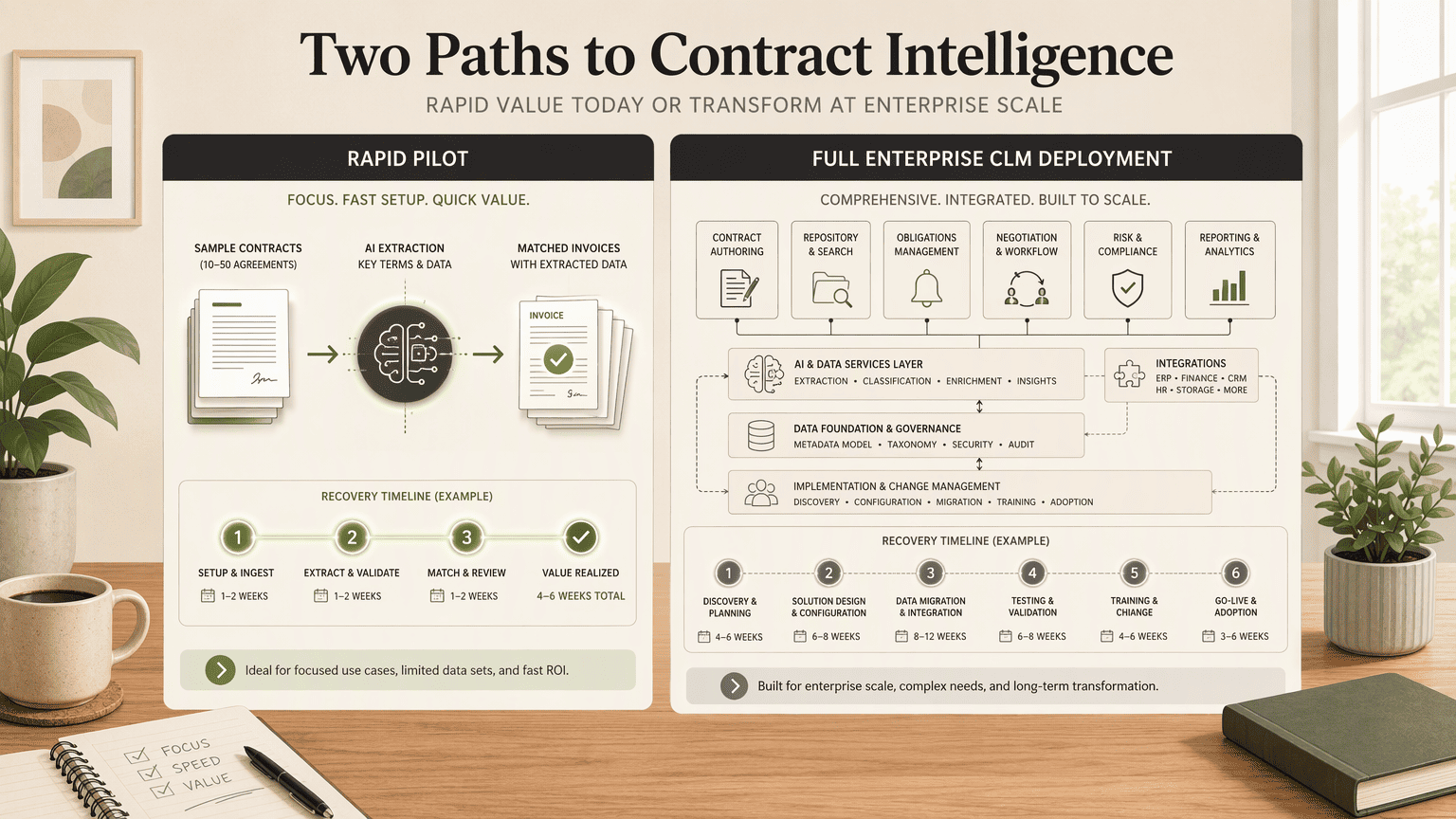
Cognitiv+ takes the opposite approach from a full-platform migration. You hand over a sample of your contracts, their AI ingests and extracts the pricing data, and the team matches those terms against real invoices inside a time-boxed pilot. Here is how that pilot model compares to the enterprise-platform approach.
| Dimension | Cognitiv+ Pilot Model | Full Enterprise CLM Deployment |
|---|---|---|
| Time to first recoveries | Weeks | Months or quarters |
| System migration required | None | Yes, full repository migration |
| Scope | Sample contract set with invoice match | All active agreements in the repository |
| Spend recovery range | 2 to 5% identified in pilot phase | Ongoing leakage prevention over lifecycle |
| Ongoing governance | Not included in pilot scope | Obligation tracking and alerts built in |
5. AuditBoard, Cross-Platform Contract and Invoice Risk Analytics

AuditBoard approaches the problem from the auditor’s chair rather than the contract manager’s desk. Its platform ingests structured contract data from multiple sources, overlays invoice feeds pulled from your ERP via pre-built connectors, and runs configurable risk-based audits that surface deviation patterns across the entire spend portfolio.
A pure extraction tool asks what one contract says. AuditBoard asks about 10,000 invoices from 400 suppliers this quarter: where are the aggregate variances large enough to matter? It cares less about pulling the raw clauses and more about connecting procurement data, contract metadata, and accounts payable invoice streams into one picture.
This dashboard-driven analytics approach fits internal audit functions that need to report savings leakage to the audit committee with quantified, portfolio-level impact. The trade-off: you must already have structured or semi-structured contract data flowing in. AuditBoard will combine and analyze it, but it is not the engine that pulls pricing tables out of a scanned PDF.
6. Sirion, Post-Signature Value and Performance Management
Sirion was built for one uncomfortable truth: the contract you signed and the supplier performance you receive are rarely the same thing. Its platform focuses exclusively on the post-signature phase. It extracts negotiated rates, rebates, service levels, and performance obligations, then compares those terms against incoming invoices and actual supplier delivery.
Sirion auto-extracts over 600 contract attributes across more than 15 languages, the broadest multilingual extraction coverage among the platforms evaluated. That scope matters when your supplier base spans Europe, Asia, and the Americas in a single contract portfolio.
The extracted attributes feed an engine that catches discrepancies the moment an invoice arrives. A supplier billing $125 per hour against a contracted $110 rate is flagged before the payment run. The variance is calculated and routed to the configured approver group.
Value leakage often happens slowly across multi-year supplier relationships rather than in a single erroneous invoice. Sirion’s governance layer tracks conformance over time and surfaces the patterns: creeping rate increases, missed rebate milestones, obligations a supplier quietly stopped meeting. Post-signature contract management becomes a continuous compliance function instead of a periodic audit.
7. Capabilities Comparison Table: Extraction, Matching, and Integration Depth
Your choice ultimately depends on whether you need rapid extraction and matching on business terms, legal-depth NLP for bespoke clauses, or enterprise governance with analytics on top.
The table below lays out the core technical dimensions side by side. Extraction method determines which pricing structures a tool can handle. A template-based engine parses predictable rate tables reliably but struggles with narrative escalation clauses, while ML-trained NLP excels there. Invoice-matching granularity reveals the depth of the comparison. Line-item matching catches a $15 variance on a single SKU that header-level matching would miss entirely, and that level of granularity is where material recoveries accumulate across thousands of invoices.
Integration depth separates the intelligence-layer approach from the rip-and-replace platforms. A tool that connects to your existing ERP via API and pulls purchase orders and receipts straight from your current systems lets you run an audit pilot inside your existing infrastructure, which is the fastest path to hard-dollar recoveries.
| Dimension | Contracts.ai | Icertis | Kira by Litera | Cognitiv+ | AuditBoard | Sirion |
|---|---|---|---|---|---|---|
| Extraction Method | AI/ML for structured pricing fields | AI/ML with rules-based obligation mapping | Legal-trained NLP, custom model training | AI-driven with document classification | Relies on incoming structured data | AI/ML across 600+ attributes, 15+ languages |
| Complex Pricing Table Handling | Normalizes structured line-items | Strong for discount schedules, escalation clauses | Strong for bespoke mechanisms, tiered adjustments | Handles structured pricing in pilot scope | Does not extract; ingests and analyzes | Extracts multi-tiered rates, rebates, service levels |
| Invoice-Matching Granularity | Line-item deviation flagging | Line-item, obligation-linked | Feeds structured output downstream; matching external | Line-item match during pilot | Cross-platform aggregate variance analysis | Line-item comparison against negotiated rates |
| Integration Depth | Overlay on existing ERP/CLM, API-based | Full enterprise CLM deployment | API output to audit workflows | No system integration required for pilot | Pre-built ERP connectors for analytics ingestion | Full post-signature suite with ERP connectivity |
| Pilot Program Availability | Yes, limited contract set, no migration | Not a pilot product; full deployment | Available as scoping exercise | Yes, standalone time-boxed pilots | Configurable audit scope on existing data | Deployment-led; governance-focused from start |
8. The Contract-to-Invoice Audit Workflow: A Step-by-Step Walkthrough

Every tool covered here follows a broadly similar technical pipeline. Knowing the seven steps demystifies what happens between uploading a contract PDF and getting an actionable deviation report.
- Ingest digital contracts: Pull executed agreements from your repository, shared drive, or CLM. Prerequisites include access to the contract repository and the ability to export invoices from your ERP.
- Classify and segment clauses: The AI identifies which provisions contain pricing terms, schedules, and rate tables, then segments them from boilerplate for focused extraction.
- Extract structured pricing fields: Machine learning models parse unit prices, volume tiers, discount triggers, and escalation formulas, normalizing them into structured data fields for each agreement.
- Normalize invoice line items: Import invoice data from your ERP and standardize it to the same structure as the extracted contract fields so the comparison engine can align them.
- Execute comparison engine: The engine runs contract pricing fields against invoice line items, matching each charge to its corresponding contractual rate or fee schedule.
- Flag deviations and calculate totals: Any variance beyond your configured tolerance threshold generates a flag with the calculated overpayment amount, such as a $125 per hour bill rate against a $110 per hour contracted rate.
- Generate audit report: Produce a prioritized deviation report with total quantified recoveries, source contract references for each flagged line item, and routing to the configured approval group for resolution.
Conclusion
You don’t have a technology gap standing between your negotiated savings and your actual invoice spend. You have a deployment decision sitting on your desk right now.
The 2 to 5 percent of spend that leaks between contract signature and final payment is recoverable. The tools already do the heavy lifting. Your job is to pick the one that matches where the money is bleeding fastest.
If hard-dollar recoveries inside weeks are the goal, stand up a rapid, no-migration pilot with Contracts.ai or Cognitiv+. These tools get you to cash without months of integration work. When the mandate runs broader, enterprise governance across the full contract lifecycle, Icertis and Sirion are the platforms built for that scope.
Some pricing mechanisms live buried in legal prose that no template engine can reliably parse. That’s where Kira earns its place. And when your internal audit team already sits on a structured data landscape and just needs cross-platform risk analytics, deploy AuditBoard.
The tools work. The leakage is yours to reclaim.
Frequently Asked Questions
What types of software can automatically extract pricing terms from contracts?
Two categories dominate:
- Purpose-built AI extraction tools like Contracts.ai and Kira use NLP and machine learning to pull structured pricing data from dense legal documents.
- Enterprise CLM platforms like Icertis and Sirion embed extraction inside full contract lifecycle governance.
Both produce audit-ready structured fields suitable for downstream invoice matching.
How does invoice-to-contract matching work in practice?
Extracted contract pricing fields (unit rates, volume tiers, discounts) are normalized and compared against invoice line items. The engine flags any charge exceeding your configured tolerance, calculates the overpayment, and routes it for review. This replaces manual comparison of stacks of invoices against paper contracts with systematic deviation detection.
What features should I look for in a contract pricing audit tool?
Prioritize:
- Structured extraction for complex pricing tables and rate cards.
- Line-item-level invoice matching rather than header-level only.
- Threshold-based alerting so minor rounding does not flood your queue.
- Dashboard reporting that aggregates identified savings.
Select a tool whose integration model fits your infrastructure.
How do these solutions compare to traditional CLM or manual auditing methods?
Traditional CLM systems manage metadata and workflow but do not parse pricing clauses into structured, comparable data. Manual three-way matching is accurate on a single invoice but cannot scale across hundreds of contracts.
Can I test these extraction and matching tools without a full system migration?
Yes. Several platforms offer standalone pilots on a limited contract set. You provide sample agreements without moving your repository, those contracts are extracted and matched against real invoices, and you see quantified recoveries within a matter of weeks. This lets you validate ROI before any enterprise-wide commitment.
What accuracy level can I expect when extracting structured pricing data from legal documents?
For well-defined fields like rate tables and unit prices, mature platforms report extraction accuracy exceeding 90%. Complex bespoke clauses with narrative pricing mechanisms challenge general models, which is why legal-trained NLP engines like Kira deliver higher precision on that subset by learning from thousands of lawyer-reviewed contracts.
Sources
- AI Clause Extraction Software for 100+ Language Contracts – www.sirion.ai
- Automated Invoice Matching Software | 2-Way & 3-Way Matching | SutiAP – www.sutisoft.com
- Invoice Matching Software to Scale Enterprise AP – www.highradius.com






