







Introduction
Your procurement team negotiated a 12% volume discount, but your AP department keeps paying full list price. It’s a quiet cash drain that most enterprises never spot until the annual audit, and by then, six figures have leaked into the supply chain.
Manual reconciliation misses these patterns because a single analyst might audit twenty line items an hour. Across thousands of invoices tied to complex agreements with tiered rebates and regional pricing, the gap widens rapidly. Poor integration between procurement and finance systems is one of the biggest barriers to realizing negotiated value, according to GEP research. The other is contract data that sits locked in PDFs no system can read.
AI-powered contract analysis has cut the cycle from weeks per batch down to minutes across hundreds of contracts. The tools don’t just parse PDFs. They pull out pricing tables, flag dollar deltas between negotiated rates and what AP actually paid, and track consumption against thresholds.
This list covers nine solutions that bridge that gap, from specialist post-signature intelligence layers to AP automation suites with extraction baked in. Each handles the problem differently. The shared outcome: static agreement language becomes structured, auditable data that catches overcharges before they compound.
Key Takeaways
Here are the top-line findings for finance and procurement leaders evaluating contract-to-invoice extraction tools in 2026:
- Highest extraction accuracy: Dext achieves over 99% accuracy on scanned invoices and crumpled receipts, trained on a corpus of over 2 billion accounting documents across 16 years.
- Non-disruptive AP matching: Esker integrates contract matching into existing ERP workflows without replacing current procurement systems, and recommends a 30-day parallel pilot to validate results.
- Legacy contract discovery gap: Seal Software (now DocuSign Insights) can crawl un-indexed network drives and old repositories, a prerequisite step many organizations skip.
- Best pilot approach: Start with a single supplier category, run parallel reconciliation without altering ERP workflows, and measure recovered overcharge amounts before expanding scope.
1. Contracts.ai, The Post-Signature Intelligence Layer for Enterprise Pricing Reconciliation

Contracts.ai was purpose-built for the exact problem that haunts AP teams: extracting pricing terms from fully executed agreements and cross-referencing them against actual invoicing data feeds. It does not manage contract workflows like approvals or redlines. It sits on top of signed agreements and treats them as a live data source.
Founded in 2025 by Jenn McCarron and Phani Gunturu, operators who have spent more than 30 years combined implementing CLMs, ERPs, and procurement systems inside global enterprises, the company built the platform to structure and activate contract data beyond static storage. The intelligence layer automatically groups related agreements and aligns shared terms so that a master agreement and its amendments are read as one coherent pricing source.
For revenue assurance, this architecture matters. Rather than relying on a general-purpose OCR engine that sees only text blocks, Contracts.ai targets commercial terms specifically. Purchase orders, invoices, and payments are continuously matched against the extracted price bands, volume thresholds, and rebates, flagging off-contract spend as soon as it hits the ledger. Every answer links back to source contract language, giving auditors a verified trail without toggling between systems.
Finance teams can pilot the platform with a limited contract set without migrating the full repository or disrupting existing workflows. The company states that the product encrypts contract fields in transit and at rest, operates within customer data boundaries, and does not train models on proprietary customer data. For enterprises that have already done the hard work of signing good agreements but lack the post-signature verification loop, it fills that gap directly.
2. Esker, End-to-End AP Automation with Embedded Contract Matching
Esker takes a suite approach. Its Contract Management Automation Software centralizes supplier agreements, automates contract workflows, and ensures purchasing and invoicing align with negotiated terms, all within its Source-to-Pay suite. Instead of a standalone extraction engine, you get OCR-based invoice capture connected to an AP workflow that automatically matches line items against stored contract terms.
The integration design is what earns it this rank. Esker connects contracts with procurement, sourcing, and invoices without disrupting existing systems. Its Synergy AI flags exceptions, risk areas, and policy deviations so teams spend time on the handful of items that actually need human judgment. Contract metadata gets extracted automatically, and non-compliant clauses are flagged for review cycles that previously stretched for days.
Spend threshold tracking is a practical differentiator. The system notifies teams when contract limits or key dates are approaching and tracks contract consumption against negotiated pricing. That means a procurement manager sees a variance before payment posts, not three months later in a quarterly review.
For organizations wanting a unified procure-to-pay ecosystem rather than a standalone extraction tool, Esker is the strongest option. The company recommends running a parallel reconciliation for 30 days on a single supplier category without altering ERP workflows, a low-risk entry point that finance executives appreciate.
3. Dext, High-Volume Line-Item Extraction for Receipt and Invoice Auditing
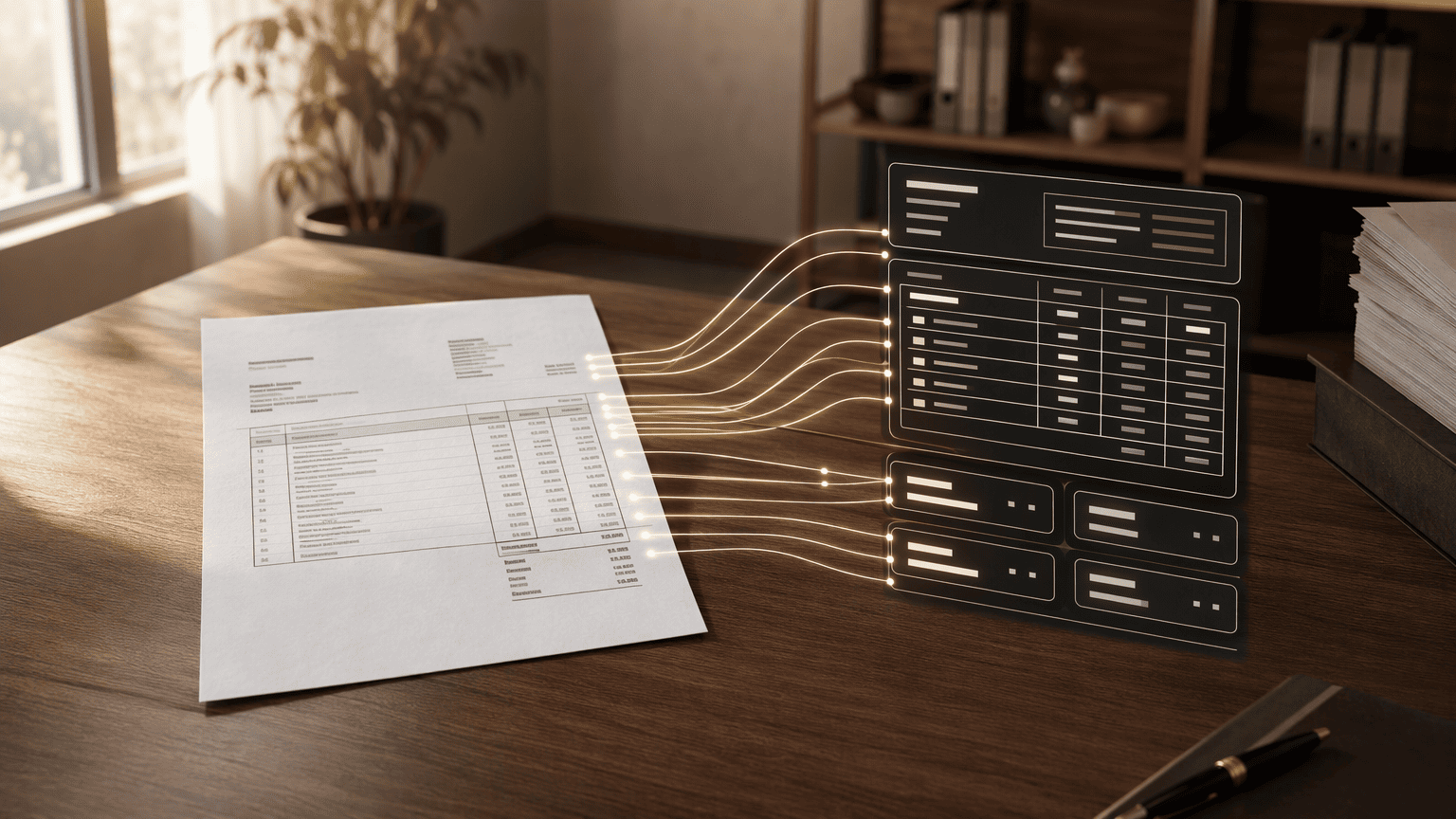
Dext is the accuracy benchmark for extracting unstructured data from messy, scanned documents where other engines fail. The company claims over 99% accuracy reading invoice line items and extracting complete fields including date, amount, supplier, tax, currency, and invoice number. That claim carries weight because of the training dataset: the machine learning model has ingested over 2 billion accounting documents across 16 years.
The use case is narrow but critical. Before you can match a supplier invoice against a contract, you need to extract every line item cleanly from a PDF that might be crumpled, water-damaged, or scanned at an angle. Dext handles that ingestion layer at scale, used by over 700,000 businesses and 12,000 accounting and bookkeeping firms worldwide.
Its compliance posture aligns with enterprise requirements. For AP teams that receive thousands of supplier invoices monthly, the volume throughput combined with field-level extraction accuracy turns a manual bottleneck into an automated feed.
Where Dext stops is where matching begins. It gets the data out of the document, but you still need a reconciliation engine or manual rules to tie that data back to contract pricing tables. Pairing it with a purpose-built contract intelligence layer closes that loop.
4. SirionLabs, AI-Powered Contract Lifecycle Management with Obligation Extraction
SirionLabs approaches pricing reconciliation from the obligation side, which changes the audit dynamic. Instead of only extracting unit prices, it identifies performance obligations and service level credits and links them to supplier scorecards and payment triggers. An invoice gets verified not just against a rate card but against whether the supplier actually hit the delivery benchmarks tied to those rates.
Gartner defines advanced contract analytics as solutions that apply AI techniques such as natural language processing, machine learning, and generative AI to analyze executed contracts and extract structured data. Sirion operates in that space and has appeared in the CLM Magic Quadrant for its obligation management architecture.
5. Icertis, Enterprise-Grade Contract Intelligence with Real-Time Spend Linkage
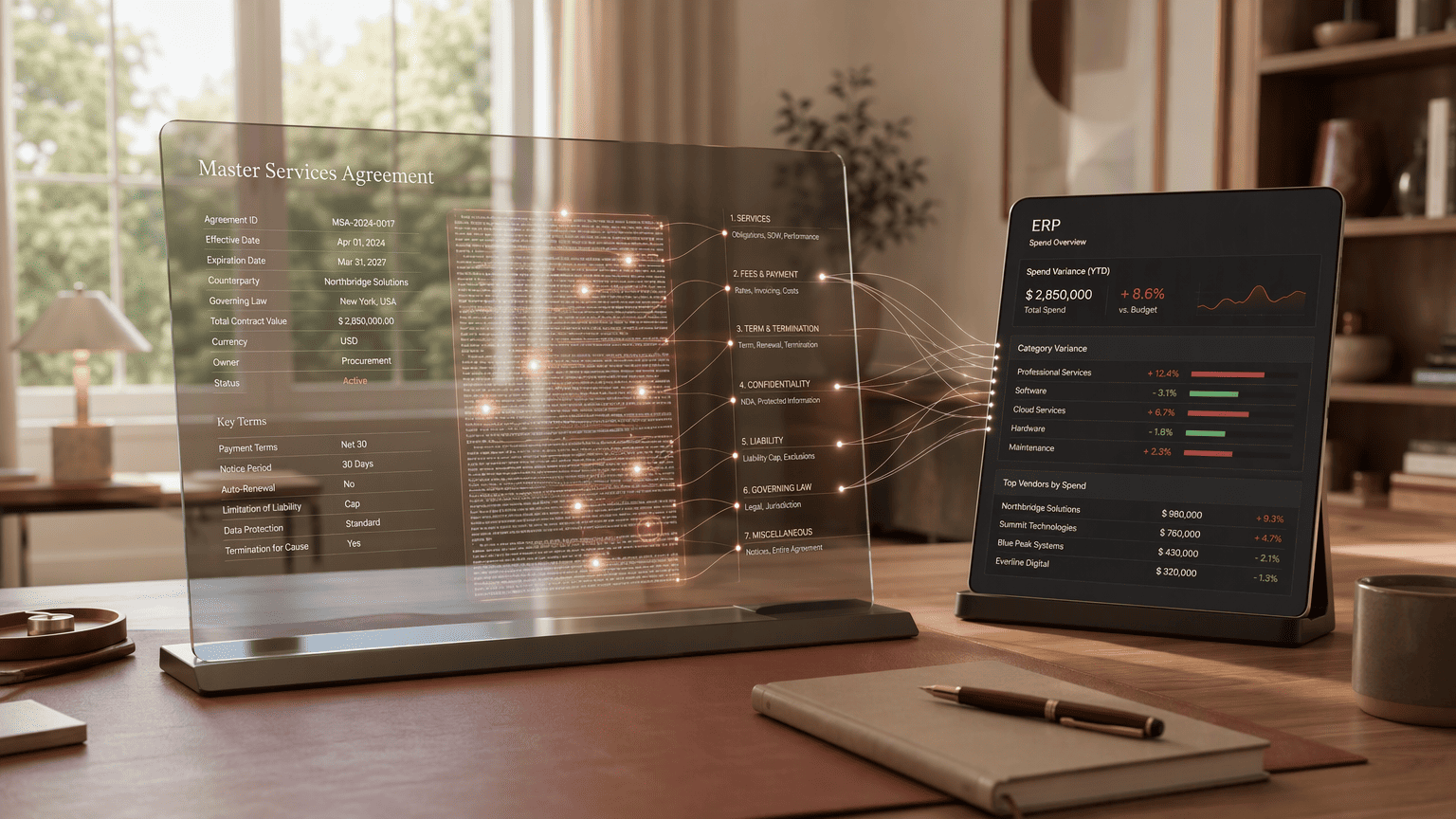
Icertis structures both the tidy fields and the messy text of a contract into a single connected data model. That model then talks to your ERP through APIs. For large enterprises on SAP or Microsoft stacks, the result is a live feed that shows you the gap between what your contracts allow and what your procurement team actually spends.
The platform works as a system-of-record that skips the separate reconciliation step. Its advanced contract analytics flag deviations from your standard provisions, call out missing clauses, score risk, and recommend changes to process or language. When those signals arrive directly inside the ERP that generates purchase orders, an overcharge gets caught before the invoice reaches AP. For a global enterprise wrangling tens of thousands of supplier agreements and multi-year pricing structures, that direct link is the reason the implementation pays for itself.
6. Seal Software (Now DocuSign Insights), Deep Discovery and Legacy Contract Analysis
Every pricing reconciliation project has a step zero: finding the contracts. Two decades of M&A activity leaves agreements scattered across network drives, email attachments, and retired file servers nobody remembers owning. Most teams skip straight to analysis on whatever is easy to find.
Seal Software, now DocuSign Insights inside the DocuSign Agreement Cloud, crawls those legacy repositories. It locates and extracts metadata and pricing tables from old, unindexed agreements. That first-pass term normalization builds the digitized contract repository that tools like Esker or Contracts.ai can then use.
Skipping this step is where reconciliation projects fail. If your audit only covers agreements already sitting in the CLM, you miss every off-system contract and every overcharge buried inside them. For enterprises carrying large M&A histories and poor document hygiene, start with deep discovery before anything else.
7. Kofax (Now Tungsten Automation), OCR-Centric Financial Process Automation

For organizations that still receive a high volume of paper and image-based invoices, the reconciliation problem starts earlier: digitization itself. Tungsten Automation’s foundational OCR technology provides the ingestion layer that transforms paper invoices into structured data that a matching engine can consume. Here is where it fits in a contract-to-invoice workflow:
- Paper invoice scanning: High-volume document capture converts paper bills into digital images with embedded metadata.
- Field extraction: OCR identifies and structures fields such as supplier name, invoice number, line items, and amounts.
- Data validation: Extracted fields are cross-checked against known formats and supplier master data to reduce error rates.
- Feeding the matching engine: The cleaned, structured invoice data is pushed to a contract matching layer for price variance detection.
- Exception routing: Flagged discrepancies follow pre-configured rules to AP reviewers for manual adjudication.
8. Evisort, Centralized Repository with Intelligent Clause Mining for Finance Teams
Evisort is built for finance departments that want to mine contract language directly, without waiting on legal or technical admins. Its pre-trained AI categorizes agreements right away and surfaces pricing clauses, payment terms, and discount structures in a single, searchable interface. A procurement analyst can navigate the UI with no deep technical training.
| Capability | Evisort | Traditional Enterprise CLM |
|---|---|---|
| Time to deploy | Rapid, pre-trained models | Weeks to months, extensive configuration |
| Primary user | Finance and procurement teams | Legal and compliance users |
| Repository function | Centralized contract repository with search | Broader lifecycle management |
| Use case fit | Finance-led audit and term mining | Legal-led contract governance |
9. Malbek, Modern CLM with Multi-Entity Agreement Grouping and Pricing Analytics

Malbek addresses a structural complexity that trips up many pricing audits: corporate hierarchies. Enterprises with dozens of subsidiaries often negotiate a single master agreement with pricing that cascades across entities, but invoices flow from different legal names. Malbek’s multi-entity grouping aligns those disparate agreements and extracts pricing across a parent-child entity structure for consolidated analytics. Here is what makes it distinct in the pricing reconciliation stack:
- Parent-child entity grouping: Links agreements negotiated at the parent level to invoices processed by individual subsidiaries, preventing entity-name mismatches from hiding off-contract spend.
- Pricing analytics layer: Aggregates extracted rate cards and discount schedules across entities to produce consolidated variance reports that would require days of spreadsheet work otherwise.
- Modern contract UI: Designed for procurement and finance users rather than legal teams, lowering the training barrier for non-legal staff who need to mine pricing data daily.
- Agreement hierarchy mapping: Connects master service agreements, statements of work, and amendments into a unified pricing structure before cross-referencing invoice data.
Conclusion
The contract-to-invoice reconciliation landscape breaks into three functional layers: deep discovery to find and digitize legacy agreements, extraction engines to pull pricing terms into structured data, and matching platforms that connect those terms to AP and ERP invoice feeds.
Your company’s biggest gap determines where to start. If you cannot find your contracts, begin with deep discovery through DocuSign Insights. If your contracts are digitized but not connected to spend data, deploy an intelligence layer like Contracts.ai or an integrated suite like Esker.
Run a parallel 30-day pilot on a single supplier category. Measure the recovered variance, and let the hard dollar results build the business case for expansion.
Frequently Asked Questions
What is automated contract pricing extraction and how does AI identify payment terms in complex agreements?
Automated contract pricing extraction uses natural language processing and optical character recognition to identify payment terms, discount structures, tiered pricing, and rebates buried in legal language. Gartner defines advanced contract analytics as solutions that use AI techniques such as NLP and machine learning to analyze executed contracts and extract structured, usable data.
What are the leading software platforms that can extract pricing terms from contracts and cross-reference them with actual invoice line items to detect overcharges?
Contracts.ai extracts post-signature pricing terms and continuously matches them against invoice feeds. Esker embeds contract matching within its AP automation suite. Dext provides 99%+ line-item extraction accuracy from scanned documents. SirionLabs links obligation extraction to payment triggers, and Icertis connects a contract data model directly to ERP spend analysis.
How do you compare AI contract analysis tools versus traditional manual audit methods for verifying invoice accuracy?
AI tools process hundreds of contracts in minutes versus weeks per batch for manual audits, achieve over 99% accuracy on structured documents, scale without headcount growth, and detect hidden clauses that human reviewers easily overlook. Manual methods struggle with legacy PDF extraction and non-standard language at scale.
What key metrics should finance and procurement teams track when auditing contracts against supplier invoices to capture lost value?
Track off-contract spend percentage, invoice-to-contract price variance, renewal miss rates, recovered overcharge amounts, and contract consumption against negotiated thresholds. Contract utilization analytics also flag underused agreements and off-contract purchases instantly, strengthening compliance and guiding smarter supplier negotiations.
What are the primary challenges of extracting structured pricing data from legacy PDFs and scanned contracts during a payment integrity audit?
Scanned PDFs, handwritten amendments, non-standard clause layouts, and crumpled physical documents degrade extraction quality. The absence of unified contract data and poor integration between procurement and finance systems remain the biggest barriers. Dext addresses the document quality problem with models trained on over 2 billion accounting documents across 16 years.
What steps should a US enterprise follow to pilot a contract-to-invoice reconciliation tool without disrupting existing ERP workflows?
Start with a single supplier category and run parallel reconciliation for 30 days without altering ERP procurement or AP workflows. Tools like Contracts.ai support a limited-contract-set pilot without full repository migration.
Sources
- B2B Contract Management Automation Software | Esker – www.esker.com
- Best Advanced Contract Analytics Reviews 2026 | Gartner Peer Insights – www.gartner.com
- Contract Utilization Analytics: Drive Efficiency & Compliance | GEP Blog – www.gep.com
- Receipt and invoice capture software for small businesses – dext.com