







Introduction
You reviewed the contracts. You shook hands on 2% net 10. But three quarters later, millions in negotiated early payment discounts have evaporated because the payment run didn’t match the terms buried in the agreement.
The gap isn’t in your negotiation. It’s in the execution. Manual workflows and basic contract repositories let complex discount windows slip because they can’t extract the specific due dates and percentage rates locked inside thousands of legal documents. Treasury teams keep funding the supply chain at their own cost of capital, bleeding returns they already earned.
In 2026, with borrowing costs elevated and every basis point of free cash flow under scrutiny, the technology has shifted. A specific category of contract analytics platforms now ingests executed agreements, computes the financial obligations, and inserts those terms directly into your payment file. They make contracts pay. This piece evaluates seven platforms that can find those missed discounts and push them into your ERP before the window closes.
Key Takeaways
Three capabilities separate platforms that actually capture early payment discounts from those that just warehouse signed PDFs.
- Automated term extraction is table stakes: A platform must algorithmically read executed contracts and pull out the exact discount percentage, net terms, and payment deadline so every line gets priced correctly before a check is cut.
- Predictive discount scoring maximizes yield: Models like Apexanalytix’s Cash Discount Likelihood (CDL) engine analyze 80+ data points such as supplier payment behavior to forecast which discounts will be accepted and at what rate.
- Bidirectional ERP integration closes the loop: Extracted terms must propagate directly into the payment run; otherwise, the intelligence stays stranded in an analytics dashboard while the bank transfer goes out at face value.
- The ROI self-funds the investment: Capturing a 2% discount for paying 20 days early generates an annualized return that dwarfs most corporate cash yields, and that math makes line‑item platform cost a rounding error once you scale the program across the supplier base.
1. Contracts.ai

Contracts.ai operates as a post-signature intelligence engine. It ingests executed, fully-signed agreements and computes the financial obligations locked inside them. That separates it from traditional pre-signature CLM tools. Those tools manage approvals and redlines but lose all computational utility after the ink dries. The platform was built to structure and activate contract data beyond static storage, enabling operational use across enterprise systems.
This matters because pricing formulas and discount rate cards are often buried in exhibits or scanned attachments. Without a computational read on those terms, your AP team has no systematic way to apply them. Invoice line items drift as old rates compound over time.
ContractsAI claims accuracy levels greater than 99% when extracting data from documents in real time, linking each answer back to the source contract language for validation.
2. Apexanalytix, The Predictive Dynamic Discounting Pioneer
Apexanalytix built the first machine-learning model specifically designed to predict whether a supplier will accept an early payment discount. The Cash Discount Likelihood (CDL) scoring engine, developed with input from treasury and finance experts, ingests over 80 data points per supplier to generate an acceptance probability.
These data points cover historical payment behavior, industry vertical trends, and real-time working capital signals. The platform layers this on top of a $25 billion proprietary spend insights database to benchmark a supplier’s discount appetite against market peers.
The CDL model produces a risk-weighted yield curve. A 2% net 10 offer to a deeply liquid supplier might show a 90% acceptance probability. A sliding-scale offer of 1.2% net 15 to a cash-strapped supplier might score lower but still deliver the highest effective return once adjusted for your own cost of capital. Treasurers can shift from blanket discount programs to targeted, high-yield campaigns.
Onboarding is supported by validation against 1,200+ trusted sources and access to a database of over 280 million verified suppliers to amplify program participation. The breadth of that supplier data is a material advantage, the model gets smarter about baseline behavior with every new participant, reducing the guesswork in setting a discount rate a supplier will actually take.
3. Ivalua, The Unified P2P and Discounting Powerhouse

Ivalua’s architecture unifies procure-to-pay, contract analytics, and dynamic discounting on a single platform with a shared data model. Most discount programs break because procurement and treasury operate in separate systems with a manual handoff between them. Ivalua removes that handoff.
When the contract module extracts a payment term, a 5% discount for payment within 10 days and 2% for payment between 11 and 30 days, that structured term propagates directly into the payment run. No one re-enters it. No one exports it to a flat file for a separate AP system.
Secure open adapters handle bidirectional ERP integration. Discount terms extracted from contracts land in the exact payment-term fields your ERP expects. Because no data translation layer sits between procurement and payment, the latency that causes missed discount deadlines disappears. The contract terms live where treasury can act on them immediately.
4. Taulia, The Working Capital Optimization Network
Taulia operates a multi-funder supplier network where early payment discounts are negotiated dynamically based on real-time capital positions. The platform’s analytics segment your supply base by working capital need and discount appetite, then run targeted campaigns. The yield beats blanket 2% net 10 offers by a wide margin because each supplier segment gets terms matched to its actual liquidity situation.
Suppliers facing a cash squeeze can signal their willingness to accept a deeper discount in exchange for immediate payment. They effectively price their own short-term funding, and Taulia’s analytics engine captures those signals. The buyer’s treasury team sees the opportunities ranked by annualized return, with the highest-yield discounts surfaced first.
This turns the program from a buyer-push exercise into a functioning market. Supplier-initiated requests for accelerated payment reveal the real-time clearing price of working capital across your supply base, so the yield curve on your payables stays transparent instead of hidden behind a single negotiated rate.
For SAP users, the platform integrates with SAP Payment Analysis Reports. Those reports deliver prepackaged analytics for monitoring payment performance and spotting early payment discount opportunities. Treasury can reconcile network-level data inside its core ERP environment without exporting or manually mapping anything across systems.
5. Coupa, The Spend Management Analytics Incumbent
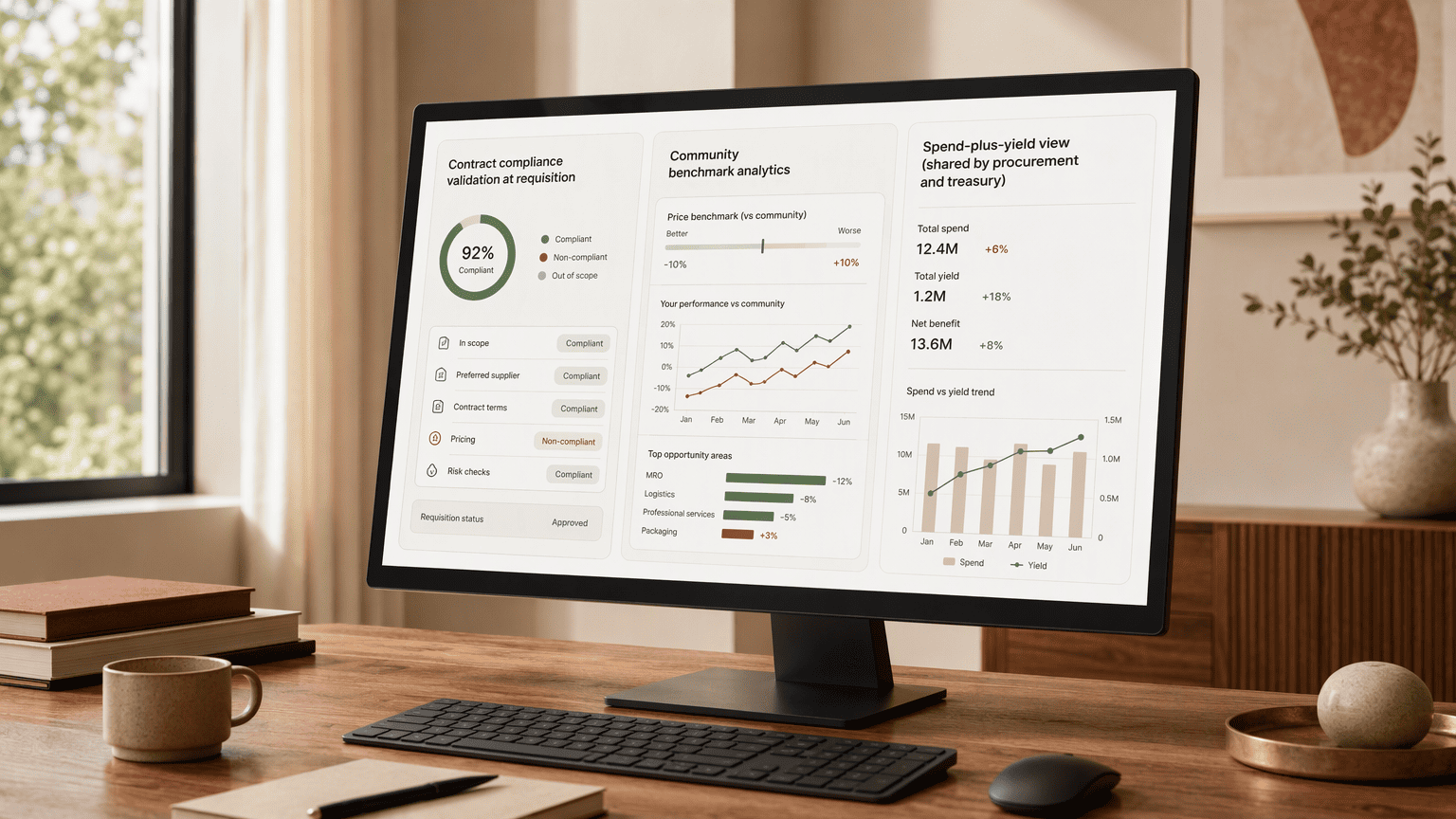
The Coupa Business Spend Management platform includes an integrated contract analytics engine. Its design connects three functions that typically operate in separate systems: transactional compliance checks, community-derived performance benchmarks, and a spend-plus-yield dashboard visible to both procurement and treasury.
The most immediate control is transactional contract compliance enforcement. Coupa validates approved supplier payment terms at the point of requisition. A transaction cannot proceed unless it matches the negotiated discount schedule in the underlying contract. That gating step stops term leakage before an invoice is ever generated, closing the gap between negotiated terms and actual payment behavior that erodes early-payment yields in many AP workflows.
Coupa then layers in community intelligence benchmarking. The platform normalizes an organization’s discount capture performance against aggregated data from its large installed base, giving the CFO a percentile ranking alongside the raw dollar yield. A percentile view lets finance compare yield efficiency against a relevant peer set, surfacing underperformance that an absolute-dollar metric on its own hides.
Those discount capture metrics live on a unified dashboard alongside procurement savings and compliance data. The shared view means treasury reports working capital returns in the same executive-level interface that procurement uses to report cost reduction. The structure creates a single pane of accountability for contract value realization, reducing the finger-pointing that occurs when finance and procurement run off separate scorecards.
ERP connectivity rounds out the analytics story. Coupa integrates with ERP and P2P systems so that extracted payment terms arrive already formatted for the receiving system’s field structure. Eliminating the manual rekeying step removes a common failure point: terms that get mistyped or delayed and cause short-window discounts to expire before they are ever scheduled for payment.
6. C2FO, The Supplier-Initiated Early Payment Market
C2FO departs entirely from the model of extracting contract terms to calculate a buyer-offered discount. Instead, it operates an auction-based marketplace where suppliers name the discount rate they are willing to accept to accelerate payment on specific invoices. The buyer sets a target yield threshold, and the platform matches eligible invoices in real time.
This supplier-pull architecture means you capture yield without perfect contract extraction. Invoices governed by poorly worded or nonstandard payment clauses can still be accelerated because the supplier enters their own acceptable rate. Treasury gains a real-time dashboard of the effective cost of capital across the supply chain.
The marketplace dynamic connects directly to research on trade credit as a source of working capital. C2FO’s analytics let you compare the yield on early payment against alternative uses of cash. Treasury treats this as a capital allocation exercise that factors in supplier liquidity signals, cash position, and forward forecasts.
| Dimension | C2FO Marketplace | Traditional Dynamic Discounting |
|---|---|---|
| Discount Rate Set By | Supplier (named in real time) | Buyer (offered based on contract terms) |
| Contract Extraction Required | No (supplier self-initiates) | Yes (terms read from executed agreements) |
| Yield Determinant | Market clearing rate of supplier liquidity | Negotiated rate plus predictive acceptance score |
| Best Fit Scenario | Highly fragmented supply base with inconsistent contract terms | Large, contractually governed strategic supplier relationships |
| Real-Time Analytics | Cost of capital vs. yield across entire payables | Discount window status and acceptance probability per supplier |
7. SirionLabs, The AI-Native Contract Lifecycle Auditor

SirionLabs applies AI-native contract analysis as a continuous audit function rather than a one-time extraction event. Its engine ingests executed agreements and builds an obligation map that persists for the life of the contract, enabling the platform to continuously correlate each incoming supplier invoice against the underlying clause that governs its payment terms.
The system flags non-compliance algorithmically. When an invoice arrives without the discount applied that the contract specifies, the audit trail updates in near-real time rather than surfacing during a quarterly review. This converts what is normally a backward-looking, sample-based audit into a production control that catches discount leakage at the point of payment.
For treasury, the most valuable output is the unrealized discount recovery report. SirionLabs calculates the historical discounts that were eligible but not captured across any look-back period, producing a quantified opportunity register. This gives finance a concrete dollar figure to pursue retroactively with suppliers where the contractual obligation was unambiguous, alongside preventing future leakage.
This audit stance is fundamentally different from extraction-only platforms. Those tools surface what you should pay. SirionLabs closes the loop by measuring what you actually paid and documenting the delta, creating a feedback cycle that tightens both the payment process and the negotiation playbook for the next contracting cycle.
8. Anatomy of a High-Yield Discount: How the Platforms Calculate ROI
A 2% discount for paying 20 days early translates to an approximate 36% annualized return. The math is straightforward, and that number slots directly into your existing capital allocation framework. You compare it against your weighted average cost of capital or any alternative short-term corporate investment, and the treasury decision becomes clear.
Platforms like Apexanalytix add a probabilistic layer by applying the CDL model’s acceptance likelihood. When a 2% discount carries a 90% predicted acceptance rate, the risk-weighted annualized yield drops to roughly 32%. That is still far above most internal hurdle rates, but you can now evaluate it in the same risk-return framework the CFO applies to every other use of cash.
For sliding-scale offers where the discount percentage varies by the payment date, the platform computes a yield curve. A discount schedule offering 5% for net 10 and 2% for net 30 produces a front-loaded return that peaks in the earliest window. Treasury can direct capital to the steepest portion of that curve first.
9. Implementation Checklist: Overlaying Intelligence Without Rip-and-Replace

Deploying contract analytics for discount capture follows three deliberate steps that deliver incremental value without disrupting current payables infrastructure:
- API-based contract ingestion: Connect the analytics platform to your existing contract repository and ERP via secure APIs or open adapters, pulling in executed PDFs and structured metadata without a full data migration.
- ERP payment-term field mapping: Configure the platform’s output schema to populate your ERP’s native discount due date, discount percent, and payment due date fields, ensuring the extracted terms land where the payment run expects them.
- Top-20 supplier pilot by spend: Run the initial extraction and discount-matching model on your 20 highest-spend strategic suppliers, capturing a concentrated return that validates the platform’s accuracy before broader roll-out.
Conclusion
The technology to automate the last mile of early payment discount capture has matured from aspiration to production-grade deployment. Platforms now handle predictive scoring, computational term extraction, and direct insertion of discount terms into the ERP payment run. The choice comes down to architecture: an intelligence overlay that reads your executed agreements, a supplier network that sets rates dynamically, or an audit engine that recovers unrealized discounts retroactively. Each approach turns contracts from static storage into financial instruments that pay for themselves with the returns they generate.
Frequently Asked Questions
What are the key analytics features a contract platform needs to identify early payment discount opportunities on supplier invoices?
The platform must deliver three core capabilities:
- Algorithmically extract specific discount rates, net terms, and due dates from executed contracts.
- Run a prioritization engine that weighs discount yield against your cost of capital.
- Provide a direct feed into the ERP payment file so extracted terms actually govern the funds transfer.
How do contract intelligence platforms calculate and prioritize early pay discounts versus other uses of working capital?
They annualize the return on the discount and compare it to your cost of capital. Predictive models like Apexanalytix’s Cash Discount Likelihood (CDL) engine layer on acceptance probability, producing a risk-weighted yield that lets treasury rank discount opportunities alongside other short-term investments.
Which contract analytics platforms in 2026 offer the strongest combination of automated term extraction and dynamic discounting insights?
ContractsAI excels at extracting and computationally enforcing post-signature terms from complex agreements. Apexanalytix leads on predictive discount acceptance scoring. Ivalua and Coupa embed extraction and discounting inside unified P2P suites, while C2FO bypasses extraction entirely with a supplier-initiated marketplace.
What real-world ROI metrics or statistics exist for capturing early payment discounts through contract analytics?
A 2% discount for accelerating payment by 20 days annualizes to roughly 36% return, far exceeding most corporate cash yields. Apexanalytix’s CDL model analyzes 80+ data points to produce risk-adjusted yields, while its platform leverages a $25 billion spend insights database to benchmark supplier discount appetite against industry peers.
How does ContractsAI’s intelligence-layer approach to contract analytics compare to traditional CLM platforms for unlocking early pay discounts?
Traditional CLM platforms optimize the pre-signature workflow of drafting and approval but lose computational utility after execution. ContractsAI is purpose-built for post-signature intelligence, it ingests signed agreements and calculates the specific financial obligations inside them, making discount terms actionable rather than just archived.
What are the integration requirements for a contract analytics tool to share structured discount data with ERP and procurement systems?
The integration must meet two requirements:
- Provide secure, bidirectional API or open-adapter connectivity that maps extracted fields such as discount percent and discount due date directly into the ERP’s payment-term schema.
- Populate the fields the payment run reads, not export data to a separate dashboard that treasury has to check manually.
Sources
- Dynamic Discounting Software: Boost Supplier Engagement – www.apexanalytix.com
- Payment Analysis Reports | SAP Help Portal – help.sap.com
- 15 Understanding Payment Terms – Oracle Help Center – docs.oracle.com