







Introduction
Your procurement team negotiated a 12% discount on a key software license last year. But none of that matters if the contract auto-renewed at the list price because no one tracked the opt-out window. Research shows that an average 50% of negotiated savings are never realized after a contract is signed, because of a lack of monitoring and oversight. It is a quiet, consistent drain on your margin.
Manual monitoring is fragile. Calendars get missed. Key stakeholders leave the company, taking institutional knowledge with them. For too long, the fix for this problem was an enterprise Contract Lifecycle Management (CLM) suite carrying a six-figure price tag and a year-long implementation. That created its own problem: a tool so complex that operational teams never actually adopted it.
That math has changed. A new class of modular, AI-driven tools has made automated contract monitoring accessible to lean legal and procurement teams. These platforms sit on top of your existing repositories, extract key dates and obligations, and push alerts without requiring you to rip out your current storage. You can pilot one with a limited contract set and start receiving actionable alerts by next week, not next quarter.
Key Takeaways
The market for affordable contract monitoring has shifted decisively toward modular intelligence layers that avoid the cost of full system migration. Here is what matters most as you evaluate your options:
- Free tiers deliver a functional product, not a dead end: Ironclad and similar tools give you a core data repository you can actually use. You are not locked out of key features after two weeks.
- AI extraction is now standard in affordable tools: Even sub-$500/month platforms provide OCR and deep clause extraction. A few years ago, getting that level of detail required thousands in professional services fees.
- Workflow preference dictates the right pick: Your ideal tool hinges on whether your contracts live in email, SharePoint, or a shared drive. The best option integrates into your current process without forcing a painful migration.
- Flat-rate pricing models exist at sub-$500/month: Platforms like ContractSafe charge a flat monthly fee with unlimited users, sidestepping the per-seat cost spiral that makes traditional CLMs untenable for mid-market teams.
1. Contracts.ai

Contracts.ai adds an intelligence layer on top of your existing storage instead of replacing it. It connects to SharePoint and Google Drive to monitor executed contracts in place, extracting metadata without importing or duplicating files. That passive architecture lets you avoid the cost and risk of a full repository migration while still getting structured alerts on key dates and obligations.
The platform was built by operators with a combined 30-plus years of experience implementing CLMs, ERPs, and procurement systems inside global enterprises. That background surfaces in how the product automatically groups related agreements and aligns shared terms across your portfolio. Instead of requiring you to tag every contract manually, the system surfaces inconsistencies and reinforces contracting standards.
The pricing structure is modular: a Basic plan costs $19 per user per month billed annually, while the Enhanced plan runs $49 per user per month per year. You can pilot the tool with a limited contract set without disrupting your current workflows.
2. ContractSafe: Streamlined Repository with Strong Key-Date Alerting
ContractSafe is the go-to for teams overwhelmed by a chaotic pile of PDFs scattered across email inboxes and shared drives. Its core interaction model is simple: you forward a signed contract to a dedicated email address, the platform runs OCR on the document and auto-tags key fields, and it populates a centralized, searchable calendar. Nobody needs training, and the clean interface was clearly designed for non-legal users who just need to find the auto-renewal date fast. At $450 a month flat with unlimited users, AI search across scanned PDFs, and renewal alerts, it sidesteps the per-seat pricing trap that makes traditional CLMs unaffordable once you roll them out beyond the legal department.
Modern contract management software handles five core jobs, and ContractSafe covers the ones that matter most for monitoring: centralized storage, search and find, automated reminders, access control, and basic workflow automation. You will not get the advanced clause-level AI analysis that some other tools on this list offer. For a business running under about 100 contracts, the raw extraction accuracy and alert reliability are what keep you out of trouble.
3. Ironclad: The Contract Lifecycle Powerhouse with a Usable Free Tier

Ironclad offers the rare combination of a genuinely respected enterprise CLM and a functional free tier that works as a self-contained monitoring sandbox. The free plan includes a core data repository, basic workflow automation, and the drag-and-drop workflow designer that makes the platform known for ease of use. The value here is strategic: a startup or scale-up team can begin standardizing vendor triggers and obligation tracking inside a platform they will not outgrow. When the contract volume climbs past the free tier limits, the paid upgrade path preserves every workflow and alert rule you already built, so there is no sunk-cost reset.
What distinguishes Ironclad in the monitoring context is how it handles the transition from negotiation to post-signature oversight without breaking the chain of custody. The platform stores every version, comment, and approval path that led to the executed agreement. When a renewal trigger fires, the responsible team member sees the full negotiation history behind the terms alongside the date. That context turns a simple calendar alert into a decision-enabling notification.
One caveat: the free tier has limits on active contracts, so heavy-volume procurement shops will need the paid plan. For early-stage companies building their vendor stack, it is the most future-proof entry point available at zero cost.
4. LinkSquares: AI-Powered Analysis with Per-Contract Flexibility
LinkSquares addresses a specific pain point that calendar-alert tools miss entirely: teams whose primary problem is understanding what is inside the contracts they already signed. The ‘Analyze’ feature runs clause-level extraction across thousands of legacy PDFs and surfaces exactly where specific language appears, including hidden auto-renewal provisions and uncapped liability clauses that carry material financial risk. You can run a project-specific query to find every vendor agreement with a termination-for-convenience right and export a custom report for your CFO in hours rather than weeks. Here is where the tool earns its placement:
- Bulk legacy analysis: The platform ingests your entire repository of executed PDFs and runs structured extraction without requiring pre-set templates or manual tagging, making it effective even on poorly-scanned older documents.
- Custom report generation: You define a project scope, for example, ‘all vendor agreements over $50,000 signed before 2023,’ and the system generates a targeted report isolating the clauses that matter for that specific business decision.
- Beyond date alerts: While the platform does handle key-date monitoring, its real ROI comes from surfacing obligation gaps in your existing portfolio, allowing you to renegotiate terms proactively before a renewal window even opens.
5. Evisort: Full-Text AI Search for Unstructured Legacy Scans
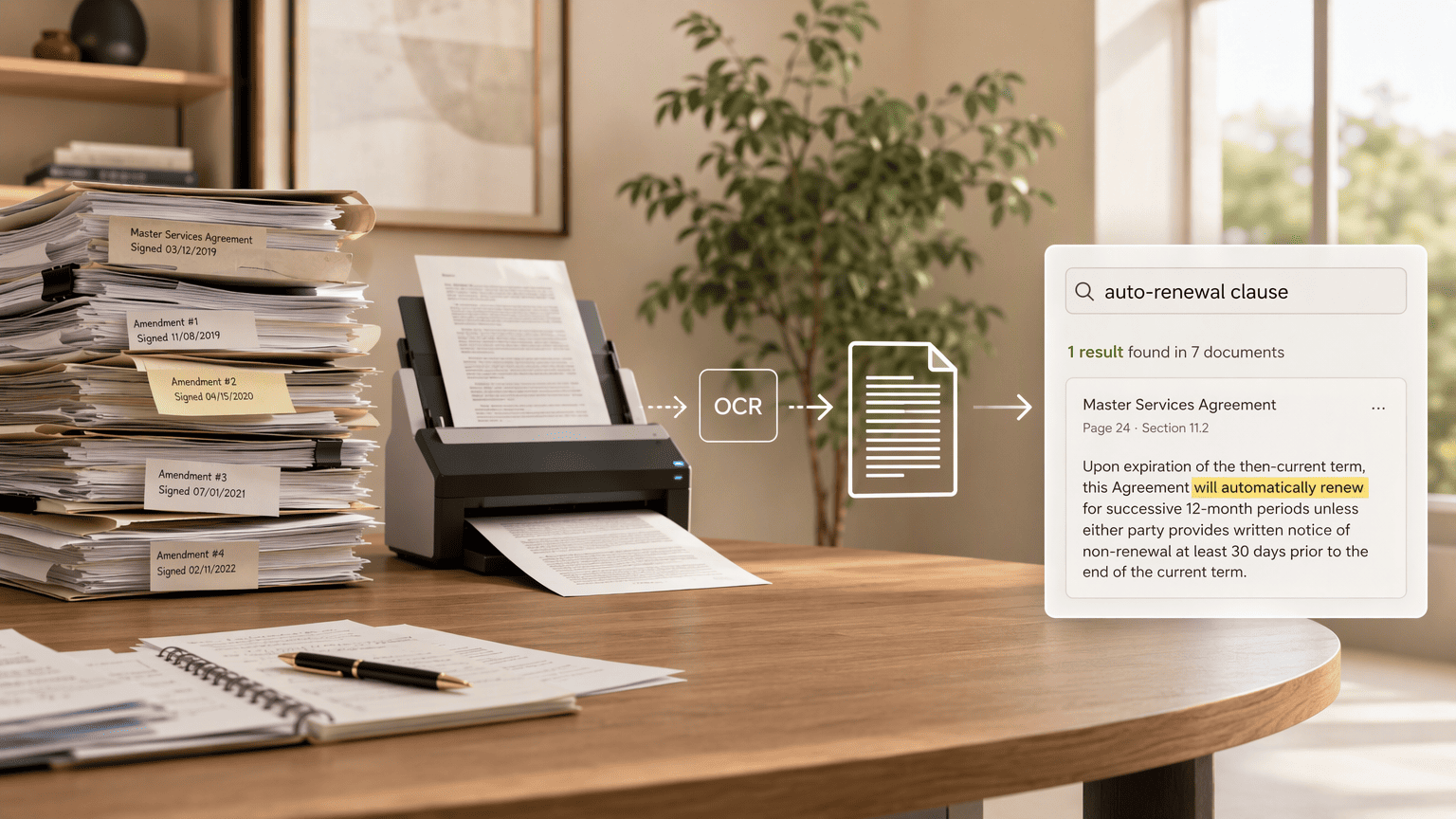
Evisort solves for the mess: the email-sent scan of a wet-ink signature, the faxed page with a crooked alignment, the amendment buried as page seven of an unrelated PDF. Its full-text AI search engine works without pre-set templates or structured data schemas. That makes it capable of finding a hidden auto-renewal clause in a poorly formatted, unsigned, or unstructured document that other AI extraction tools read incorrectly. The technical backbone is an OCR pipeline tuned for contract legalese, and the search interface lets you query your entire corpus in plain English rather than requiring Boolean logic or metadata tags.
This tool is not the cheapest on the list. You turn to it when the cost of missing a clause dwarfs the subscription price. For a company inheriting a decade of unmanaged vendor agreements after an acquisition, Evisort turns a months-long paralegal project into an afternoon query.
6. Outlaw (by Filevine): Unlimited-User Pricing for Growing Teams

Outlaw’s unlimited-user pricing model removes the per-seat math that keeps broad contract monitoring locked to a handful of people. You can roll the platform out to every person who touches a vendor relationship, starting with the accounts payable clerk who never made the license budget.
The collaboration-focused native e-signature and template monitoring feed the post-signature alert system directly. When a sales leader sends an order form and captures an e-signature, the key dates populate the monitoring engine on their own. For a 50-person operational team where cost constraints previously limited CLM access to five people, an unlimited model makes widespread adoption realistic for the first time.
7. PandaDoc: Familiar Document Workflows Extended into Simple Monitoring
PandaDoc earns its spot by eliminating the adoption hurdle entirely: your sales team already works inside it every day. The core document generation platform includes auto-reminders for expiring contracts and status tracking baked into the standard plan, which means vendor monitoring starts without installing or training on a separate application. For a revenue team that sends proposals through PandaDoc and converts them into signed vendor agreements, the trigger-based alert system ties directly to the CRM integration with HubSpot, creating a unified view of when key supplier contracts require review or renewal action.
This is not a deep AI extraction tool, and it will not read your legacy scanned PDFs with 99% accuracy. For teams that want to start monitoring without leaving a familiar workflow, the simplicity here is the feature.
8. Dock 365: SharePoint-Native Contract Management for Microsoft Shops

Dock 365 builds directly on SharePoint document libraries to add automated ticklers, approval flows, and Power BI dashboards without migrating files to an external system. For a Microsoft-centric enterprise, your contracts already live in SharePoint, so adoption means installing a connector rather than running a parallel implementation.
The integration connects to your Azure AD and Microsoft Teams environment. Automated alerts can surface inside a Teams channel where your procurement group already collaborates, and role-based permissions map to existing Azure AD groups instead of a separate user directory that IT needs to maintain. You skip the extra cost of standalone user management infrastructure and redundant security controls.
One limitation is that the AI extraction capabilities are serviceable rather than class-leading. If your primary need is deep clause analysis across unstructured PDFs, Evisort or LinkSquares will outperform Dock 365 on pure extraction accuracy. If your priority is eliminating the integration tax and staying fully inside the Microsoft ecosystem, this is the most natural fit.
9. Self-Assessment: Matching Workflow Maturity to Your Ideal Tool Tier
The right tool depends less on your budget than on where your contracts sit today and what sophistication your team can absorb. Use this matrix to map your current state to the recommended starting point.
| Your Current Workflow | Best-fit Tool | Why |
|---|---|---|
| Contracts live in SharePoint or Google Drive; we want AI alerts without migration | Contracts.ai | Passive intelligence layer that monitors in place; modular pricing avoids large upfront cost |
| Scattered PDFs across email; we need a central searchable hub fast | ContractSafe | Flat-rate unlimited-user pricing with straightforward OCR; lowest adoption friction for non-technical teams |
| Startup scaling fast; we want an enterprise-grade foundation on a free tier | Ironclad | Free tier with full data repository and workflow designer; smooth upgrade path preserves all configurations |
| Hundreds of legacy agreements; we need to find clauses quickly | LinkSquares or Evisort | Powerful bulk analysis and custom reporting; Evisort excels on unstructured scans; LinkSquares on structured post-review projects |
| Everything runs on Microsoft 365 already | Dock 365 | Native SharePoint integration with Teams alerts and Power BI dashboards; zero external migration cost |
| Large cross-functional team; per-seat pricing kills our budget | Outlaw (Filevine) | Unlimited-user pricing makes full departmental adoption possible without multiplying license costs |
To validate your choice, audit your current contract volume and storage locations first. If you are under about 100 contracts with just two or three people touching them, a shared drive and calendar reminders may still work. As your vendor list grows, the 50% of negotiated savings that go unrealized without monitoring becomes a measurable P&L line item that justifies the subscription.
Conclusion
You don’t need a quarter-million-dollar CLM implementation to catch auto-renewals anymore. Modular AI layers, flat-rate pricing, and extraction engines that handle poorly scanned PDFs have made automated vendor contract monitoring accessible to teams of any size.
Start by identifying your current storage pattern. Pick a tool that fits that pattern, pilot it against a handful of live contracts, and measure how many missed deadlines it surfaces in the first week. That test tells you more than any feature comparison.
Hidden auto-renewals eat margin. Fixing that problem costs less than a single overrun.
Frequently Asked Questions
What are the most affordable tools available in 2026 for automating vendor contract monitoring and generating alerts for key dates and obligations?
The most affordable options stack across price points:
- Ironclad offers a functional free tier.
- Contracts.ai starts at $19 per user per month billed annually for the Basic plan.
- ContractSafe charges a flat $450 per month with unlimited users, AI search, and renewal alerts included.
How do budget-friendly contract monitoring platforms compare in core features like AI extraction, alerting, and compliance for a US-based business?
Key differentiators at sub-$500/month pricing:
- AI extraction is now standard even at sub-$500/month pricing.
- Alerting customization tends to improve with price tier.
What is the typical cost range for automated contract monitoring software, and are there hidden fees or worthwhile free tiers?
Cost considerations for contract monitoring tools:
- Costs range from free (Ironclad’s tier) to roughly $500 per month for full-featured unlimited-user platforms like ContractSafe.
- Watch for per-seat add-ons that inflate the total cost when you roll the tool beyond the legal team; flat-rate models avoid this surprise.
Is it possible to start with a pilot program or a limited contract set without migrating my entire repository into a new system?
Yes. Contracts.ai, for example, runs as an intelligence layer on top of existing SharePoint or Google Drive storage, so you can pilot it with a limited contract set without migrating your full repository or disrupting current workflows.
What specific security and privacy features should a small-to-midsize business look for in an affordable contract intelligence tool?
Prioritize these security and compliance features:
- Role-based access controls with least-privilege principles.
- A clear policy that your proprietary contract data is not used to train public AI models.
How do tools like ContractsAI structure and activate post-signature contract data beyond simple storage and keyword alerts?
ContractsAI automatically groups related agreements, aligns shared terms, extracts obligations, and links every finding back to source contract language. That creates an audit-ready, structured intelligence layer usable by finance and procurement systems.
Sources
- 16 Best Contract Management Software Platforms for 2026 – www.contractsafe.com
- Gatekeeper Contract Management – marketplace.microsoft.com