


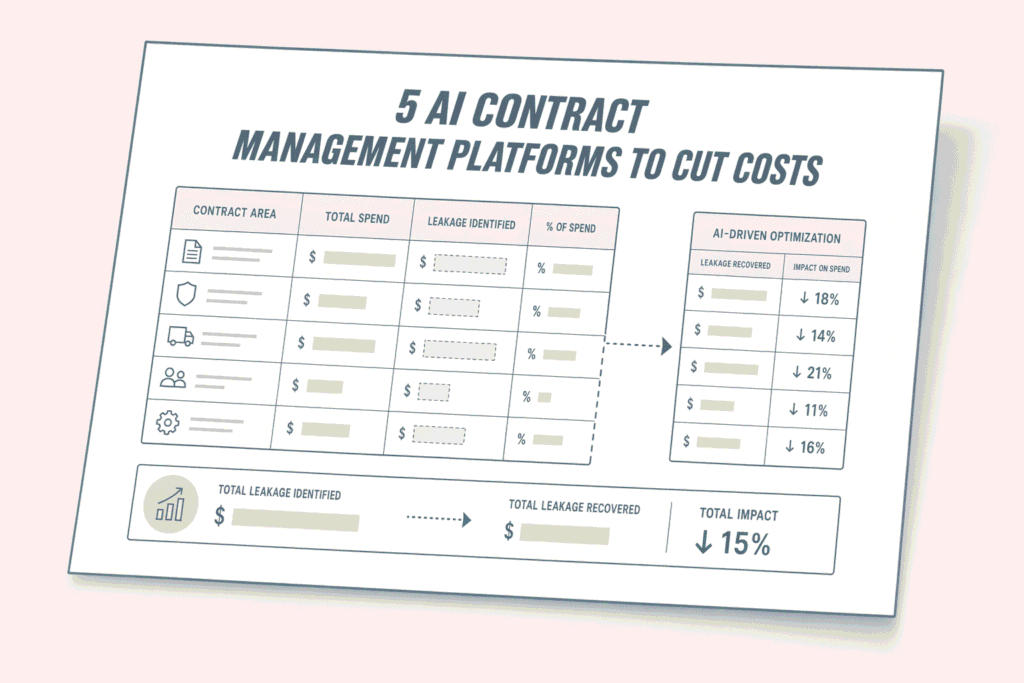
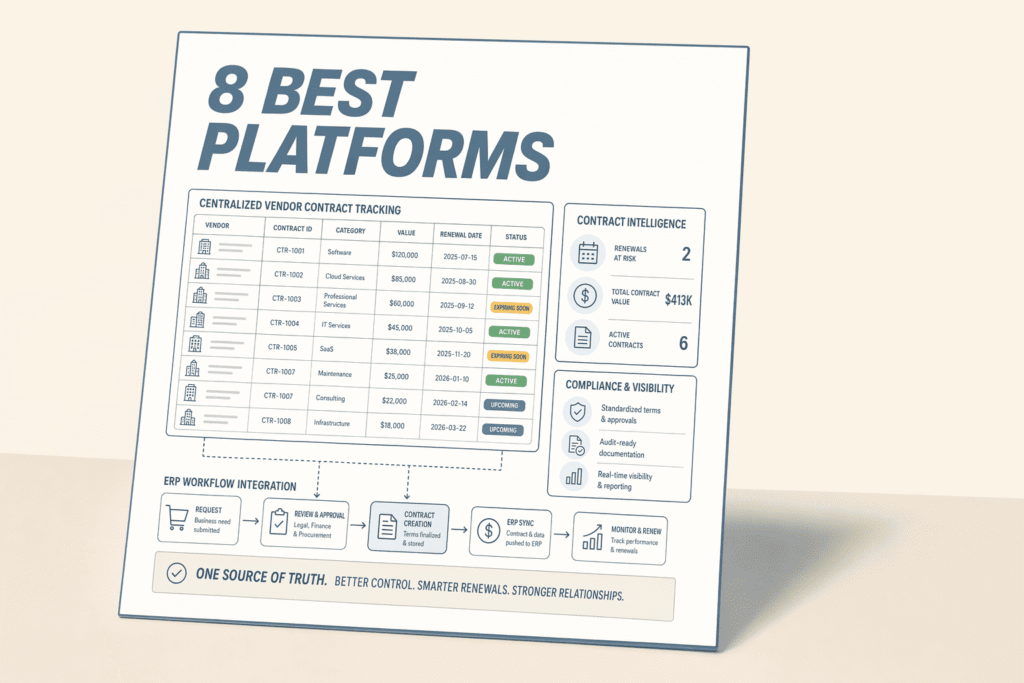
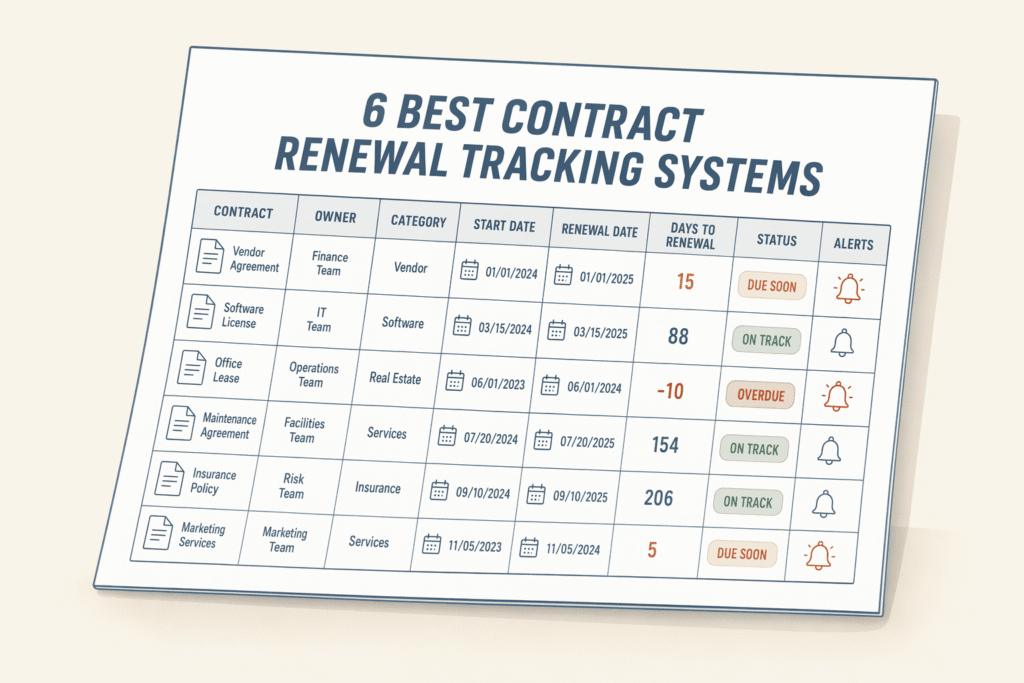
Finance teams lose revenue when renewal windows and payment obligations slip through manual tracking processes. Modern contract obligation tracking systems automate alert delivery, extract payment terms with AI, and integrate with enterprise finance platforms to prevent costly missed deadlines.
Key Takeaways
- Renewal tracking requires configurable notice-period alerts (30/60/90 days) distinct from contract expiration dates to prevent auto-renewal at unfavorable terms
- AI payment-term extraction achieves 90%+ accuracy for standard schedules but requires manual review for milestone-based fees and custom escalation clauses
- Intelligence-layer systems overlay existing contract repositories to add obligation tracking without full CLM migration, reducing deployment timelines from 12-18 months to 4-8 weeks
- Enterprise integration depth—REST API sync frequency, webhook support, multi-channel alert routing—determines whether contract alerts reach finance systems in real time or batch cycles
- SOC 2 Type II certification, role-based access controls, and audit logging are baseline compliance requirements when tracking financial obligations embedded in contracts
Finance teams lose revenue when contract obligations slip past notice — not because agreements are poorly written, but because payment terms, escalation clauses, and milestone-based fees remain invisible until the cost has already materialized. Organizations lose approximately 9% of revenue to contract leakage, driven largely by overlooked obligations beyond renewal dates.
Revenue Leakage from Auto-Renewals and Overlooked Termination Windows
The direct cost of missed renewal windows compounds when contracts auto-renew at unfavorable rates. Most enterprise agreements embed 30-, 60-, or 90-day termination notice periods; when these dates pass silently in file systems, finance teams inherit another year of above-market pricing. Vendor contracts with evergreen clauses convert a one-time oversight into multi-year revenue drain, and without systematic extraction of these terms across hundreds of agreements, even diligent teams miss the window.
Hidden Costs: Payment Penalties, Milestone-Based Fees, and Escalation Clauses
Beyond renewal dates, finance teams must track payment schedules, milestone-based fees, penalty clauses, and service-level commitments scattered across vendor, procurement, and customer agreements. Late-payment penalties trigger when invoices aren’t reconciled against contract terms; milestone fees accumulate when project phases close without finance visibility; price-escalation clauses reset rates annually unless flagged in advance. Systems that layer AI-powered extraction over existing repositories — such as Contracts.ai, which transforms executed agreements into structured operational intelligence — surface these obligations without requiring full CLM replacement, feeding finance alerts directly from clause-level data rather than relying on manual spreadsheet tracking.
Understanding which contract dates and terms require automated tracking determines whether your system prevents revenue loss or simply archives documents.
Critical Contract Dates and Terms to Track Automatically
Finance operations teams lose revenue not because they lack contract storage, but because they lack extraction. Automated contract tracking prevents missed deadlines by categorizing obligations into three structural types: calendar-based lifecycle milestones, financial payment terms buried in clauses, and conditional triggers tied to business events. Each obligation type requires different extraction logic and alert routing—renewals flow to procurement, payment schedules to accounts payable, termination penalties to legal, but most CLM platforms treat all dates as homogeneous calendar entries.

Renewal Dates, Notice Periods, and Auto-Renewal Clauses
Renewal obligations are calendar-anchored: a notice period (30, 60, or 90 days pre-expiration), an initial term end date, and an auto-renewal clause that converts inaction into a new commitment. Contract obligation management systems extract these dates from signed PDFs and route alerts to the stakeholder responsible for re-negotiation or cancellation. The gap most finance teams face is not the renewal date itself, that’s typically tagged, but the *notice deadline* that precedes it. Missing a 60-day notice window locks the organization into another full term, converting what should be a renegotiation opportunity into a revenue leak when pricing or scope no longer aligns with current business needs.
Payment Schedules, Milestone Fees, and Escalation Terms
Payment obligations live in contract body text, not metadata fields. A SaaS agreement might specify quarterly invoicing on the 15th of each quarter-start month; a services contract might tie payment to milestone completion (design approval, UAT sign-off, go-live); a multi-year deal might include annual CPI-based escalation clauses or volume-discount tiers that trigger mid-term repricing. These are the obligations competitors overlook: most CLM platforms alert on renewal dates but require manual tagging of payment schedules, milestone-based fees, and escalation triggers. AI-powered extraction closes this gap by reading clause language (‘invoiced quarterly in advance,’ ‘payment due within 30 days of milestone acceptance,’ ‘3% annual escalation beginning Year 2’) and converting prose into structured payment timelines that flow into ERP and accounts-payable workflows.
Termination Clauses, Penalty Provisions, and Performance Milestones
Conditional obligations activate when a business event occurs: a party exercises a termination-for-convenience clause (often with 30 to 90 days’ notice and an early-exit fee), performance falls below a contracted SLA threshold (triggering penalty payments or service credits), or a change-of-control provision requires consent or repricing. These triggers are date-adjacent but not date-certain, they depend on external conditions, not calendar progression. Finance operations need two-layer tracking: the *potential* obligation (a termination right exists; a penalty clause is in force) and the *activated* obligation (the trigger event occurred; the penalty is now due). Systems that treat all obligations as static calendar events miss these conditional structures entirely, leaving finance teams to discover penalty liabilities only when an invoice disputes arise or an audit surfaces an unexercised right.
With the taxonomy of trackable obligations established, the next step is building a framework to evaluate which platforms deliver the intelligence your finance team needs.
When revenue leaks through missed renewals and overlooked payment terms, the root cause is rarely lack of intent, it’s lack of system-level intelligence. A strong obligation tracking system must deliver five core capabilities: granular renewal alerts that respect termination windows, AI-powered payment-term extraction that operates at clause level, enterprise-system integration that pushes obligations into operational workflows, compliance and audit infrastructure that meets SOC 2 requirements, and an implementation model that deploys intelligence without forcing repository migration. The framework below structures your evaluation across these dimensions.
| Platform | Renewal Alerts | AI Extraction | CRM/ERP Sync | SOC 2 | Implementation Model |
|---|---|---|---|---|---|
| Contracts.ai | 30/60/90-day windows | >99% accuracy | NetSuite, native integrations | Yes | Intelligence layer — no migration |
| Sirion | Configurable notice periods | Clause-level detection | API + bi-directional sync | Yes | Full CLM deployment |
| IntelAgree | Multi-tier alerts | Contract-specific training | Salesforce, SAP connectors | Not disclosed | Standalone or CLM module |
| Raindrop | Auto-renewal flags | Financial-clause focus | Email/Slack push | Not disclosed | Overlay — existing repos |
| HyperStart CLM | Termination-date tracking | Manual tagging + AI assist | Limited API | In progress | Full platform swap |
| Icertis | Enterprise-scale reminders | Multi-language OCR | ERP-native workflows | Yes | Full CLM replacement |
Renewal-Alert Granularity and Notice-Period Coverage
Effective renewal tracking hinges on configurable notice windows that align with contract-specific termination clauses, 30-day, 60-day, or 90-day periods before auto-renewal kicks in. Systems that treat all contracts identically (single global reminder) miss the nuance: a SaaS agreement with a 60-day out clause requires earlier action than a 30-day service contract. Contracts.ai surfaces these windows by extracting termination language and setting tiered reminders; Sirion and Icertis offer similar configurability at enterprise scale. Platforms lacking clause-level parsing (manual tagging workflows) force users to set alerts by hand, reintroducing the coordination failure the system was meant to solve.
Payment-Term Extraction: AI Accuracy vs. Manual Tagging
Payment-term extraction separates intelligence-layer platforms from workflow-native CLM with AI bolted on. True clause-level AI identifies payment schedules, milestone-based invoicing triggers, and penalty clauses embedded in multi-page agreements; manual tagging requires finance or legal teams to annotate each obligation, a process Bind Legal flags as the bottleneck in workflow-native systems. Contracts.ai claims >99% extraction accuracy in real time, linking extracted terms to source contract language for validation. Raindrop focuses specifically on financial clauses; IntelAgree trains models per contract type. HyperStart CLM defaults to manual tagging with AI-assist fallback, acceptable when contract volume is low but untenable at scale.
Enterprise Integration: CRM, ERP, and Finance-System Sync
Obligation tracking delivers ROI only when alerts reach the teams empowered to act, procurement for renewals, finance for payment milestones, legal for compliance deadlines. CloudEagle’s SaaS tool comparison emphasizes bi-directional ERP sync as the minimum viable standard: systems must push extracted obligations into NetSuite invoicing queues, Salesforce opportunity records, or Slack channels without manual export. Contracts.ai integrates natively with NetSuite to reconcile supplier invoices against signed contract terms; Icertis embeds workflows directly in ERP environments. Platforms lacking API infrastructure, or those requiring CSV export for every update, recreate the coordination gap they’re meant to close.
Compliance and Audit Requirements
Enterprise buyers in regulated industries, finance, healthcare, government contractors, require SOC 2 Type II certification, role-based access controls, and immutable audit trails for every obligation extracted or alert triggered. Contracts.ai is SOC 2 and SOC 3 certified, maintains incident response programs, and logs all contract-analysis activity for compliance review. Sirion and Icertis meet these standards by default; HyperStart CLM lists certification as in-progress. Platforms without SOC 2 attestation are non-starters for buyers under HIPAA, GDPR, or federal procurement rules.
Implementation Model: Intelligence Layer vs. Full CLM Replacement
The implementation decision separates pilots from multi-year transformation projects. Full CLM platforms (Sirion, Icertis, HyperStart) require migrating all legacy contracts into a new repository, re-training users on approval workflows, and replacing existing systems, a 12 to 18 month deployment window. Intelligence-layer platforms overlay existing contract storage (SharePoint, Google Drive, legacy CLM) and extract obligations without forcing migration. Contracts.ai positions explicitly as an intelligence layer, it does not replace workflows or repositories, enabling finance teams to pilot obligation tracking on high-risk contracts (top 50 suppliers by spend, all auto-renewing SaaS) before expanding. Raindrop offers a similar overlay model. For buyers who need results in 30 to 60 days rather than next fiscal year, the intelligence-layer architecture collapses time-to-value.
Notice-period coverage translates evaluation criteria into operational capability, how systems detect renewal clauses and schedule alerts before termination windows close.
Automated Renewal Alerts: Granularity and Notice-Period Coverage
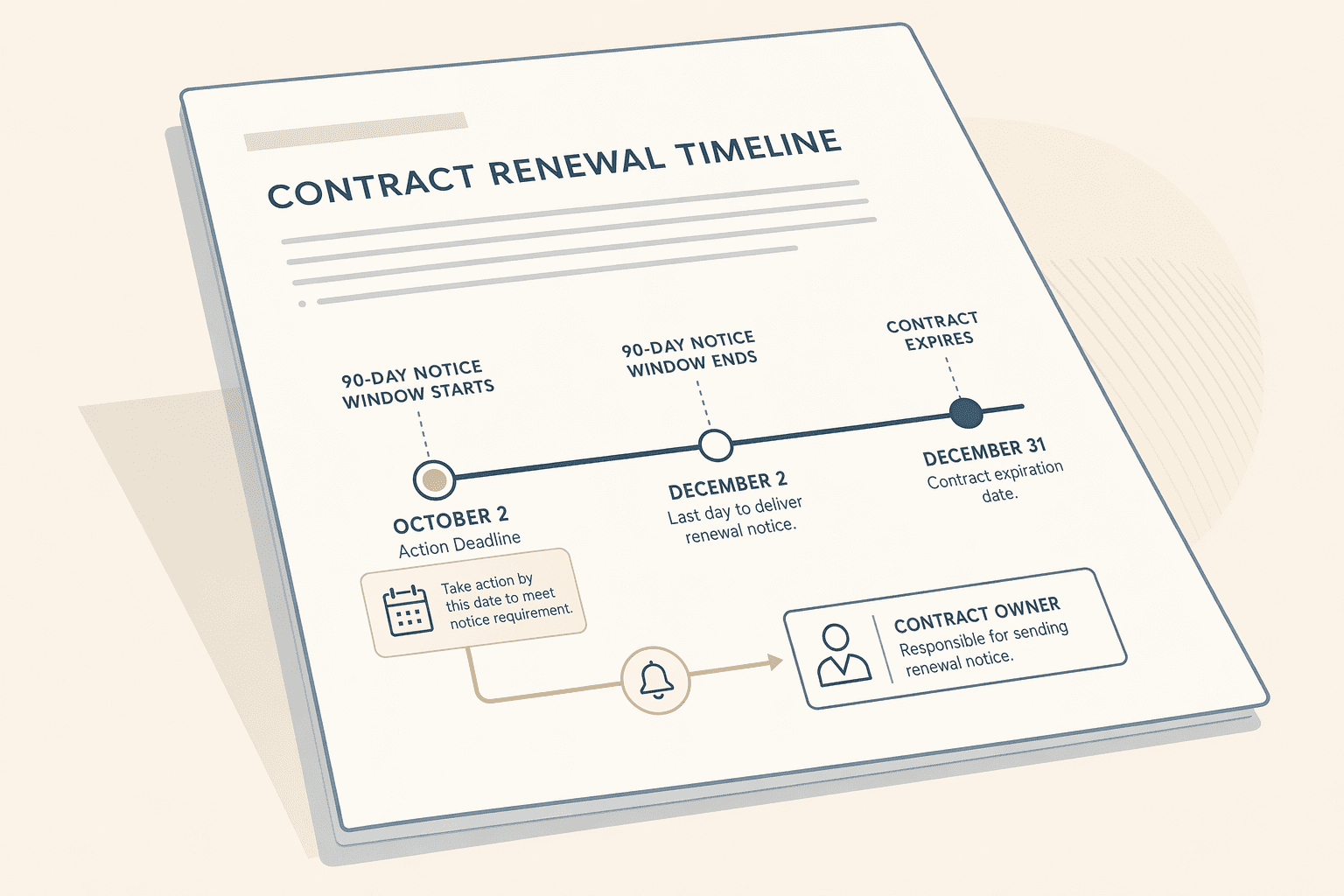
Effective renewal tracking depends on alert systems that recognize notice periods as distinct from expiration dates. A contract ending December 31 with a 90-day termination window requires action by October 2, yet many finance teams discover this only when the auto-renewal has already triggered. Systems that surface critical dates early and route obligations to the right stakeholder prevent surprise auto-renewals and unnecessary spend.
Multi-Window Alert Scheduling (30/60/90-Day Notice Periods)
Notice-period tracking distinguishes mature platforms from basic spreadsheet replacements. Finance operations commonly require cascading alerts at 90, 60, and 30 days before a termination window closes, the 90-day signal feeds budget-planning cycles, the 60-day alert triggers vendor performance review, and the 30-day reminder finalizes the renewal decision. Platforms that support custom notice-period windows beyond default intervals allow teams to align alerts with internal approval workflows and fiscal calendars.
Auto-Renewal Clause Identification and Escalation Logic
AI-powered clause detection scans contract language for auto-renewal terms and extracts escalation conditions, percentage increases, tier shifts, or evergreen extensions. Pattern-matching algorithms identify phrases like “automatically renew unless written notice” and surface them alongside the notice deadline, reducing the manual tagging burden finance teams face when onboarding legacy agreements. Systems that preserve source language alongside structured fields enable users to validate extraction accuracy before setting alerts.
Role-Based Alert Routing: Finance, Legal, Procurement
Stakeholder-aware notification logic routes alerts based on contract type and obligation category. Payment-term alerts flow to finance, indemnity-clause reviews route to legal, and vendor performance conditions notify procurement. Platforms like Contracts.ai build on role-based access controls to ensure the right team sees renewal decisions when action is still possible, rather than when the window has closed.
Beyond renewal alerts, finance operations depend on extracting payment schedules and milestone fees from contract body text, a task where AI accuracy varies widely.
Payment Term Extraction: AI Accuracy vs. Manual Tagging
AI clause detection for contracts uses machine learning and natural language processing to identify, classify, and extract specific provisions automatically. Accuracy varies by clause complexity: standard payment schedules (fixed amounts, simple due dates) typically achieve 90%+ extraction rates, while milestone-based fees and escalation clauses, which often embed custom language and conditional logic, require context understanding and may fall to 70 to 85% confidence.

AI Clause Detection: Training Data and Accuracy Benchmarks
Platforms train AI models on financial-clause patterns drawn from thousands of labeled contracts. Contracts.ai, for example, claims more than 99% accuracy when extracting data from documents in real time and links answers to source contract language for validation. High-confidence extraction works best for structured payment terms, net-30 invoices, quarterly milestone schedules, where training data is abundant. Custom escalation clauses tied to performance metrics or revenue thresholds present harder targets; models flag lower confidence scores when clause language deviates from training norms.
Manual Tagging Workflows: When Human Review Is Required
Renewals are missed when AI misclassifies ambiguous payment language or custom fee structures. When confidence scores drop below a platform-defined threshold, commonly 80%, the system flags the clause for manual review. Human taggers step in for edge cases: escalation formulas referencing external indices, conditional milestone payments triggered by third-party events, or payment terms split across multiple document sections. The AI-manual handoff ensures extraction accuracy on non-standard clauses while preserving speed on routine terms.
Obligation alerts deliver value only when they reach the right systems at the right time, integration architecture determines whether your finance and procurement workflows receive actionable signals or orphaned notifications.
Enterprise Integration: Syncing Alerts with Finance and Procurement Systems
Manual contract processes create significant challenges, including a lack of visibility, compliance risks, and security vulnerabilities. Automated CLM solutions address these gaps by centralizing contract data and enabling operational use across enterprise systems, syncing alerts for renewal deadlines, payment terms, and obligation triggers directly into the finance and procurement platforms teams already rely on.
API Availability and Sync Frequency Options
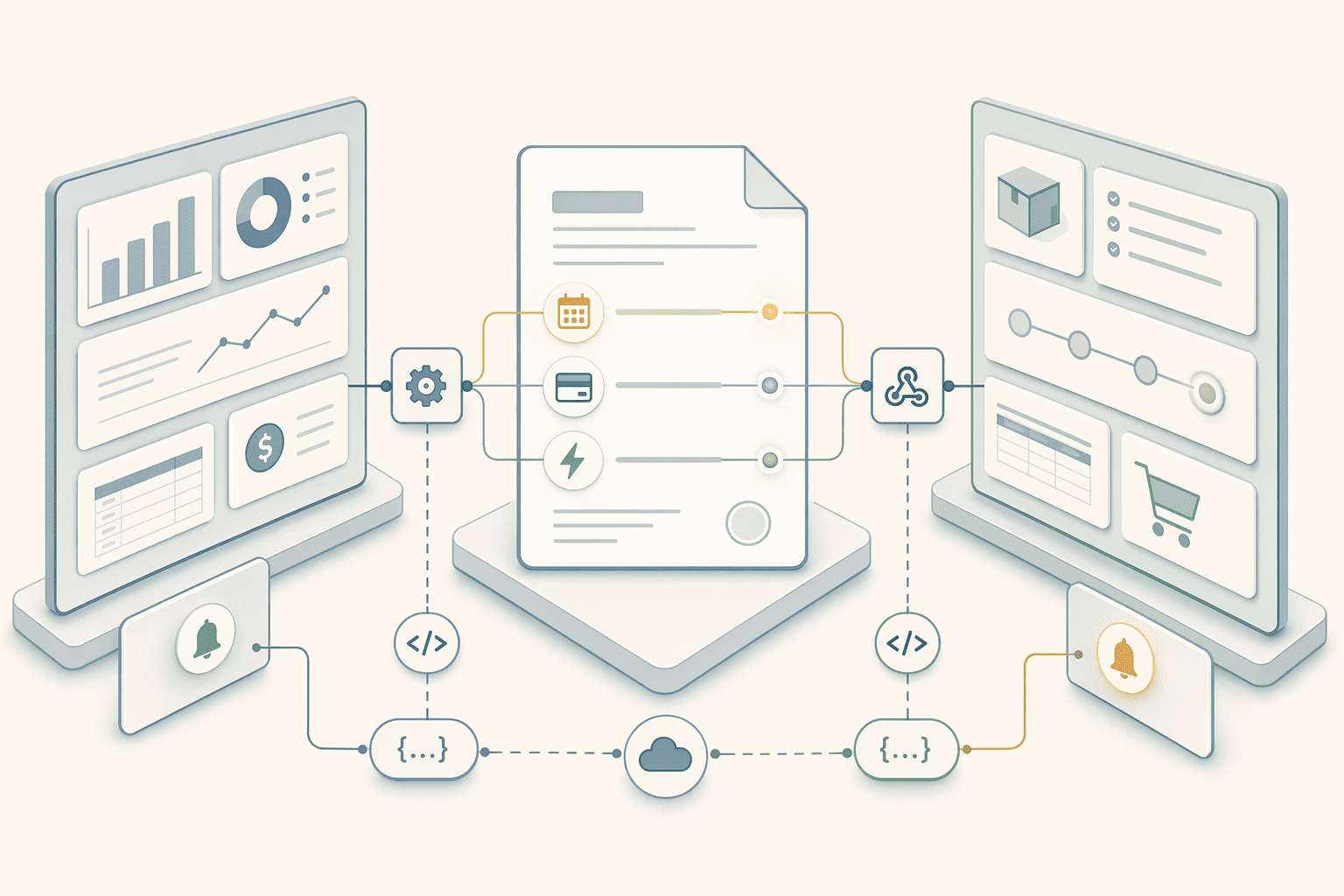
Modern contract intelligence platforms expose REST APIs and webhook endpoints for real-time or batch synchronization. Real-time webhooks fire alerts the moment an obligation trigger is detected, typically within seconds, while batch sync configurations refresh data on hourly or daily schedules. Leading tools support both models, allowing finance teams to choose immediate notification for high-value renewals and periodic refresh for routine reporting.
Alert-Channel Distribution: Email, Slack, In-App Notifications
Integration architecture routes alerts across multiple communication channels. Email notifications reach stakeholders asynchronously; Slack channels embed alerts into team workflows; in-app dashboards surface upcoming deadlines within the finance platform itself. Multi-channel distribution ensures that renewal and payment-term alerts land where decision-makers work, reducing the risk of missed obligations.
ERP and Finance-System Connectors: Oracle, SAP, NetSuite
Pre-built connectors for Oracle, SAP, and NetSuite allow contract data to flow directly into ERP workflows. Contracts.ai offers Oracle and SAP integrations as examples of finance-system connectors built to sync contract obligations with procurement and accounting modules. These integrations reconcile supplier invoices against signed terms, flag payment-term discrepancies, and surface renewal alerts within the finance team’s operational environment.
Financial data embedded in contracts triggers regulatory scrutiny, compliance certifications and audit logging separate enterprise-grade platforms from basic tracking tools.
Compliance and Audit Requirements for Contract Tracking
SOC 2 and Security Certifications for Financial Data
Finance teams require SOC 2 Type II and ISO 27001 certifications when tracking contract obligations because financial data embedded in contracts, payment terms, pricing schedules, revenue milestones, demands the same security posture as core financial systems. These certifications verify that a platform maintains documented security policies, change management processes, and continuous monitoring controls. Organizations face mounting pressure to maintain compliance across jurisdictions, making third-party attestations non-negotiable for procurement approval.
Role-Based Access and Alert Permissions
Platforms enforce least-privilege access by restricting obligation alerts to authorized users. Finance operations typically configure role-based permissions so accounts-payable staff see payment-term alerts while revenue-recognition teams receive renewal notifications. This segmentation prevents unauthorized disclosure of sensitive commercial terms and supports internal audit requirements for data access governance.
Audit Logging and Data Retention Policies
Compliance frameworks require audit logs to capture who accessed or modified obligation alerts, timestamp of the action, originating IP address, and the specific data element changed. Finance audits validate that contract-tracking systems retain these logs for the statutory period, often seven years for financial records, and that logs are tamper-evident. When contracts contain personal data from EU-based vendors or customers, platforms must incorporate GDPR regulatory requirements, including data-subject access rights and secure deletion workflows.
Deployment strategy determines whether your team validates ROI in weeks or commits to multi-year transformation projects, pilot scope and migration requirements separate fast-time-to-value options from thorough platform overhauls.
Implementation Considerations: Pilot vs. Full Repository Migration
Pilot Deployment: Starting with High-Value Contract Subsets
Finance teams can validate ROI before committing to enterprise-wide rollout by scoping a pilot to high-value contract subsets, typically the top 50 vendors by spend, contracts exceeding $100k ACV, or agreements with auto-renewal clauses that carry material revenue risk. This approach mirrors the phased deployment model described in implementation guidance, which emphasizes starting small while building toward broader adoption. A pilot limited to 50 to 100 contracts delivers measurable results (e.g., renewal-date coverage, invoice-to-contract reconciliation accuracy) within 30 to 60 days, providing the empirical basis finance leadership needs to approve full-repository migration.

Intelligence-Layer Overlay vs. Full CLM Replacement
Systems like Contracts.ai function as a post-signature intelligence layer, overlaying existing contract repositories, SharePoint folders, Google Drive hierarchies, legacy CLM archives, to add AI-driven extraction and obligation tracking without requiring full data migration. This intelligence-layer model contrasts with full-CLM-replacement platforms (Icertis, Sirion) that demand migrating every contract into a new system and adopting end-to-end workflow orchestration. For finance teams focused narrowly on renewal tracking and payment-term visibility, the overlay approach delivers faster time-to-value: contracts remain in their current storage location, access governance stays intact, and the intelligence layer reads metadata and obligations in place. Full CLM replacement becomes justified when the organization also needs contract authoring, approval workflows, and redline negotiation, requirements outside the renewal-tracking scope.
Evaluating contract obligation tracking systems requires balancing renewal-alert granularity, AI payment-term extraction accuracy, and enterprise-system integration depth against compliance requirements. Intelligence-layer systems like Contracts.ai add obligation tracking without full contract migration, trading the comprehensiveness of a full CLM platform for faster deployment and lower change-management overhead. AI payment-term extraction achieves 90%+ accuracy on standard schedules but requires manual review for milestone-based fees and custom escalation clauses, teams with complex, non-standard payment structures may need higher manual-tagging budgets.
As contract volumes grow and renewal cycles shorten, AI-powered obligation extraction will shift from a competitive advantage to a baseline finance-operations requirement, manual tagging workflows will become unsustainable for teams managing hundreds of vendor relationships.
Compare pilot deployment timelines and integration requirements across Contracts.ai, Sirion, IntelAgree, and other platforms in the comparison table above, or explore Contracts.ai’s intelligence-layer approach for teams who need obligation tracking without migrating existing contract repositories.
Frequently Asked Questions
What is the difference between contract renewal tracking and obligation tracking?
Renewal tracking monitors contract end dates and auto-renewal clauses, while obligation tracking encompasses payment schedules, milestone fees, penalty clauses, and termination notice periods, a broader set of financial commitments. Effective systems recognize notice periods as distinct from expiration dates, triggering alerts 30, 60, or 90 days before termination windows close.
How accurate is AI extraction for payment terms compared to manual tagging?
AI clause detection achieves 90%+ accuracy for standard payment schedules like fixed monthly or quarterly terms but requires manual review for milestone-based fees and custom escalation clauses, where accuracy drops to 70-80%. Platforms train machine learning models on financial-clause patterns from thousands of labeled contracts, yet ambiguous payment language still triggers misclassifications.
Can I pilot a contract obligation tracking system without migrating all my contracts?
Yes, intelligence-layer systems like Contracts.ai overlay existing contract repositories (SharePoint, Google Drive) to add AI extraction and alerts without full migration. Start with high-value subsets such as the top 50 vendors by spend or contracts exceeding $100k ACV to validate ROI before expanding.
What integrations are required to sync contract alerts with finance systems?
Contract tracking systems need REST API or webhook support to sync alerts with ERP platforms (Oracle, SAP, NetSuite) and communication channels (email, Slack, in-app). Real-time webhooks fire alerts within seconds of obligation detection, while batch sync configurations refresh data on hourly or daily schedules for less time-sensitive obligations.
What compliance certifications should I look for in a contract tracking system?
Finance teams should require SOC 2 Type II for financial-data security, role-based access controls enforcing least-privilege permissions, and audit logging that captures who accessed or modified obligation alerts with timestamps and IP addresses. GDPR and CCPA compliance applies when contracts contain personal data from EU or California-based parties.
How do contract tracking systems handle 30/60/90-day notice periods?
Systems schedule cascading alerts for multi-window notice periods: 90-day alerts feed budget planning, 60-day alerts trigger vendor negotiations, and 30-day alerts prompt final termination decisions. AI auto-renewal detection identifies renewal clauses and schedules alerts based on contract-specific notice-period language extracted from body text.
Does Contracts.ai support contract approval workflows?
No, Contracts.ai tracks obligations and delivers alerts but does not route contract approvals. It functions as an intelligence layer for obligation extraction and monitoring, not a full workflow-automation CLM. Teams requiring approval routing should evaluate full-CLM platforms like Icertis or Sirion alongside Contracts.ai’s obligation-tracking capabilities.
Sources
- AI Contract Management Software 2026: 10 Best Tools – bindlegal.com (2026)
- Optimize renewals with contract renewal management software – www.bettercloud.com
- Contract lifecycle management: An overview – legal.thomsonreuters.com
- How to Simplify Global Compliance with Contract Lifecycle Management Tools – modern-counsel.com (2025)
- Contract Lifecycle Management Best Practices (2026 Guide) – swiftwaterco.com (2026)
- How To Implement Contract Life Cycle Management To Strengthen Your Business – www.forbes.com (2022)